

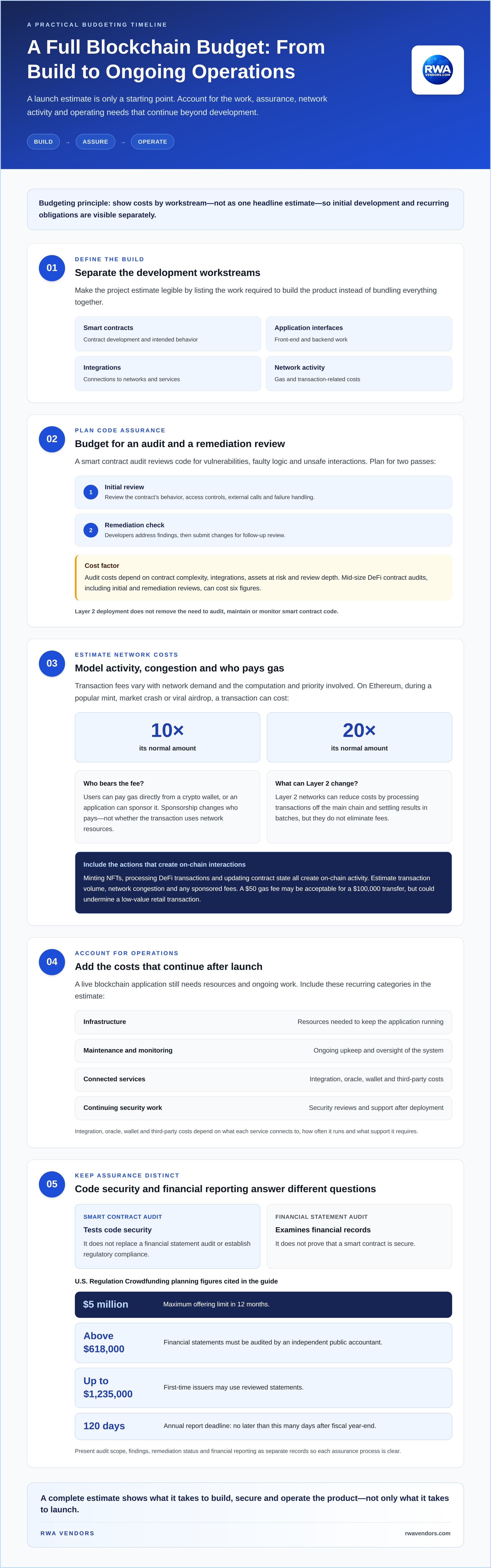
The build budget is only part of the bill, so a launch estimate is a starting point, not a complete budget.
It makes sense to focus first on development: the application, smart contracts and integrations are visible deliverables. But security audits, transaction fees, infrastructure and post-launch maintenance also affect the total. Costs depend on the solution’s complexity, network design and operational needs.
This guide explains what blockchain development may cost, where audit and ongoing expenses enter the budget, and why enterprise projects can require a different level of investment. It also shows how architecture, security requirements, integrations and network operations shape the overall cost, helping you build a more complete view before planning a project.
Key Takeaways
- Build a full project estimate by separating development, security, infrastructure and post-launch operating costs.
- Plan for an initial smart contract audit and a remediation review, then account for continued monitoring and maintenance.
- Use a budget structure that makes architecture, contracts, interfaces, integrations and security visible as separate workstreams.
- Assess enterprise costs through the demands of governance, integrations, security and ongoing network operations.
- For U.S. Regulation Crowdfunding, account for the $5 million offering limit in 12 months, according to the U.S. Securities and Exchange Commission.
Putting Numbers on It: How Much Does Blockchain Development Cost?
Compared with a traditional database application, a blockchain project may add smart contract, network, audit and transaction costs alongside familiar application development.
For a U.S. Regulation Crowdfunding offering, the maximum offering limit is $5 million in 12 months, according to the U.S. Securities and Exchange Commission. A Regulation Crowdfunding issuer in the United States must file its annual report no later than 120 days after its fiscal year ends, according to the U.S. Securities and Exchange Commission.
Investor Due Diligence and Cost Transparency
Investor due diligence is the review of a project’s costs, risks, operating assumptions and financial reporting before investment decisions. A transparent budget helps investors distinguish initial development cost from recurring obligations, such as network fees and security reviews. For a U.S. Regulation Crowdfunding issuer, the $5 million offering limit and annual report deadline of no later than 120 days after fiscal year-end frame important planning considerations.
Show costs by workstream rather than relying on one headline estimate. Separate contract development, front-end and backend work, audits, infrastructure, gas and post-launch support. Clear categories help investors understand what a ledger-based product needs to operate after launch.
Transaction Fees and Sponsored Costs
Transaction fees can vary with network demand and reflect the computation and priority involved. On Ethereum, a transaction during a popular mint, market crash or viral airdrop can cost ten or twenty times its normal amount.
Users may pay gas directly from a crypto wallet, or an application may sponsor fees as part of its user experience. Sponsorship changes who bears the expense, not whether the transaction consumes network resources. Layer 2 networks can reduce costs by processing transactions off the main chain and settling results in batches, but they do not eliminate fees.
Network selection also affects operating assumptions. Ethereum’s transition from proof-of-work to proof-of-stake reduced its energy use by 99.95% in 2022. That change matters when assessing energy-related operating impacts, but it does not make transaction costs disappear. Bitcoin consumed approximately 107 terawatt hours of electricity in 2022, and the emissions from one Bitcoin transaction were compared with those of 800,000 Visa transactions.
Include user activity in the estimate: minting NFTs, processing DeFi transactions and updating contract state all create on-chain interactions. A $50 gas fee might be acceptable for a $100,000 transfer, yet the same charge could undermine a low-value retail transaction. The hidden costs of blockchain projects become clearer when budgets account for transaction volume, network congestion, fee sponsorship and the cost of maintaining a reliable ledger.
Smart contract code audits and financial statement audits
A smart contract audit examines code for vulnerabilities, faulty logic and unsafe interactions before deployment. A financial statement audit examines an issuer’s financial records, a separate process that can support investor due diligence. Budgeting for both matters because code security and financial reporting answer different questions.
Scope the code review and remediation
Audit costs depend on contract complexity, integrations, assets at risk and review depth. Mid-size DeFi contract audits, including initial and remediation reviews, can cost six figures.
Plan for two audit passes: an initial review, followed by a remediation check. The review should cover the deployed contract’s intended behavior, access controls, external calls and failure handling. Developers then address findings and submit changes for follow-up review. Layer 2 deployment does not remove the need to audit smart contract code, maintain it or monitor its operation.
Separate code assurance from financial assurance
Smart contract security audits test code; they don’t replace financial statement audits or establish regulatory compliance. For a U.S. Regulation Crowdfunding offering above $618,000, financial statements must be audited by an independent public accountant. First-time issuers may use reviewed statements up to $1,235,000. These thresholds affect reporting preparation, not the technical scope of smart contract development.
For investor due diligence, present audit scope, findings, remediation status and financial reporting as distinct records. A clean code review doesn’t verify an issuer’s accounts, and audited statements don’t prove a contract is secure. This separation helps investors assess what each assurance process covers.
Trace public spending and on-chain activity
Public blockchain records can make transaction histories searchable by address or transaction identifier. That visibility can support audits of public expenditure, but a ledger entry alone doesn’t establish whether an off-chain purchase was authorized or delivered. Auditors still need supporting records connecting on-chain events with budgets, approvals and real-world activity.
Examples show the limits of implementation claims. Peru began developing a blockchain-based government procurement system in 2019, but it did not pass the pilot phase. Spain’s Aragon region has operated a procurement blockchain since 2018, but only as a limited proof of concept. These cases illustrate why project reporting should distinguish a live platform from a pilot and explain its audit trail.
For providers documenting their role in tokenization, publish a platform profile to help issuers assess relevant capabilities.
Which costs recur after launch?
After launch, blockchain applications still need infrastructure, maintenance, monitoring and security work. Integration, oracle, wallet and third-party costs depend on what each service connects to, how often it runs and what support it requires.
Ongoing Infrastructure and Maintenance
Ongoing infrastructure and maintenance keep an application available, updated and monitored after deployment.
Those estimates cover different planning approaches, so separate infrastructure bills from engineering work. Maintenance can include monitoring, patching, infrastructure updates and security reviews. Budget for 3-6 months of post-launch development at a reduced but steady pace. That runway gives teams room to address operational issues and make necessary improvements after real users begin interacting with the application.
Permissioned networks have additional operating duties. The organization remains responsible for node management, scaling, monitoring, security, upgrades, disaster recovery and performance optimization. These tasks continue after deployment, even when transaction demand is stable. In-house infrastructure typically requires 2-3 dedicated infrastructure engineers.
Integrations and Third-Party Services
Integrations and third-party services connect an application to external data, identity, payments or user access. An oracle, wallet connection or blockchain integration takes work to build and maintain. Each dependency creates an operational requirement beyond the core application and smart contract, so include it in the budget.
For example, an application using an oracle needs a process for receiving and handling external data. A wallet integration must support the user actions the application depends on. Payment or identity services bring their own interfaces and support needs. The number and complexity of these connections, along with their usage and maintenance requirements, shape the ongoing budget.
Node and RPC infrastructure also affects ongoing costs. An application can rely on external node access or operate its own infrastructure, and each approach brings different operational responsibilities. As demand rises, teams must account for monitoring, capacity and service continuity. Private networks require organizations to manage node operations and scaling, while public-chain applications still need dependable access to network data.
Gas is another recurring operational expense, not a one-time deployment charge. Layer 2 networks can reduce transaction costs, but don't remove them entirely. Keep gas, infrastructure, service integrations and maintenance as distinct budget lines so each cost driver remains visible after launch.
Blockchain project budgeting
Blockchain budgets depend on technical scope, network choices, security needs and ongoing operations. Common overrun risks include expanding requirements and unplanned dependencies; a quick MVP can reach 2x or 3x its expected cost when teams fail to plan for unknowns.
Factors Driving Project Budgets
Project budgets reflect the work needed to design, build, test and operate a blockchain application. Smart contract complexity, front-end requirements, integrations, security testing and infrastructure all shape the development estimate.
A technical design that requires more network integrations or monitoring adds work beyond the core application. Define the MVP’s users, essential functions and external dependencies before estimating each workstream.
Allocate the MVP Budget
Use budget ranges as planning categories, not fixed shares that must add up exactly. Estimates vary by project scope, and the ranges below can overlap as technical requirements change.
- Scoping and architecture: allocate an estimated 5-10% to define system design and requirements.
- Smart contracts: estimate 15-25% for contract development.
- Front end or dashboard: estimate 20-30% for the user interface.
- Backend, APIs and integrations: estimate 20-30% for application services and connections.
- Security and testing: estimate 10-20% for validation and risk reduction.
- Infrastructure and DevOps: estimate 10-15% for deployment and operating foundations.
These categories make trade-offs visible early. For example, a dashboard with complex permissions can require more work than a minimal interface, while multiple integrations increase backend and testing demands. Keep deployment, monitoring and security visible as technical workstreams rather than treating them as incidental development tasks.
Cost Risks and Budget Overruns
Cost risks arise when scope grows, technical assumptions prove wrong or dependencies require additional work. An MVP can become a 2x or 3x cost overrun if unknowns and risks are left outside the plan. Treat change requests, integration complexity and network requirements as explicit budget variables.
Review scope and burn rate every 2-4 weeks. Each review should compare completed work with remaining features, technical risks and spending. If requirements expand, revise the estimate before adding work. Revisit the budget every quarter as adoption grows, since higher usage can change infrastructure, support and monitoring needs.
Plan for what follows the initial build. An estimate covering only smart contract development may omit deployment, quality assurance or operating requirements. Separate one-time build items from recurring obligations, then update each line as the MVP’s scope and adoption change. This makes hidden costs easier to identify before they affect delivery.
Enterprise blockchain solution costs
Enterprise blockchain costs depend on more than software development. A solution may connect existing systems, support multiple organizations, meet security requirements and operate across public or private networks. The difference reflects scope: a product build is not the same as a full enterprise program.
Separate a solution build from a wider program
These figures describe different project boundaries, so a budget should specify whether it covers one application, a platform or an organization-wide rollout.
Examples make the scope distinction tangible. Neither example should be treated as a universal quote; each illustrates how use case, system connections and operational requirements influence project size.
Identify the enterprise cost drivers
Integration is a central cost driver. A payments protocol connected to established financial software requires interfaces, testing and coordination across systems. A supply chain application may need to connect records across participants, while a tokenization platform may require distinct roles and permissions. Each connection adds design and validation work, especially when multiple organizations use the same workflow.
Security and governance also shape enterprise scope. A regulated product may need stronger access controls, detailed transaction records and a defined process for managing upgrades. Audits and remediation add work, while private networks require ongoing responsibility for nodes, security and recovery. A hybrid design can use private infrastructure for confidential operations and public networks for transparency or interoperability, but it requires decisions about what belongs on each layer.
Budget for the full operating model
Enterprise blockchain programs can reach or exceed seven figures over their first 12-18 months. Include deployment, integrations, audits, infrastructure and post-launch operations in that planning horizon, not only the initial build. Private blockchain networks also require organizations to develop ecosystem growth and interoperability independently. Those strategic responsibilities can affect long-term value, even when they are not line items in the initial software estimate.
Migration creates another material risk: moving a blockchain project to another chain later can pose a six-figure financial risk. Architecture decisions should account for intended users, data visibility, transaction needs and future connectivity. An enterprise budget is more useful when it states which systems the protocol must connect, what the launch includes and which operational responsibilities continue afterward.
RWA Vendors
RWA Vendors connects asset issuers with verified tokenization platforms and service providers. When your budget depends on coordinating technology, legal, compliance and tokenization capabilities, the directory can help you identify providers relevant to each project stage. This is useful when assessing how a real estate, fund, securities or other asset tokenization project will fit together across vendors.
Use the directory to explore the provider landscape alongside your project scope, architecture and operating requirements. RWA Vendors helps issuers discover companies serving real-world asset tokenization, rather than providing direct tokenization or advisory services. This can support a more informed view of the capabilities needed before finalizing a vendor ecosystem.
If you’re exploring provider connections for a tokenization project, contact RWA Vendors.
Build a clearer path from budget to delivery
Use your blockchain budget to clarify not only what the software will do, but who will deliver each capability and how those roles fit together. The hidden costs of blockchain projects are easier to manage when technology, compliance and tokenization requirements have clear owners from the outset. This shared view helps issuers plan a coherent provider ecosystem rather than treating each dependency as a separate late-stage decision.
RWA Vendors connects asset issuers with verified tokenization platforms and service providers. Its Vendor Directory Listing, Founding Membership, and Lead Generation and Referrals support companies participating in the real-world asset tokenization ecosystem. Issuers can use the directory to identify providers across the project lifecycle, while vendors can build visibility and relevant connections.
A well-structured project starts with clear responsibilities and informed choices. Use that foundation to move from cost planning toward delivery with greater confidence.
Frequently Asked Questions
Does a cheaper chain lower the total cost?
A different chain can reduce some transaction expenses, but it won’t automatically lower total project costs. It may require new integrations, developer expertise, testing or changes to contract code. Migration later can pose a six-figure financial risk. Compare the full operating model: transaction demand, security review, infrastructure, ecosystem compatibility and the work needed to connect the chain with existing software.
What are the main hidden costs of blockchain projects?
The main costs beyond core development include security reviews, infrastructure, transaction fees, integrations and post-launch maintenance. Their impact depends on how the application is used. For example, a product with frequent on-chain updates has different operating demands from one that records occasional settlement events. Build the estimate around user activity and dependencies, then distinguish recurring expenses from one-time implementation work.
How much does it cost to build and maintain a blockchain application in the United States?
These are different project types, not interchangeable estimates. Maintenance is often estimated at 10%-20% of total development cost annually. Actual budgets depend on features, integrations, security requirements, network choice and expected operations.
What are typical blockchain developer, security auditor, and infrastructure costs?
In-house blockchain developers in the U.S. typically command six-figure salaries, while specialized contractors bill higher hourly rates. These figures cover different cost categories; staffing model, contract complexity and infrastructure design determine which apply to a particular project.
How much do smart contract audits and penetration tests cost?
Penetration testing is a separate security activity, and its cost depends on which systems, interfaces and environments are in scope. Treat the two reviews as distinct workstreams, and budget time to address findings before release.
What are blockchain gas fees, and how do they affect project operating costs?
Gas fees are network charges for processing on-chain transactions, and they fluctuate with demand. A transaction during a popular mint, market crash or viral airdrop can cost ten or twenty times as much as during normal activity. The operating impact depends on transaction frequency, contract complexity and who pays. If an application sponsors fees, it carries that expense instead of the user.
What ongoing costs arise from node hosting, cloud infrastructure, and data storage?
Ongoing infrastructure can include node access, RPC services, cloud hosting, monitoring, backups and storage for application data. Architecture determines how much data stays on-chain and how much sits in external systems, shaping storage and operational needs.
What regulatory and legal compliance costs apply to U.S. blockchain projects?
There is no single compliance budget for every U.S. blockchain project. Costs depend on the offering structure, asset type, disclosures, financial reporting needs and jurisdictions involved. A project may need legal, compliance and accounting capabilities, but the applicable work varies with its design. Treat these as project-specific budget workstreams, separate from software, smart contract audits and network operations.
Disclaimer
This article is provided by RWAVendors.com for general informational and educational purposes only. It does not constitute legal, financial, investment, tax, regulatory or other professional advice, or an offer, solicitation, recommendation or endorsement of any company, product, service, token, security or investment. RWAVendors.com is an informational vendor directory and does not sell, issue, broker, custody or facilitate transactions involving cryptocurrencies, digital tokens, tokenized assets, securities or investment products. Some vendor listings and references may involve paid advertising, sponsored placement or membership relationships. These relationships do not guarantee a vendor’s qualifications, regulatory status, performance or suitability. Information may be incomplete, outdated or subject to change. You should independently verify all information, conduct your own due diligence and consult qualified professionals before making any business or investment decision. RWAVendors.com is not responsible for the content, services, representations or actions of third-party vendors or linked websites.


