

A tokenization platform is more than an interface for issuing digital assets. It can coordinate asset records, transfer controls, and connections to operational systems. A tokenization platform integration guide should start with what the platform does and how it fits existing workflows, not with technology alone.
Integrating these systems involves more than connecting APIs. Provider capabilities, compliance requirements, identity controls, wallet access, and security processes all shape how the platform works in practice.
This guide explains how to assess platform responsibilities, plan integrations, test a rollout, and manage security and wallet permissions. It also covers the decisions that help align technology with your operating model before launch.
Key Takeaways
- Set clear boundaries for platform, issuer, and service-provider responsibilities before selecting an integration model.
- Plan a controlled rollout that tests transaction flows and operational handoffs before production use.
- Reduce exposure to sensitive data by limiting where it is handled and stored across payment processes.
- Connect tokenization workflows with existing business systems so records and reporting remain aligned.
- Structure identity checks, wallet permissions, and key controls around defined roles and approval processes.
Platform evaluation and provider responsibilities
For a tokenization platform integration guide, start with the asset, jurisdiction, and operating model, not a feature list. A token representing a fund interest has different records and transfer controls from one representing a real estate participation. Define the assets, investor groups, transaction flows, and internal systems the platform must support. Then assign responsibility for issuance, identity checks, transfer approvals, recordkeeping, and incident handling.
IOSCO’s report on financial-asset tokenization finds that familiar securities-market risks remain relevant. Technology and operating models can also change settlement, custody, resilience, interoperability, and third-party risks. Use these areas as evaluation criteria. Ask how the provider handles each function, which responsibilities remain with the issuer, and where another vendor is involved. Record the answers in the contract and operating model.
Assess technical fit alongside governance. A platform should support controlled transfer rules and connections to marketplaces where secondary liquidity is part of the plan. Check compatibility with existing records and standards for portability, such as ERC-3643. Public blockchains can support composability and liquidity access; private chains offer privacy and control but can fragment liquidity. Select based on the asset’s distribution and operating requirements.
- Asset controls: Confirm how eligibility rules, transfer restrictions, and issuer approvals are represented.
- Integration: Map APIs and data exchange to accounting, investor records, and reporting.
- Operational resilience: Identify dependencies, recovery processes, and responsibility during service disruption.
- Jurisdiction: Evaluate relevant frameworks, including SEC, MiCA, and GDPR considerations, against asset and investor locations.
- Portability: Review supported token standards and how records move between systems.
Costs depend on project scope, asset structure, required integrations, and transaction model; pricing is provided after a quote request. Separate implementation charges from recurring platform and transaction fees in the commercial proposal, and identify which activities each fee covers.
Token creation generally involves defining asset terms and token rules, then issuing through the platform. Document how each token maps to authoritative asset records, how keys or credentials are rotated, and whether termination uses a burn or another recorded process. Blockchain records may persist, so deleting a token identifier differs from removing associated off-chain documents.
Support and documentation vary by contract, as do service-level commitments. Before signing, evaluate API and operational documentation, escalation routes, incident responsibilities, and measurable service commitments. The contract should specify covered services, exclusions, and remedies rather than relying on general assurances. A useful tokenization platform integration guide includes these responsibilities in provider evaluation.
Check provider support across the SEC, MiCA, and GDPR frameworks, and verify licensing status directly on regulator registers before finalizing the operating model.
Implementation, testing, and production rollout
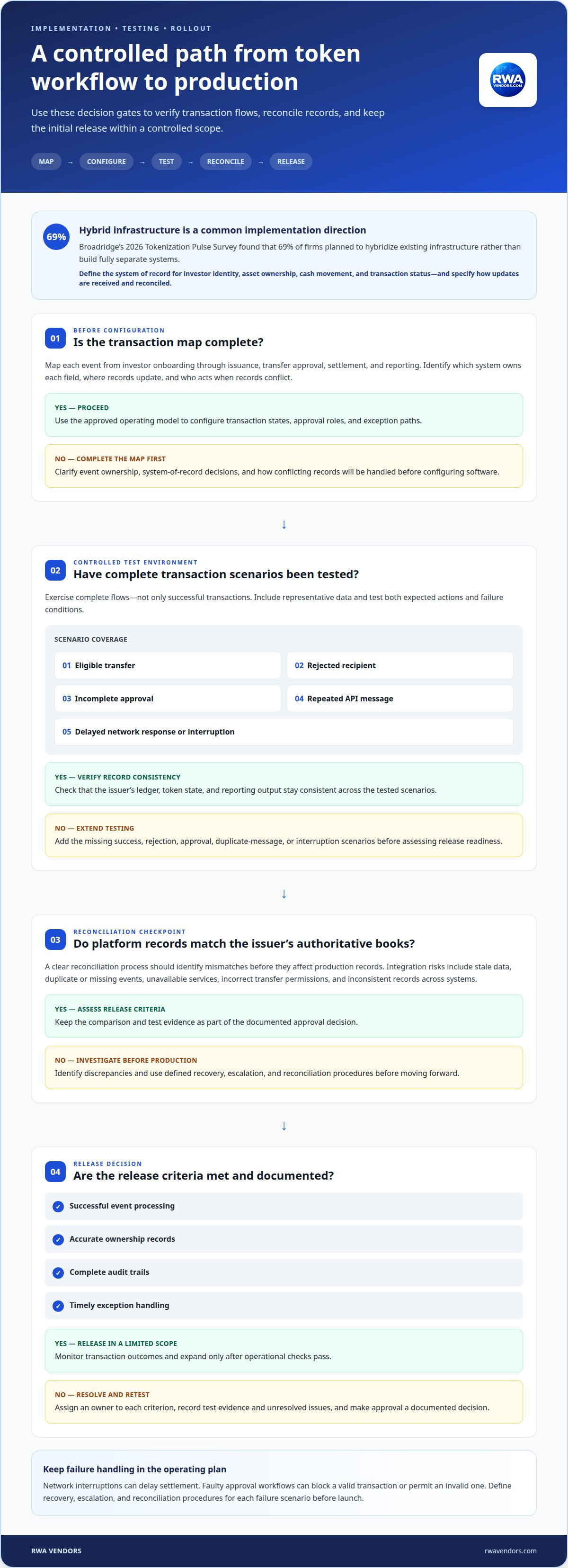
Translate the approved operating model into a transaction map before configuring software. Show each event from investor onboarding through issuance, transfer approval, settlement, and reporting. For a fund, identify where the issuer’s records update after a subscription. Show which system owns each field and which entity acts when records conflict.
Broadridge’s 2026 Tokenization Pulse Survey found that 69% of firms planned to hybridize existing infrastructure rather than build fully separate systems. A hybrid implementation can preserve established finance operations while adding token-specific workflows. Define the system of record for investor identity, asset ownership, cash movement, and transaction status. Specify how each system receives and reconciles updates.
Use a controlled test environment to exercise complete scenarios, not just successful transactions. Test an eligible transfer, a rejected recipient, an incomplete approval, a repeated API message, and a delayed network response. Confirm that the issuer’s ledger, token state, and reporting output stay consistent. A clear reconciliation process should identify mismatches before they affect production records.
Integration risks include stale data, duplicate or missing events, unavailable services, incorrect transfer permissions, and inconsistent records across systems. A network interruption can delay settlement, while a faulty approval workflow can block a valid transaction or permit an invalid one. Define recovery, escalation, and reconciliation procedures for each failure scenario before launch.
- Configure: Map transaction states, approval roles, and exception paths to the issuer’s operating procedures.
- Test: Run end-to-end scenarios with representative data, including rejected actions and recovery from interruptions.
- Reconcile: Compare platform records with the issuer’s authoritative books and investigate discrepancies.
- Release: Limit the initial production scope, monitor transaction outcomes, and expand only after operational checks pass.
Set release criteria before testing begins. Criteria can cover successful event processing, accurate ownership records, complete audit trails, and timely exception handling. Assign an owner to each criterion, then record test evidence and unresolved issues. This makes approval a documented decision rather than an informal sign-off.
On an established tokenization platform, a straightforward note can take about 2 to 6 weeks from agreed economics to first settlement. The schedule depends on asset terms, integration scope, approvals, and readiness of supporting records. Use that process window to coordinate technical testing with operational preparation, rather than treating launch as a software deployment alone.
After release, track failed transactions, unresolved reconciliation breaks, and support escalations. Providers documenting their integration capabilities can make them easier to find through a tokenization provider directory listing.
Security and breach-risk reduction
Start with operational keys: token issuance, administrative changes, and recovery should not depend on one credential. A 2-of-3 or 3-of-5 multisignature scheme requires several authorized keys to approve a sensitive action. Define who holds each key, which actions need approval, and how access is restored if a key becomes unavailable. This creates separation between routine operations and high-impact changes.
Security must cover the asset lifecycle, from onboarding and issuance through transfer, servicing, and redemption. At each stage, identify sensitive records, system access, and the party responsible for responding to an incident. For example, an issuer may need to approve a restricted asset transfer before it settles. A clear control sequence can prevent an unauthorized transfer from being treated as complete.
Build jurisdiction and compliance considerations into the design rather than treating them as a later review. Transfer controls may depend on recipient eligibility, approved jurisdictions, holding-period status, and issuer policy. Run these checks before settlement. Document how the platform handles a failed check, records the decision, and prevents a later system update from bypassing the original restriction.
- Access: Limit administrative permissions to defined roles and separate approval from execution.
- Keys: Establish custody, backup, rotation, and recovery procedures for operational keys.
- Records: Preserve an auditable account of approvals, rejected actions, and administrative changes.
- Response: Assign incident owners and define how affected transactions are paused, reviewed, and reconciled.
Payment tokenization is a related but distinct use case. It replaces sensitive card information with a token while the actual data remains in a token vault. Gateway tokenization can keep merchants from accessing or storing cardholder data. Network tokenization can further limit exposure of original card details across a payment lifecycle. These controls address payment credentials, not ownership records or securities transfer rules.
That distinction matters for PCI DSS. Payment tokenization can reduce the sensitive payment data a business stores or processes, helping support compliance. It does not establish that an entire tokenized-asset platform meets every security or regulatory requirement. Map payment systems and asset systems separately, then identify where their data flows or permissions intersect.
Test controls with concrete failure scenarios before production. Simulate a lost operational key, a rejected transfer, an unavailable approval service, and an attempted permission change. Confirm that each event triggers the intended response and leaves usable records. Security depends on responsibilities, access controls, and recovery procedures working together across the full lifecycle and distribution model.
APIs and back-office integration
A tokenization platform should connect with existing institutional systems, not create a parallel recordkeeping environment. Map how investor onboarding, asset records, transaction instructions, settlement updates, and reporting move between applications. For example, a completed subscription may need to update fund administration, accounting, and the investor’s account record. Assign one authoritative source for each data field to prevent conflicting values.
Three patterns can structure these connections: event-driven architecture, an API gateway, and a shared state layer. Event-driven architecture sends updates when actions occur, such as when an investor becomes eligible or a transfer receives approval. An API gateway manages requests between applications and applies consistent access controls. A shared state layer keeps relevant systems aligned on transaction status and asset records.
Choose a pattern based on the workflow and system boundaries. An API gateway can suit a platform receiving requests from several internal applications. Event-driven updates can help when accounting or reporting needs to respond to a settlement event. A shared state layer can reduce discrepancies when fund administration and investor services need the same transaction status. These patterns can also work together.
- CRM: Pass approved investor information into onboarding workflows and maintain a clear record of status changes.
- KYC tools: Return review outcomes without copying unnecessary identity data into every system.
- Fund administration: Send subscriptions, allocations, and ownership changes to the appropriate records.
- Accounting: Match transaction and settlement events with entries and reconciliation processes.
- Reporting: Deliver consistent asset and investor data to operational and management reports.
Define message behavior before connecting systems. An API request should identify the action, the relevant asset or investor entity, and the current transaction state. Set rules for duplicate messages, delayed responses, and failed updates. For instance, an accounting system should not record a completed settlement solely because it received an earlier instruction. It needs a reliable status signal.
Make data ownership explicit. The platform may manage token events, while a fund administrator maintains official fund records. Document which system can create, amend, or correct each record. Include a reconciliation process for mismatches, with a named operational owner and an audit trail for corrections. Clear ownership also helps teams investigate onboarding delays or reporting discrepancies.
Use native integrations where they fit the existing architecture, but do not treat them as a substitute for agreed data definitions. A field named “active” may mean onboarding status in one system and transfer eligibility in another. Define meanings, formats, and update timing before mapping fields. For recurring payment transactions, a payment token can be reused without collecting sensitive payment data again. Keep that payment workflow separate from asset ownership and settlement records.
Identity, permissions, and wallet-access processes
Separate identity from ownership records with a two-layer design. Keep personally identifiable information off-chain, while linking a verified identity to the relevant wallet through controlled records. This limits where sensitive data appears and lets tokenization infrastructure apply permissions without placing personal details directly on a public ledger.
Define the identity process before issuance. An investor may complete onboarding in an identity system, while the platform receives only the status and attributes needed for its workflow. For a credit fund, for example, a wallet can be linked to an eligible investor record without exposing underlying identity documents on-chain. Document how updates, corrections, and revoked permissions flow between systems.
Set permissions according to responsibilities, not job titles alone. Give separate rights for viewing records, approving issuance, initiating transfers, and changing wallet settings. A staff member who prepares an action should not automatically have authority to approve it. Granular access control also helps preserve a clear audit trail when teams change or an investor’s access status is updated.
- Identity layer: Store personal information off-chain and use controlled references for platform decisions.
- Wallet layer: Associate wallets with verified records, then apply the relevant ownership and transfer permissions.
- Administrative layer: Restrict sensitive actions and require appropriate review before changes take effect.
- Key layer: Use hardware security modules, multi-signature wallets, and geographically distributed key management.
Wallet access also needs a defined operating process. Specify how an investor receives access, how access is suspended, and how a lost credential is recovered. Keep recovery separate from ordinary transaction approval. For example, replacing a compromised signing credential should trigger a controlled review, while routine access should follow the established authorization path.
Choose a wallet format that fits the asset’s rules and participants’ operating needs. A wallet may represent an investor’s ability to hold or transfer an asset, but it should not become the source of truth for every identity or servicing record. Link wallet activity to authoritative records, and define how a change in investor status affects permitted actions.
Test these controls with practical cases: a newly approved investor, an access request from an unauthorized role, a lost key, and a wallet linked to an outdated identity record. Confirm that the platform blocks prohibited actions and records each decision. Review access after role changes, and ensure key-management responsibilities remain clear across locations and teams.
Also test a change in investor status, and confirm that each outcome follows the documented permissions and recovery path. Check that suspension does not erase records needed to review or restore access, and that recovery remains separate from transaction approval. These exercises can expose gaps between identity updates, wallet settings, and the records used to authorize activity. Resolve mismatches before relying on the process in live operations. Repeat the same tests after a permission or wallet-setting change.
The platform should support hardware security modules, multi-signature wallets, granular access control, and geographically distributed key management.
RWA Vendors: RWA Vendors connects asset issuers with verified tokenization platforms and service providers
RWA Vendors connects asset issuers with verified tokenization platforms and service providers. Use the directory when your integration plan is defined and you need to identify potential technology, legal, or compliance partners for a specific stage of tokenization.
For example, an issuer preparing to tokenize a fund can use the directory to discover providers across the real-world asset ecosystem. The directory helps narrow the search for relevant expertise, while platform selection and project decisions remain with the issuer. RWA Vendors also offers Vendor Directory Listing, Founding Membership, and Lead Generation and Referrals for participating providers.
Use RWA Vendors as a discovery and connection point as you move from requirements to provider conversations. Contact RWA Vendors to discuss the next step.
Move from integration design to operational ownership
Treat this tokenization platform integration guide as a starting point for ongoing operational discipline. Once a platform is live, teams need clear ownership of decisions, issue escalation, and changes to the operating model. Assign responsibility for reviewing exceptions and coordinating updates across technical and business functions. This keeps integration decisions connected to the asset’s operational needs.
Before expanding to additional assets or investor workflows, document what your initial deployment taught the team. Capture unresolved dependencies, recurring support needs, and changes required to internal procedures. Use these findings to refine governance and plan the next phase, rather than scaling a workflow that still creates uncertainty for staff or investors.
If you are identifying partners for an upcoming tokenization initiative, RWA Vendors can help connect asset issuers with providers across the ecosystem.
A measured next step can turn a technical launch into a durable operating capability. Keep the plan focused, responsibilities clear, and the path forward practical.
Frequently Asked Questions
What does a tokenization platform actually do?
A tokenization platform coordinates an asset’s digital representation with the systems and processes that support its use. It can connect issuance records, transfer controls, investor workflows, and transaction data. For example, a fund issuer may use a platform to coordinate token issuance with investor records. The platform supports operations, but the issuer remains responsible for defining the asset and its operating arrangements.
What is a tokenization platform and how does it work?
A tokenization platform is technology for creating and managing digital tokens linked to real-world assets or financial interests. The issuer defines asset terms and operating rules, then the platform records token activity and connects it with relevant workflows. A token’s format and network affect how systems process it. For example, a transfer may generate a platform event that downstream records use to update transaction status.
What steps are required to integrate a tokenization platform with an existing application?
Start by mapping the application’s role and the information it exchanges with the platform. Define field meanings, access permissions, and which system owns each record. Connect through the selected API or integration pattern, then test representative messages, including duplicates and failed responses. For example, ensure retrying an issuance request cannot create conflicting records. Reconcile results before enabling the workflow in production.
What security standards and compliance requirements apply, including PCI DSS and data privacy laws?
Applicable requirements depend on the asset, jurisdictions, participants, and data handled. PCI DSS is relevant when payment card data enters the payment environment; payment tokenization can reduce the sensitive data stored or processed. Privacy frameworks, including GDPR, may also be relevant to personal data flows. Map each data type and system boundary, then assess the controls and obligations that apply to those specific operations.
How long does implementation take, and what testing and certification are required?
A straightforward note on an established platform can take about 2 to 6 weeks from agreed economics to first settlement. Integration scope, asset terms, approvals, and record readiness affect the schedule. Testing should cover issuance, transaction processing, rejected actions, recovery, and reconciliation. Certification requirements depend on the platform and applicable operating context; distinguish formal certification from internal testing and contractual acceptance criteria.
Disclaimer
This article is provided by RWAVendors.com for general informational and educational purposes only. It does not constitute legal, financial, investment, tax, regulatory or other professional advice, or an offer, solicitation, recommendation or endorsement of any company, product, service, token, security or investment. RWAVendors.com is an informational vendor directory and does not sell, issue, broker, custody or facilitate transactions involving cryptocurrencies, digital tokens, tokenized assets, securities or investment products. Some vendor listings and references may involve paid advertising, sponsored placement or membership relationships. These relationships do not guarantee a vendor’s qualifications, regulatory status, performance or suitability. Information may be incomplete, outdated or subject to change. You should independently verify all information, conduct your own due diligence and consult qualified professionals before making any business or investment decision. RWAVendors.com is not responsible for the content, services, representations or actions of third-party vendors or linked websites.


