

A clean smart contract review is not a complete security case. Evaluating tokenization platform security means examining custody and oracle dependencies alongside code. Risks can also arise from privileged access, external services, and data flowing into onchain systems. Security depends on how these components work together, not simply on whether a contract has been reviewed.
That broader view is essential when assessing an asset tokenization platform. A weakness in custody, governance, or an oracle can affect control of assets or how the platform responds to external information. This article offers a practical way to assess these connected risks without treating any single control as a security guarantee.
Learn how to examine platform governance, security standards, architecture, and scaling risks, then assess counterparties, custody arrangements, and oracle dependencies. Together, these areas provide a structured way to see where security controls are strong and where risks may extend beyond the core technology.
Key Takeaways
- Assess who can administer, upgrade, or pause platform contracts, and how approval controls and governance processes limit privileged access.
- Review custody, key management, separation of duties, and operational safeguards as connected parts of the platform’s security model.
- Reassess security as issuers, asset types, and blockchain networks are added; launch-time reviews do not cover every later integration or configuration.
- Examine upgradeability, token-generation logic, business rules, and oracle dependencies through architecture reviews and threat modeling.
- Include counterparties and connected services in due diligence, since platform-code reviews alone can leave important risks outside the assessment.
1. Administrative access and governance controls
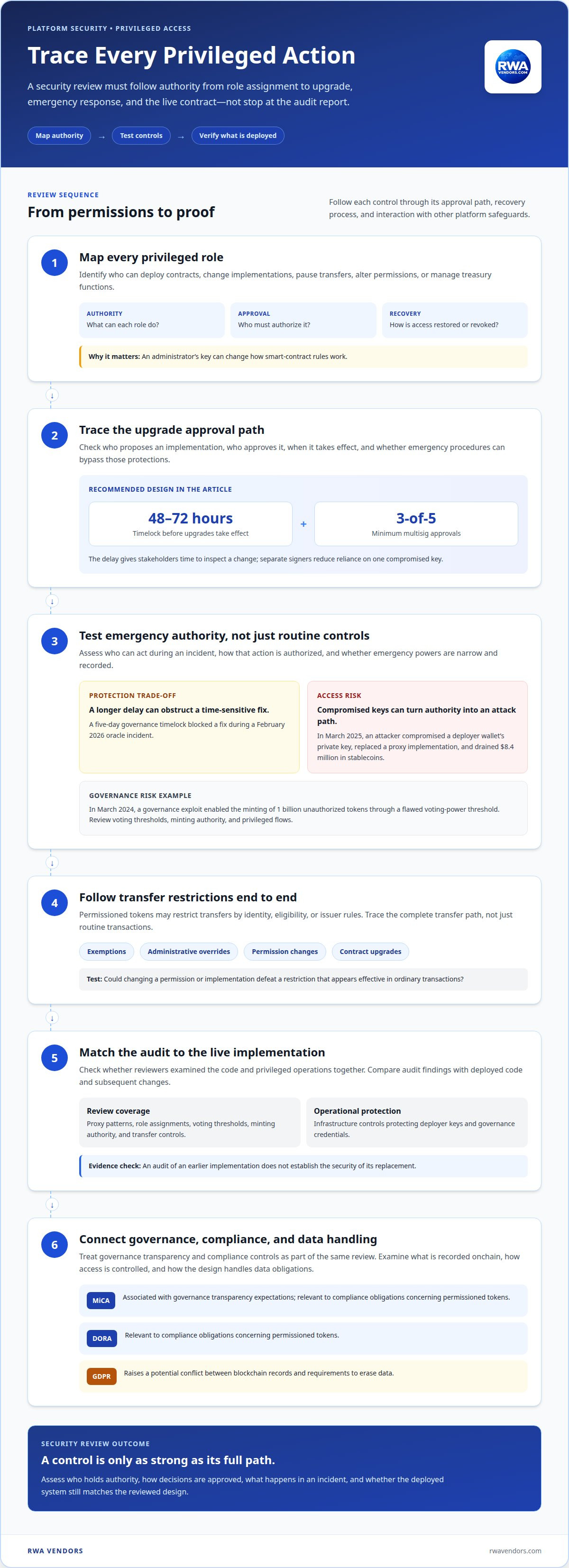
Start by mapping every privileged role in the platform’s blockchain environment. Identify who can deploy contracts, change implementations, pause transfers, alter permissions, or manage treasury functions. Record each role’s authority, approval path, and recovery process. A smart contract may enforce rules, but an administrator’s key can still change how those rules work.
That authority creates a distinct attack surface. In March 2025, an attacker compromised a deployer wallet’s private key and replaced a proxy contract implementation, draining $8.4 million in stablecoins. In March 2024, a governance exploit enabled the minting of 1 billion unauthorized tokens through a flawed voting-power threshold. These incidents show why access reviews must test privileged flows, not only public contract functions.
Examine upgrade controls as a sequence: who proposes an implementation, who approves it, and when it takes effect. A recommended design places upgrades behind a 48–72 hour timelock and requires at least 3-of-5 multisig approvals. The delay gives stakeholders time to inspect a change, while separate signers reduce reliance on one compromised key. Confirm that emergency procedures do not silently bypass these controls.
Timelocks also require careful design. A five-day governance timelock blocked a fix during a February 2026 oracle incident. That example makes response authority part of the review: assess which actions can be taken during an incident, who can authorize them, and whether emergency powers are narrow and recorded. A delay that protects routine upgrades can obstruct a time-sensitive mitigation.
Review transfer restrictions as carefully as administrator permissions. Permissioned tokens may restrict transfers by identity, eligibility, or issuer rules, but those controls can be bypassed. Trace the full transfer path, including exemptions, administrative overrides, and contract upgrades. Test whether changing a permission or implementation could defeat restrictions that appear effective in routine transactions.
Smart contract audits should cover implementation logic and privileged operations together. Check whether reviewers examined proxy patterns, role assignments, voting thresholds, minting authority, and transfer controls. Compare audit findings with deployed code and subsequent changes. An audit of an earlier implementation does not establish the security of its replacement. Also assess the infrastructure controls protecting deployer keys and governance credentials.
Finally, examine governance transparency and compliance controls as connected requirements. MiCA is associated with governance transparency expectations, while MiCA and DORA are relevant frameworks for compliance obligations concerning permissioned tokens. The European Union’s GDPR also raises a potential conflict between blockchain records and requirements to erase data. Assess what information is recorded onchain, how access is controlled, and how the design handles that tension.
2. What Security Standards Should an Asset Tokenization Platform Follow?
Assess custody, key management, and daily operations as connected security controls. A platform should protect sensitive data, validate access, log administrative activity, and review changes. Its security program should bring together smart contract and operational security, monitoring, incident response, threat modeling, and independent reviews. No single standard replaces evidence that these controls work together.
Leading platforms use controls such as encryption, secure storage, authentication, authorization, auditing, and protected communication channels. Pricing depends on implementation scope and is provided after a quote request; cost factors include custody arrangements, integrations, network support, and operational responsibilities.
Token generation and sensitive data mapping require separate consideration. A token can represent a sensitive value, while a protected token vault retains the mapping needed for authorized retrieval. Review how tokens are generated, how the mapping is stored, and which roles can access or change it. Encrypt sensitive data and protect communication between the data store and vault.
Key management determines who can sign transactions or authorize operational changes. Map each wallet to its purpose, such as issuance, treasury, or administrative actions. Then assess key creation, storage, access approval, rotation, recovery, and revocation procedures. Separating duties reduces the chance that one operator can initiate and approve a sensitive transaction alone.
Custody of underlying assets is distinct from custody of tokens or signing keys. For a real estate or fund structure using a special-purpose vehicle (SPV), trace how the legal entity holds the asset and how token-holder rights relate to it. Compare governing documents, asset records, and operational procedures. Reconcile records to identify discrepancies between represented interests and underlying assets.
For stablecoins and other treasury assets, review wallet permissions and transaction workflows alongside reconciliation and monitoring. Determine who can initiate transfers, who approves them, and how exceptions are recorded. Assess whether operational records let an incident team reconstruct activity across wallets, platform systems, and relevant asset records.
Standards can provide a useful comparison point. ERC-3643, ERC-1400, ERC-7518, and Solana Token-2022 are identified as tokenization or token standards. Examine how the chosen implementation handles identity, transfer controls, and permissions; a standard name alone does not establish secure configuration. Review deployed code, audit scope, findings, and subsequent implementation changes together.
Organizations offering relevant custody, compliance, or tokenization capabilities can make those services easier to discover through a tokenization vendor directory listing.
3. Security considerations that scale with issuers and chains
A platform’s risk surface expands with each issuer, asset class, blockchain, and external provider. A security incident can affect every issuer using the platform at once, even when only one integration is compromised. As of March 2026, real-world asset tokenization spanned 33 networks. Each additional chain can introduce distinct contracts, permissions, monitoring needs, and operational dependencies.
Cloud-based and on-premises platforms differ in where infrastructure operates, not in whether either model is inherently secure. Compare access controls, patching, key management, monitoring, incident responsibilities, and recovery arrangements in the actual deployment. For cloud services, include provider dependencies. For on-premises systems, assess the organization’s own infrastructure and operational controls.
Assess each issuer configuration as a separate source of technical risk. Issuers may use different transfer rules, identity providers, asset records, and contract settings. A review of platform code alone can miss a weak issuer configuration or compromised identity provider. Trace the path from investor onboarding through authorization, transfer, and record updates, including where administrators can change settings.
Cross-chain designs add bridge and messaging dependencies. Map how a digital asset is represented on each chain, which component authorizes cross-chain actions, and how mismatched or delayed messages are handled. Treat every bridge, relayer, and chain-specific contract as part of the system boundary. A compromise in one component may affect activity beyond the chain where it began.
Jurisdictional exposure also changes when issuers, investors, and infrastructure providers operate across borders. Map the entities responsible for platform operations, identity, custody, and data handling, then document which jurisdictions govern each relationship. This provides a practical view of dependencies without assuming one jurisdiction’s controls automatically apply to every participant.
Monitoring must extend beyond smart contracts. Include wallet activity, cloud infrastructure, identity services, bridge messages, privileged configuration changes, and issuer-specific events. Define which team receives each alert and how technical evidence is preserved. A contract-only dashboard can miss an exploit that starts with a compromised provider account or altered issuer configuration.
For data breaches, incident response, and disaster recovery, assess the documented steps for detection, containment, investigation, service restoration, and communication. Confirm that responsibilities cover platform operators and relevant providers, and that recovery procedures address infrastructure and digital asset records. Revisit this assessment whenever the platform adds an issuer, chain, asset class, or external dependency. A launch review does not establish ongoing security.
4. Architecture reviews and threat modeling
Review the full system architecture, not just the smart contract source. Trace how an asset moves from issuance through transfer, settlement, and recordkeeping. At each stage, identify the contracts, services, operators, and data inputs involved. This map shows where an error or compromise could affect financial operations or asset-holder rights.
Contract upgradeability creates an additional attack surface. Identify which implementation controls upgrades, how a new version is authorized, and whether users can detect changes before they take effect. Compare deployed code with the implementation examined by independent reviewers. A review of an earlier release does not establish the security of a later implementation. For teams evaluating tokenization platform security, checking version alignment is a core architectural step.
Threat modeling should connect technical paths to business outcomes. For example, trace an unauthorized transfer from its initiating call through permission checks, contract execution, and downstream records. Ask what the attacker needs, which control should stop the action, and what evidence would reveal a failure. Include misuse of legitimate functions, not only unexpected inputs or obvious code vulnerabilities.
Token-generation methods also need architectural scrutiny. Determine how tokens are created, which roles can initiate issuance, and how the implementation prevents unintended supply changes. Favor proven, validated methods over arbitrary designs. Then test how issuance logic interacts with transfer restrictions, redemption processes, and issuer-specific business rules.
Oracle dependencies can become single points of failure. Map every external data source to the contract decisions it influences, including pricing or collateral calculations where applicable. In February 2026, an oracle misconfiguration reported cbETH at about $1.12 instead of roughly $2,200 and led to liquidations of more than 1,096 cbETH. This illustrates why architecture reviews must examine data validation, update paths, and failure responses.
Include operational and governance paths in the same model. A privileged operator may change configuration, while an automated service may submit data or transactions. For each path, document its authority, input validation, monitoring, and fallback behavior. Engineering teams should test whether a single failure could bypass controls elsewhere in the architecture.
Use a repeatable review sequence: diagram components and trust boundaries; list valuable assets and sensitive actions; model likely threats; map each threat to preventive and detective controls; then test those controls against business scenarios. Include issuer configuration and external dependencies, not just shared platform code. This structure makes evaluating tokenization platform security more actionable by linking threats to specific controls.
Close the review by connecting findings to remediation. Rank issues by the asset or function exposed, the access an attacker would need, and the potential effect on transfers or records. Assign an owner and a retest condition to each corrective action. Revisit the threat model whenever architecture, token-generation logic, or a material dependency changes.
5. Counterparty and onchain due diligence
Ask vendors who controls each critical service, what evidence supports its security claims, and how incidents affect issuers. Request a clear map of ownership, responsibilities, subcontractors, and dependencies. The answers show where a project may rely on a single partner, privileged account, or external system.
Examine the legal and operational roles behind the tokenized asset. Identify the issuer, the entity holding the underlying asset, the platform operator, and the parties responsible for investor records. For an SPV structure, compare its governing documents with the stated ownership and token-holder rights. A mismatch between legal records and platform representations can create risk beyond the blockchain.
Review each provider by function, not category alone. Map custody, identity, cloud infrastructure, oracles, bridges, and payment services to the actions they can perform. Record the data and permissions each provider receives, its incident escalation path, and the party accountable for continuity. This dependency map shows how a compromise at one counterparty could affect issuance, transfers, or records.
Onchain due diligence should connect contract addresses to the project’s actual operating model. Compare deployed contracts with the documented implementation, trace issuance and transfer paths, and examine privileged functions. Review transaction history for unexpected minting, configuration changes, or activity inconsistent with stated operations. Preserve relevant block and transaction records so findings can be reproduced.
Oracle and market-data counterparties need specific scrutiny. In April 2025, an oracle manipulation exploit on a Solana lending protocol used a low-liquidity price pair and caused $5.8 million in losses. Assess how each data provider selects sources, validates inputs, handles stale or abnormal values, and communicates incidents. Determine whether a single source can trigger consequential contract actions.
Before launch, ask vendors to walk through a realistic attack scenario involving a compromised provider account or incorrect data. Identify the detection signal, response owner, containment action, and records retained for investigation. Then establish how provider, contract implementation, or issuer configuration changes trigger a renewed review. Due diligence is ongoing, not a one-time launch document.
Compare answers with evidence such as architecture diagrams, audit scope, incident procedures, and responsibility matrices. Note any dependency without a named owner, claim without supporting documentation, and onchain function without a clear business purpose. These gaps help decision-makers prioritize follow-up and define conditions for proceeding.
RWA Vendors: RWA Vendors connects asset issuers with verified tokenization platforms and service providers
RWA Vendors connects asset issuers with verified tokenization platforms and service providers. After defining your requirements for governance, custody, architecture, and counterparties, use the directory to find providers in tokenization, technology, legal, and compliance categories.
The directory is a practical next step when a project needs to match specialist capabilities to its risk areas. Issuers can find companies supporting real estate, funds, securities, and other assets, then use provider information to continue their due diligence. Vendor Directory Listing and Lead Generation and Referrals support discovery and connections across the ecosystem.
Contact RWA Vendors to discuss finding relevant tokenization providers.
Turn security findings into a stronger next step
A security review is most useful when its findings inform decisions beyond initial provider selection. Use the assessment to define which risks require remediation before launch, who owns each action, and what evidence supports acceptance. This makes evaluating tokenization platform security an ongoing governance practice rather than a one-time procurement exercise.
For issuers, the next step may be finding providers whose capabilities align with the project’s risk profile. For vendors, participation can support visibility and connections across the tokenization ecosystem through Vendor Directory Listing, Founding Membership, and Lead Generation and Referrals.
Keep the assessment current as project requirements and dependencies change. A clear process helps teams make informed decisions and build with greater confidence.
Take the next step with a defined security approach and the right ecosystem connections.
Frequently Asked Questions
How Do Custody and Oracle Risks Affect RWA Projects?
Custody and oracle weaknesses can undermine different parts of an RWA project: control of assets and the reliability of external data. Inaccurate collateral data, for example, could trigger an incorrect contract action, while unclear custody records could make ownership difficult to reconcile. Assess how information flows between custodians, data providers, issuer systems, and contracts. The resulting dependency map helps identify where an operational failure could affect asset records or platform decisions.
What Are the Biggest Security Risks in RWA Tokenization?
The main risks arise when technical and operational weaknesses combine. For example, a compromised identity account might enable unauthorized access to an issuer’s administrative tools, followed by a configuration change affecting token transfers. Review connected attack paths, not just isolated vulnerabilities. Include user access, provider integrations, contract logic, asset records, and incident procedures. This approach helps reveal whether one failure could cross organizational or system boundaries.
What Security Standards Should an Asset Tokenization Platform Follow?
A platform should use recognized token standards suited to its transfer and permission model, alongside a security program covering sensitive data and operations. ERC-3643, ERC-1400, ERC-7518, and Solana Token-2022 are examples of identified token standards. Compare how the platform implements its selected standard with its actual business requirements. A standards label alone does not show whether configuration, operating procedures, and connected services are secure.
What security standards and certifications should a tokenization platform have?
No single certification establishes security for every tokenization platform. Distinguish technical token standards from organizational certifications, then assess each credential’s scope, issuing body, covered systems, and validity period. A credential covering one service may not cover issuer integrations or custody workflows. Ask how independent assessments relate to the live production environment and whether findings have documented remediation and retesting.
How does a tokenization platform protect encryption keys and token vaults?
Protection depends on limiting who can use keys and access the token vault, while keeping sensitive mappings inaccessible to ordinary platform functions. Review how key access is approved, logged, revoked, and recovered. One useful test is to trace a staff departure or suspected credential compromise: the response should address access removal and affected credentials. Also examine whether vault access is separate from routine application permissions and whether retrieval events are recorded.
What security risks and attack vectors are common in tokenization platforms?
Common attack paths include stolen credentials, exposed administrative interfaces, unsafe integrations, flawed contract logic, and manipulated external data. Follow a scenario across systems: an attacker compromises an account, changes an issuer setting, and attempts an unauthorized action. Look for controls at each transition, such as access checks, alerts, and transaction limits. Include recovery workflows and third-party connections, since attackers may target these paths instead of contract code.
How can a tokenization platform be evaluated for PCI DSS, GDPR, and CCPA compliance?
Start by mapping which systems collect, store, transmit, or process personal and payment-related data. Identify the responsible entities and applicable obligations. Evaluate PCI DSS scope around payment data flows, and assess GDPR and CCPA considerations against the project’s data practices. The European Union identifies a potential tension between blockchain records and GDPR data-erasure requirements. Document where personal information resides and how the design addresses that tension.
What should a security audit or penetration test cover for a tokenization platform?
An audit should cover deployed contract code, APIs, administrative interfaces, identity flows, and integrations that can affect issuance or transfers. A penetration test can examine whether an attacker can move from a user-facing weakness to privileged functions or sensitive records. Request clear scope, testing dates, findings, remediation status, and retest results. Compare the assessed version with production so an audit report is not mistaken for evidence about untested changes.
Disclaimer
This article is provided by RWAVendors.com for general informational and educational purposes only. It does not constitute legal, financial, investment, tax, regulatory or other professional advice, or an offer, solicitation, recommendation or endorsement of any company, product, service, token, security or investment. RWAVendors.com is an informational vendor directory and does not sell, issue, broker, custody or facilitate transactions involving cryptocurrencies, digital tokens, tokenized assets, securities or investment products. Some vendor listings and references may involve paid advertising, sponsored placement or membership relationships. These relationships do not guarantee a vendor’s qualifications, regulatory status, performance or suitability. Information may be incomplete, outdated or subject to change. You should independently verify all information, conduct your own due diligence and consult qualified professionals before making any business or investment decision. RWAVendors.com is not responsible for the content, services, representations or actions of third-party vendors or linked websites.


