

Institutional custody is an operating-control system, not simply a place to store private keys. That distinction matters when evaluating institutional crypto custody platforms: safeguarding assets also involves governance, transaction approvals, operational responsibilities, and integration with the systems around custody.
When comparing custody models, terminology can obscure where control sits and how responsibilities are divided. This guide provides a consistent framework for understanding custody architecture and operating models, then assessing the controls and integrations that matter for institutional use.
We examine key-management approaches, governance and approval workflows, and the connections custody needs to support token issuance, settlement, and reporting. We also place custody within the wider tokenized-asset infrastructure, where issuers may coordinate providers across compliance, trading, payments, and blockchain technology. Use the framework to assess how a custody platform fits your operating model and the rest of your digital-asset stack.
Key Takeaways
- Assess institutional crypto custody platforms by the control, authorization, and operational responsibilities they support, not by key storage alone.
- Trace how access requests, policy checks, approvals, signing, and recordkeeping fit together to see where transaction controls sit.
- Compare self-custody, third-party, and shared-control models against your governance requirements and operational dependencies.
- Evaluate governance, access, transaction policy, resilience, and oversight as distinct parts of an institutional control framework.
- Map custody integrations to token issuance, compliance, transfer, settlement, and reporting to identify the provider categories your RWA workflow requires.
What Are Institutional Crypto Custody Platforms, and What Do They Control?
Institutional crypto custody platforms are technologies and workflows used to safeguard and administer digital assets for organizations. Private keys are cryptographic credentials used to authorize transactions, but custody covers more than where keys are stored or how they are protected. It also includes how access is granted, transactions are approved, activity is monitored, and records are maintained.
Control is distributed through an operating model. A platform may provide tools for setting permissions and routing approvals, while the institution, a third-party custodian, or both retain defined responsibilities. The arrangement determines who can initiate, authorize, or execute actions, subject to the platform’s design and the parties’ agreements.
What makes a crypto custody platform institutional?
Institutional use calls for processes that can be governed and reviewed, not just a wallet interface. Treasury teams may need controls over organizational holdings; funds may require documented transaction authorization; and tokenized-asset issuers may need custody operations that work alongside issuance and asset administration. In each case, clear roles, approval paths, and reviewable activity help connect day-to-day operations with internal oversight.
“Institutional grade” is a descriptive term, not a universal certification or regulatory category. Assess the actual control framework and assigned responsibilities rather than relying on the label.
What does custody cover beyond private keys?
Key storage is one technical component. Broader custody operations can include deciding who can access assets, applying transaction authorization policies, monitoring activity, and maintaining operational records. For foundational information about wallets and keys, Cryptocurrency provides a general overview of the underlying concepts.
Custody is distinct from adjacent functions. An exchange executes trades, a tokenization platform may support issuance, and an investment manager makes portfolio decisions. A custody platform can connect to those workflows without performing each function itself. The scope depends on the platform and the arrangement in place.
Technical safeguards do not, by themselves, establish legal ownership or determine how assets would be treated if a provider became insolvent. Those questions depend on contracts and applicable law, which can vary by jurisdiction. Keep the technical control model separate from the legal and insolvency analysis when assessing institutional crypto custody platforms.
How Institutional Custody Platforms Manage Keys, Approvals, and Transactions
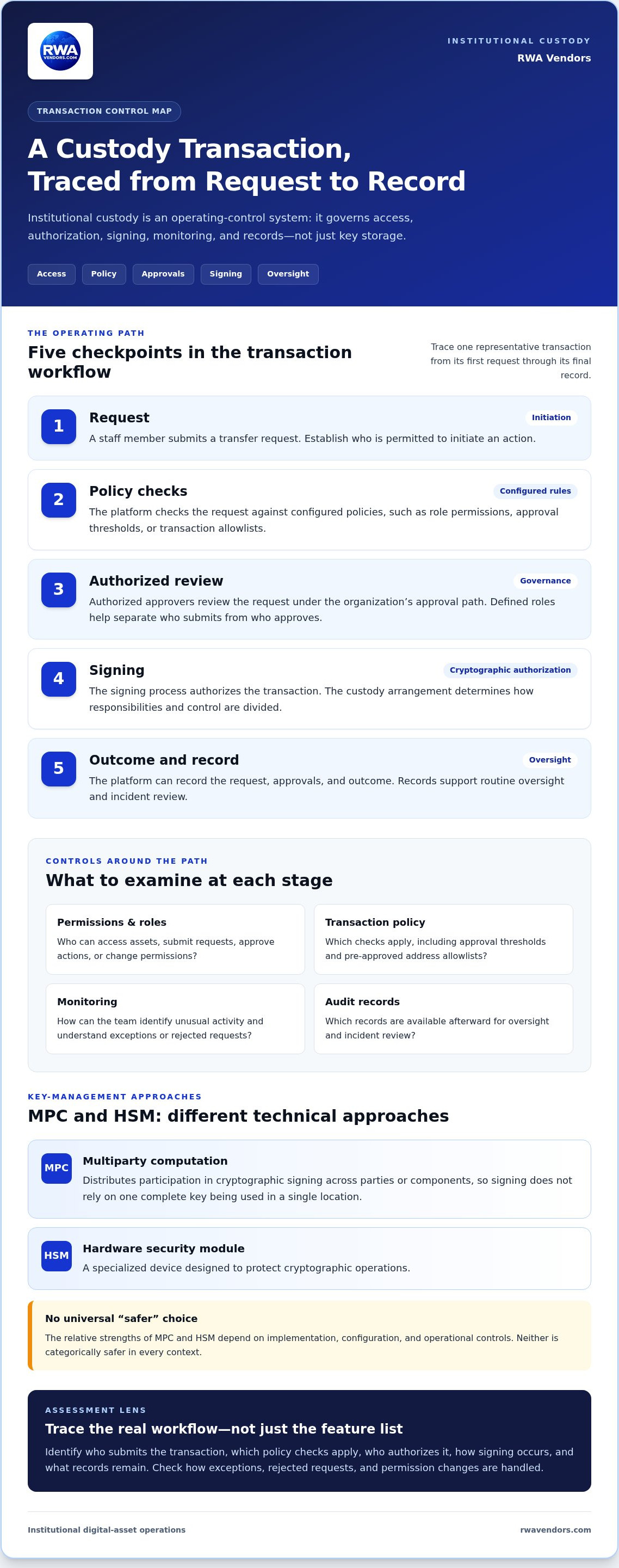
A custody workflow should make each transaction’s path visible, from the initial request to the final record. For example, a staff member requests a transfer, the platform checks it against configured policies, authorized approvers review it, and a signing process authorizes the transaction. The platform can then record the request, approvals, and outcome for oversight.
Authorization policy supports transaction governance by defining who may approve which actions and under what conditions. Separating roles helps prevent one person from controlling every step. An institution might require additional approval above a defined transaction threshold or allow transactions only to pre-approved addresses. Choose settings that reflect the organization’s risk controls and operating procedures.
How do MPC and HSM approaches differ?
Multiparty computation (MPC) distributes participation in cryptographic signing across parties or components, so signing does not rely on one complete key being used in a single location. A hardware security module (HSM) is a specialized device designed to protect cryptographic operations. These are distinct technical approaches, and their relative strengths depend on implementation, configuration, and operational controls. Neither is categorically safer in every context.
How do policy controls shape transaction workflows?
Depending on the platform, configurable controls may include role-based permissions, approval thresholds, and transaction allowlists. Monitoring can help teams identify unusual activity, while audit records support routine oversight and incident review. Compare specific controls and integrations with documented vendor information. A feature name alone does not show how that feature works in practice.
During assessment, trace a representative transaction from start to finish. Identify who can submit it, which policy checks apply, who authorizes it, how signing occurs, and which records are available afterward. Also establish how the workflow handles exceptions, rejected requests, and permission changes. This exercise can reveal gaps between intended governance and the system’s actual behavior.
US custody discussions also address safeguarding responsibilities and control arrangements. An industry comment submitted to the SEC offers context on these issues and the proposed SEC framework for crypto asset safeguarding. Treat the document as a submitted comment, not as a final rule or binding guidance.
These technical and operational details can inform how institutions map custody into their wider tokenized-asset infrastructure. Custody-platform providers can also build visibility among issuers exploring this ecosystem through a directory listing.
Custody Models Compared: Self-Custody, Third-Party, and Shared Control
The custody model determines where operational control sits and how responsibilities are divided. No approach is universally best. The right fit depends on an institution’s governance capacity, operational dependencies, asset workflows, and risk framework. Outsourcing custody does not remove the institution’s need for oversight. Legal classification and duties depend on the applicable jurisdiction and the specific arrangement.
When might an institution consider each custody model?
An institution-controlled model may suit an organization seeking direct operational control and able to manage the associated processes. A third-party model assigns defined custody functions to an external provider. Shared control divides authorization or key-related responsibilities between the institution and another party. For every model, document who can act, who oversees those actions, and how exceptions are handled.
| Model | Control | Governance responsibilities | Operational dependencies | Common use cases |
|---|---|---|---|---|
| Self-custody | Institution retains direct operational control of assets and related processes. | Institution defines and oversees access, approvals, and internal procedures. | Depends on the institution’s own people, technology, and operating processes. | Treasury or other organizations seeking direct control. |
| Third-party custody | An external provider performs specified custody functions under an agreed arrangement. | Provider and institution have defined roles; the institution still needs oversight. | Relies on the provider’s service and the institution’s connections to it. | Organizations assigning custody operations to an external provider. |
| Shared control | Authorization or key-related responsibilities are divided between parties. | Each party’s permissions, approvals, and escalation responsibilities must be clear. | Depends on coordination between the institution and other participants. | Organizations seeking a split-control workflow. |
What changes when custody supports tokenized assets?
Tokenized assets can connect custody workflows to issuance, transfer restrictions, and settlement processes. Custody may be one part of a wider operating chain, alongside technology for issuance, compliance processes, transfer-agent functions, and settlement. These functions are related but distinct, so do not assume a custody provider also performs them. Map handoffs, data flows, and authorization points between providers before choosing a model.
For a broader view of the ecosystem, explore digital asset infrastructure providers as a category. When comparing institutional crypto custody platforms, assess how each custody model fits the full lifecycle, not just the point where assets are held.
Which Custody Controls Matter for Institutional Risk and Governance?
Assess controls as an operating framework, not as a collection of security features. For institutional crypto custody platforms, organize the review across five areas: governance, access, transaction policy, resilience, and oversight. For each area, identify who owns the control and how it supports the institution’s risk requirements.
- Governance: Are responsibilities, escalation paths, and policy-change approvals documented?
- Access: Are permissions limited by role, and are privileged actions recorded?
- Transaction policy: Can the institution configure approval rules and review exceptions?
- Resilience: Are recovery procedures, incident response, and continuity planning addressed separately?
- Oversight: Can authorized reviewers access records and assurance evidence relevant to the service?
How should institutions assess governance and access controls?
Look for role separation and least-privilege access, so users receive only the permissions needed for their responsibilities. Review approval records, periodic access reviews, and documentation of policy changes and privileged actions. These records help oversight teams establish who made a change, what was authorized, and how activity can be examined later. Specific legal obligations vary by entity, asset, and jurisdiction.
What resilience and assurance evidence should the review cover?
Evaluate recovery planning, incident escalation, service continuity, and operational dependencies as separate topics. For example, understand how the documented response process addresses a suspected security incident, then examine how recovery and continuity are planned if a service or dependency becomes unavailable. Independent assurance reports can provide evidence about defined controls and scope, but they do not guarantee protection against asset loss or service disruption.
Certification names alone do not establish that controls are suitable for a particular institution. Examine what an assessment covers, which systems and processes fall within scope, and how the evidence relates to the custody service being evaluated. Compare vendor-specific controls, integrations, and assurance materials against the institution’s requirements.
Use the review to identify gaps between documented procedures and your own governance needs. A clear control map can support internal oversight and help connect custody with the wider tokenized-asset operating model.
Mapping Custody Platforms to RWA Workflows & Providers
Custody is one component of a tokenized-asset operating model. Its responsibilities need to connect clearly with issuance, compliance, transfer, settlement, and reporting workflows. Map requirements before comparing institutional crypto custody platforms:
- Map the assets. Identify the asset types, relevant networks, and stages of the token lifecycle your operating model must support.
- Define control needs. Specify who should initiate, approve, and oversee asset access and transactions, and where responsibilities sit across your organization and external providers.
- Map integrations. Trace information and workflow handoffs among custody, issuance, compliance checks, transfer restrictions, settlement, and reporting components.
- Identify provider categories. Determine which capabilities belong to custody platforms and which require separate tokenization, compliance, trading, payment, or blockchain infrastructure providers.
This map helps surface dependencies early. For example, a transfer may need to follow an issuer-defined restriction and a compliance workflow before proceeding to settlement. Custody can support the asset-control component, but it does not replace the systems or parties responsible for issuance, compliance decisions, or settlement processes.
How does custody fit into a tokenized-asset operating model?
Assign distinct roles to the issuer, custody provider, compliance function, trading or transfer venue, and payment provider. Then document where data and instructions pass between them, including which records support reporting. Custody technology does not replace legal, compliance, or financial advice. For broader context, refer to the compliant asset tokenization guide when mapping the wider issuance and governance environment.
How can institutions discover custody and adjacent providers?
Provider discovery is most useful when it follows the workflow map. RWA Vendors lets businesses browse and filter vetted providers globally by service category, including custody, compliance, trading, blockchain infrastructure, and payments. This helps issuers consider custody alongside the other roles their operating model requires, rather than treating it as an isolated technology decision. The institutional digital asset partners guide offers another perspective on how provider categories fit together across institutional workflows.
Use the directory to identify relevant provider categories and compare them with your requirements. Discovery supports infrastructure planning; it does not provide custody or determine whether a provider is suitable for a particular institution.
Build a Custody Model That Fits Your Operating Framework
Choose institutional crypto custody platforms by examining the full control environment, not just key storage. Clear authorization paths, defined responsibilities, and reviewable records help institutions assess how custody supports their governance requirements.
Compare self-custody, third-party, and shared-control arrangements against your operational capacity and oversight needs. Then map custody to the wider tokenized-asset workflow, including issuance, compliance, transfers, settlement, and reporting. No single model fits every organization, so a structured comparison makes the trade-offs easier to evaluate.
RWA Vendors supports global discovery and filtering across tokenization provider categories. Custody sits alongside compliance, trading, legal, blockchain infrastructure, and payment providers, helping institutions explore the broader ecosystem around their requirements. RWA Vendors is a directory, not a custody provider.
A well-mapped custody framework gives your organization a stronger starting point for evaluating providers and building connected tokenized-asset operations.
Frequently Asked Questions
What is an institutional crypto custody platform?
An institutional crypto custody platform is a technology and operating environment used to safeguard and administer digital assets for an institution. Depending on the arrangement, it can coordinate key control, transaction authorization, access policies, monitoring, and operational records. The platform itself does not determine legal ownership or settle every regulatory question. Map which parties perform each function and understand how responsibilities are allocated under the specific custody arrangement.
How do institutional crypto custody platforms protect private keys?
Institutional crypto custody platforms may use multiparty computation, hardware security modules, or other cryptographic controls to manage signing operations. These mechanisms can limit exposure by controlling how a transaction is authorized, but they are only part of the security framework. Configuration, access policies, operating procedures, and recovery planning also matter. No architecture guarantees protection in every circumstance, so compare documented controls and assigned responsibilities rather than relying on a technology label alone.
What is the difference between MPC and an HSM for crypto custody?
Multiparty computation distributes participation in cryptographic signing across multiple components. A hardware security module is a specialized device designed to protect cryptographic operations. These are different approaches, and either may be combined with additional governance controls. Their suitability depends on implementation, operational requirements, and the institution’s control model. Neither term alone proves that a platform meets a particular security or regulatory standard, so assess the specific design and documented procedures.
Can an institution use self-custody for tokenized assets?
An institution may consider an institution-controlled custody model if it has the governance, technical capability, and operating processes to manage the responsibilities involved. The appropriate structure depends on the assets, organizational requirements, counterparties, and applicable jurisdiction. Self-custody does not eliminate oversight or operational risk. Before deployment, map who controls access, authorizes transactions, handles incidents, and maintains records, then assess the legal duties that apply to the specific arrangement.
What should institutions compare in crypto custody platforms?
Compare control models, authorization workflows, access governance, monitoring, recordkeeping, recovery processes, resilience, and integration requirements. Assess how each capability fits your operating model; feature counts alone do not establish suitability. Compare platform claims and assurance evidence with current documentation, including what a report covers and which systems fall within its scope. Legal and regulatory implications vary by jurisdiction, so do not infer an entity’s status or obligations from product descriptions alone.
Are institutional crypto custody platforms regulated?
Regulatory treatment depends on the provider’s role, the assets and services involved, and the applicable jurisdiction. The phrase “institutional custody platform” does not by itself establish a licence, registration, or regulatory status. Distinguish the technology’s capabilities from the legal status of the entity providing a service. Check relevant claims against current primary sources, and seek qualified legal advice for specific circumstances rather than drawing conclusions from a platform description.
How does custody support real-world asset tokenization?
Custody can support the control and administration of digital assets within a broader tokenized-asset workflow. It may connect operationally with issuance, compliance, transfer, settlement, and reporting, while each system and provider retains a distinct role. The integrations required depend on the asset structure and participating providers. Mapping these dependencies early helps clarify where instructions, records, and control responsibilities pass across the asset lifecycle.
Disclaimer
This article is provided by RWAVendors.com for general informational and educational purposes only. It does not constitute legal, financial, investment, tax, regulatory or other professional advice, or an offer, solicitation, recommendation or endorsement of any company, product, service, token, security or investment. RWAVendors.com is an informational vendor directory and does not sell, issue, broker, custody or facilitate transactions involving cryptocurrencies, digital tokens, tokenized assets, securities or investment products. Some vendor listings and references may involve paid advertising, sponsored placement or membership relationships. These relationships do not guarantee a vendor’s qualifications, regulatory status, performance or suitability. Information may be incomplete, outdated or subject to change. You should independently verify all information, conduct your own due diligence and consult qualified professionals before making any business or investment decision. RWAVendors.com is not responsible for the content, services, representations or actions of third-party vendors or linked websites.


