
The vendor with the broadest feature list may be the wrong choice for your RWA program. Infrastructure capabilities often overlap, and labels alone rarely show who is responsible for issuance, compliance workflows, custody dependencies, distribution, or ongoing asset administration. Comparing RWA blockchain infrastructure vendors is therefore a question of lifecycle fit, not just technology claims.
If it’s difficult to distinguish provider roles or compare architectures, start by mapping each capability to your asset, operating model, and requirements. Then check how providers connect across the asset’s lifecycle, including who manages each handoff.
This 2026 guide explains the main infrastructure categories involved in real-world asset tokenization and offers a practical framework for assessing providers. It covers what to examine across tokenization platforms, blockchain networks, custody, compliance, and related services, with questions to use during due diligence. RWA Vendors helps you discover providers by category. A directory listing is a starting point for research, not an endorsement or a substitute for your own assessment.
Key Takeaways
- Clarify which providers support issuance, operation, or transfer, and distinguish them from issuers, asset managers, and investor-facing platforms.
- Map each lifecycle need to a provider responsibility, and account for how multiple vendors may work together.
- Assess RWA blockchain infrastructure vendors against your requirements for architecture, workflows, integrations, operating model, and supporting evidence.
- Use a consistent due diligence sequence: define requirements, request evidence, test fit, examine dependencies, and document decisions.
- Use directory profiles to identify potential providers, then confirm capabilities and current availability directly with each provider.
Role of RWA Blockchain Vendors in Asset Tokenization
RWA blockchain infrastructure vendors provide technology that enables blockchain-based issuance, operation, or transfer of tokenized assets. Their work is one part of a broader operating model. An issuer establishes the asset offering, an asset manager may oversee the underlying portfolio, and investor-facing platforms support access or transactions. Professional service firms may handle legal, compliance, custody, or payment-related work. Some organizations span multiple roles, so a provider’s category label alone won’t tell you exactly what it does.
Requirements depend on the asset and how the project will operate. A real estate issuance, a fund, and another type of security can have different ownership records, administration, transfer controls, and reporting needs. Relevant jurisdictions and the intended lifecycle matter as well. A project focused on issuance may need different infrastructure from one planning for ongoing administration and potential secondary transfers. Define these requirements before choosing technology.
Which services count as RWA blockchain infrastructure?
Infrastructure can include blockchain networks, smart-contract tooling, tokenization platforms, wallets, and node infrastructure. These are distinct capabilities: a network provides the environment for transactions, while tooling or a platform may support token creation and related workflows. Custody, payments, legal, and compliance services are adjacent categories, even when they connect closely to the technology.
Screening definition: Classify a provider as infrastructure when its technology directly enables or supports blockchain-based issuance, operation, or transfer of a tokenized asset. Record the specific workflow it supports and what remains outside its scope. A token representing an asset may take the form of a security token, but the technical label alone doesn’t establish the holder’s rights or the project’s readiness.
How is infrastructure different from an RWA service provider?
Infrastructure supports workflows through software, networks, or technical components. Professional services may advise on or administer parts of those workflows, such as legal structuring or compliance processes. The boundaries can overlap. A tokenization platform might provide software and coordinate third-party services, while another provider may focus on one technical component.
Ask each candidate to define its responsibilities, dependencies, and exclusions. Confirm which party handles onboarding, controls, records, support, and operational decisions instead of inferring this from a broad service description. Technical infrastructure by itself doesn’t establish legal or operational readiness. A directory listing can help identify providers, but it’s a discovery tool, not a guarantee of suitability, compliance, or quality. Assess each provider against your own requirements and diligence process.
Map RWA Blockchain Infrastructure Vendors to Each Lifecycle Layer
Start with the asset’s lifecycle, then assign a provider or internal team to each required task. An architecture may combine a blockchain network, issuance platform, smart-contract developer, wallet provider, data service, custodian, and payment provider. One vendor may cover several functions, but those responsibilities aren’t interchangeable. Map the handoffs as well as the components. Note who controls records, approves transactions, handles exceptions, and maintains systems after issuance.
This approach helps expose dependencies early. For example, a token contract may rely on a network to process transactions, wallet infrastructure to enable access, and data services to support administration or reporting. Custody and payments can connect to these workflows, but remain distinct service categories with their own roles and diligence needs.
What infrastructure supports issuance and asset representation?
For issuance, evaluate the proposed network, token standard, smart-contract development process, and issuance tooling as separate decisions. Ethereum and ERC-3643 can serve as technical reference points during comparisons, not as default choices or endorsements. Ask providers to explain why their approach fits the asset, operating model, and intended transfer environment. Before relying on specific claims, verify current network capabilities and standards details against reliable, up-to-date documentation.
Clarify which party configures and maintains the contracts, what testing or review evidence is available, and how changes are managed. The goal is to understand the dependencies behind issuance, not simply confirm that a provider can create a token.
What supports operations after issuance?
Assess post-issuance requirements separately. Consider wallet access, transaction monitoring, connections to relevant asset or investor data, and lifecycle administration, including updates and reporting. Identify what each component does, how information moves between providers, and who is responsible when a process fails. Custody and payment services may integrate with these systems, but should be assessed as separate vendor categories.
For a broader view of architecture and the potential risks and benefits of tokenization, consult institutional digital asset infrastructure guidance and examine how technical choices connect to operating requirements. A practical comparison can record the provider, dependencies, evidence to review, and unresolved questions for each lifecycle task. This gives the project team a clearer basis for evaluating RWA blockchain infrastructure vendors without assuming one platform covers every need.
Infrastructure firms seeking directory visibility can explore a directory listing as one way to be discoverable by organizations researching providers.
Compare RWA Blockchain Infrastructure Vendors by Fit, Not Feature Lists
A comparison matrix makes provider claims easier to assess consistently. Set project requirements first, then record how each candidate meets them and what evidence supports its response. A long feature list isn’t proof of fit if it doesn’t address the asset, workflows, and operating model your project requires.
Use one row per requirement and capture the provider’s answer, evidence reviewed, dependencies, and open questions. Compare RWA blockchain infrastructure vendors across these areas:
- Architecture: Networks, environments, standards, deployment options, and interfaces currently supported.
- Workflows: Which project tasks the provider’s technology supports, and which remain with your team or another provider.
- Integrations: Required connections to wallets, custody, data, payment, or other systems, including who maintains them.
- Operating model: Responsibility boundaries, change management, support and escalation processes, and service continuity arrangements.
- Evidence: Documentation, test results, security materials, and other substantiation relevant to the claims being assessed.
Score candidates against requirements that matter to your project, not by counting features. A capability may be essential for one issuer and irrelevant for another. Flag unsupported claims for follow-up rather than awarding credit based on marketing language.
Which technical criteria belong in a vendor comparison?
Ask providers to specify the networks, environments, standards, and interfaces they support today. Check deployment options, access controls, monitoring, technical documentation, and incident-response processes. For each integration, record whether it is available, custom-built, or dependent on a third party. Confirm details directly with the provider and note any limits or prerequisites.
Assess portability and interoperability in practical terms: what would be required to move data, contracts, or workflows to another provider or environment? Review upgrade processes and dependencies, too. No architecture is universally best. Evaluate trade-offs against your own continuity, control, and integration needs.
How should teams compare operational and governance fit?
Document who makes changes, approves them, communicates incidents, and handles escalation. Ask what continuity arrangements exist and which party owns each operational task. Treat security, compliance, and performance claims as assertions to verify, not conclusions. Review relevant evidence with qualified internal or external specialists, and keep issuer-side legal conclusions separate from vendor representations.
For related control considerations, consult a guide on compliant asset tokenization alongside your project’s own requirements. In the matrix, distinguish provider-supplied materials from independently reviewed evidence, record gaps, and assign an owner to resolve each open question before selection.
Run Due Diligence Before Selecting an RWA Infrastructure Vendor
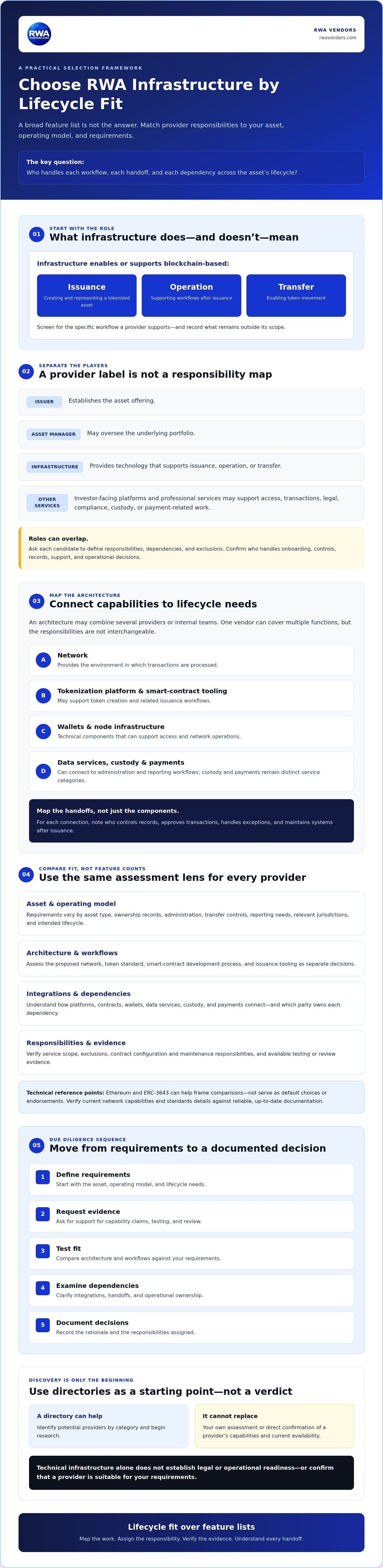
Use a consistent process to move from a promising provider profile to an evidence-based decision. For each candidate, define project requirements, request documentation, test proposed workflows, assess dependencies, and record the selection rationale. This helps teams compare RWA blockchain infrastructure vendors without treating sales claims as independently established facts.
- Define requirements: Specify the asset, intended workflows, operating model, jurisdictions, and technical constraints.
- Request evidence: Ask for current documents that address the provider’s responsibilities and relevant controls.
- Test fit: Validate priority workflows against measurable operational and technical requirements.
- Assess dependencies: Identify subcontractors, integrations, and responsibilities outside the provider’s scope.
- Document decisions: Record evidence reviewed, unresolved risks, owners, and approval gates.
Keep three things distinct: what the vendor says, what your team or an independent specialist has reviewed, and the issuer’s own legal conclusions. Legal and regulatory analysis must account for the specific offering and jurisdictions. A technology provider’s description of its controls or capabilities doesn’t settle those questions.
What evidence should an issuer request from a provider?
Request architecture documentation, security materials, clear service boundaries, and current integration documentation. Ask how testing is conducted, how production changes are approved and deployed, how incidents are handled, and how vulnerabilities can be disclosed. Also ask about business continuity arrangements, relevant subcontractors, and the provider’s process for managing dependencies.
Review the scope and date of any supporting materials. Don’t treat a certification title or audit reference as proof that every system, service, or workflow in your project is covered. Confirm what was reviewed, by whom, and whether the evidence applies to the provider’s proposed role.
How can teams test vendor fit before commitment?
Agree on a defined proof of concept with success criteria tied to actual requirements. These might include completing a priority workflow, recovering from a planned exception, or exchanging data with a component in the intended service stack. Check how responsibilities and records behave when a process fails, not just when it runs as expected.
Before selection, document assumptions, unresolved risks, accountable owners, and approval gates. Note what the test didn’t cover, too. This creates a reviewable basis for a decision and helps prevent a successful demonstration from being mistaken for proof of full operational readiness.
Find and Assess RWA Blockchain Infrastructure Vendors Through a Directory
Category-based directories help issuers identify providers across a tokenization ecosystem that can otherwise be difficult to map. Search by the capability you need, such as blockchain infrastructure, tokenization technology, custody, legal, compliance, trading, or payments. This gives you a starting point for a shortlist, not a decision about which provider is right for your project.
RWA Vendors is a global directory connecting asset issuers with providers across these categories. A profile can help you understand how a provider describes its role, but it isn’t a substitute for direct diligence. Confirm the provider’s current capabilities, service scope, integrations, jurisdictions served, and supporting evidence. A directory profile or listing doesn’t guarantee suitability, regulatory compliance, quality, or project outcomes.
How should buyers use a vendor directory responsibly?
Filter by the specific capability required, then compare potential providers against documented project criteria. For example, if you need issuance tooling, distinguish providers that support that workflow from firms focused on adjacent services. Ask shortlisted candidates to explain what they deliver, what depends on another provider, and what evidence they can share.
Use the directory for discovery, then confirm scope, integrations, relevant jurisdictions, and current availability directly with each provider. For a wider discovery framework, consult an institutional digital asset partners guide alongside your own selection process.
How can infrastructure vendors seek relevant directory visibility?
For providers serving tokenized markets, precise category and capability information helps issuers distinguish technical infrastructure from advisory, custody, or investment-related services. Describe the workflows your technology supports, clarify what falls outside your scope, and keep profile details current. Where available, provide supporting materials that prospective buyers can review and assess independently.
Clear descriptions help buyers frame better questions, but a directory profile shouldn’t imply capabilities or evidence that a provider hasn’t established. Providers should also avoid presenting directory inclusion as a guarantee of compliance, suitability, or commercial outcomes. Buyers remain responsible for assessing each candidate against their project requirements.
Infrastructure providers can apply to get listed in the RWA Vendors directory. For issuers, the directory offers a way to discover RWA blockchain infrastructure vendors and related service providers, then carry out the due diligence needed to make an informed selection.
Build a Stronger Foundation for Your RWA Program
Choose providers by the responsibilities they can support across your asset’s lifecycle, not by category labels or feature counts. Map required workflows, clarify where provider roles overlap, and compare architecture, integrations, operating arrangements, and evidence against your project’s needs. A structured due diligence process can expose dependencies and unanswered questions before selection.
Directories can make the search for RWA blockchain infrastructure vendors and related tokenized-market services more efficient, but discovery is only the starting point. RWA Vendors is a global provider directory covering blockchain infrastructure and related services. Issuers should confirm each candidate’s current scope and capabilities and conduct their own assessment.
Infrastructure providers serving tokenized markets can apply to be included in the directory.
With a clear requirements map and disciplined evaluation, your team can approach provider selection with greater confidence and build an architecture aligned with its operational needs.
Frequently Asked Questions
What are RWA blockchain infrastructure vendors?
RWA blockchain infrastructure vendors provide technology that supports blockchain-based issuance, operation, or transfer of tokenized real-world assets. Their capabilities may include networks, smart-contract tooling, tokenization platforms, wallets, or node infrastructure. They’re distinct from asset issuers and may also differ from custodians, legal or compliance firms, payment providers, and investor-facing platforms. Since provider roles can overlap, confirm exactly which workflows a vendor supports and what falls outside its scope.
Which blockchain infrastructure does an RWA tokenization project need?
The required infrastructure depends on the asset, project workflows, operating model, jurisdictions, and intended lifecycle. A project may need a blockchain network, smart contracts, issuance tooling, wallet access, monitoring, and connections to data or other services. It may also depend on separate custody or payment providers. Map the tasks the project must perform first, then identify the components and integrations needed to support them, rather than assuming one standard stack fits every issuance.
How do I evaluate blockchain vendors for tokenized assets?
Compare each provider against documented project requirements, not the length of its feature list. Assess architecture, supported workflows, network and standards support, integrations, deployment options, operating responsibilities, and evidence. Ask how the provider handles upgrades, incidents, dependencies, and portability. Record which claims are supported by documentation or independent review, along with gaps and follow-up questions. The goal is to determine whether the provider fits your project, not to identify a universally best architecture.
Can one vendor provide the full infrastructure stack for an RWA project?
One vendor may offer multiple infrastructure capabilities, but issuers shouldn’t assume a single provider covers every technical and operational need. A project may combine a network, issuance tooling, wallet services, data connections, custody, and payments, with responsibilities split across organizations. Ask for a clear scope of services, integrations, subcontractors, and exclusions. Map ownership of each workflow and handoff so gaps aren’t hidden behind a broad “end-to-end” description.
What should issuers ask blockchain infrastructure vendors during due diligence?
Ask for current architecture and integration documentation, security materials, and a clear description of service boundaries. Find out how testing and production changes are managed, how incidents and vulnerabilities are handled, and what continuity arrangements and subcontractors are involved. Test important workflows, including exceptions and recovery, against defined requirements. Separately, have qualified specialists assess relevant evidence and obtain project-specific legal and regulatory analysis for the offering and jurisdictions.
Does a vendor directory listing verify compliance or guarantee provider suitability?
No. A directory profile can help issuers discover and compare providers, but it doesn’t guarantee compliance, quality, suitability, or project outcomes. Treat it as a starting point for research. Confirm the provider’s current capabilities, service scope, integrations, relevant jurisdictions, and supporting evidence directly. Then conduct your own diligence against project requirements. A listing isn’t legal, financial, tax, or investment advice, and it doesn’t replace issuer-side review or professional analysis.
How can an RWA infrastructure company get listed in a vendor directory?
Infrastructure companies can seek a Vendor Directory Listing by applying through the RWA Vendors get-listed page. Describe capabilities precisely so issuers can distinguish technical infrastructure from adjacent services, and keep profile information accurate and current. Be prepared to clarify service scope and provide supporting information for buyer review. Directory inclusion supports discovery, but it doesn’t guarantee leads, business outcomes, regulatory compliance, or suitability for a particular issuer.
Disclaimer
This article is provided by RWAVendors.com for general informational and educational purposes only. It does not constitute legal, financial, investment, tax, regulatory or other professional advice, or an offer, solicitation, recommendation or endorsement of any company, product, service, token, security or investment. RWAVendors.com is an informational vendor directory and does not sell, issue, broker, custody or facilitate transactions involving cryptocurrencies, digital tokens, tokenized assets, securities or investment products. Some vendor listings and references may involve paid advertising, sponsored placement or membership relationships. These relationships do not guarantee a vendor’s qualifications, regulatory status, performance or suitability. Information may be incomplete, outdated or subject to change. You should independently verify all information, conduct your own due diligence and consult qualified professionals before making any business or investment decision. RWAVendors.com is not responsible for the content, services, representations or actions of third-party vendors or linked websites.


