
Strong blockchain credentials don’t automatically make a lawyer the right fit for an asset tokenization project. The right RWA legal service providers need to understand how the asset, issuer structure, offering terms, and investor jurisdictions affect the legal work.
If you’re unsure whether you need securities, funds, real estate, corporate, or digital-asset counsel, start by mapping what the project involves. Tokenization work can span several disciplines, and legal responsibilities may continue after issuance. This guide explains how to match project facts to legal workstreams, compare providers on relevant experience and jurisdictional knowledge, and agree on a clear engagement scope.
You’ll also find questions to raise with qualified counsel before making decisions, including how the proposed structure affects token-holder rights and which ongoing responsibilities may need attention. RWA Vendors is a global directory where issuers can discover potential legal and compliance providers. A listing is a starting point for independent diligence, not confirmation that a provider is suitable for your project.
Key Takeaways
- Identify the legal work your project may require by mapping its asset, proposed rights, issuer structure, offering, and target jurisdictions.
- Assess RWA legal service providers on relevant matters and jurisdictional fit, not broad claims about tokenization expertise alone.
- Clarify what the engagement covers, who will handle the work, and how ongoing responsibilities will be addressed after issuance.
- Prepare a concise issuer brief so potential counsel can evaluate your project and define a focused scope of work.
- Use a global directory to discover potential providers, then independently verify their credentials, experience, and suitability.
Why RWA Legal Service Providers Matter Across the Tokenization Lifecycle
RWA legal service providers are external counsel engaged to analyze and support the legal structuring, issuance, and operation of tokenized assets. Their role is to assess how an asset and the proposed token-holder rights fit relevant legal frameworks, not simply to review a blockchain design. The technical process of converting asset value into a token can be one part of a project, but it doesn’t establish what legal rights the token represents.
Legal work may start with the issuer and asset-holding structure, then extend to offering documents, investor eligibility, distribution arrangements, transfer restrictions, and ownership records. Depending on the structure, counsel may also help identify contractual responsibilities and matters to address after issuance. The work depends on the project facts and applicable jurisdictions, so no general checklist can determine every issuer’s obligations.
Finding counsel is not a compliance determination: it is a starting point for independent assessment, not proof that an offering complies with applicable law. RWA Vendors helps issuers discover potential legal and compliance providers through its global directory. A listing doesn’t establish suitability or replace advice from qualified counsel.
What legal work can arise in an RWA project?
Counsel may assess whether the issuer has the right to use or transfer the asset, which entity should hold it, and what claims token holders receive. Other questions may involve offering terms, investor eligibility, transfer rules, and contracts governing servicing or administration. These are legal-analysis workstreams. Selecting a blockchain, building smart contracts, and setting commercial terms are separate activities, although their design may need to reflect counsel’s conclusions. Depending on the structure, responsibilities can continue after issuance.
Why does the asset and offering structure matter?
A real estate project may raise questions about the asset-holding entity and the rights attached to an interest. A fund token may involve rights under the fund’s governing documents, while a security offering may raise questions about the instrument and its distribution. These examples aren’t legal classifications. A token’s label or technical form alone doesn’t settle the legal nature of the interest. Read the guide to compliant asset tokenization as a starting framework, and leave project-specific conclusions to qualified counsel.
Which Legal Requirements Should Issuers Assess Before Tokenizing Assets?
There’s no universal legal checklist for tokenizing an asset. The assessment depends on what the issuer owns or controls, the rights it plans to offer, how the offering will be conducted, and where relevant parties are located. Use the questions below to brief qualified counsel, not as legal conclusions or a substitute for project-specific advice. Ask RWA legal service providers to explain which issues they’ll assess and which assumptions need confirmation.
Tokenization alone doesn’t determine the legal treatment of an asset interest. The rights, structure, offering, and applicable law must be assessed in context.
How do asset rights and issuance terms affect the analysis?
Start with the underlying documents. Ask counsel to examine who owns or controls the asset, which contractual rights attach to it, and how those rights relate to what token holders are promised. The issuer’s authority, any proposed asset transfer, custody arrangements, and the enforceability of relevant agreements may also need review. Don’t assume a token creates ownership, a claim, or security rights just because those terms appear in its documentation or interface.
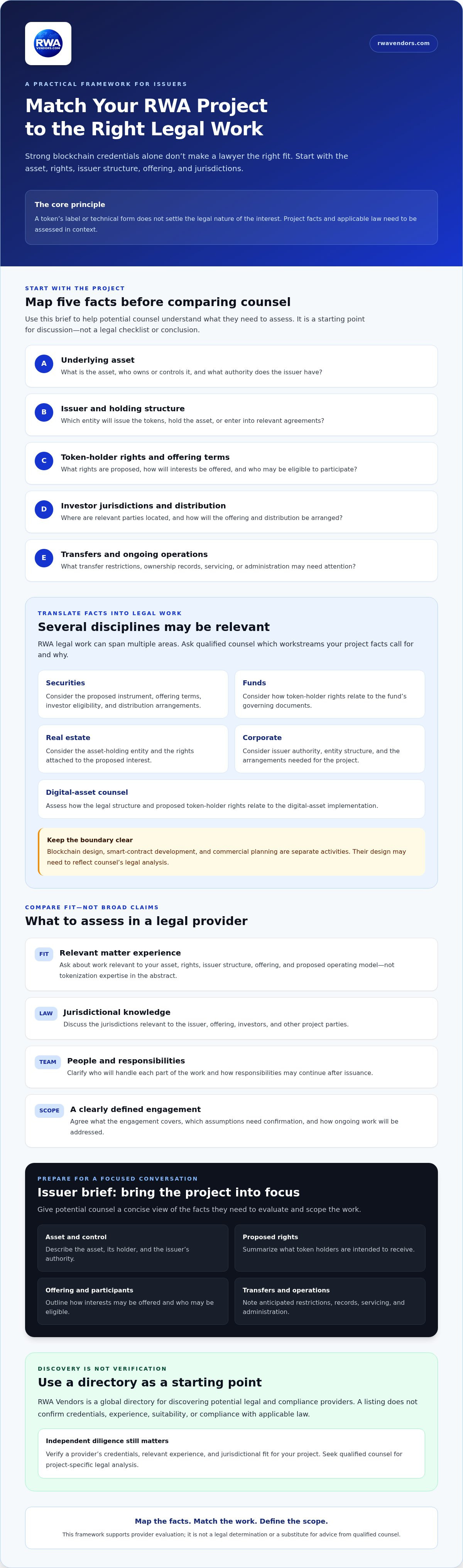
Before engaging counsel, organize the facts they’ll need to evaluate:
- Asset and issuer: What is the asset, who holds it, and what authority does the issuer have?
- Offering and holders: What rights are proposed, who may be eligible, and how will interests be offered?
- Transfers and servicing: What restrictions, recordkeeping arrangements, and ongoing services are contemplated?
This outline helps separate legal analysis from technology implementation and commercial planning. For example, a technical transfer function can’t establish whether a transfer is permitted under governing documents or applicable law. Ask counsel to identify the legal assumptions that technology and operations teams need to account for.
Which jurisdictional questions should counsel address?
Work with counsel to map the locations relevant to the project, including those of the issuer, asset, intended investors, intermediaries, and planned distribution. Ask which securities, financial-services, and consumer-protection rules may be relevant, and request confirmation of current laws and guidance for each applicable jurisdiction. Don’t assume that an analysis for one jurisdiction settles the treatment elsewhere. The guide to regulatory compliance in asset tokenization can provide broader context, while counsel should confirm how current requirements apply to your project.
For firms seeking visibility among issuers researching potential providers, review directory listing options. For issuers, a directory profile is a discovery point only. Independently verify each provider’s credentials, jurisdictional experience, and proposed scope before deciding whether to engage.
How to Compare RWA Legal Service Providers for Your Project
Compare candidates against the legal work your project actually requires, not the breadth of their marketing language. Provider fit depends on demonstrated relevance to the project’s defined legal workstreams. Apply the same criteria to each candidate, then verify the evidence independently.
| Comparison area | What to assess |
|---|---|
| Jurisdictional fit | Which jurisdictions can the proposed team cover, and where would local counsel be needed? |
| Relevant matters | Can the provider describe comparable work involving your asset type, issuer structure, or offering needs? |
| Service scope | Which legal analyses and deliverables are included, and what is excluded? |
| Team | Who will lead and perform the work, and what experience does each person bring? |
| Conflicts and coordination | How will the firm identify conflicts and coordinate with your other advisers? |
What evidence should an issuer request from prospective counsel?
Ask for examples of comparable matters, and distinguish public descriptions from references you can verify. Confirm who will lead the work, which jurisdictions the team can cover, and whether additional counsel may be needed. Ask how the firm handles conflicts, protects confidential information, and responds if the project changes. Verify credentials and references independently. A profile or general claim isn’t proof of relevant experience.
Legal counsel may coordinate with tax, compliance, custody, and technology advisers, but those roles aren’t interchangeable. Clarify who owns each workstream and how legal conclusions will reach the implementation teams. For technical context, consult the guide to digital asset infrastructure providers alongside your legal assessment.
How should legal scope and fees be compared?
Request a written proposal that identifies deliverables, assumptions, exclusions, dependencies, and the jurisdictions covered. Compare fee structures only after confirming the proposals cover comparable work. A lower or higher fee alone doesn’t establish quality or fit. Check how additional work will be approved and billed if the structure, offering, or distribution plan changes.
Evaluate RWA legal service providers on both capability and clarity of engagement. A well-defined scope shows what advice you’ll receive, what remains outside the mandate, and where separate specialists may be needed.
How to Run Due Diligence and Engage Tokenization Counsel
A disciplined engagement starts before the first legal opinion. Describe the project’s current design, identify what remains undecided, and look for counsel whose experience matches the work. Then verify the team, agree on scope, and keep a record of advice and decisions. This process helps issuers compare RWA legal service providers on project fit rather than visibility alone.
- Define the project. Document the asset, proposed token-holder rights, issuer structure, planned distribution, intended investors, relevant jurisdictions, and launch assumptions.
- Shortlist potential counsel. Use your required legal workstreams and jurisdictional needs to identify providers for further review.
- Verify fit. Independently confirm relevant experience, credentials, team responsibilities, references, and conflicts.
- Scope the engagement. Review the written engagement terms, deliverables, assumptions, exclusions, and dependencies with qualified advisers before relying on the proposed work.
- Document decisions. Record advice received, open questions, approvals, and the assumptions behind material project choices.
What should the initial counsel brief contain?
Give prospective counsel a focused, factual summary. Describe asset ownership and available documentation, the rights intended for token holders, the issuer and any proposed holding structure, and the project’s objectives. Include anticipated investor types, distribution channels, counterparties, and jurisdictions connected to the issuer, asset, investors, or planned distribution. Mark assumptions and unresolved points clearly. Ask counsel to identify missing information and explain which conclusions depend on it.
How can teams manage legal work after engagement?
Agree with counsel on decision owners, review milestones, document-version controls, and escalation paths at the outset. Establish how advice and deliverables will be recorded, and who must review changes before implementation. Ask counsel which changes to the asset, proposed rights, issuer structure, or distribution plan should trigger renewed legal analysis. A tokenization due-diligence checklist can help teams track workstreams, but it doesn’t replace project-specific legal review.
Before acting on advice or signing engagement terms, have the appropriate decision-makers review the scope, conflicts process, assumptions, and deliverables. Keep legal conclusions distinct from operational or technical decisions, and return to counsel when material project facts change.
Find RWA Legal Service Providers Through a Directory: Then Verify Fit
A specialized directory gives issuers a structured place to discover potential RWA legal service providers without treating provider search as a legal conclusion. RWA Vendors is a global directory connecting businesses with providers across tokenized capital markets, including legal and compliance categories. Issuers can browse and filter providers, then compare profiles against their project brief and the jurisdictions they need assessed.
A directory listing is a discovery starting point, not legal advice, a suitability guarantee, or evidence that an offering complies. Treat profile details as leads for direct follow-up. Independently verify provider credentials, jurisdictional coverage, representative matters, and regulatory experience.
What can a legal-provider directory help an issuer do?
Use legal and compliance categories to build an initial candidate list, then narrow it by your project’s defined workstreams. A profile may help you identify a provider to assess, but it can’t establish that the provider has the right experience for your asset, issuer structure, or distribution plan. Confirm relevant matters and credentials directly, request references where appropriate, and ask which jurisdictions the proposed team can cover.
During diligence, clarify potential conflicts, who will perform the work, confidentiality arrangements, and the engagement scope. Compare the answers with your project brief instead of relying on broad marketing descriptions. A strong match is one that can explain how its experience relates to the specific legal questions you need addressed.
When should an issuer contact a potential provider?
Contact candidates when you can summarize the asset, proposed token-holder rights, issuer structure, intended distribution, relevant jurisdictions, unresolved questions, and expected deliverables. This gives providers a clearer basis for discussing fit and scope. You don’t need every project decision finalized, but separate established facts from working assumptions so prospective counsel can identify information gaps.
Share only information appropriate for an initial discussion. Before disclosing sensitive materials, ask about confidentiality protections and agree on suitable arrangements. Then confirm the proposed engagement terms, conflicts process, deliverables, assumptions, exclusions, and fees directly with the provider. Have qualified counsel review legal advice and engagement terms before relying on them.
For issuers, a directory supports discovery and comparison, while the project team remains responsible for selecting and verifying counsel. For legal providers seeking visibility among businesses researching tokenization services, RWA Vendors offers directory listings as part of its provider marketplace.
Build Your Tokenization Project on a Clear Legal Foundation
Choosing RWA legal service providers starts with the project facts: the asset, proposed rights, issuer structure, distribution plan, and relevant jurisdictions. Use those details to define the legal workstreams, then compare counsel on verifiable experience, jurisdictional fit, and a written scope. Continue reviewing the work after engagement, especially when material project assumptions change.
RWA Vendors’ global tokenization ecosystem directory includes legal and compliance providers, alongside custody, trading, infrastructure, and payment categories. It helps businesses discover potential providers across the ecosystem. Treat directory profiles as a starting point for independent diligence, not legal advice, an endorsement, or confirmation that a provider is suitable for your needs.
For legal providers seeking visibility among businesses exploring tokenization services, consider requesting a directory listing.
With a focused scope and careful verification, you can make a more informed decision about finding and engaging counsel.
Frequently Asked Questions
What does an RWA legal service provider do?
An RWA legal service provider is external counsel that advises on legal questions connected with representing real-world assets through digital tokens. Depending on the engagement, work may cover asset rights, issuer structure, offering documents, distribution, transfers, and ongoing obligations. The scope depends on the project and jurisdictions involved. Confirm the provider’s qualifications, relevant experience, conflicts, and deliverables directly. A directory profile can help with discovery, but it isn’t legal advice or a guarantee of fit.
Do tokenized real-world assets automatically qualify as securities?
No. Tokenization alone doesn’t determine whether an interest is legally treated as a security. The analysis may depend on the rights represented, the overall arrangement, the parties involved, and applicable jurisdictional rules. Don’t rely on a token’s label or technical design as its legal classification. Ask qualified counsel to assess the specific asset, offering, and distribution plan, and to verify current requirements before making decisions or marketing an issuance.
Which legal requirements apply to asset tokenization?
Requirements depend on the project structure and relevant jurisdictions, so no single checklist applies to every issuance. Counsel may assess asset ownership and transfer, issuer authority, investor-facing terms, offering and distribution rules, intermediary roles, disclosures, and ongoing administration. Some topics may not apply to a particular project, while others may need further analysis. Prepare a clear description of the asset, proposed rights, counterparties, and distribution plan, then ask qualified counsel to identify applicable requirements.
How do I choose legal counsel for an RWA tokenization project?
Start by documenting the asset, proposed token-holder rights, intended offering, and relevant jurisdictions. Compare RWA legal service providers on relevant experience, jurisdictional coverage, the named team, written scope, conflicts process, and references. Verify credentials and experience claims independently. Before engagement, request clear deliverables, assumptions, and exclusions, and confirm who will advise on each jurisdiction. A directory can help you identify potential candidates, but it can’t determine whether a provider is suitable for your project.
Can one law firm cover every jurisdiction in an RWA offering?
Don’t assume one firm has the authorization, expertise, or capacity to cover every jurisdiction relevant to an offering. Ask each candidate to specify which jurisdictions and workstreams its team can handle, and whether qualified local counsel may be needed. Map where the issuer, asset, investors, intermediaries, and distribution activities are situated with legal advisers. Confirm responsibilities, communication arrangements, and jurisdictional scope in the engagement documentation before work begins.
What should I ask an RWA legal provider before signing an engagement?
Ask who will lead the work, which jurisdictions and legal questions are in scope, and what deliverables, assumptions, and exclusions apply. Clarify how conflicts and confidential information will be handled, how project changes may affect scope, and how fees and timelines are documented. Request examples of relevant experience and references you can verify appropriately. Review the written agreement carefully, and seek independent legal review where appropriate before relying on its terms.
Is a directory listing enough to verify an RWA legal provider?
No. A directory listing can help identify potential providers, but it doesn’t establish that one is suitable for your project or replace independent diligence. Verify credentials, relevant experience, jurisdictional coverage, references, conflicts, and proposed scope directly with the provider. Ask how the team would address your project’s specific facts and changing assumptions. RWA Vendors is a provider directory, not a law firm or legal adviser, and its listings aren’t legal advice or a suitability guarantee.
Disclaimer
This article is provided by RWAVendors.com for general informational and educational purposes only. It does not constitute legal, financial, investment, tax, regulatory or other professional advice, or an offer, solicitation, recommendation or endorsement of any company, product, service, token, security or investment. RWAVendors.com is an informational vendor directory and does not sell, issue, broker, custody or facilitate transactions involving cryptocurrencies, digital tokens, tokenized assets, securities or investment products. Some vendor listings and references may involve paid advertising, sponsored placement or membership relationships. These relationships do not guarantee a vendor’s qualifications, regulatory status, performance or suitability. Information may be incomplete, outdated or subject to change. You should independently verify all information, conduct your own due diligence and consult qualified professionals before making any business or investment decision. RWAVendors.com is not responsible for the content, services, representations or actions of third-party vendors or linked websites.


