
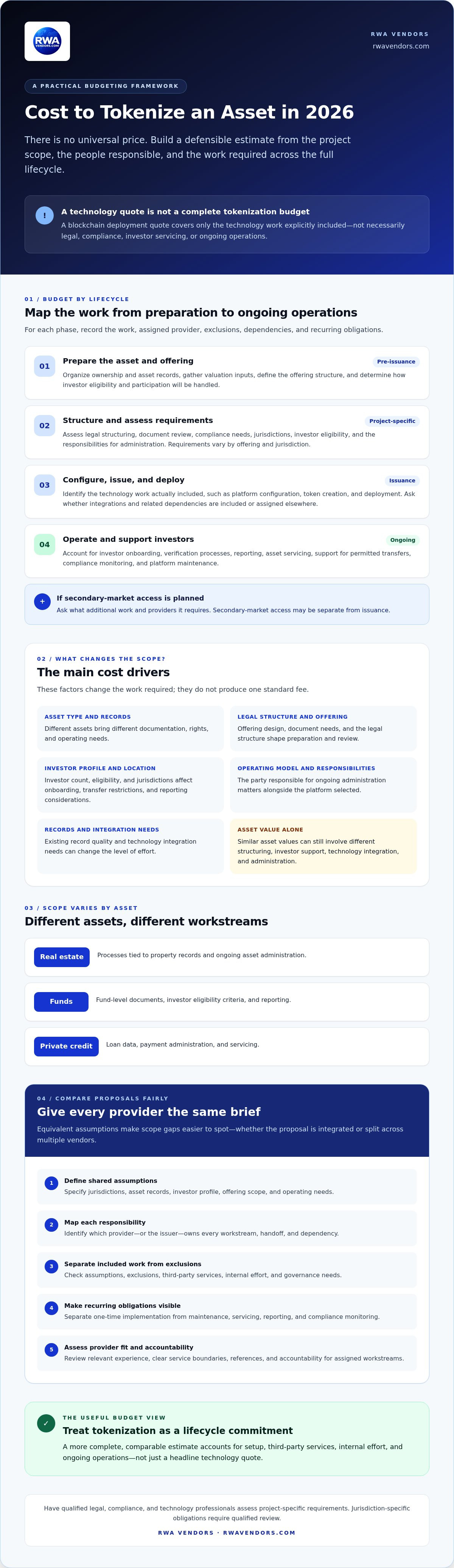
A technology quote is not a tokenization budget. The cost to tokenize an asset 2026 depends on the work required to structure the offering, assess applicable compliance needs, build or configure technology, and support investors over time. A single benchmark can be misleading because it may leave out assumptions, exclusions, and ongoing obligations.
A defensible budget starts with scope, not a universal price. This guide breaks down the cost categories to assess, explains why projects can require different levels of work, and shows how to compare integrated and multi-vendor proposals on equivalent terms. It also covers recurring needs, such as platform maintenance, investor servicing, and compliance monitoring, that may sit outside an initial quote.
Use the practical framework below to map each workstream to a provider, spot gaps between proposals, and prepare informed questions for qualified legal, compliance, and technology professionals. The goal is a more complete, comparable estimate that treats tokenization as a lifecycle commitment rather than a one-time technology purchase.
Key Takeaways
- Build your budget around the full tokenization lifecycle, including setup, third-party services, internal effort, and ongoing operations.
- The cost to tokenize an asset 2026 depends on factors such as asset type, legal structure, investor scope, and operating model.
- Compare integrated and multi-vendor proposals by mapping responsibilities, included work, exclusions, and recurring obligations.
- Give providers the same assumptions about jurisdictions, asset records, investor profile, and operating needs so their proposals are easier to compare.
- Assess providers by relevant experience, clear service boundaries, references, and accountability for their assigned workstreams.
Cost to tokenize an asset in 2026: why there is no single reliable price
The cost to tokenize an asset 2026 is best understood as the cost of a defined project scope, not a standard fee for putting an asset on a blockchain. A useful estimate accounts for preparation, third-party services, issuance and deployment, and the work required to operate the offering afterward. The scope depends on the asset, its legal structure, investor eligibility, and the issuer’s operating model.
A blockchain deployment quote is not a complete project budget. It covers only the technology work explicitly included, not necessarily the legal, compliance, servicing, or operating obligations around it.
What does an asset-tokenization estimate include?
Map the estimate across the project lifecycle. Preparation may involve organizing asset records and defining the offering structure. Issuance can include technology configuration, token creation, and deployment. Investor onboarding and post-issuance operations may require verification processes, reporting, asset servicing, and support for permitted transfers. If secondary-market access is part of the plan, ask what work and providers it requires. It may be separate from issuance.
Proposals often cover different parts of this work. A technology provider’s quote may exclude legal review, compliance functions, custody, or distribution. Ask providers to state inclusions, exclusions, assumptions, dependencies, and recurring obligations. For a general overview of the concept, see Asset Tokenization. A reference overview cannot replace project-specific scoping.
Why do estimates differ between projects?
Asset classes bring different documentation and operating needs. A real estate offering may require processes tied to property records and ongoing asset administration. A fund may involve fund-level documents, investor eligibility criteria, and reporting. Private credit can require attention to loan data, payment administration, and servicing. Each asset type has its own records, rights, and operational requirements, so the work is not simply interchangeable between projects.
Investor count and location can also affect the work. A defined investor group in one jurisdiction may involve different onboarding, transfer restrictions, and reporting considerations from a broader, multi-jurisdiction offering. The legal structure and the party responsible for ongoing administration matter as much as the platform selected. Have qualified professionals assess jurisdiction-specific requirements.
Asset value alone does not establish the cost of tokenization. Two offerings with similar values can require different levels of structuring, investor support, technology integration, and continuing administration. Separate one-time implementation from recurring needs such as reporting, servicing, compliance monitoring, and technology maintenance. That gives issuers a more useful basis for comparing proposals than a headline quote.
The main cost drivers across an asset-tokenization lifecycle
A useful budget separates workstreams and identifies who is responsible for each one. The cost to tokenize an asset 2026 reflects more than provider fees. It can also involve issuer staff time, governance, due diligence, and third-party expenses. A proposal may look comprehensive while leaving important activities to the issuer or another provider.
Which pre-issuance workstreams shape the budget?
Before issuance, assess what needs to happen to prepare the asset and offering. Work may include organizing ownership and asset records, gathering valuation inputs, preparing documents, and deciding how investor eligibility and participation will be handled. The effort depends on the quality of the existing records, the offering design, and the jurisdictions involved.
Legal structuring, document review, and compliance analysis are project-specific professional work. Requirements differ by offering and jurisdiction, so issuers should have qualified counsel assess applicable obligations. The European Parliament on Digital Finance provides broader context on digital-asset policy and regulatory frameworks. For a deeper discussion of issuer-side considerations, see this compliant asset tokenization guide.
Investor onboarding can create additional dependencies. The chosen process may determine what information needs to be collected, how it is reviewed, and which technology or service providers need to coordinate. List these responsibilities in the scope rather than assuming they are covered by the platform.
Which launch and post-launch activities should be scoped?
At launch, identify the technology work required by the selected architecture, such as token development or configuration, testing, deployment, and integration with relevant systems. Clarify who handles each step, what testing is included, and whether changes or additional integrations fall outside the proposal.
Issuance is not the end of the work. The operating plan may need to assign responsibility for:
- Administration: maintaining issuance records and coordinating relevant processes.
- Investor communications and reporting: preparing and distributing updates that meet the offering’s needs.
- Transfers and servicing: defining how permitted transfers and asset-related administration will be handled.
- Technology operations: addressing maintenance, updates, and ongoing support requirements.
Budget for custody, servicing, or trading arrangements when the project model requires them. Do not assume they are automatic parts of every tokenization effort. Map each need to a responsible party, then separate external fees from internal oversight and coordination. Providers supporting these workstreams can submit a tokenization vendor listing so issuers can discover providers by category.
How asset type and delivery model change tokenization costs
The cost to tokenize an asset 2026 depends on the work an offering requires, not just its asset category or headline value. Use the comparison below to identify questions for scoping. These examples are illustrative, not statements of universal legal or technology requirements.
How do real estate, funds, and private credit differ?
| Asset type | Legal complexity to assess | Investor scope | Servicing and reporting | Likely workstreams |
|---|---|---|---|---|
| Real estate | Ownership evidence, holding structure, and offering documents | Eligibility criteria and transfer controls | Property-related records, income or expense updates, investor reporting | Asset records, structuring, valuation inputs, issuance, administration |
| Funds | Fund structure, governing documents, and investor records | Subscription processes and investor eligibility | Fund administration, capital activity, periodic reporting | Legal review, investor onboarding, recordkeeping, reporting integrations |
| Private credit | Loan documentation, rights, and payment arrangements | Investor qualification and permitted transfers | Payment tracking, loan-level data, portfolio updates | Data preparation, servicing coordination, reporting, transfer processes |
A fund structure, for example, may call for distinct administration and investor-record processes, while a property-backed offering may place more emphasis on ownership evidence and asset-level reporting. The right scope depends on the specific structure, records, investor profile, and operating plan. For a broader overview of provider categories, consult the institutional digital asset infrastructure guide.
Integrated provider or coordinated vendor stack?
An integrated provider may coordinate several activities through one engagement. That can simplify identifying points of contact, but issuers still need to check which services are included, which are delivered by partners, and where responsibility sits. A multi-vendor model lets an issuer select specialists for defined workstreams, while requiring more coordination of interfaces, schedules, and handoffs.
Compare models by deliverables, not marketing language or headline quotes. Ask how systems interoperate, what happens if a provider changes, and who resolves dependencies between teams. A simple responsibility matrix can expose gaps before contracting:
- Legal structure and documents: name the responsible legal provider and issuer approver.
- Technology, testing, and deployment: identify the platform provider, technical owner, and person responsible for acceptance.
- Onboarding, records, and reporting: assign operational ownership and identify data dependencies.
- Custody, servicing, or trading: include these only where the project model requires them, and name the accountable provider.
Use the same matrix and assumptions for each proposal. Clear accountability, continuity planning, and defined interfaces make scopes easier to compare, whether one provider coordinates the work or several specialists deliver it.
How to estimate and compare tokenization proposals in 2026
To estimate the cost to tokenize an asset 2026, give each provider the same project brief and compare the work they have actually agreed to deliver. A lower headline quote may reflect a narrower scope, while a broader proposal may include work another vendor prices separately. Align assumptions before comparing totals.
What should an issuer include in a request for proposal?
Start with a shared assumptions sheet. State the asset type, proposed ownership structure, intended issuance model, target investor profile, relevant jurisdictions, available asset records, and desired operating model. Mark unresolved items clearly so providers do not make different assumptions.
Then ask each provider to respond against the same workstreams. For every deliverable, request the responsible party, dependencies, exclusions, estimated timeline, and whether the work is one-time or recurring. Ask which ongoing services are optional, required for the proposed model, or supplied by another party. This makes gaps visible before you assess proposals side by side.
Use a comparison grid to separate quoted deliverables, pass-through expenses, issuer responsibilities, third-party dependencies, and recurring commitments. Keeping these categories distinct helps prevent a complete-looking quote from obscuring costs or work outside the provider’s scope.
Which questions expose gaps between proposals?
Use specific questions to test service boundaries and operating assumptions:
- Legal and compliance: Is legal review included, and which compliance workflows are covered? Which jurisdiction assumptions need confirmation with qualified counsel?
- Investor operations: Does the scope include investor onboarding, communications, records, and reporting? Who owns each activity?
- Custody and related services: Are custody, servicing, or trading arrangements included, handled by a separate provider, or outside the project model?
- Technology: Which architecture, integrations, testing, and deployment tasks are assumed? Are security testing, maintenance, and support included, and who is responsible?
- Dependencies and changes: What information or decisions must the issuer provide, and how will changes to assumptions or scope be handled?
Ask providers to identify items that need independent professional advice. Do not treat a proposal as confirmation that the offering meets applicable requirements. For a fair comparison, resolve major differences in assumptions first, then assess deliverables, accountability, and ongoing obligations. This gives decision-makers a defensible basis for choosing providers by project fit rather than headline figure alone.
Find tokenization providers that match your project scope
A scoped budget turns a broad tokenization plan into a more practical provider search. Rather than expecting one vendor to cover every need, identify the workstreams your project requires, such as legal and compliance support, tokenization technology, infrastructure, custody, trading, or payments. Then assess provider fit against the responsibilities and dependencies in your project scope.
How can issuers assess provider fit beyond a proposal?
A polished proposal is a starting point, not a substitute for due diligence. Ask for references and examples of work involving comparable asset types, investor workflows, and operating requirements. Relevant experience should relate to the work you need, not just tokenization in general.
Clarify how the provider delivers each service. Ask which activities it performs directly and which rely on subcontractors, partners, or separate vendors. For every handoff, establish who owns coordination, approvals, and issue resolution. This matters when technology, compliance workflows, and ongoing asset administration need to work together.
Assess the operating relationship as well as the initial deliverables. Discuss governance, communication channels, escalation processes, security practices, and post-launch responsibilities. Confirm how maintenance, reporting, and other continuing needs are handled, and what falls outside the proposed scope. These questions help show whether a provider can support the project model you have budgeted for, without treating a proposal as a guarantee of outcomes or compliance.
Where can issuers discover providers by workstream?
RWA Vendors is a discovery directory connecting issuers with providers across tokenization technology and related service categories. Issuers can browse providers in areas including legal and compliance, custody, trading, blockchain infrastructure, and payments, then assess each independently against project requirements. The directory supports discovery and comparison. It does not tokenize assets or provide legal, financial, tax, investment, brokerage, or custody advice.
Use your scope and responsibility map to narrow the search. A project needing a defined technology provider and legal review has different discovery needs from one that also requires custody, payment infrastructure, or trading-related providers. Check relevant experience, service boundaries, references, and accountability directly with each prospective provider. A directory listing can help identify potential providers, but it does not replace issuer due diligence or qualified professional advice.
For vendors serving real-world asset issuers, a directory listing can help make the company discoverable to organizations searching by workstream. Details are available through the RWA Vendors listing page.
Build a tokenization budget you can defend
A reliable estimate starts with defined work, not a universal price. The cost to tokenize an asset 2026 depends on the asset, offering structure, investor scope, and operating model. Separate implementation from recurring administration, then compare proposals against the same assumptions, deliverables, exclusions, and responsibilities.
Use your budget to identify the provider categories your project needs, then assess each provider’s relevant experience, service boundaries, and accountability. RWA Vendors connects issuers with providers across tokenization workstreams through a global directory where users can browse and filter by category. It is a discovery resource, not a tokenization provider or professional adviser. Conduct your own due diligence and seek qualified advice where needed.
For vendors helping issuers with these workstreams, a clear directory presence can make the company easier to discover. Explore the RWA Vendors listing option.
A well-scoped estimate and a structured provider search give you a clearer basis for the next project decisions.
Frequently Asked Questions
How much does it cost to tokenize an asset in 2026?
There is no universal price for an asset-tokenization project. The cost to tokenize an asset 2026 depends on the defined scope, including asset preparation, legal structuring, compliance review, technology, issuance, investor onboarding, and ongoing operations. A technology quote alone may cover only part of the work. To develop a useful estimate, define the asset and offering, specify the jurisdictions and operating model, then request proposals using shared assumptions.
What factors have the biggest effect on asset-tokenization costs?
Major cost drivers include the work required to structure the offering, assess legal and compliance needs, configure technology, and operate the issuance. Scope can also change with the asset’s records, investor profile and eligibility, number of jurisdictions, transfer restrictions, and reporting and servicing needs. Ask providers to separate their fees from third-party expenses, issuer responsibilities, and recurring commitments so you can see what each proposal covers.
Does tokenizing real estate cost more than tokenizing a fund?
Not inherently. Either project could require more work depending on its structure and operating model. A real estate offering may require attention to ownership evidence, property records, and asset-level administration. A fund may need distinct fund administration and investor-record processes. These are illustrative considerations, not universal requirements. Compare the actual workstreams, investor needs, reporting expectations, and provider responsibilities rather than assuming one asset type is always less costly.
Are legal and compliance work included in a tokenization platform quote?
Not necessarily. A platform proposal may cover technology setup while excluding legal structuring, document review, compliance workflows, custody, or distribution. Ask for an itemized scope that identifies included deliverables, excluded work, dependencies, and services supplied by third parties. Have qualified legal and compliance professionals assess requirements applicable to your offering and jurisdictions. Do not treat a platform quote as confirmation that legal or compliance obligations are covered.
What ongoing costs should an issuer plan for after token issuance?
Plan for the operating work your offering requires after launch. This may include platform maintenance, technology updates, investor communications and recordkeeping, reporting, compliance monitoring, and asset servicing. Custody or trading arrangements may also matter for a particular project model. Confirm which activities recur, who is responsible, and whether they are included in a proposal or provided separately. A lifecycle budget should distinguish these commitments from one-time implementation work.
Can an issuer compare tokenization providers using the same project scope?
Yes. Give each provider the same assumptions sheet, including asset type, proposed ownership structure, jurisdictions, investor profile, available asset records, and target operations. Request deliverables, exclusions, dependencies, timelines, and responsibility owners for each workstream. Then compare quoted services, pass-through expenses, internal responsibilities, and recurring commitments separately. If proposals make different assumptions, clarify them before comparing totals. This helps reveal scope gaps without relying on headline quotes alone.
Does an asset need to be fully prepared before it can be tokenized?
Not always, but assess asset readiness early. Ownership evidence, asset records, valuation inputs, and supporting documents can affect project scope and the work needed before issuance. Identify missing or incomplete information, then ask providers and qualified professionals how those gaps affect their deliverables and dependencies. A readiness review helps establish a realistic sequence of work. It does not replace legal, financial, or other professional advice specific to the offering.
Disclaimer
This article is provided by RWAVendors.com for general informational and educational purposes only. It does not constitute legal, financial, investment, tax, regulatory or other professional advice, or an offer, solicitation, recommendation or endorsement of any company, product, service, token, security or investment. RWAVendors.com is an informational vendor directory and does not sell, issue, broker, custody or facilitate transactions involving cryptocurrencies, digital tokens, tokenized assets, securities or investment products. Some vendor listings and references may involve paid advertising, sponsored placement or membership relationships. These relationships do not guarantee a vendor’s qualifications, regulatory status, performance or suitability. Information may be incomplete, outdated or subject to change. You should independently verify all information, conduct your own due diligence and consult qualified professionals before making any business or investment decision. RWAVendors.com is not responsible for the content, services, representations or actions of third-party vendors or linked websites.


