
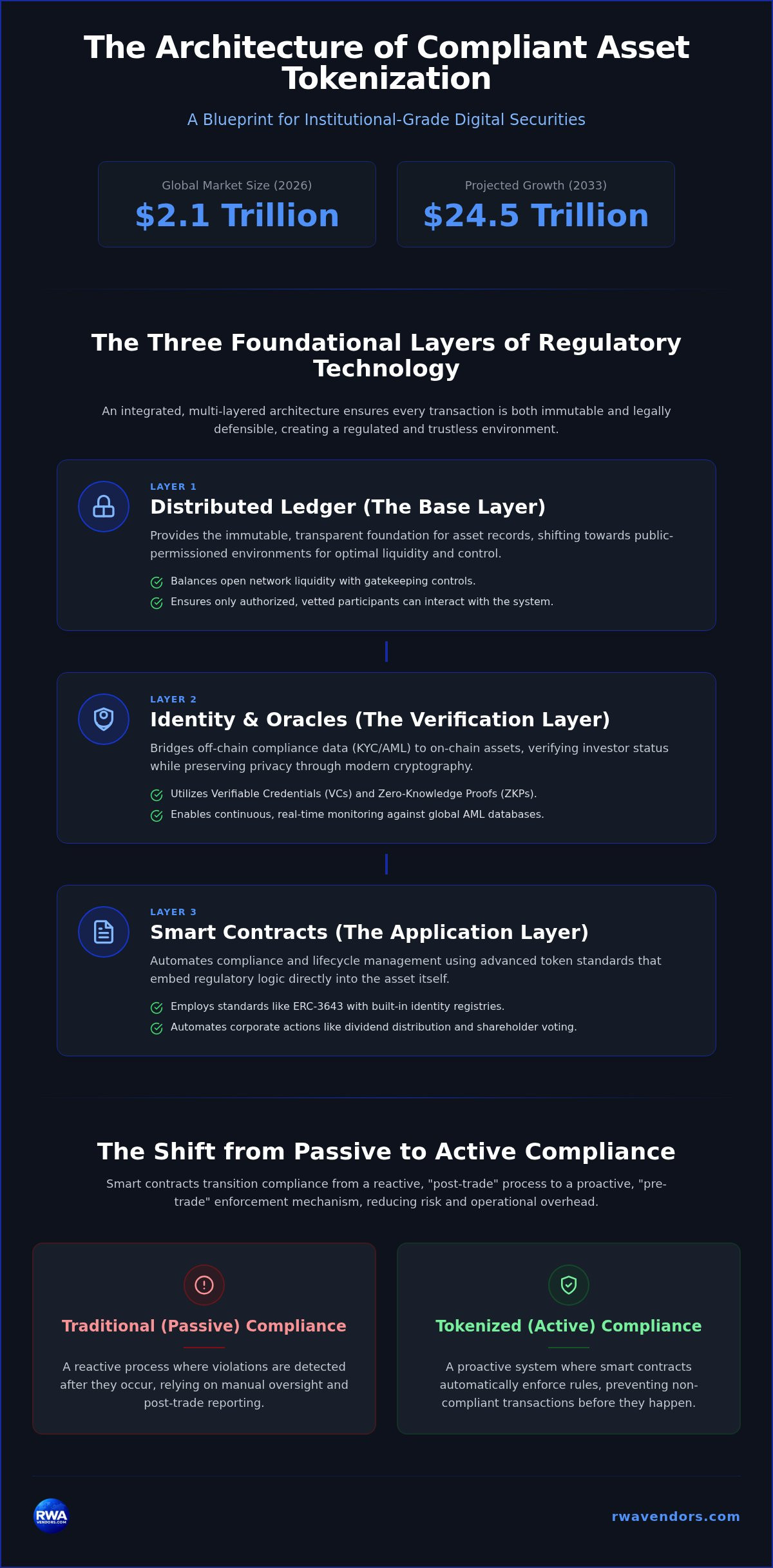
The global asset tokenization market has reached $2.1 trillion in 2026, marking a definitive shift from experimental pilots to full-scale production environments. You likely recognize that the projected growth to $24.5 trillion by 2033 depends entirely on the reliability of the underlying compliant asset tokenization tech. Integrating these systems across multi-jurisdictional frameworks is frequently a fragmented and costly process, often complicated by a lack of vetted infrastructure and the fear of regulatory non-compliance.
This guide provides a definitive blueprint for the architectural layers and regulatory requirements necessary to master the technology stacks powering this $30 trillion ecosystem. We'll examine the three foundational layers of institutional infrastructure, establish rigorous criteria for evaluating high-grade vendors, and explain how smart contracts automate complex compliance workflows. By the end of this resource, you'll have the framework needed to identify the right partners and deploy resilient, institutional-grade digital securities.
Key Takeaways
- Define the core architectural layers required to bridge distributed ledger technology with global securities laws.
- Identify specific requirements for institutional-grade digital identity and privacy layers within whitelisted environments.
- Evaluate compliant asset tokenization tech vendors using a standardized framework to ensure technical interoperability.
- Differentiate between automated compliance workflows for retail offerings and the rigorous oversight required for institutional private placements.
- Access a strategic blueprint for navigating the global ecosystem of verified service providers to accelerate transition to live production.
Defining the Compliant Asset Tokenization Technology Stack
With the global asset tokenization market valued at $2.1 trillion in 2026, the industry has moved beyond experimental testing into full-scale institutional production. Compliant asset tokenization tech refers to the integrated software and hardware systems used to issue, manage, and trade digital securities. This shift is evidenced by the Depository Trust & Clearing Corporation (DTCC) preparing for its commercial launch in October 2026. Unlike legacy systems, this technology provides a transparent, immutable record of ownership while maintaining strict regulatory boundaries.
Standard, permissionless blockchain infrastructure often fails to meet the rigorous demands of global capital markets. It doesn't offer the necessary controls for identity verification or transaction reversal. These frameworks are vital for the successful execution of Security Token Offerings (STOs), where the SEC's January 2026 clarification confirmed that tokenized assets remain subject to federal securities laws. The market's infrastructure must now account for these legal realities at the protocol level.
A compliant tech stack is the intersection of distributed ledger technology (DLT), sovereign identity management, and programmed legal logic.
The Core Components of a Regulated Stack
Building an institutional-grade environment requires three primary pillars. First, issuance platforms act as the engine for creating and distributing tokens to eligible investors. Second, identity and oracle layers bridge the gap between off-chain compliance data, such as KYC/AML status, and the on-chain assets. Finally, lifecycle management tools automate corporate actions like dividend distributions and shareholder voting. This integrated approach ensures the compliant asset tokenization tech remains functional throughout the entire duration of the asset's life.
The Shift from Passive to Active Compliance
Modern capital markets are transitioning from "post-trade" reporting to "pre-trade" prevention through Compliance-as-Code. In traditional systems, compliance is often a reactive process that occurs after a violation is detected. With sophisticated compliant asset tokenization tech, smart contracts enforce transfer restrictions in real-time. If an investor doesn't meet specific accreditation requirements, the protocol prevents the transaction from ever occurring. This active enforcement reduces the risk of regulatory friction and lowers the overhead associated with manual oversight, allowing for seamless scaling across multiple jurisdictions.
The Three Foundational Layers of Regulatory Technology
Institutional infrastructure for real-world assets requires a multi-layered approach to balance transparency with regulatory oversight. By 2026, the industry has standardized a three-tier architecture that ensures every transaction is both immutable and legally defensible. These layers interact to create a "Trustless" yet "Regulated" environment where participants don't need to trust each other, but can trust the verified logic of the system.
Layer 1 serves as the Distributed Ledger. While early experiments favored private permissioned chains, the market has shifted toward public-permissioned environments. These allow for the liquidity of open networks while maintaining gatekeeping controls at the validator or protocol level. This ensures that only authorized participants can interact with the underlying compliant asset tokenization tech.
The Identity Layer: KYC/AML for the Blockchain Era
Identity is the prerequisite for any regulated transaction. Modern stacks utilize Verifiable Credentials (VCs) and Soulbound Tokens (SBTs) to represent an investor's status on-chain without exposing sensitive personal data. This is often achieved through Zero-Knowledge Proofs (ZKP). ZKPs allow a protocol to verify that an investor is "accredited" or "non-sanctioned" without revealing their specific identity to the entire network. Real-time integration with global AML databases ensures continuous monitoring, replacing the static, one-time checks of the past. For a detailed checklist on legal structuring and identity requirements, the LSTA Guide to Asset Tokenization provides essential institutional context.
Smart Contract Standards: ERC-3643 and Beyond
Standard tokens like ERC-20 are insufficient for securities because they lack native transfer restrictions. Compliant asset tokenization tech now relies on advanced standards like ERC-3643, which features a built-in identity registry. This allows transfer agents to maintain an accurate, real-time cap table. The smart contract checks the identity registry before every transfer, ensuring that assets only move between verified wallets. This programmatic layer removes the need for manual trade approval, significantly reducing settlement times and operational risk.
Custody and Security: MPC vs. HSM
In 2026, institutional custody has evolved to handle high-frequency RWA trading through Multi-Party Computation (MPC). Unlike traditional private keys, MPC splits the signing authority among multiple parties, eliminating a single point of failure. While MPC is the standard for active trading, Hardware Security Modules (HSM) remain the preferred choice for long-term "cold" storage of the underlying physical or financial assets. If you are a provider offering these specialized security services, you can get listed in our global directory to reach institutional issuers looking for vetted infrastructure.
Institutional vs. Retail Compliance Frameworks
Compliance requirements diverge significantly based on the target investor profile. Private placements and public offerings demand different technical configurations within the compliant asset tokenization tech stack. While institutional tech prioritizes auditability, retail tech prioritizes accessibility. With North America holding a 38.4% revenue share of the asset tokenization market in 2025, US-specific regulatory frameworks often dictate the technical standards for these systems globally.
For institutional environments, the "Whitelisted Wallet" model is the standard. This architecture ensures that only pre-verified, institutional-grade wallets can hold or trade tokens. It creates a closed-loop ecosystem where every participant is known. Institutional frameworks often incorporate a higher degree of manual oversight for complex, high-value transactions to ensure rigorous adherence to internal risk protocols. In contrast, retail frameworks must handle fractional ownership at scale. This requires high-performance settlement layers capable of managing thousands of micro-transactions while maintaining automated compliance profiles for every fractional holder.
Accredited Investor Verification Tech
Verifying high-net-worth and sophisticated investors requires automated systems that integrate with global identity providers. These tools must manage complex geographic restrictions, such as the distinction between Regulation D and Regulation S in the United States. Automated workflows handle the periodic re-certification of investor status. It's essential that these systems ensure an investor remains "accredited" throughout the lifecycle of the asset. By integrating these workflows directly into the token holder portal, issuers reduce the administrative burden of manual compliance checks and ensure continuous eligibility.
Reporting and Auditability for Regulators
Transparency is a core requirement for modern compliant asset tokenization tech. Regulators now expect real-time access to ledger data via dedicated "regulatory nodes." These nodes provide a live view of transactions without compromising the privacy of individual participants. Smart contracts also automate tax reporting and withholding at the point of distribution. Issuers don't have to worry about manual tax calculations when these features are embedded in the protocol. The result is an immutable audit trail that traditional financial auditors can verify with surgical precision, bridging the gap between blockchain records and legacy accounting standards.
Strategic Vendor Due Diligence for Institutional Issuers
Selecting the right infrastructure is no longer just a technical decision; it's a critical risk management priority. Many early adopters now face the costly reality of "Vendor Lock-in," where proprietary protocols prevent the seamless migration of assets or data to alternative providers. To avoid this, institutional issuers must prioritize compliant asset tokenization tech that adheres to open standards. This ensures long-term flexibility as the $30 trillion ecosystem continues to mature and consolidate.
Interoperability is the benchmark for operational success in 2026. Your issuance engine must communicate directly with your chosen custody solution without manual intervention. If these systems are siloed, settlement risks and operational friction increase. Issuers should also assess the regulatory history of their infrastructure partners. Working with providers that have successfully navigated SEC audits or participated in the DTCC's 2026 production tests offers a level of security that unproven startups cannot match. Longevity and institutional backing are essential indicators of a vendor's ability to support an asset throughout its entire multi-decade lifecycle.
The Vetting Checklist: 5 Questions to Ask
To mitigate technical and legal risks, use this standardized framework during your evaluation process:
- Multi-chain deployment: Does the provider support deployment across different ledgers to future-proof the asset?
- Modular compliance: Is the compliance engine modular, allowing for updates as laws change, or is the logic hard-coded and static?
- Disaster recovery: What is the specific recovery plan for private key management if the vendor's primary infrastructure fails?
- System uptime: How does the vendor handle critical software updates without pausing secondary market trading?
- Regulatory integration: Does the platform provide native, real-time integration with regulatory reporting nodes for instant transparency?
Interoperability Standards in 2026
By 2026, the role of cross-chain communication protocols like CCIP has become central to the RWA ecosystem. These protocols allow tokenized securities to move between different blockchain environments while maintaining their compliance metadata. Standardizing data formats between platforms is now a requirement for institutional liquidity. Ensuring your tech stack can integrate with verified digital asset infrastructure providers is the only way to maintain a competitive edge in a global market. This connectivity allows for broader distribution and more efficient secondary market trading across diverse jurisdictions.
Navigating the Ecosystem: Finding Vetted Compliance Partners
Identifying reliable partners in a market flooded with thousands of emerging blockchain startups is a significant operational hurdle. For institutional issuers, the risk isn't just technical; it's reputational and legal. Relying on unvetted infrastructure can lead to integration failures and regulatory friction. This is why sophisticated market participants increasingly turn to curated ecosystems and industry foundations to anchor their compliant asset tokenization tech strategy. By utilizing a centralized resource, firms can move past the noise and focus on providers with a documented history of institutional engagement.
RWA Vendors serves as the primary tool for streamlining this discovery process. As the infrastructure directory arm of the Security Token Offering Foundation, which has been active since 2017, it provides a structured taxonomy of the global landscape. This organization doesn't just list companies; it categorizes them by their specific role in the capital markets lifecycle, from legal counsel to digital custody providers. This methodical organization allows issuers to build a stack that is both resilient and legally defensible.
Leveraging the RWA Vendor Directory
The directory allows users to filter providers with surgical precision. You can segment search results by critical categories such as Infrastructure, Custody, Legal, and Trading. The "Vetted" status within the directory is a vital tool for reducing initial due diligence overhead. It indicates that a provider has undergone a verification process regarding their services and market standing. Prioritizing partners who are members of the Security Token Offering Foundation ensures that your compliant asset tokenization tech stack is built on a foundation of industry-standard best practices and shared regulatory understanding.
Building Your Ecosystem Strategy
Modern tokenization projects have moved away from the "all-in-one" single-vendor model. Today's successful issuers build a strategic partner network, selecting "best-of-breed" components for each layer of their stack. This modular approach prevents vendor lock-in and allows for greater technical resilience. You can use RWA Vendors to identify specific tokenization service providers that specialize in your asset class, whether it's real estate, private credit, or sovereign debt. Connecting with founding members and industry leaders who have already navigated the complexities of live production is the most efficient path to market. Building these relationships early ensures that your infrastructure can scale as the global tokenized asset market expands toward its multi-trillion dollar potential.
Scaling Institutional-Grade Asset Tokenization
The transition from experimental pilots to a $2.1 trillion production environment in 2026 underscores the necessity of a robust, modular infrastructure. Success in this landscape requires more than just blockchain adoption; it demands an integrated approach where identity, legal logic, and settlement layers function as a single, cohesive unit. By prioritizing interoperability and selecting compliant asset tokenization tech that adheres to global standards, issuers can effectively mitigate the risks of vendor lock-in and regulatory friction.
RWA Vendors remains the central pillar for this evolution. Operated by the Security Token Offering Foundation since 2017, our platform serves as a verified global directory for institutional-grade providers. We've been connecting issuers with vetted infrastructure since 2018, ensuring that participants in our ecosystem meet the highest standards of professional excellence.
The path to a $30 trillion ecosystem is built on these verified foundations. Establishing the right partnerships today ensures your infrastructure is prepared for the capital markets of tomorrow.
Frequently Asked Questions
What is compliant asset tokenization tech exactly?
Compliant asset tokenization tech refers to the integrated software and hardware systems used to issue, manage, and trade digital securities within established legal frameworks. It includes issuance engines, sovereign identity layers, and automated lifecycle management tools. Unlike standard blockchain technology, these systems embed regulatory restrictions directly into the protocol level. This ensures that every transaction is legally valid and that ownership records remain accurate and immutable across the entire lifecycle of the asset.
How do smart contracts handle regulatory compliance automatically?
Smart contracts act as programmable enforcement agents that verify transaction parameters against a decentralized identity registry before execution. If a potential buyer isn't on the approved whitelist or exceeds specific holding limits, the contract automatically prevents the transfer. This "pre-trade" prevention replaces traditional, reactive post-trade reporting. It ensures the asset remains in compliance with jurisdictional laws in real-time without the need for constant manual oversight or administrative intervention.
Can I tokenize assets without a specialized technology vendor?
While building an in-house stack is technically possible, it's rarely feasible for institutional issuers due to the immense complexity of maintaining 2026 security and interoperability standards. Specialized vendors provide audited code, regulatory connectors, and established custody integrations that have already been vetted. Attempting to build without these experts often leads to significant technical debt and increased liability if the internal logic fails to correctly enforce securities laws or identity requirements.
What are the risks of using non-compliant tokenization platforms?
Using non-compliant platforms exposes issuers to severe legal penalties, including regulatory fines and the potential rescission of the entire offering. Beyond legal consequences, these platforms often lack institutional-grade security protocols, increasing the risk of asset loss or theft. Additionally, non-compliant assets are typically excluded from institutional secondary market liquidity. Regulated exchanges and sophisticated buyers won't interact with infrastructure that hasn't undergone rigorous technical and legal verification.
How does MiCA impact the technology stack for European RWA projects?
MiCA requires European projects to implement specific transparency, reporting, and asset-safekeeping standards across the EU Single Market. The technology stack must support detailed whitepaper disclosures and provide real-time data access for regulator oversight. Issuers must ensure their compliant asset tokenization tech supports the specific asset-referenced token requirements outlined in the regulation. This ensures legal compliance while maintaining the high standards of investor protection required by the European Securities and Markets Authority.
What is the difference between a white-label platform and a custom stack?
A white-label platform is a pre-configured solution that allows for rapid deployment using standardized features and compliance logic. It's often a cost-effective choice for smaller or more standard offerings. A custom stack involves integrating specific, best-of-breed components for issuance, identity, and custody layers. Institutional issuers frequently prefer this modular approach to avoid vendor lock-in and to ensure the infrastructure aligns perfectly with complex, multi-jurisdictional private placement requirements.
How often do compliance rules in smart contracts need to be updated?
Compliance rules must be updated whenever the underlying legal framework changes or when an asset transitions through different lifecycle stages, such as the end of a lock-up period. Modular compliant asset tokenization tech allows for these updates through administrative functions without requiring a total token migration or reissuance. Issuers should conduct regular technical audits to ensure the programmed logic remains perfectly aligned with current jurisdictional requirements and internal risk management protocols.
Where can I find a list of vetted tokenization technology providers?
You can discover a comprehensive list of verified providers through the RWA Vendors global directory. Operated by the Security Token Offering Foundation since 2017, our marketplace connects asset issuers with vetted technology, legal, and compliance partners. The directory allows you to filter by specific categories, such as infrastructure or custody, ensuring you find institutional-grade vendors that have already been curated for their reliability, expertise, and commitment to maintaining the integrity of the ecosystem.
Disclaimer
This article is provided by RWAVendors.com for general informational and educational purposes only. It does not constitute legal, financial, investment, tax, regulatory or other professional advice, or an offer, solicitation, recommendation or endorsement of any company, product, service, token, security or investment. RWAVendors.com is an informational vendor directory and does not sell, issue, broker, custody or facilitate transactions involving cryptocurrencies, digital tokens, tokenized assets, securities or investment products. Some vendor listings and references may involve paid advertising, sponsored placement or membership relationships. These relationships do not guarantee a vendor’s qualifications, regulatory status, performance or suitability. Information may be incomplete, outdated or subject to change. You should independently verify all information, conduct your own due diligence and consult qualified professionals before making any business or investment decision. RWAVendors.com is not responsible for the content, services, representations or actions of third-party vendors or linked websites.


