
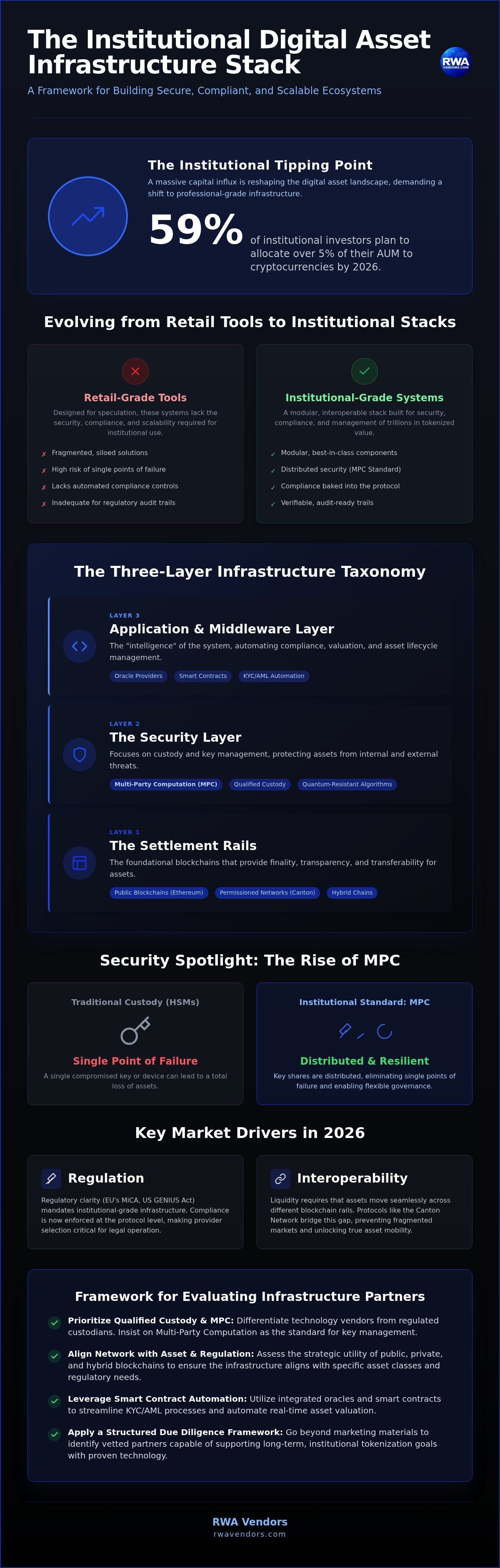
59% of institutional investors plan to allocate over 5% of their assets under management to cryptocurrencies in 2026, signaling a definitive move toward digital asset integration. This massive capital influx requires a shift from experimental silos to a modular, interoperable stack supported by verified digital asset infrastructure providers. As the EU's MiCA regulations and the US GENIUS Act establish strict new compliance boundaries, the risk of selecting non-compliant or retail-grade technology has never been higher for global firms.
You understand that a fragmented vendor landscape makes technical due diligence both difficult and critical for maintaining market integrity. This guide allows you to master the complex landscape of digital asset infrastructure and discover the vetted providers essential for institutional tokenization. We establish a clear taxonomy of the current infrastructure stack and provide a structured framework for evaluating long-term strategic partners. By the end of this guide, you'll have the confidence to build a secure, compliant, and scalable digital asset ecosystem.
Key Takeaways
- Differentiate between retail-grade tools and the professional-grade systems necessary for global financial compliance and institutional scale.
- Navigate the selection of digital asset infrastructure providers by prioritizing qualified custody solutions and the adoption of Multi-Party Computation (MPC) standards.
- Assess the strategic utility of public, private, and hybrid blockchain networks to ensure your infrastructure aligns with specific asset classes and regulatory requirements.
- Leverage smart contract automation and integrated oracle services to streamline KYC, AML, and real-time asset valuation processes.
- Apply a structured technical due diligence framework to identify vetted partners capable of supporting long-term institutional tokenization goals.
The Evolution of Digital Asset Infrastructure Providers
Digital asset infrastructure is the foundational technology enabling the issuance, storage, and transfer of tokenized securities. In the early stages of the market, participants relied on retail-grade tools designed for speculative trading. By 2026, the landscape has matured into a professional ecosystem of digital asset infrastructure providers that serve as the essential plumbing for global capital markets. This evolution reflects a shift from experimental silos toward robust, institutional-grade systems capable of handling trillions in tokenized value. Understanding What is a Digital Asset? provides the necessary context for why these specialized systems are now mandatory for risk management and legal compliance.
Modern institutions favor a modular stack over monolithic platforms. This modularity allows firms to select best-in-class components for specific functions, such as choosing one vendor for custody and another for secondary market connectivity. This approach mitigates vendor lock-in and ensures that each layer of the technology stack meets the rigorous standards of global regulators. The role of the infrastructure provider is now critical for regulatory compliance; they don't just provide software, they provide the verifiable audit trails and automated controls that satisfy institutional mandates.
The Three-Layer Infrastructure Taxonomy
To navigate this space, institutions must categorize digital asset infrastructure providers into three distinct layers:
- Layer 1: The Settlement Rails. This includes public blockchains like Ethereum and Polygon, alongside permissioned networks such as Canton or Hyperledger. These rails provide the finality and transparency required for asset transfer.
- Layer 2: The Security Layer. This layer focuses on custody and key management. Multi-Party Computation (MPC) has become the institutional standard, replacing traditional cold storage with more flexible, secure signing protocols.
- Layer 3: The Application & Middleware Layer. This layer contains the intelligence of the system. It includes oracle providers for real-time valuation and smart contracts that automate lifecycle management, ensuring compliance is baked into the asset itself.
Market Drivers in 2026: Interoperability and Regulation
Interoperability is no longer a luxury; it's a requirement for liquidity. Protocols like the Canton Network bridge the gap between disparate rails, allowing assets to move across the ecosystem without fragmented liquidity. Simultaneously, regulatory clarity has reshaped infrastructure design. With the EU's MiCA authorization deadline of July 1, 2026, having passed, providers must demonstrate full compliance with rigorous security mandates. Infrastructure is now the primary tool for enforcing these rules at the protocol level, ensuring that every transaction remains within legal bounds.
The Foundation: Institutional Custody and Wallet Technology
Secure custody is the primary barrier to institutional adoption. While early entrants focused on simple cold storage, modern digital asset infrastructure providers offer sophisticated technology stacks that separate the software layer from the regulated service layer. It's essential to distinguish between technology providers, who supply the software and security protocols, and qualified custodians, who provide the legal and fiduciary oversight required for institutional compliance. This distinction ensures that firms don't just have the tools to manage assets, but also the regulatory standing to do so on behalf of clients.
Multi-Party Computation (MPC) has emerged as the industry standard for key management. Unlike traditional Hardware Security Modules (HSMs) that rely on a single physical secure enclave, MPC distributes key shards across multiple parties. This eliminates the single point of failure risk and allows for more flexible governance policies. As NIST finalized its first post-quantum cryptography standards in August 2024, including FIPS 203 and 204, leading infrastructure providers are already integrating these quantum-resistant algorithms to protect against future decryption threats. Operational resiliency now requires this level of forward-thinking security architecture.
Custody Models: Direct vs. Sub-Custody
Institutions must decide whether to build an internal custody stack or leverage a third-party service. Direct custody offers maximum control but requires significant internal expertise and ongoing maintenance. Many banks and asset managers opt for a sub-custody model, where they use the technology of established digital asset custody providers while maintaining the primary client relationship. This model is particularly effective for Real-World Asset (RWA) tokenization, where the Qualified Custodian status is often a regulatory prerequisite for managing client funds under global frameworks.
Wallet-as-a-Service (WaaS) for Scaling
Scaling a tokenization project requires the ability to provision thousands of wallets for investors efficiently. Wallet-as-a-Service (WaaS) enables firms to deploy secure, investor-facing applications without building the underlying blockchain connectivity from scratch. However, this convenience necessitates a rigorous focus on Cybersecurity for Digital Assets, as software-based wallets must be hardened against sophisticated exploits. Organizations looking to showcase their institutional-grade security protocols can apply for a verified vendor listing to connect with asset issuers seeking secure infrastructure. Disaster recovery protocols must account for both technical failure and the loss of key shards, ensuring that assets remain accessible even in extreme market conditions.
The Network Layer: Private, Public, and Hybrid Blockchain Rails
The network layer serves as the actual transport mechanism for tokenized value. Digital asset infrastructure providers currently offer a spectrum of blockchain rails, ranging from permissionless public networks to highly controlled private environments. Selecting the appropriate rail depends on the specific asset class and the regulatory jurisdiction of the issuer. While public blockchains like Ethereum and Polygon provide unparalleled access to global liquidity, they often present challenges regarding transaction privacy and gas price volatility. These public rails are increasingly used for assets where transparency is a primary requirement for market trust.
Permissioned chains, such as Hyperledger Fabric or the Canton Network, address institutional concerns by restricting network access to verified participants. These networks allow for granular control over data visibility, ensuring that sensitive trade information remains confidential between transacting parties. Hybrid models are also gaining traction, utilizing zero-knowledge proofs to maintain privacy on-chain while relying on public networks for final settlement. This architectural choice is central to the design of modern blockchain settlement systems, which must balance transparency with professional confidentiality requirements.
Interoperability Protocols: Connecting Fragmented Liquidity
Liquidity fragmentation remains a significant hurdle in the 2026 market. Cross-chain communication standards enable "collateral mobility," allowing an institution to move tokenized assets between different networks without friction. The Canton Network stands as a primary example of this evolution. It creates a "network of networks" where traditional financial institutions can interact with decentralized applications while maintaining their own governance rules. This connectivity ensures that assets aren't trapped in technological silos, maximizing their utility as high-quality collateral across the global financial ecosystem. It's a bridge that allows TradFi systems to tap into DeFi liquidity pools safely.
Scalability and Finality in Capital Markets
In institutional finance, transaction finality is a more critical metric than raw transactions per second (TPS). A settlement system that processes 100,000 TPS is useless if a trade can be reversed or delayed by network congestion. Digital asset infrastructure providers prioritize "deterministic finality," ensuring that once a transaction is recorded, it's legally and technically irrevocable. Layer 2 solutions play a vital role here by batching transactions to reduce costs while inheriting the security of the underlying Layer 1 settlement rail. Institutions must conduct a cost-benefit analysis of these layers, weighing the immediate settlement speed against the long-term security and decentralization of the chosen network.
Middleware and Compliance: The Intelligence Layer of Tokenization
While custody and network rails provide the necessary foundation, the intelligence layer determines the operational success of tokenized assets. Digital asset infrastructure providers are increasingly focusing on the middleware that bridges on-chain assets with off-chain data. This layer manages the complex lifecycle of a security, from initial issuance to final redemption. It acts as the brain of the system, ensuring that every transaction adheres to the legal and financial logic required by institutional stakeholders.
Data Integrity and On-Chain Reporting
Real-world assets (RWAs) require constant valuation to maintain market trust. Unlike native cryptocurrencies, the value of a tokenized private equity fund or real estate parcel exists outside the blockchain. This is where digital asset oracle providers are indispensable. They feed Net Asset Value (NAV) data into smart contracts, ensuring the token price accurately reflects the underlying asset's current worth. High-fidelity data is the bedrock of blockchain reporting and accounting, which allows for real-time audits and transparent investor reporting. Institutions must balance this transparency with privacy; they need to ensure sensitive stakeholder data remains shielded while proving solvency and regulatory compliance to auditors.
Compliance-as-Code
Regulatory mandates like the EU's MiCA and the US GENIUS Act require rigorous, ongoing oversight. Modern compliant asset tokenization tech embeds these jurisdictional rules directly into the token's smart contract. This "compliance-as-code" approach enables dynamic white-listing, where tokens can only be transferred to verified, eligible wallets. If a user’s KYC status expires or a new sanction is issued, the smart contract automatically restricts secondary market trading. This level of automation reduces the administrative burden of KYC, AML, and tax reporting. It turns compliance from a manual bottleneck into a scalable competitive advantage.
Beyond compliance, the middleware layer handles essential corporate actions that were previously manual and error-prone. This includes automating dividend distributions, managing shareholder voting, and executing stock splits. By using verifiable credentials and decentralized identity frameworks, infrastructure providers ensure that only authorized participants interact with these functions. This creates a seamless management experience that mirrors traditional financial systems but operates with the efficiency and finality of blockchain technology. Digital asset infrastructure providers that offer these integrated lifecycle tools are becoming the preferred partners for global asset managers.
Strategic Selection: How to Evaluate Infrastructure Partners
Selecting digital asset infrastructure providers requires a shift from technical curiosity to rigorous procurement standards. Institutional stakeholders must evaluate potential partners based on their ability to integrate with existing legacy systems while maintaining the agility to support future technological shifts. The choice of a provider is a multi-year commitment that impacts every facet of the tokenization lifecycle; therefore, firms must prioritize vendors that demonstrate both technical excellence and long-term financial stability. A modular infrastructure design is essential to avoid vendor lock-in, allowing institutions to swap individual components of the stack as the market matures.
Technical teams must look beyond the marketing hype and focus on the provider’s track record in capital markets. It's better to choose a vendor with a deep understanding of financial regulations than one that only offers bleeding-edge features without a compliance framework. Evaluating the longevity of a partner involves reviewing their funding history, client roster, and commitment to maintaining industry-standard certifications. This grounded approach ensures that the chosen infrastructure can withstand market volatility and regulatory shifts over the next decade.
The Institutional Due Diligence Checklist
A comprehensive due diligence process ensures that selected technology meets global compliance and security mandates. Institutions should verify the following credentials during the selection phase:
- Regulatory licenses and SOC 2 Type II certifications to ensure operational security and data integrity.
- Robust API documentation that facilitates seamless integration with internal ERP and accounting systems.
- Native support for multi-chain and multi-asset strategies to prevent technological silos as new networks emerge.
- Proven disaster recovery protocols and documented uptime statistics to ensure continuous market access.
Leveraging the RWA Vendor Directory
Discovery in a fragmented market is often the most significant bottleneck for asset issuers. The RWA vendor directory serves as a centralized resource for identifying and vetting potential partners. By using this curated ecosystem, firms can bypass the noise of the retail market and connect directly with institutional-grade digital asset infrastructure providers that understand the high-stakes nature of global finance.
Look for Founding Members and established ecosystem partners within the directory. These entities often represent the vanguard of the industry and have already undergone preliminary vetting by The STO Foundation. Once you've identified a shortlist of providers, the next step is to initiate a controlled pilot launch. This phase allows you to test the infrastructure in a live environment with limited capital, ensuring the technology performs as expected before a full-scale rollout. This methodical approach minimizes operational risk and builds the necessary internal confidence for long-term digital asset strategies.
Building the Future of Tokenized Capital Markets
Institutional finance has moved beyond the experimental phase. It now demands a robust, modular stack that prioritizes security and regulatory compliance. Success in this landscape requires a deep understanding of how digital asset infrastructure providers facilitate the lifecycle of tokenized securities through MPC custody, hybrid settlement rails, and automated compliance. You shouldn't settle for retail-grade tools when the stability of global capital markets is at stake. By selecting partners that hold SOC 2 Type II certifications and demonstrate financial stability, firms can effectively mitigate the risks of a fragmented vendor market.
Professional discovery is the final step in moving from theoretical frameworks to live pilot launches. RWA Vendors serves as a global ecosystem for capital markets, offering a comprehensive directory of institutional-grade partners vetted by The STO Foundation. It's the most efficient way to bridge the gap between traditional structures and modern innovation while maintaining the integrity of your investment ecosystem.
Establishing a secure foundation today ensures your firm remains competitive as the global financial system continues its transition to on-chain settlement. Take the lead by engaging with partners who are already architecting the future of finance.
Frequently Asked Questions
What is the difference between a digital asset custodian and an infrastructure provider?
An infrastructure provider supplies the foundational technology, such as MPC protocols and API layers, while a custodian is the regulated entity that assumes legal responsibility for the assets. Digital asset infrastructure providers empower institutions to build internal systems or manage workflows, whereas custodians provide the fiduciary oversight required by law. It's vital to distinguish between the software developer and the regulated service provider when architecting your tokenization stack.
How do digital asset infrastructure providers ensure regulatory compliance?
Providers ensure compliance by embedding jurisdictional rules directly into smart contracts through "compliance-as-code." This includes automated KYC and AML verification that prevents unauthorized wallet addresses from interacting with tokenized securities. With the EU’s MiCA authorization deadline of July 1, 2026, having passed, authorized providers must also demonstrate adherence to strict security and capital requirements to operate legally within the European market.
Which blockchain is best for institutional real-world asset tokenization?
The optimal blockchain depends on your specific privacy and liquidity requirements. Public networks like Ethereum offer deep liquidity and broad interoperability, but many institutions prefer permissioned chains like the Canton Network for sensitive capital market transactions. These permissioned rails provide the data privacy and deterministic finality essential for regulated securities. Hybrid models are also popular, using public rails for settlement while maintaining sensitive data on private layers.
What are the key security risks when selecting an infrastructure partner?
Key risks include smart contract vulnerabilities, single points of failure in key management, and the emerging threat of quantum computing. Malicious actors may employ "harvest now, decrypt later" strategies, making the adoption of NIST post-quantum cryptography standards essential. Institutions must also evaluate the financial stability of their tech partners to avoid operational disruptions. Conducting thorough technical due diligence on digital asset infrastructure providers is the primary defense against these risks.
Can digital asset infrastructure integrate with existing legacy banking systems?
Modern infrastructure is designed to bridge the gap between distributed ledgers and legacy ERP or core banking systems. This integration typically occurs through robust RESTful APIs and specialized middleware that translates on-chain events into traditional ledger entries. This allows banks to maintain their existing accounting workflows while benefiting from the efficiency of tokenized asset management. Successful integration ensures that digital assets don't remain in technological silos.
How do oracle providers impact the valuation of tokenized real-world assets?
Oracle providers serve as the essential link between off-chain valuations and on-chain tokens. They provide verifiable data feeds for Net Asset Value (NAV), which is critical for assets like real estate or private funds where price isn't determined by a public exchange. Without reliable oracles, tokenized real-world assets cannot accurately reflect their underlying value, which undermines investor trust and market integrity in the digital securities ecosystem.
What is the role of MPC technology in institutional digital asset custody?
Multi-Party Computation (MPC) technology eliminates the risks associated with traditional private key storage by distributing key shards across multiple secure environments. This ensures that no single party can authorize a transaction, significantly reducing the threat of internal fraud or external hacks. MPC has become the institutional standard because it offers a superior balance of security and operational flexibility compared to legacy hardware security modules or cold storage solutions.
How should a firm begin the vendor selection process for tokenization?
A firm should begin by identifying its specific regulatory and technical requirements before browsing the RWA Vendor Directory to find vetted partners. This resource allows you to filter by category, ensuring you engage only with institutional-grade digital asset infrastructure providers. After shortlisting candidates, initiate a technical due diligence process and a controlled pilot launch to verify that the technology meets your long-term strategic goals.
Disclaimer
This article is provided by RWAVendors.com for general informational and educational purposes only. It does not constitute legal, financial, investment, tax, regulatory or other professional advice, or an offer, solicitation, recommendation or endorsement of any company, product, service, token, security or investment. RWAVendors.com is an informational vendor directory and does not sell, issue, broker, custody or facilitate transactions involving cryptocurrencies, digital tokens, tokenized assets, securities or investment products. Some vendor listings and references may involve paid advertising, sponsored placement or membership relationships. These relationships do not guarantee a vendor’s qualifications, regulatory status, performance or suitability. Information may be incomplete, outdated or subject to change. You should independently verify all information, conduct your own due diligence and consult qualified professionals before making any business or investment decision. RWAVendors.com is not responsible for the content, services, representations or actions of third-party vendors or linked websites.


