
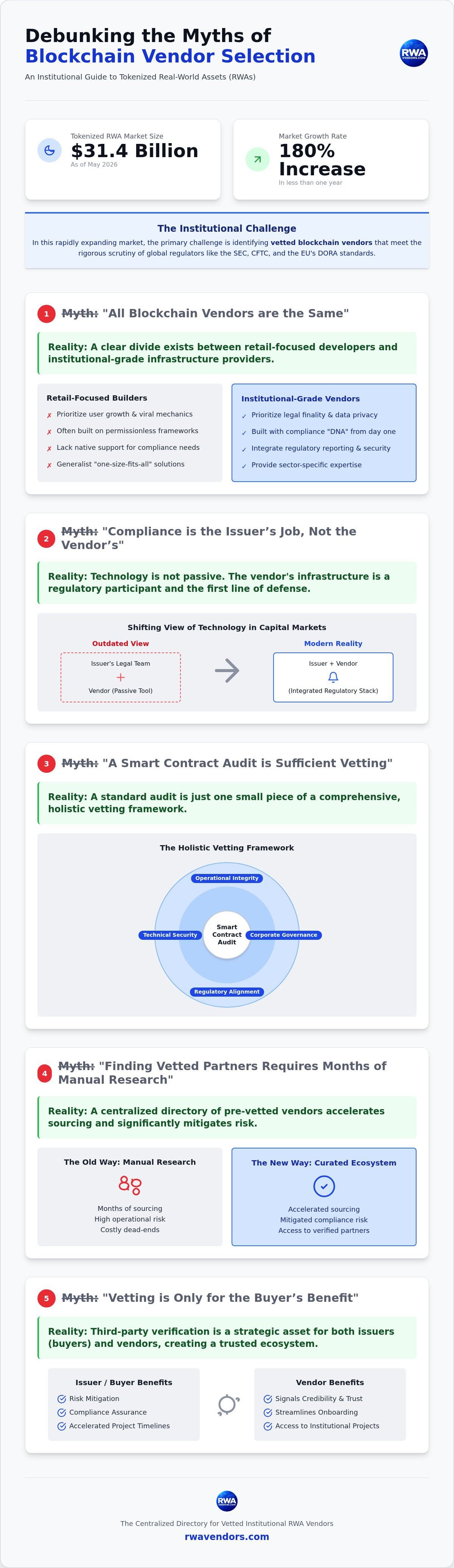
The market for tokenized real-world assets reached a staggering $31.4 billion in May 2026, representing a 180% increase in less than a year. This rapid expansion has created a fragmented landscape where the "noise" from unvetted providers often drowns out the professional infrastructure required for global finance. For institutions, the primary challenge isn't just finding technology; it's identifying vetted blockchain vendors that can withstand the rigorous scrutiny of the SEC, CFTC, and international regulators.
You're likely concerned about the escalating risks of regulatory non-compliance and the difficulty of verifying vendor track records in such a volatile environment. It's frustrating to realize that a standard smart contract audit is no longer sufficient to guarantee security or operational resilience under modern standards. You need a reliable method to move beyond the hype and establish a stable, compliant foundation for your digital asset strategy.
This guide provides the clarity you need by debunking five persistent myths that currently compromise institutional due diligence. You'll learn how to evaluate partners based on the 2026 SEC and CFTC joint guidance and the EU's Digital Operational Resilience Act (DORA) standards. We'll provide a clear framework for vendor selection and show you how to access a curated ecosystem of providers designed specifically for the tokenized capital markets.
Key Takeaways
- Distinguish between retail-focused developers and institutional-grade infrastructure to ensure your platform meets the rigorous demands of regulated finance.
- Shift from viewing compliance as a secondary task to a foundational requirement that must be integrated into the vendor’s core technology stack.
- Implement a holistic vetting framework that prioritizes operational integrity and corporate governance alongside technical smart contract audits.
- Accelerate your sourcing process and mitigate risk by accessing a centralized directory of vetted blockchain vendors already evaluated for institutional readiness.
- Leverage third-party verification as a strategic asset to signal credibility and streamline the onboarding process for complex capital market projects.
Myth 1: 'All Blockchain Vendors are Essentially the Same'
The market for tokenized real-world assets is no longer a playground for experimental startups. As the industry matures, a clear divide has emerged between retail-focused dApp builders and institutional infrastructure providers. Many asset issuers mistakenly believe that any firm with blockchain expertise can deliver a compliant security token offering. This assumption ignores the vast spectrum of technical and legal requirements that differentiate a decentralized finance (DeFi) protocol from a regulated capital markets platform. While a retail developer might prioritize user growth and viral mechanics, vetted blockchain vendors prioritize legal finality, data privacy, and regulatory reporting.
Sector-specific expertise is equally critical. A vendor specializing in fractionalized real estate must manage local property laws, tax reporting, and complex cap tables. Conversely, a provider focused on debt instruments needs infrastructure capable of handling precise interest distributions and maturity lifecycles. Generalist firms often lack the granular understanding of these asset classes, leading to "one-size-fits-all" solutions that fail under the scrutiny of institutional legal teams. A truly vetted provider acts as a specialized architect, ensuring the technology serves the specific legal and financial logic of the underlying asset.
Institutional-Grade vs. Retail-Focused Providers
Retail-focused vendors often lack the compliance "DNA" necessary for the securities industry. Their systems are frequently built on permissionless frameworks that don't natively support mandatory investor white-listing or jurisdictional restrictions. In contrast, institutional providers design their systems with these constraints in mind from day one. They implement rigorous security protocols and maintain high uptime requirements to ensure market stability. An institutional-grade blockchain vendor is a specialized infrastructure partner that aligns its technical architecture with global financial regulations and rigorous security standards. These partners understand that in the world of institutional finance, a system failure isn't just a technical bug; it's a significant regulatory and reputational event.
The Hidden Risks of Using Unvetted Generalists
Selecting an unvetted generalist introduces significant operational risk. Projects often face months of delays when internal legal departments discover that the vendor's code doesn't support essential tokenization data security standards or lacks the necessary audit trails. We've seen instances where infrastructure built by non-vetted providers failed to integrate with legacy financial systems, forcing issuers to scrap their progress and restart with specialized partners. To avoid these pitfalls, institutions are increasingly turning to a curated list of tokenization service providers who have already demonstrated their ability to operate within the bounds of global securities law. Relying on vetted blockchain vendors isn't just about technical safety; it's about ensuring the long-term viability and legal defensibility of your tokenized assets.
Myth 2: 'Compliance is the Issuer’s Job, Not the Vendor’s'
Technology is not a passive tool in the capital markets. In the evolving digital asset ecosystem, the infrastructure itself becomes a regulatory participant. Many issuers assume that compliance begins and ends with their internal legal teams, viewing the blockchain layer as a neutral utility. However, regulatory bodies increasingly scrutinize the entire issuance stack. A recent speech from the Federal Reserve on tokenization highlighted the importance of addressing financial stability and operational risks at the structural level. This means that vetted blockchain vendors must provide more than just code; they must deliver a framework that satisfies international oversight from the outset.
A vetted vendor acts as the issuer's first line of defense. By choosing partners who understand cross-border securities law, institutions mitigate the risk of accidental non-compliance when dealing with global investors. These providers ensure that the technology supports jurisdictional restrictions and investor eligibility requirements automatically. Relying on an unvetted partner shifts an immense burden of technical verification onto the issuer, often leading to gaps in KYC/AML enforcement that regulators will not overlook.
Built-in Compliance: The Mark of a Vetted Vendor
Top-tier providers employ "Compliance-as-Code," where regulatory rules are baked directly into the smart contracts. This automation differentiates vetted blockchain vendors from generic technology firms. Their stacks include real-time investor white-listing, automated tax withholding, and jurisdictional reporting tools. Because the software is pre-configured for institutional standards, it reduces the friction of onboarding and ensures that every transaction remains within legal bounds. This proactive approach to infrastructure design is a prerequisite for any serious institutional project.
Adhering to Robust Compliance Standards
The RWA Vendors directory applies a rigorous filter to identify companies with proven legal track records. We prioritize vendors who demonstrate a deep understanding of the regulatory environment established by the SEC, CFTC, and international bodies like MAS. Regulated Tokenization in 2026 requires the absolute convergence of legal logic and technical execution to ensure assets remain compliant throughout their entire lifecycle. This rigorous adherence to compliance ensures that issuers aren't just buying software, but are engaging with a legally-aware ecosystem. To signal your firm's institutional readiness and join this professional landscape, you can apply for a directory listing to reach verified asset issuers.
Myth 3: 'A Smart Contract Audit is Sufficient Vetting'
A common misconception in the digital asset space is that a successful smart contract audit equates to comprehensive security. While technical audits are essential, they only verify the "what"-the specific logic of the code at a single point in time. They don't address the "who" or the "how" behind the business operations. For institutions, technical soundness is meaningless if the provider lacks corporate governance or financial stability. Relying solely on a code review ignores the systemic risks associated with the entity managing the infrastructure. Vetted blockchain vendors must demonstrate a level of operational maturity that extends far beyond the blockchain layer.
Institutional partners prioritize business continuity and risk mitigation. This requires proof of professional liability insurance, SOC2 Type II compliance, and robust disaster recovery protocols. If a vendor provides critical infrastructure but lacks a clear path for service restoration during a crisis, the issuer faces unacceptable operational risk. A code audit won't protect an asset issuer if the vendor's internal access controls are compromised or if the company faces a liquidity event. Comprehensive vetting ensures that the partner is as stable as the technology they provide.
The Three Pillars of Comprehensive Vetting
To establish a truly institutional-grade ecosystem, vetting must rest on three distinct pillars:
- Technical Vetting: This includes smart contract audits, regular penetration testing, and stress tests for network scalability. It ensures the software performs as intended under heavy market loads.
- Operational Vetting: This focuses on the business itself. It involves background checks on key personnel, an analysis of financial health, and verification of insurance coverage for digital asset risks.
- Regulatory Vetting: This confirms the vendor’s legal standing in their operating jurisdictions. It verifies necessary licenses and ensures the provider remains in good standing with financial regulators.
Why Custody and Trading Require Deeper Scrutiny
The stakes are highest during the custody and trading phases of the RWA lifecycle. When an institution selects a digital asset custodian, they are entrusting them with the legal and technical control of high-value assets. Vetted blockchain vendors in this category must offer transparent governance structures and clear multi-signature or MPC (Multi-Party Computation) protocols. You should be alert to specific red flags during your due diligence. An opaque corporate structure, the absence of independent third-party financial audits, or a lack of comprehensive cyber-insurance are signals of institutional unreadiness. A vetted custodian provides the transparency and security required to satisfy both internal risk committees and external regulators.
Myth 4: 'Finding Vetted Partners Requires Months of Manual Research'
Manual research in the tokenization space is notoriously labor-intensive. Compliance officers and procurement teams often face "due diligence fatigue" as they sift through hundreds of unverified startups. The fragmented nature of the market means that a single project might require separate, exhaustive searches for legal counsel, custody solutions, and issuance platforms. However, the emergence of specialized infrastructure directories has fundamentally changed this process. By utilizing a centralized resource, institutions can bypass the noise and focus on vetted blockchain vendors that have already passed a baseline of professional scrutiny.
Unlike generic business aggregators that rely on unverified user reviews, a curated directory model provides a structured taxonomy of services. Standardized vendor profiles allow your team to perform apples-to-apples comparisons across critical metrics such as regulatory licensure and technical stack. This systematic approach transforms a chaotic search into a methodical selection process, significantly reducing the time-to-market for new tokenized offerings. Standardized profiles provide a uniform lens through which to view potential partners, allowing you to evaluate technical capabilities and financial health without interpreting different marketing formats. It turns a month-long research project into a precise, data-driven exercise.
The RWA Vendor Directory: Sourcing at Institutional Speed
The ability to filter providers by specialized categories like Legal, Custody, or Blockchain Infrastructure saves weeks of preliminary research. For cross-border projects, a global directory is indispensable; it allows you to identify partners with specific jurisdictional expertise without starting from scratch in every market. This efficiency is vital when navigating the complexities of multi-jurisdictional compliance. Founding Members within our ecosystem represent the bedrock of this infrastructure, providing the stability and long-term commitment required for large-scale capital market operations. By starting your search with vetted blockchain vendors, you ensure that every potential partner already understands the high stakes of institutional finance.
5 Questions to Ask Any Blockchain Vendor Today
Even when using a directory, your final due diligence should be targeted and precise. Use these five questions to separate institutional-grade partners from the rest of the market:
- Which jurisdictions have you successfully operated in, and can you demonstrate local regulatory alignment?
- What is your specific protocol for handling smart contract vulnerabilities post-deployment?
- Can you provide references from regulated financial institutions that have used your infrastructure?
- What specific insurance coverage do you maintain for professional liability and cyber-risk?
- How do you ensure data privacy and sovereignty across different regulatory regimes?
Myth 5: 'Vetting is Only for the Buyer’s Benefit'
The assumption that vetting is merely a hurdle for asset issuers overlooks the strategic advantage it provides to the technology providers themselves. For vetted blockchain vendors, third-party verification functions as a critical sales enablement tool. In a market where institutional buyers are hyper-vigilant about risk, a pre-vetted status serves as a definitive signal of quality and compliance. It removes the initial layer of skepticism that often stalls high-value negotiations. Instead of spending months proving their operational integrity to every individual prospect, verified providers can lead with their credentials, significantly accelerating the onboarding process.
Being part of a curated professional ecosystem builds immediate trust with global finance leaders. When a vendor is listed alongside other institutional-grade partners, they benefit from a "halo effect" of credibility. This positioning is particularly vital for firms aiming to capture a share of the projected $24.5 trillion tokenized asset market by 2033. For serious providers, vetting is not an obstacle; it's a competitive differentiator that separates professional infrastructure from experimental projects.
Joining the RWA Infrastructure Ecosystem
A directory listing provides unmatched visibility within the professional tokenization community. As the infrastructure directory arm of The STO Foundation, RWA Vendors offers providers a direct line to qualified asset issuers. Founding Membership options further enhance this alignment, allowing companies to position themselves as the bedrock of the industry alongside established leaders. This ecosystem isn't just about visibility; it's about high-quality lead generation. Verified providers receive inquiries from issuers who have already moved past the exploratory phase and are ready to deploy capital into institutional-grade systems.
The Future of Professional Blockchain Standards
As we move through 2026, the standards for institutional tokenization are becoming increasingly rigid. Regulators like the SEC and CFTC have clarified that the economic reality of a digital asset dictates its legal treatment, placing more pressure on infrastructure providers to maintain high standards. Being discoverable by global asset issuers is no longer optional for firms that want to scale. The industry is moving toward a model where unvetted providers are effectively locked out of the primary capital markets. You can take a proactive step in this evolving landscape today. Join the global directory and verify your institutional status here.
Securing the Future of Tokenized Capital Markets
The path to a $24.5 trillion tokenized market is paved with professional standards and rigorous due diligence. Code audits are only one piece of the puzzle; true institutional readiness involves a holistic alignment of legal, technical, and operational integrity. Utilizing a centralized resource doesn't just save time; it mitigates the systemic risks that can derail complex capital market projects.
RWA Vendors operates as the specialized infrastructure arm of The STO Foundation, offering a global reach across the legal, custody, and technology sectors. Our institutional-grade vetting framework ensures that the ecosystem remains stable and credible for all participants. By prioritizing partnerships with vetted blockchain vendors, you position your organization at the center of the modern financial architecture.
We are committed to acting as the industry architect that connects verified expertise with global opportunity. Join us in building a more efficient and transparent future for the tokenized capital markets.
Frequently Asked Questions
What exactly does it mean for a blockchain vendor to be 'vetted'?
Vetting signifies that a vendor has undergone a comprehensive review of their technical, operational, and legal standing. This process includes verifying smart contract security, analyzing corporate governance, and ensuring alignment with regulatory standards like the SEC or CFTC. Vetting confirms that the provider meets the high-stakes requirements of institutional finance. It moves beyond simple technical checks to evaluate the entity's long-term stability, financial health, and professional licensure.
How often should an institutional blockchain vendor undergo re-vetting?
Institutional partners should undergo a formal re-vetting process annually or whenever significant protocol upgrades occur. The digital asset landscape evolves rapidly, with new regulatory requirements like the EU's DORA or updated SEC guidance appearing frequently. Regular reviews ensure that vetted blockchain vendors maintain their compliance posture and technical resilience. Continuous monitoring of financial health and insurance coverage is also recommended to mitigate ongoing operational and reputational risks.
Is a smart contract audit the same as a security audit?
No, a smart contract audit is a specialized subset of a broader security audit. While a smart contract audit focuses specifically on the code's logic and vulnerabilities, a comprehensive security audit examines the entire infrastructure. This includes penetration testing, access controls, and data privacy protocols across the organization. For institutions, a code review is insufficient without assessing the broader environment, including oracle dependencies and administrative privilege management systems.
Can small blockchain startups be considered institutional-grade?
Yes, small startups can achieve institutional-grade status if they prioritize professional standards from their inception. Size is less critical than the presence of robust corporate governance, SOC2 compliance, and regulatory alignment. Many vetted blockchain vendors began as lean teams that successfully built "Compliance-as-Code" into their core architecture. Provided they maintain adequate insurance and business continuity plans, these specialized firms often offer superior agility compared to larger, generalist technology providers.
What are the most critical categories of vendors for an RWA project?
A successful Real-World Asset (RWA) project requires several specialized partners working in coordination:
- Tokenization Platforms for asset issuance and lifecycle management.
- Legal and Compliance Vendors for jurisdictional white-listing and KYC/AML.
- Digital Asset Custodians for secure, regulated asset storage.
- Secondary Market Infrastructure for trading and investor liquidity.
Each category must be evaluated for its ability to handle specific asset classes, such as real estate or private credit.
How do I verify the claims made by a vendor in a directory?
You should cross-reference directory listings with independent third-party reports and regulatory databases. Request SOC2 Type II audit results, proof of professional liability insurance, and references from regulated financial institutions. A professional directory provides a baseline for due diligence, but the final verification remains the responsibility of the issuer's risk committee. Look for vendors who are transparent about their corporate structure and provide clear documentation of their legal standing.
Why is the STO Foundation involved in vendor directory listings?
The STO Foundation serves as an industry architect to establish and maintain professional standards in the tokenized securities market. Through its directory arm, RWA Vendors, it provides a curated ecosystem that connects asset issuers with verified infrastructure providers. This involvement ensures that the directory isn't just a passive list but a filtered resource that prioritizes institutional readiness. It helps eliminate the noise from unvetted providers in a fragmented global market.
Does a 'vetted' status guarantee that a project will not fail?
No, a vetted status is not a guarantee of project success or a substitute for financial risk assessment. It signifies that a vendor has met specific technical, legal, and operational benchmarks at the time of review. While vetting significantly reduces operational and regulatory risk, it doesn't eliminate market volatility or the underlying risks of the asset being tokenized. Issuers must still conduct their own thorough financial due diligence on every project and partner.
Disclaimer
This article is provided by RWAVendors.com for general informational and educational purposes only. It does not constitute legal, financial, investment, tax, regulatory or other professional advice, or an offer, solicitation, recommendation or endorsement of any company, product, service, token, security or investment. RWAVendors.com is an informational vendor directory and does not sell, issue, broker, custody or facilitate transactions involving cryptocurrencies, digital tokens, tokenized assets, securities or investment products. Some vendor listings and references may involve paid advertising, sponsored placement or membership relationships. These relationships do not guarantee a vendor’s qualifications, regulatory status, performance or suitability. Information may be incomplete, outdated or subject to change. You should independently verify all information, conduct your own due diligence and consult qualified professionals before making any business or investment decision. RWAVendors.com is not responsible for the content, services, representations or actions of third-party vendors or linked websites.


