
The on-chain value of real-world assets reached $33.5 billion in July 2026, representing a 400 percent increase since early 2025. This rapid expansion, coupled with the SEC and CFTC joint interpretation issued in March 2026, has solidified digital securities as a core pillar of modern finance. However, for many institutions, the primary challenge remains the technical complexity of the ecosystem. It's often difficult to distinguish between payment-centric tokenization service providers and those specialized in complex asset lifecycle management.
You likely recognize that a misstep in vendor selection leads to more than just technical friction; it risks regulatory non-compliance and prohibitive switching costs. This guide clarifies the provider landscape by categorizing vetted vendors across payment and asset classes. You'll discover a structured framework for conducting technical and legal due diligence, ensuring your chosen partner aligns with the latest institutional standards and stringent operational requirements. We'll provide the clarity needed to transition from traditional structures to a verified digital ecosystem with confidence and precision.
Key Takeaways
- Identify the strategic shift from legacy payment security to the full-scale digitization of global real estate and private equity funds.
- Evaluate essential technical capabilities, such as smart contract architecture for automated compliance and interoperability across institutional blockchain subnets.
- Navigate a vetted landscape of tokenization service providers specialized in fractionalized assets and institutional fund management.
- Apply a rigorous two-step selection framework that prioritizes jurisdictional regulatory alignment and comprehensive technical security audits.
- Utilize the RWA Vendors directory to filter global infrastructure partners across critical categories like custody, legal counsel, and secondary trading.
Understanding the Tokenization Service Provider Landscape in 2026
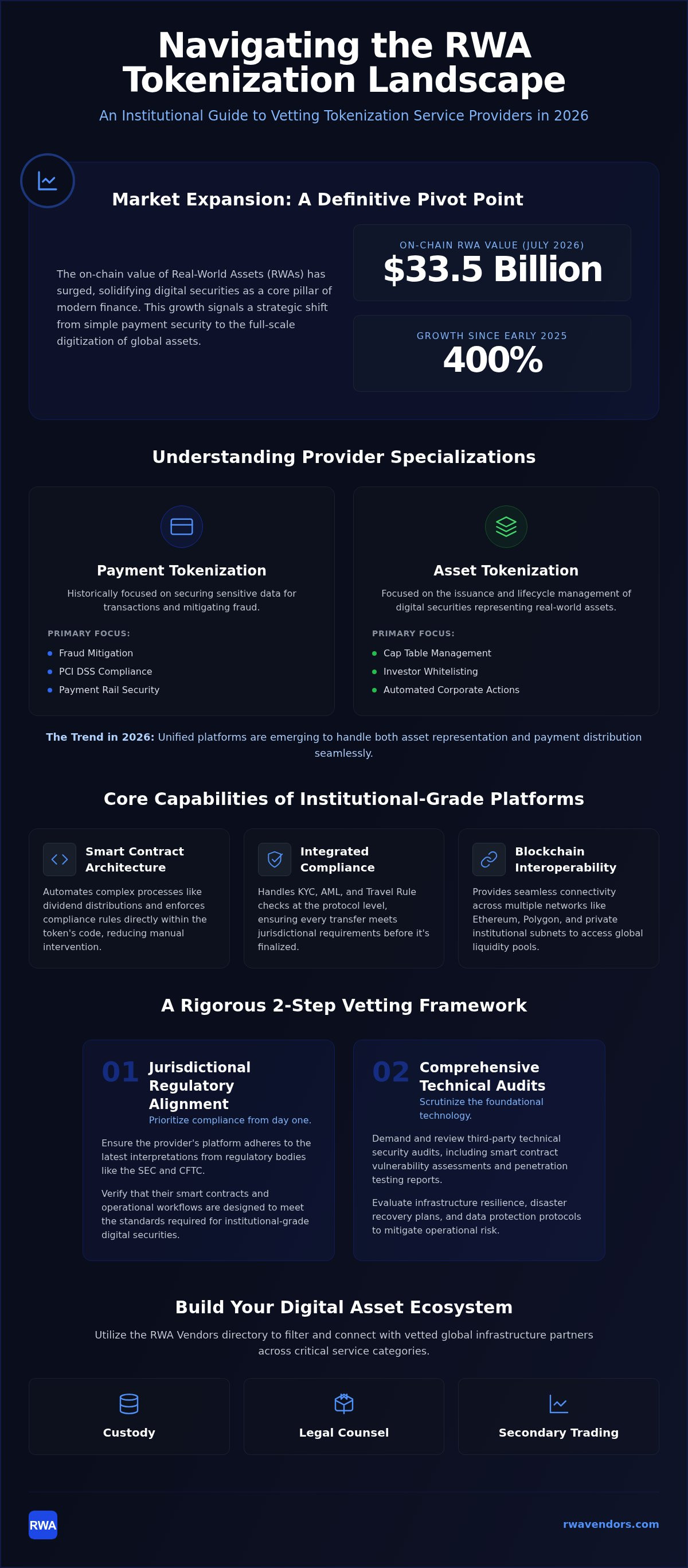
A Tokenization Service Provider (TSP) functions as a specialized infrastructure partner that replaces sensitive data or tangible assets with digital tokens. Historically, this technology served primarily as a security measure for credit card processing. However, the industry reached a definitive pivot point in 2026. The focus has expanded from securing transaction data to digitizing global real estate, private funds, and commodities. This shift follows the 400 percent growth in on-chain real-world asset (RWA) value, which reached $33.5 billion in July 2026.
Institutions are now moving toward unified infrastructure. They require systems that manage both data security and asset representation. To grasp the technical underpinnings, one must understand What is Tokenization? and how it creates a bridge between traditional ledgers and blockchain environments. Modern tokenization service providers provide the necessary architecture to handle this transition without disrupting existing operational workflows. Selecting a partner from a curated ecosystem, such as the RWA Vendors directory, ensures that institutions engage with providers that meet these rigorous new standards.
Payment Tokenization vs. Asset Tokenization
Distinguishing between the two primary TSP categories is essential for institutional due diligence. Payment TSPs prioritize PCI DSS compliance and are foundational for mobile wallets and e-commerce security. Their primary role is to protect sensitive financial information during the transaction lifecycle. Asset TSPs, however, focus on the issuance and management of digital securities. They facilitate fractional ownership and enhance secondary market liquidity by embedding compliance rules directly into the token's code.
- Payment TSPs: Focus on fraud mitigation and payment rail security.
- Asset TSPs: Focus on cap table management, investor whitelisting, and automated corporate actions.
A significant crossover is occurring in 2026. Digital securities increasingly use established payment rails for automated distributions. This allows for real-time dividend payments to thousands of fractional owners simultaneously, reducing administrative overhead for fund managers. This integration helps solve the high cost of switching providers after initial integration, as unified platforms handle both the asset and the payment distribution layer.
The Role of the STO Foundation in Setting Standards
The Security Token Offering Foundation, Inc. acts as a central architect for the industry. It develops the standardized protocols that allow different platforms to communicate. This interoperability is critical as institutions deploy assets across Ethereum, Polygon, and various institutional subnets. Standardized frameworks prevent the "walled garden" effect that previously limited the growth of digital capital markets. Following the SEC and CFTC joint interpretation in March 2026, these standards have become the benchmark for regulatory compliance.
Institutional-grade tokenization is the process of issuing digital assets within a verified framework that guarantees regulatory compliance, technical security, and seamless connectivity to global liquidity pools.
Core Capabilities of Top Tokenization Platforms
Leading tokenization service providers distinguish themselves through the sophistication of their software layer. While basic encryption was once the standard, modern platforms offer a comprehensive suite of tools designed for the entire asset lifecycle. These systems function as the foundational infrastructure for digital capital markets, providing the necessary automation to handle high-volume institutional trades. The effectiveness of a platform is defined by its ability to manage issuance, investor relations, and complex corporate actions without manual intervention.
Smart contract architecture serves as the operational brain of these platforms. These digital protocols automate dividend distributions and enforce compliance rules in real time. Integrated compliance modules now handle KYC, AML, and Travel Rule checks at the protocol level. This ensures that every transfer meets jurisdictional requirements before the transaction is finalized on the ledger. By embedding these rules into the token's code, providers eliminate the risk of unauthorized secondary market transfers.
Blockchain Infrastructure and Security
The industry is shifting toward public permissioned networks. This model provides the transparency of public blockchains while maintaining strict control over participant access. Security is anchored by Hardware Security Module (HSM) integration, which protects private keys within a tamper-resistant environment. Furthermore, oracle providers are now essential for bringing real-world data, such as property valuations or occupancy rates, directly on-chain. When analyzing the Implications for the Financial System, it's clear that these security layers are mandatory for maintaining market integrity and institutional trust.
Investor and Issuer Dashboards
Effective tokenization service providers deliver robust white-label dashboards. As of July 2026, approximately 60 percent of the market prefers these white-label solutions because they offer a faster, more cost-effective entry point for businesses. These interfaces allow issuers to maintain brand consistency while providing investors with a professional portal for portfolio management. Key features include:
- Automated Cap Table Management: Real-time updates to ownership records in a decentralized environment.
- Multi-Chain Interoperability: Native support for Ethereum, Polygon, and institutional subnets to ensure liquidity access.
- Global Reporting Tools: Integrated tax compliance and regulatory reporting for multiple jurisdictions.
These dashboards simplify the administrative burden of managing thousands of global investors. Institutions can explore a directory of vetted infrastructure partners to identify platforms that offer these specific technical and security capabilities.
Comparing the Best Tokenization Service Providers by Sector
Diverse asset classes demand specialized tokenization service providers that understand specific legal and technical nuances. Real estate accounts for over 40 percent of all tokenized volume as of July 2026. Providers in this sector must manage local property titles and fractional land rights through digital registries. For private equity and venture capital funds, the priority is efficient Limited Partner management. These platforms automate fund administration and capital calls. Commodities and fine art require providers with robust physical asset verification and secure storage partnerships. This ensures the digital token is always backed by a verified physical equivalent. Debt and fixed income platforms focus on the automation of coupon payments and maturity handling, which reduces the operational burden of traditional bond issuance.
The RWA Infrastructure Stack
A successful ecosystem relies on a layered stack of specialized vendors. Custody providers serve as the bedrock for institutional digital asset safety; they ensure that private keys are held in bankruptcy-remote structures. Transfer agents bridge the gap between blockchain records and legal registries, maintaining the official cap table. Secondary market venues provide the necessary liquidity for investors to exit positions before asset maturity. RWA Vendors acts as the central directory for these infrastructure layers, providing a vetted list of partners across every category to ensure institutional grade delivery.
Global Regulatory Leaders
The 2026 market demands regulated tokenization service providers that hold specific licenses in key financial hubs. Singapore capital-markets licenses and UAE VARA licenses represent the gold standard for international operations. Institutions should prioritize vendors with established footprints in the US, EU, Singapore, or the UAE. A robust comparison framework for these providers includes license type, supported asset classes, and jurisdictional coverage. This ensures that the chosen partner can facilitate cross-border capital flow without compromising on legal integrity. When evaluating providers, institutions must verify the following license categories:
- US/EU: Focus on SEC/FINRA registered broker-dealers or MiCA compliant entities.
- Singapore: Capital Markets Services (CMS) license holders for regulated security tokens.
- UAE: VARA-regulated entities specialized in virtual asset issuance and management.
Selecting a partner with the appropriate jurisdictional licensing is the most critical step in avoiding regulatory non-compliance. This methodical approach to vendor selection ensures that the technical infrastructure remains subservient to the legal requirements of the underlying asset.
Selection Framework: How to Vet a Tokenization Partner
Selecting tokenization service providers requires a methodical approach that extends beyond basic technical compatibility. Institutions must conduct multi-layered due diligence to mitigate legal and operational risks. This framework prioritizes long-term stability and regulatory adherence over short-term implementation speed. A failure at the vetting stage often results in high switching costs or, in extreme cases, the loss of an asset's legal standing.
- Step 1: Regulatory Alignment. Verify that the provider holds the necessary licenses for your specific asset class and target jurisdictions. This includes checking for MAS CMS licenses in Singapore or VARA compliance in the UAE.
- Step 2: Technical Audit. Review recent smart contract audits from reputable third-party firms. Ensure the provider maintains SOC2 Type II certification to guarantee institutional-grade data security.
- Step 3: Ecosystem Interoperability. Confirm the platform's ability to export tokens to secondary market venues or institutional subnets. Avoiding vendor lock-in is critical for future liquidity.
- Step 4: Financial Stability. Assess the provider's institutional backing and financial runway. In a market where setup fees range from $50,000 to $100,000, you need a partner that will remain operational through the entire asset lifecycle.
- Step 5: Reference Checks. Utilize specialized directories to verify industry reputation and track records with similar institutional clients.
The Tokenization Due Diligence Checklist
Institutional issuers must demand clear answers regarding data ownership and portability. It's essential to determine if you can migrate your cap table and investor data if the provider ceases operations. Centralized tokenization models often introduce a single point of failure where the insolvency of the infrastructure provider results in the permanent loss of the asset's digital representation. You should evaluate the provider's "exit strategy" and ensure that the legal ownership of the asset is not technically tied to the provider’s continued existence.
Vetting Legal and Compliance Partners
The role of vetted legal counsel is as important as the technical infrastructure itself. You'll need "blockchain-native" law firms that understand the intersection of traditional securities law and distributed ledger technology. These firms ensure that your offering documents are technically accurate and legally binding across all relevant jurisdictions. To streamline this process, you can access a Tokenization Due Diligence Checklist through our curated resources. Establishing these legal guardrails early prevents regulatory non-compliance as your digital asset ecosystem scales.
To identify partners that have already passed rigorous industry vetting, you can search the global directory of RWA infrastructure providers.
Using the RWA Vendors Directory to Build Your Ecosystem
rwavendors.com serves as the global source of truth for the real-world asset infrastructure ecosystem. Operated by the Security Token Offering Foundation, Inc., this platform provides a curated environment where institutions identify and engage with vetted partners. It acts as a bridge between traditional financial structures and blockchain-native innovation. This ensures that the integrity of the capital markets is maintained through rigorous verification of every listed entity. It's the central pillar for those who prioritize reliability and security in global finance.
The directory allows users to filter tokenization service providers and other infrastructure vendors by specific operational categories with surgical precision. This organized taxonomy is necessary for building a robust ecosystem that spans custody, legal counsel, and secondary trading venues. By organizing a complex landscape into digestible, thematic blocks, the directory enables issuers to construct their technical stack with confidence. Every word on the platform reinforces its position as a serious, institutional-grade resource for the global finance community. The prose is functional and prioritizes information density for ease of navigation.
Finding Strategic Institutional Partners
Strategic discovery is simplified through a methodical classification of service types. Issuers use the directory for partner discovery and lead generation, connecting with global providers that meet the STO Foundation's high standards of excellence. Founding Members within the directory represent the vanguard of industry leadership. They provide a mark of reliability for institutions entering the digital asset space. Premium directory placement ensures that the most qualified vendors are visible to those seeking high-stakes financial and legal solutions. This personality is characterized by a gatekeeper sensibility that implies a high standard of excellence for the entire ecosystem.
Next Steps for Issuers and Service Providers
Service providers can join the directory as verified vendors to establish their position within the institutional-grade ecosystem. This visibility facilitates connections with global issuers and other infrastructure partners. It fosters a well-oiled machine of professional services that are essential for scaling operations. Staying informed is equally critical for long-term success. The platform provides industry news and job postings to help businesses stay ahead of evolving RWA trends and regulatory shifts. It's an active connector that empowers businesses to build and scale with surgical precision.
To begin building your institutional framework, you can Browse the Global RWA Vendor Directory. This resource provides the definitive reference point for selecting the tokenization service providers and legal experts required for a successful issuance. It empowers businesses to build and scale within a professional, stable, and credible ecosystem. Don't leave your infrastructure to chance when a vetted directory of global partners is readily available.
Advancing the Institutional Digital Asset Framework
The transition to on-chain capital markets in 2026 relies on selecting infrastructure that prioritizes regulatory integrity and technical resilience. Institutions must move beyond basic data security to implement comprehensive lifecycle management for complex assets. This requires a rigorous evaluation of tokenization service providers based on their jurisdictional licenses and smart contract security standards. By establishing these guardrails early, you protect your organization from the high costs of technical friction and regulatory non-compliance.
As the official directory of the Security Token Offering Foundation, Inc., RWA Vendors serves as a global database of institutional-grade partners. Every listing is verified across legal, custody, and blockchain technology categories to maintain a high standard of excellence within the ecosystem. This curated resource allows you to identify strategic partners that have already undergone the hard work of industry vetting, ensuring a secure bridge between traditional finance and modern innovation.
Access the Vetted Tokenization Service Provider Directory to begin building your digital asset ecosystem today. Establishing a stable foundation ensures your organization is positioned for the continued growth of tokenized real-world assets with confidence.
Frequently Asked Questions
What is the difference between a payment TSP and an asset tokenization provider?
Payment TSPs primarily focus on securing sensitive credit card data to meet PCI DSS compliance standards during transactions. In contrast, asset tokenization service providers digitize real-world assets to facilitate fractional ownership and secondary market liquidity. While payment TSPs protect data in transit, asset TSPs manage the entire lifecycle of a digital security; this includes issuance, automated compliance, and cap table management on a blockchain ledger.
How do I verify if a tokenization service provider is regulated?
Institutions should verify a provider’s status by searching official regulatory registers in the relevant jurisdiction. You should look for specific licenses like a Capital Markets Services (CMS) license from the MAS in Singapore or a VARA license in the UAE. Cross-referencing these findings with the RWA Vendors directory provides an additional layer of verification; every listed partner is vetted for institutional-grade compliance and operational standing.
Can I use a single provider for both issuance and custody of digital securities?
Some vertically integrated platforms offer both issuance and custody services; however, many institutions prefer a modular approach to mitigate counterparty risk. Separating these functions ensures that the entity managing your digital cap table isn't the same entity holding the private keys to the assets. This structure aligns with traditional financial practices where the transfer agent and the custodian are distinct, bankruptcy-remote entities, which enhances overall security.
What are the typical fees associated with institutional tokenization services?
Upfront setup and onboarding fees for institutional platforms typically range from $50,000 to $100,000 as of 2026. Ongoing costs include per-investor verification fees, which range from $2 to $100 depending on accreditation requirements. Annual maintenance for digital transfer agent services often costs between $5,000 and $25,000. Legal fees for drafting offering documents remain a significant variable; these often range from $30,000 to $150,000 depending on the asset's complexity.
Which blockchain is best for institutional RWA tokenization in 2026?
Ethereum remains the primary choice for global liquidity; however, Polygon and various institutional subnets offer the scalability required for high-volume transactions. The best blockchain depends on your specific regulatory and privacy needs. Many tokenization service providers now support multi-chain interoperability. This allows assets to move between public permissioned networks and private institutional ledgers, ensuring your digital securities can access broad liquidity pools while maintaining strict compliance guardrails.
How long does it take to integrate with a tokenization service provider?
Integration timelines vary based on the complexity of the asset and the chosen regulatory framework. A standard white-label setup can often be completed within 4 to 8 weeks; however, custom platform development or complex cross-border offerings may take 3 to 6 months. This timeline includes technical integration, smart contract auditing, and the establishment of legal offering documents. Engaging with vetted partners through a directory helps streamline this process significantly.
What is the role of the STO Foundation in the vendor ecosystem?
The Security Token Offering Foundation, Inc. acts as the governing body for the RWA Vendors directory. Its role is to establish and maintain the standardized protocols required for interoperability within the tokenized capital markets. By vetting every listed provider, the Foundation ensures that the ecosystem remains stable, professional, and compliant with global securities laws. It functions as an industry architect, bridging the gap between traditional finance and modern blockchain-native infrastructure.
Are there white-label tokenization platforms available for banks?
White-label tokenization platforms are a primary entry point for banks and financial institutions in 2026. Approximately 60 percent of the current market utilizes these solutions to launch digital asset offerings quickly without the high cost of custom development. These platforms allow banks to maintain their brand identity while leveraging audited smart contract architecture. They include built-in modules for KYC/AML compliance and reporting tools that meet the rigorous standards required by regulators.
Disclaimer
This article is provided by RWAVendors.com for general informational and educational purposes only. It does not constitute legal, financial, investment, tax, regulatory or other professional advice, or an offer, solicitation, recommendation or endorsement of any company, product, service, token, security or investment. RWAVendors.com is an informational vendor directory and does not sell, issue, broker, custody or facilitate transactions involving cryptocurrencies, digital tokens, tokenized assets, securities or investment products. Some vendor listings and references may involve paid advertising, sponsored placement or membership relationships. These relationships do not guarantee a vendor’s qualifications, regulatory status, performance or suitability. Information may be incomplete, outdated or subject to change. You should independently verify all information, conduct your own due diligence and consult qualified professionals before making any business or investment decision. RWAVendors.com is not responsible for the content, services, representations or actions of third-party vendors or linked websites.


