
An RWA token issuance isn’t a launch event. It’s a gated operating process that starts before minting and continues after distribution. A useful RWA token issuance checklist covers more than smart contracts. It coordinates legal and regulatory work, asset and investor operations, technology, distribution, and ongoing administration.
Issuance is difficult to coordinate because responsibilities cross team and provider boundaries. A launch-focused checklist can miss the work required once tokens are in circulation. Specialist providers can contribute essential capabilities, but the issuer remains responsible for its decisions.
This guide sets out the major workstreams in sequence, highlights handoffs and post-issuance responsibilities, and explains where service providers can support the process. Use it to understand issuer needs, shape a clear service offering, and discover providers across tokenization technology, legal and compliance, custody, infrastructure, and payments through a categorized vendor ecosystem such as RWA Vendors.
Key Takeaways
- Define the asset, holder rights, intended participants, and business rationale before selecting a tokenization approach.
- Use an RWA token issuance checklist to organize work into gates, with a decision owner and supporting evidence for each stage.
- Assess legal treatment and holder rights based on the asset and its structure, not token format alone.
- Require documented testing and approved procedures for onboarding, servicing, security, and incident response before launch decisions.
- Map specialist providers to defined workstreams while keeping project decisions and accountability with the issuer.
RWA token issuance readiness: define the asset, outcome, and stakeholders
Issuing a token is a technical event. Preparing an operating financial product is broader: the issuer must define what the token represents, what rights holders receive, who may participate, and how the product will be administered over time. Choosing a platform or token standard before settling these questions can embed assumptions that later require redesign.
Start the RWA token issuance checklist with a short project brief. State the business rationale, intended outcome, underlying asset, proposed holder rights, target participants, and intended jurisdictions. Treat choices about jurisdictions and participants as assumptions for specialist legal review, not conclusions about how the product will be regulated.
What should an issuer define before token design?
Record the asset’s ownership structure and the relationship between the asset, issuer, and token. Describe relevant cash flows, such as how income or repayments are expected to reach holders, while keeping the payment mechanism distinct from the legal rights themselves. Specify whether holders are intended to receive an economic interest, governance rights, redemption rights, or another defined claim.
- Asset and ownership: Identify the asset, its owner, and the entity responsible for issuing the token.
- Holder rights: Document proposed entitlements, restrictions, transfer conditions, and any rights that do not attach to token ownership.
- Participants and jurisdictions: Record intended investor or holder categories and relevant markets for legal analysis.
- Decision status: Mark each item as decided, assumed, or unresolved. Assign an owner and next action to every open question.
This distinction helps prevent a working assumption from being presented as an approved product feature. For example, a proposal to restrict transfers to eligible participants needs a defined eligibility policy and an enforcement plan. Design the mechanism after the requirement has been examined and approved by the appropriate specialists.
Issuance readiness is the documented alignment of the asset, proposed holder rights, target participants, accountable decision-makers, and operating capabilities needed to assess and advance an issuance. This is a practical project definition, not a universal legal test or a substitute for jurisdiction-specific analysis.
Who owns the issuance workstreams?
The issuer retains accountability for the product and its decisions, even when external specialists perform defined work. Appoint an executive sponsor and name accountable leads for legal, compliance, technology, and operations. For each lead, record decision rights, deliverables, dependencies, and an escalation route. A responsibility matrix makes handoffs visible before they become launch blockers.
- Issuer leadership: Owns the business rationale, product parameters, approvals, and decisions to proceed or pause.
- Legal and compliance leads: Coordinate specialist analysis, project assumptions, disclosures, and applicable controls.
- Technology and operations leads: Translate approved requirements into system design, records, workflows, and ongoing servicing.
External legal, compliance, tokenization, custody, payments, or infrastructure providers can supply expertise and execute agreed tasks. They do not replace issuer approval of rights, disclosures, risk appetite, or operating policy. Record these boundaries in the responsibility matrix, along with the evidence each lead must deliver before the project advances.
Build the RWA token issuance plan around gated workstreams
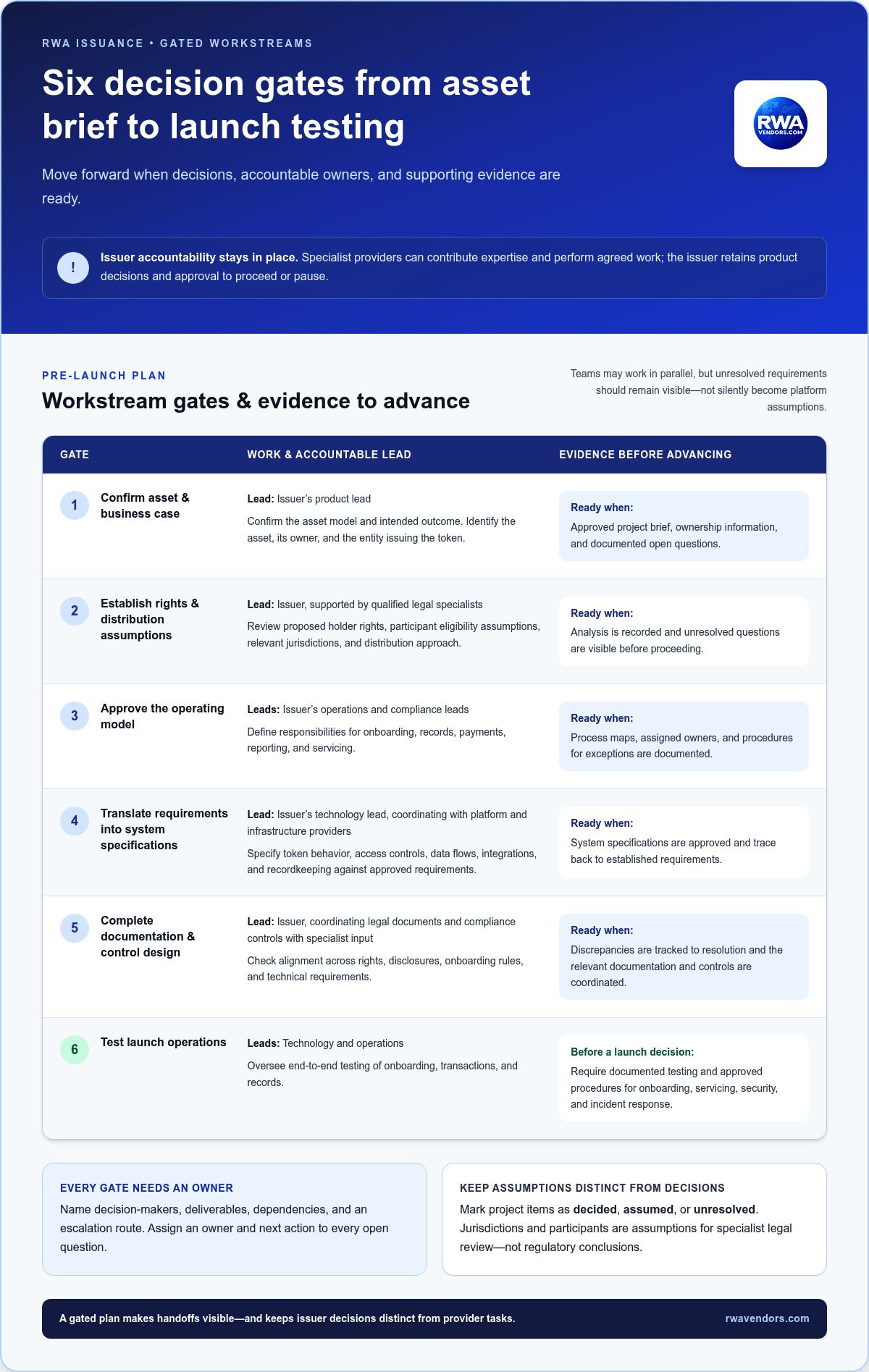
Turn the project brief into a sequence of decisions, accountable owners, and evidence. At each gate, the issuer reviews whether required decisions and deliverables are ready before approving the next stage. Teams can work in parallel where appropriate, but unresolved requirements should stay visible rather than becoming assumptions in platform configuration.
- Confirm the asset and business case. The issuer’s product lead confirms the asset model and intended outcome. Evidence includes an approved project brief, ownership information, and a documented list of open questions.
- Establish rights and distribution assumptions. The issuer, supported by qualified legal specialists, reviews proposed holder rights, participant eligibility assumptions, jurisdictions, and the distribution approach. Record the analysis and unresolved questions before proceeding.
- Approve the operating model. The issuer’s operations and compliance leads define onboarding, records, payments, reporting, and servicing responsibilities. Evidence includes process maps, assigned owners, and procedures for exceptions.
- Translate requirements into system specifications. The issuer’s technology lead coordinates with relevant platform and infrastructure providers. Approve specifications for token behavior, access controls, data flows, integrations, and recordkeeping against established requirements.
- Complete documentation and control design. The issuer coordinates legal documents and compliance controls with specialist input. Evidence should show that rights, disclosures, onboarding rules, and technical requirements align, with discrepancies tracked to resolution.
- Test launch operations. Technology and operations leads oversee end-to-end testing of onboarding, transactions, records, reporting, and exception handling. Retain test results, issue resolutions, and approved operating procedures for the launch decision.
- Authorize issuance and post-issuance servicing. The issuer’s designated decision-maker reviews outstanding risks and readiness evidence. Before proceeding, confirm ownership of ongoing reporting, holder communications, reconciliations, updates, and incident escalation.
These gates need not be strictly sequential. Legal structuring, compliance analysis, and operating design can develop alongside platform assessment, but their outputs must inform technical choices. For example, eligibility rules and transfer restrictions can affect onboarding workflows, token controls, and the records needed to demonstrate how those controls operate.
Control dependencies and approval points
Maintain a dependency register linking each deliverable to the decisions and teams it relies on. Legal documentation may depend on final rights; onboarding and custody workflows may depend on approved eligibility assumptions; smart-contract specifications may depend on transfer rules; and reporting may depend on reliable transaction and holder records. At each gate, name the issuer approver, required evidence, open dependencies, and conditions that block progression. This makes it easier to resolve issues instead of letting incomplete requirements pass silently into launch plans.
Sequencing issuance work makes dependencies and decisions visible, which can reduce avoidable rework, but it doesn’t guarantee compliance. Providers whose capabilities support defined issuance workstreams can use the RWA Vendors listing pathway to present their services to issuers looking for relevant expertise.
Address the hardest issuance question: how do compliance and rights vary?
A token format doesn’t, by itself, determine an asset’s legal treatment or the rights a holder receives. Those questions depend on the underlying asset and structure, how the product is offered, who may participate, and the jurisdictions involved. Tokens with similar technical features can represent different arrangements.
A checklist supports issuance planning, but it does not establish legal compliance. Use the RWA token issuance checklist to organize issues for review, then have qualified specialists assess the project’s facts and applicable requirements. Keep assumptions, conclusions, and outstanding questions distinct in project records.
Which compliance questions need jurisdiction-specific analysis?
Ask qualified legal and compliance specialists to assess the proposed offering structure, participant eligibility, disclosure needs, and transfer restrictions against the asset, distribution model, and intended jurisdictions. Where relevant, define how identity verification, sanctions screening, and ongoing activity monitoring fit into onboarding and transaction operations. The precise controls and obligations require project-specific analysis. For broader context, see Compliant Asset Tokenization: 2026 Institutional Guide.
Issuer question | Specialist input | Project evidence
What is being offered, and to whom? | Review the asset structure, offering approach, intended participant types, and jurisdictional scope. | A documented project description, distribution assumptions, and written analysis of open legal questions.
What eligibility and transfer conditions apply? | Assess relevant participant criteria and restrictions for the proposed offering. | Approved eligibility rules, transfer policy, and a clear record of unresolved decisions.
Which onboarding controls are needed? | Advise on applicable identity checks, sanctions screening, and monitoring design. | Defined control procedures, assigned operational owners, and records of how exceptions are escalated.
What information must holders receive? | Review disclosures and other relevant communications for the structure and jurisdictions. | Approved documents, version controls, and a process for delivering and retaining records.
How should rights and records align with token behavior?
Make the relationship between approved rights, platform permissions, and operating procedures traceable. If transfers are restricted, for example, specify the restriction in governing documents and define how the platform enforces it, who can approve exceptions, and how those actions are recorded. A technical control cannot replace a clear, approved rights framework.
Identify the authoritative ownership record rather than assuming an on-chain balance automatically serves that role. Assign responsibility for maintaining investor records, reconciling records when systems differ, handling correction requests, and processing corporate actions such as notices or distributions where applicable. Document which system is used for each purpose and how discrepancies are escalated.
Before launch, compare the rights described in approved documents with platform permissions and operational procedures. Assign a named owner and resolution path to every mismatch before the issuer approves the relevant activity.
Pre-launch Checklist for Tech and Operations
Technical readiness is only one part of a launch decision. A functioning smart contract doesn’t establish legal approval, determine investor suitability, or prove commercial viability. Before issuance, require documented test results, approved operating procedures, and named owners for routine work and exceptions. Treat the pre-launch review as an evidence-based governance gate, not a technology sign-off alone.
What should teams test before issuance?
Test against approved requirements, not just the expected transaction path. Confirm that permissions and transfer controls behave as intended, administrative actions are restricted to authorized roles, and documented recovery procedures can be followed. Review cybersecurity controls, access management, key governance, and incident escalation. For broader security context, see Tokenization Cybersecurity Vendors: The 2026 Institutional Guide to RWA Protection.
- Technology: Retain test cases and results for contract permissions, transfer restrictions, integrations, and recordkeeping. Document defects, their disposition, and any retesting.
- Security: Record access approvals, key-management responsibilities, security review findings, and escalation steps for suspected compromise.
- Onboarding: Rehearse participant enrollment, eligibility checks, identity verification where applicable, and exception handling from submission through approval or rejection.
Are post-issuance operations ready on day one?
Plan for routine servicing and less common events. Assign responsibility for investor communications, reporting, record maintenance, monitoring, and operational escalation. Rehearse corrections, failed or disputed transactions, corporate actions, and other exceptions relevant to the product. Define who reviews monitoring outputs, how often reviews occur, and where decisions are recorded. Approved procedures should make handoffs between issuer teams and service providers explicit.
- Servicing: Confirm the owner and process for each recurring task, including communications and reporting.
- Incident response: Document how teams identify, escalate, investigate, and record operational or security incidents.
- Evidence: Keep test results, approvals, procedures, issue logs, and ownership records accessible to those responsible for the launch decision.
Adapt this readiness list to the issuer’s governance process. For every item, record an accountable owner, evidence reviewed, open issues, and approval status:
- Technology behavior and integrations tested against approved requirements.
- Security controls, access, key governance, and escalation procedures reviewed.
- Onboarding, communications, reporting, and servicing workflows rehearsed.
- Exception handling, correction procedures, and incident response documented.
- Monitoring ownership and review cycles assigned.
The RWA token issuance checklist should support a clear go, pause, or remediation decision. Technical test completion does not substitute for legal review or an issuer decision about investor suitability, and none of these checks guarantees commercial success. The issuer’s designated governance body should review the evidence and unresolved issues before authorizing launch.
Match issuance workstreams to providers and prepare the next step
A completed RWA token issuance checklist can reveal capability gaps, but it won’t determine which providers an issuer needs. Start with defined deliverables, dependencies, and accountable issuer owners, then map each requirement to relevant specialist support. Providers contribute expertise and services within agreed scopes; the issuer retains responsibility for product decisions, approvals, and overall project accountability.
How do provider categories map to issuance needs?
Match provider capabilities to specific work, not just a broad project label. A provider map helps the issuer see which functions are covered, where handoffs occur, and which needs still require an owner.
- Legal and compliance providers can support analysis of product structure, participant controls, disclosures, and operating requirements. The issuer remains accountable for approving its decisions and policies.
- Tokenization platforms and blockchain infrastructure providers can support system design, deployment, integrations, and technical operations in line with approved requirements.
- Custody providers may contribute digital asset safekeeping and related administration capabilities, depending on the project model and assigned responsibilities.
- Payments providers can support defined payment flows, while trading providers may be relevant when a project plans market access. Neither category determines whether a transaction flow or market approach is appropriate for the issuer.
For each provider relationship, document the assigned work, expected deliverables, dependencies, and handoff points. For example, platform configuration may rely on approved transfer requirements, while payment operations may depend on clear reconciliation and exception processes. This makes gaps easier to spot before they become launch dependencies.
How can service providers prepare to be discoverable?
Describe capabilities in terms issuers can connect to actual workstreams. Specify the services provided, the types of issuer needs supported, and relevant asset or service categories. Clear descriptions help distinguish a provider focused on compliance workflows from one focused on technical infrastructure, even when both contribute to the same issuance.
A categorized directory helps issuers discover providers across legal and compliance, tokenization technology, custody, payments, trading, and infrastructure. RWA Vendors connects asset issuers with verified tokenization platforms and service providers, making specialist capabilities easier to find across different stages of tokenization. Directory discovery supports provider identification, but does not replace issuer assessment, project approvals, or defined scopes of work.
Providers supporting RWA issuance can prepare a focused company profile that explains their capabilities and the workstreams they serve. The RWA Vendors listing pathway gives issuers a place to discover relevant services. Directory visibility does not guarantee referrals or leads.
Turn issuance expertise into a clear next step
Use the RWA token issuance checklist to identify where your organization contributes, which issuer needs your capabilities address, and what handoffs your work depends on. A precise provider profile can help issuers connect a defined requirement with a relevant service category, rather than relying on broad claims about supporting tokenization.
RWA Vendors provides a global directory connecting issuers with providers across legal, compliance, technology, custody, trading, infrastructure, and payments. Its organized service categories let providers present their capabilities in the context of distinct issuance needs. Describe your expertise and the workstreams you support so issuers can assess how your services may fit their project.
Take the next step and make your company’s contribution easier for issuers to discover.
Frequently Asked Questions
Does every RWA token represent a security?
No. A token’s legal characterization depends on the rights and economic arrangement it represents, along with the facts and jurisdictions relevant to the project. The blockchain or token standard alone doesn’t settle the question. For example, recording an ownership interest in a token doesn’t automatically make that interest equivalent to a security or a direct claim on an asset. Issuers should document the structure and obtain qualified, jurisdiction-specific legal analysis.
Do token holders automatically own the underlying real-world asset?
No. Holding a token doesn’t automatically transfer title to the underlying asset. The governing documents and legal structure determine what a holder owns or may claim, which could differ from direct ownership of the asset itself. For example, a token may reflect an interest in an entity that holds an asset, rather than ownership of that asset. Issuers should state the relationship clearly and align transfer records with the documented rights.
Can an RWA token be transferred between blockchains?
Sometimes, but cross-chain transfer requires a supported design and is not an automatic feature of tokenization. A system may use a bridge or another mechanism to represent or move an asset between networks. The project must account for how it prevents conflicting representations, applies transfer permissions, and reconciles records across chains. Before enabling transfers, define who controls the process and how failures or discrepancies are handled.
What does an oracle do in an RWA token issuance?
An oracle provides a way for an on-chain application to receive information from outside its blockchain. Depending on the design, that information might include an asset valuation, payment status, or another data point used by a contract or operational workflow. An oracle reports data; it doesn’t independently verify the legal rights behind an asset or guarantee that supplied information is accurate. Define the data source, update process, and response to missing or disputed inputs.
Who maintains investor records after a token is issued?
The issuer should designate a responsible party and define which record is authoritative for each purpose. That may involve issuer personnel or contracted administrators, depending on the operating model. For example, a team may need to reconcile wallet activity with a separate investor register, resolve correction requests, and retain evidence of updates. Document who can change records, how changes are approved, and how discrepancies are escalated.
Can a token issuance launch before every operational process is finalized?
Not responsibly if unresolved processes affect core rights, controls, records, or the ability to service holders. Some procedures may be refined after launch, but only when the issuer has assessed the risk, assigned ownership, and approved a controlled plan. A launch decision should identify any remaining work, explain why it doesn’t block issuance, and set a review point. The RWA token issuance checklist can help distinguish controlled follow-up from a critical readiness gap.
What information should a tokenization provider include in its company profile?
A useful profile explains the provider’s specific capabilities, the issuance workstreams it supports, and the issuer needs it is equipped to address. Identify relevant service and asset categories, describe the provider’s role and typical deliverables, and clarify important dependencies or integrations. Keep claims precise and supportable. This helps issuers distinguish, for instance, a platform provider from a compliance specialist and assess how each capability may fit a project.
Disclaimer
This article is provided by RWAVendors.com for general informational and educational purposes only. It does not constitute legal, financial, investment, tax, regulatory or other professional advice, or an offer, solicitation, recommendation or endorsement of any company, product, service, token, security or investment. RWAVendors.com is an informational vendor directory and does not sell, issue, broker, custody or facilitate transactions involving cryptocurrencies, digital tokens, tokenized assets, securities or investment products. Some vendor listings and references may involve paid advertising, sponsored placement or membership relationships. These relationships do not guarantee a vendor’s qualifications, regulatory status, performance or suitability. Information may be incomplete, outdated or subject to change. You should independently verify all information, conduct your own due diligence and consult qualified professionals before making any business or investment decision. RWAVendors.com is not responsible for the content, services, representations or actions of third-party vendors or linked websites.


