
A polished “security token advisory” label doesn’t tell you what a firm will actually deliver. Security token advisory firms may guide strategy, legal structuring, compliance planning, provider selection, or launch coordination, and their scopes can differ substantially. For issuer teams, the challenge is to identify expertise that fits the project and understand how it connects with technology, legal, custody, and operational providers.
The right fit depends on the work required, not the firm’s label. Look for clear deliverables, relevant experience, and defined boundaries between the advisor’s role and other providers’ responsibilities. Instead of relying on a broad claim of end-to-end support, map who will handle each requirement and how the handoffs will work.
This guide explains the roles security token advisors can play, how to assess firms against your project’s needs, and what to compare in proposed scopes. It also shows how to organize provider discovery across strategy, structuring, compliance, technology, and launch support. RWA Vendors provides a structured directory for discovering providers across this wider ecosystem, where firms can describe their specialties and service scope to issuers.
Key Takeaways
- Map advisory work across the token offering lifecycle, distinguishing strategic guidance from legal opinions, technology delivery, and issuance execution.
- Assess security token advisory firms against your asset, project stage, required deliverables, and provider dependencies, not broad labels alone.
- Turn your project brief into a focused provider search by defining the scope and identifying internal capabilities first.
- Use specific service descriptions to clarify which workstreams an advisory firm covers and where its responsibilities connect with other providers.
- Organize provider discovery across legal, compliance, custody, trading, infrastructure, and payments to support a coordinated tokenization plan.
What security token advisory firms do across a token offering
Security token advisory firms help issuers plan and coordinate tokenized securities projects. Depending on the mandate, they may assess readiness, shape a workplan, identify required expertise, or coordinate providers. This is distinct from a tokenization platform, which supplies technology, legal counsel, which provides legal services, and an issuer or other authorized party, which executes the offering.
A security token advisor guides project decisions and provider coordination; a tokenization platform supplies the technology used to issue or manage tokens. These roles can intersect, but they aren’t interchangeable. An issuer may engage an advisor without outsourcing every workstream, or use a platform directly when its internal team already has the expertise to lead planning and provider selection. For background on the term itself, see What is a Security Token?
Tokenized securities combine capital-markets questions with digital-asset considerations. An issuer may need to define the business objective, understand how the asset and investor model affect the project plan, and coordinate legal, compliance, technology, custody, and administration providers. An advisor can help organize these decisions and clarify handoffs, but does not replace specialist counsel or technology delivery.
How security token advisory differs from tokenization technology
Advisory work focuses on planning, project guidance, and coordination, depending on the mandate. Technology providers, by contrast, may offer systems for issuance workflows, investor onboarding, token administration, or other lifecycle functions. Capabilities vary by provider, so distinguish recommendations and coordination from building, operating, or maintaining software.
A firm may focus on one workstream, such as readiness or provider selection, or coordinate several workstreams across a project. For example, an advisor might help a fund manager map decisions and dependencies, then coordinate introductions to separate legal, compliance, and technology providers. The fund manager and its professional providers retain their respective responsibilities, while the advisor’s role follows the agreed scope.
Which organizations typically engage security token advisors?
Asset issuers, fund managers, and businesses assessing tokenized securities may engage an advisor when they need outside experience to frame a project or align specialist providers. Their needs vary. A team exploring feasibility may need a defined assessment and recommendations, while an issuer with an established structure and internal legal and technology teams may need narrower coordination around selected workstreams.
Before defining a mandate, identify the asset, intended jurisdictions, current project stage, and capabilities already available in-house. A real estate issuer, for instance, may have asset and finance expertise but need help coordinating digital infrastructure and compliance-related work. Another organization may already have those relationships and need a structured review of its project plan instead.
The right advisory model follows the project’s requirements, not a generic promise of “end-to-end” coverage. Specify the decisions the advisor will support, the expected deliverables, and which activities remain with counsel, technology providers, or the issuer. Clear boundaries make the advisor’s contribution easier to assess and give the wider provider team a practical basis for coordination.
What services can a security token advisory mandate cover?
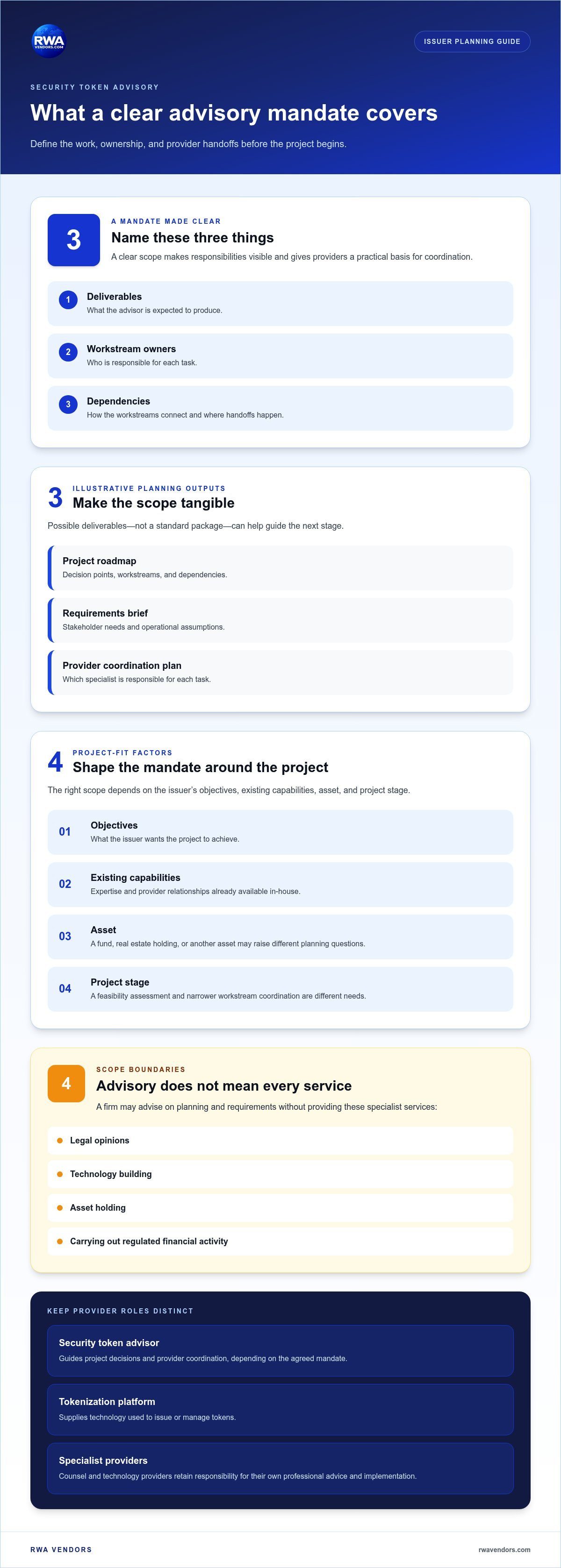
A security token advisory mandate can range from an initial project assessment to coordination across several offering workstreams. Its scope depends on the issuer’s objectives, existing capabilities, asset, and project stage. Treat the services below as possible components, not a standard package. A firm may advise on planning and requirements without providing legal opinions, building technology, holding assets, or carrying out regulated financial activity.
A clear mandate identifies the deliverables, the owner of each workstream, and the dependencies between them. This makes responsibilities visible before work begins. For example, an advisor may document requirements for counsel and a platform provider, while those specialists remain responsible for their own professional advice or technology implementation.
Strategy, structuring, and offering preparation
At the planning stage, an advisor may help an issuer define the project’s purpose, target stakeholders, key decisions, and operating model. Asset characteristics matter: a fund, real estate holding, or other asset can raise different planning questions about how the offering is organized and administered. The advisor can map these questions and coordinate discussions with legal and compliance specialists, without replacing their independent work.
Useful outputs might include:
- A project roadmap with decision points, workstreams, and dependencies.
- A requirements brief covering stakeholder needs and operational assumptions.
- A provider coordination plan showing which specialist is responsible for each task.
These deliverables should be specific enough to guide the next stage. “Support the offering” is difficult to measure. A roadmap, documented requirements, or agreed coordination responsibilities gives the issuer a clearer basis for tracking progress.
Technology, operations, and provider coordination
Some mandates include documenting requirements for the technology and operating model. An advisor may help an issuer compare needs for issuance workflows, investor onboarding, transfer administration, custody, and ongoing servicing, then coordinate discussions with relevant specialists. This is requirements planning, not software development or asset custody. A platform provider implements or operates technology within its scope; a custody provider is responsible for custody under its own arrangements.
Responsibilities vary by project. An advisor might coordinate a handoff between the issuer, a technology provider, and a transfer or servicing provider. The issuer retains project decisions, and each specialist delivers its defined function. Issuers mapping those dependencies can also review digital asset infrastructure providers to understand the wider provider landscape.
For advisory firms, precise descriptions of these workstreams make their role easier to understand. Firms seeking directory visibility can create a vendor directory listing that presents their specialties and service scope to issuers.
How to evaluate security token advisory firms for project fit
A useful comparison starts with your project’s requirements, not a firm’s reputation or broad claims of expertise. A familiar name may bring relevant experience, but that alone doesn’t establish fit for every asset, offering structure, or stage. Review concrete examples of comparable work and establish what the firm will deliver, who is responsible, and which specialist providers the work depends on.
Assess experience against the asset and project stage
Compare a firm’s experience with both your asset type and the stage you’ve reached. Experience advising on a fund may not demonstrate fit for a real estate issuer, and launch preparation differs from planning or post-launch coordination. Look for examples that explain the firm’s role, project context, and completed work, rather than relying on client names or claims of “end-to-end” expertise alone.
Use a comparison table to assess security token advisory firms consistently. Adapt the entries to your project and record gaps as points to resolve, not automatic proof of poor fit.
| Comparison area | What to record | Fit question |
|---|---|---|
| Project stage | Planning, launch preparation, or post-launch needs | Does the firm’s experience match the work required now? |
| Asset experience | Relevant asset types and offering structures | Can it describe comparable work and its specific role? |
| Scope | Included workstreams and exclusions | Is the proposed role clear and bounded? |
| Deliverables | Roadmaps, requirements, coordination plans, or other outputs | Can your team assess completion against defined outputs? |
| Dependencies | Legal, compliance, platform, custody, and servicing inputs | Are owners and handoffs identified? |
Compare scope, deliverables, and coordination
Turn each proposal into a workstream map. For every activity, record the deliverable, responsible party, and input needed from others. For instance, an advisory roadmap may depend on issuer decisions and legal or compliance specialist input, while platform configuration belongs to the technology provider’s scope. This makes gaps and overlaps visible before they become coordination problems. For background on compliance dimensions issuers may need to map, review this guide to compliant asset tokenization.
Directory verification and profile visibility help issuers discover providers and understand how a firm describes its specialties. They aren’t an independent assessment of whether the firm suits a particular mandate, nor do they establish the quality of a proposed project plan. Treat directory information as a starting point for comparison, then assess experience, responsibilities, deliverables, and dependencies against your requirements.
The strongest fit is the firm whose documented scope addresses the project’s actual needs, with clear boundaries around specialist legal, compliance, and technical responsibilities. This standard applies whether the firm is widely recognized or less familiar.
How issuers can organize a search for security token advisors
A focused search starts with a project brief, not a list of firm names. Define the asset, intended offering, jurisdictional scope, current stage, and capabilities already available in-house. These details help distinguish which expertise is needed now from work that can wait for a later phase. They also make searches for security token advisory firms more precise than relying on a single broad label.
Translate the project into search requirements
Record the project’s purpose, target stakeholders, asset characteristics, and decisions already made. Then separate essential expertise from optional capabilities and future-phase requirements. For example, a project still assessing feasibility may need planning support before it needs detailed technology implementation. Search by the workstreams involved, such as offering strategy, tokenization project coordination, compliance support, or platform requirements, as well as by the phrase “security token advisor.”
- Asset and offering: Describe the asset type, intended offering, and key stakeholder groups.
- Jurisdictional scope: Identify the jurisdictions relevant to the project so specialist needs can be scoped appropriately.
- Project stage: Mark whether the work concerns early planning, launch preparation, or post-launch operations.
- Internal capabilities: Note which functions your team can lead and where external expertise or coordination is needed.
- Priorities: Separate required work from optional support and needs that belong to a later phase.
This brief becomes the basis for search terms and an initial shortlist. It also helps prevent a common mismatch: selecting a firm for broad experience when the immediate need is a specific deliverable or defined coordination role.
Build a coordinated provider shortlist
Group potential providers by function rather than treating every company as an advisor. A working shortlist might include:
- Advisory: Project planning, requirements development, and coordination.
- Legal: Counsel for legal analysis and documentation.
- Compliance: Specialists for relevant compliance workstreams.
- Custody and servicing: Providers responsible for their defined asset or ongoing operational functions.
- Technology: Platforms and infrastructure providers for implementation needs.
For each category, record the expected role, required input, and handoff to the next provider. A platform’s requirements may depend on decisions made by the issuer and its specialists; custody and servicing arrangements may also affect operational planning. The institutional digital asset partners guide outlines related provider categories to include in this ecosystem view.
RWA Vendors offers a structured directory where issuers can browse and filter providers across tokenized capital markets. Advisory firms can present their specialties and service scope through a directory listing.
How security token advisory firms can make their expertise discoverable
Clear positioning helps issuers understand what an advisory firm does before they begin a conversation. A concise profile should identify the firm’s actual workstreams, relevant asset experience, project stages, and boundaries with adjacent providers. This is more useful than broad claims such as “full-service tokenization,” which may leave issuers unsure whether the firm advises, coordinates specialists, or delivers technology.
Present advisory capabilities in issuer-friendly language
Describe services in terms of issuer needs and concrete outputs. Explain whether the firm supports project planning, requirements development, provider coordination, launch preparation, or post-launch work. If the firm covers several areas, separate them rather than grouping every capability under a single end-to-end claim. Specific language helps issuers compare profiles against their project brief.
Give context for experience without overstating it. For example, a firm might describe prior work with fund issuers during planning or explain its role coordinating providers for a real estate tokenization project. Include examples the firm can substantiate, and clarify whether the work involved strategy, project management, or another defined contribution.
A useful profile can make these distinctions easy to scan:
- Asset experience: Identify relevant asset types and the nature of the firm’s involvement.
- Project stage: State whether capabilities apply to planning, launch preparation, or ongoing coordination.
- Workstreams: Name the services directly, such as project scoping or provider coordination.
- Boundaries: Distinguish advisory coordination from legal opinions, compliance services, and technology implementation delivered by separate specialists.
- Related capabilities: Describe partner or ecosystem relationships accurately without implying that another provider’s work is the firm’s own.
These details help an issuer understand the firm’s role and form a more focused shortlist. They also make it easier for firms to be discovered for the work they actually perform, rather than for a generic label.
Use directory categories to improve discovery
A structured global directory gives issuers a way to browse provider categories across the tokenization ecosystem, including advisory, legal, compliance, custody, trading, infrastructure, and payments. Categorization helps distinguish firms with complementary responsibilities and supports a coordinated search across the project lifecycle.
A directory profile is a discovery resource, not a determination that a firm suits every mandate. A verified profile can improve visibility within the provider ecosystem, but it doesn’t guarantee project fit, leads, or commercial outcomes. Issuers still assess experience, scope, deliverables, and dependencies against their needs. For advisory firms, precise profile information gives that assessment a stronger starting point.
Make your firm's specialties and service scope easier for issuers to find with a RWA Vendors directory listing.
Make your next step a clearer market presence
For security token advisory firms, expertise supports issuer decisions only when its scope is easy to recognize. Treat public positioning as an extension of project discipline: make the work legible, describe your role precisely, and keep examples aligned with the mandates your team can support. That clarity can help issuers begin a more focused provider search.
RWA Vendors provides a global directory spanning tokenization technology and professional-service categories. Its categorized discovery and structured vendor profiles help issuers explore the provider ecosystem, while firms can present their capabilities in context. A listing supports visibility, while project suitability and outcomes remain specific to each issuer’s requirements and provider relationships.
Use your directory presence to make your specialties and service boundaries easier to understand. A precise profile gives prospective partners a stronger starting point for a substantive conversation.
Bring your expertise into clearer view and help issuers find the right place to start.
Frequently Asked Questions
What does a security token advisory firm do?
A security token advisory firm may help an issuer plan a project or coordinate selected workstreams. Its remit could include comparing operating-model options or translating business needs into questions for specialist teams. For example, an issuer might engage an advisor for a readiness assessment while separately contracting counsel and a platform provider. Review the firm’s stated outputs and responsibilities; its title alone doesn’t establish legal authority, software delivery, custody, brokerage, or financial-service capability.
How do I choose a security token advisory firm?
Match documented experience to your asset, project stage, and unresolved tasks. Review a relevant example and clarify what the firm itself delivered, rather than relying on a client name or broad expertise claim. Then compare the proposed work against your team’s existing capabilities. If your organization has already selected a platform, for instance, focus on whether the advisor’s defined scope covers remaining planning or coordination needs without duplicating work assigned elsewhere.
Do security token advisory firms provide legal and compliance advice?
Some firms may coordinate legal or compliance workstreams, but that doesn’t necessarily mean they provide formal legal opinions or jurisdiction-specific advice. Those services should be clearly assigned to appropriately qualified professionals. Separate project planning, such as identifying questions for counsel, from the professional advice itself. Review the mandate for precise boundaries, including who is responsible for interpreting requirements, preparing legal documents, and handling compliance tasks relevant to the issuer’s structure.
What should a security token advisory engagement include?
An engagement should connect its objective to defined work and outputs. It may specify project assumptions, included workstreams, expected deliverables, responsible parties, and information or decisions needed from the issuer. For example, a planning engagement could identify a roadmap as an output and document which specialist inputs inform it. The exact scope depends on the project; legal, technical, custody, and operational implementation may sit with separate providers.
Are security token advisory firms the same as tokenization platforms?
No. An advisory firm provides project guidance or coordination within its agreed remit, while a tokenization platform supplies technology for specified issuance or lifecycle functions. An issuer could use a platform for a particular workflow and engage an advisor to assess project requirements. Neither role automatically covers the other: platform software doesn’t itself provide strategic or legal expertise, and an advisor doesn’t necessarily build or operate software.
How can security token advisory firms reach issuers looking for providers?
Firms can make their capabilities easier to discover through clear service categories, concise descriptions, and supportable examples of relevant assets and project stages. RWA Vendors’ global directory lets issuers browse provider profiles across tokenization technology and professional-service categories. A profile can help communicate a firm’s role within that ecosystem, but directory visibility is a discovery channel, not proof of project suitability or a promise of leads or commercial results.
Disclaimer
This article is provided by RWAVendors.com for general informational and educational purposes only. It does not constitute legal, financial, investment, tax, regulatory or other professional advice, or an offer, solicitation, recommendation or endorsement of any company, product, service, token, security or investment. RWAVendors.com is an informational vendor directory and does not sell, issue, broker, custody or facilitate transactions involving cryptocurrencies, digital tokens, tokenized assets, securities or investment products. Some vendor listings and references may involve paid advertising, sponsored placement or membership relationships. These relationships do not guarantee a vendor’s qualifications, regulatory status, performance or suitability. Information may be incomplete, outdated or subject to change. You should independently verify all information, conduct your own due diligence and consult qualified professionals before making any business or investment decision. RWAVendors.com is not responsible for the content, services, representations or actions of third-party vendors or linked websites.


