
Can an asset become easier to transfer without becoming easier to sell? That distinction sits at the heart of the tokenization impact on asset liquidity. Tokenization can make ownership records and transfers more efficient, but a transferable token doesn’t create buyers, trading venues, or market depth on its own.
Digital ownership may reduce friction or widen access, but whether those advantages translate into actual trading depends on other conditions: the asset’s characteristics, legal and compliance arrangements, operating processes, custody, payments, and distribution to eligible participants.
This article separates what tokenization changes from what still governs liquidity. You’ll learn how to assess claims across market access, legal structure, operations, and asset-level demand, and how to compare tokenized assets with conventional ones without confusing transferability with tradability. We’ll also examine the provider categories involved in tokenized markets, from blockchain infrastructure and custody to compliance, trading, and payments. The goal is a practical basis for evaluating liquidity claims, not an assumption that putting an asset on-chain guarantees an active market.
Key Takeaways
- Separate an asset’s saleability, the depth of its market, and the mechanics of transferring its token. These measure different aspects of liquidity.
- Assess the tokenization impact on asset liquidity across issuance, transfer, settlement, and servicing, while distinguishing process efficiencies from buyer demand.
- Use a consistent framework to compare technical transferability with executable trades and sustained market depth.
- Evaluate liquidity claims by examining represented asset rights, investor access, trading venues, restrictions, and evidence of actual activity.
- Map market needs to the relevant technology, compliance, custody, trading, and payment provider categories. Coordinated capabilities support market operations but don’t guarantee liquidity.
Tokenization’s impact on asset liquidity: what changes and what does not
Tokenization represents rights to an asset digitally, typically through a record on a blockchain or another digital ledger. It can change how ownership is recorded and how a transfer is processed. It does not, by itself, create buyers or ensure that a sale can be completed.
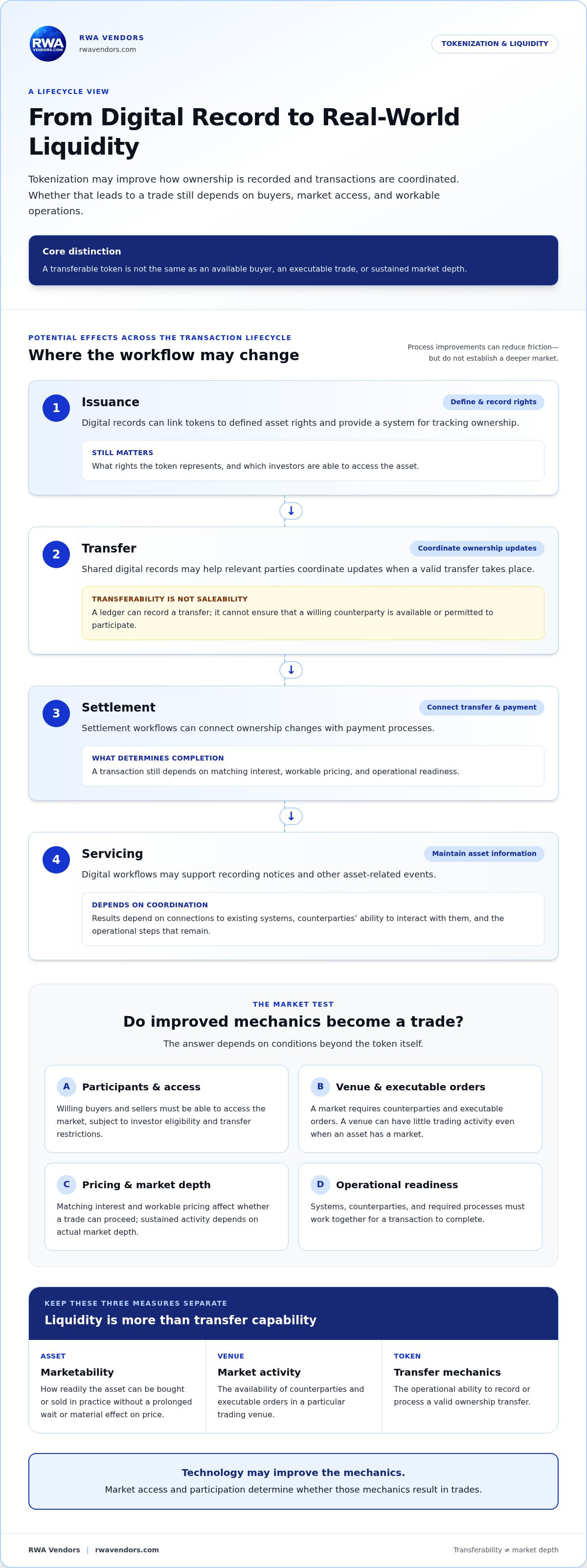
Liquidity is the practical ability to transact without undue delay or price impact. To assess the tokenization impact on asset liquidity, keep three related ideas separate: the asset’s marketability, the activity and depth of a particular trading venue, and the operational ability to transfer the token. Digital transfer may reduce friction, but whether that leads to a trade still depends on market conditions.
What does asset liquidity mean in a tokenized market?
Asset liquidity describes how readily an asset can be bought or sold in practice without a prolonged wait or a material effect on price. Market liquidity is more specific: it reflects the availability of counterparties and executable orders in a given venue. An asset may have a market, yet a particular venue may have little trading activity.
Liquidity varies with the asset, the investor base able to access it, applicable transfer restrictions, and actual market activity. A token’s presence in a decentralized finance ecosystem, where liquidity pools are one possible market mechanism, does not establish that this particular asset has buyers, sufficient market depth, or an accessible trading route.
Token transferability is not the same as liquidity
A ledger can record an ownership change when a valid transfer occurs. That technical capability doesn’t mean a counterparty is available, a trade can execute at an acceptable price, or an investor is permitted to participate. Settlement technology addresses how a transaction may be recorded or completed. Demand and market depth determine whether there’s a meaningful transaction to settle.
Hypothetical example: An issuer creates digital tokens representing interests in an asset, and its ledger can process transfers between eligible holders. If no eligible buyer wants to purchase a holder’s tokens, the transfer capability alone won’t produce a sale. If a buyer does appear, restrictions, venue access, pricing, and operational readiness may still affect whether the transaction can proceed.
This distinction is central to evaluating claims about tokenization. Ask whether a claim concerns faster or simpler ownership transfer, access to a functioning market, or sustained trading activity. These are different outcomes. Tokenization can improve transaction mechanics, but it cannot substitute for willing market participants and workable arrangements.
How tokenization can affect asset liquidity across the transaction lifecycle
The potential effects of tokenization extend beyond the moment an investor buys or sells. A digital representation can shape how ownership is recorded, transfers are initiated, settlement is coordinated, and asset-related information is maintained. Each stage may benefit from clearer or more integrated workflows, but process improvements alone don’t establish a deeper market.
Where digital ownership records may reduce friction
At issuance, digital records can link tokens to defined asset rights and provide a system for tracking ownership. During a transfer, shared records may help relevant parties coordinate updates. Settlement workflows can connect ownership changes with payment processes, while servicing may involve recording notices or other asset-related events.
These are potential coordination benefits, not universal promises of faster or cheaper transactions. Results depend on how the ledger connects with existing systems, whether counterparties can interact with it, and which operational steps still apply. The World Economic Forum report on asset tokenization also examines implementation barriers alongside potential value, underscoring that market infrastructure matters as much as the digital representation.
Why fractionalization and continuous availability are not liquidity guarantees
Dividing an asset’s represented rights into smaller interests may change the participation threshold for some structures. That can widen the pool of potential participants, depending on the asset, its terms, and who can access the market. It doesn’t establish that additional buyers will participate or that holders will find counterparties when they want to sell.
Likewise, a token or venue being technically available for transfers doesn’t mean active orders are present. A market needs participants willing and able to transact, and completed trades depend on matching interest, workable pricing, and operational readiness. Availability is a capability; order flow and market depth are evidence of activity.
In short, tokenization can influence the recording, coordination, divisibility, transfer, and settlement of asset interests, but it cannot by itself create investor demand, executable orders, or sustained market depth. That distinction clarifies the tokenization impact on asset liquidity across the lifecycle: technology may improve the mechanics, while market access and participation determine whether those mechanics result in trades.
Liquidity outcomes depend on coordinated capabilities across technology, compliance, custody, trading, and payments. Providers building those parts of the ecosystem can explore a vendor listing to make their capabilities discoverable to businesses working across tokenized markets.
What determines whether a tokenized asset can trade in practice?
The tokenization impact on asset liquidity depends on more than whether a token can move between digital wallets. In practice, trading depends on the asset’s characteristics, who can participate, where orders can meet, what restrictions apply, and whether the operating infrastructure can complete the transaction. Use these factors to distinguish technical capability from a functioning market.
| Dimension | Technical transferability | Executable trading | Sustained market depth |
|---|---|---|---|
| Asset and rights | A token can be transferred under system rules. | The represented rights are clear enough for eligible participants to transact. | Buyers and sellers continue to value and trade those rights. |
| Access and venue | A ledger or platform supports transfers. | Eligible buyers and sellers can access a venue and submit compatible orders. | Participation and order flow persist rather than depending on isolated trades. |
| Restrictions and operations | The system can process a transfer that meets its technical conditions. | Transfer controls, custody, identity processes, and settlement workflows align. | Those arrangements remain workable as trading activity continues. |
Market depth, counterparties, and price discovery
Market depth is the availability of buy and sell interest across a range of prices. A single completed trade shows that a transaction occurred; it doesn’t prove that other holders can sell, that buyers will remain available, or that another trade can happen without a substantial price change. Assess whether counterparties can access the venue, whether both sides are active, and whether prices reflect actual executable interest. A listing or displayed quote alone is not evidence of demand. For more on venue design and institutional participation, see this security token secondary markets guide.
Transfer restrictions, compliance, and infrastructure
Eligibility rules and transfer controls can narrow the pool of potential counterparties. Even where a buyer and seller are interested, identity checks, custody arrangements, venue rules, and settlement processes must work together for a transaction to complete. A token may be technically transferable while a proposed transfer is restricted or the necessary operational steps cannot be completed.
Evaluate the full transaction path, not just the ledger: who can access the venue, how transfers are controlled, how assets are held, and how payment and settlement are coordinated. The compliant asset tokenization guide offers further context on how compliance considerations fit into these arrangements. Fragmented venues or limited eligible participation can constrain trading even when the token itself can move.
How to evaluate claims about tokenization and asset liquidity
Liquidity claims often combine three different things: what the technology can do, what a market has already done, and what someone expects it to do later. Separate them before drawing conclusions. Assess the tokenization impact on asset liquidity against evidence for the specific asset, venue, investor base, and period being discussed.
Five questions that test a liquidity claim
Use these questions to examine the claim’s scope and supporting evidence:
- 1. What rights does the token represent? Identify the underlying asset interest and the terms attached to ownership. A token label alone doesn’t establish what a holder can own or transfer.
- 2. Where can it actually trade? Identify the venue or transaction mechanism, and distinguish an active market from a token being technically transferable or merely listed.
- 3. Who can participate? Clarify which investors can access the venue and whether eligibility conditions limit the available pool of buyers and sellers.
- 4. What does the activity measure? Separate completed transactions from indicative interest, displayed quotes, or planned functionality. For completed trades, consider whether the cited activity concerns this asset and the relevant time period.
- 5. What must work for a transaction to complete? Account for transfer rules, identity processes, custody, trading systems, and settlement arrangements. A technical feature may depend on several operational steps before a trade can be executed.
Then examine pricing evidence alongside trading activity. A quoted price may not reflect an executable offer, while an isolated transaction may not show whether meaningful depth exists at other prices or later dates.
Separate current evidence from future-market assumptions
Label each supporting point clearly. Existing functionality describes what the technology and operating arrangements currently permit. Observed activity describes transactions that have actually occurred, with their asset, venue, and time period identified. Anticipated development covers planned features, expected participation, or projections about future market growth.
Projections may help describe a strategy, but they rely on future participation and market conditions. Don’t treat them as evidence of present trading. Nor should an asset be called liquid or illiquid without context: the conclusion depends on what is being traded, who can access the market, and the quality and scope of the available evidence.
Evaluate liquidity using market evidence, not tokenization claims alone. This keeps technical capability, completed activity, and future assumptions distinct, and makes comparisons more consistent.
Build a tokenization ecosystem with liquidity in view
Liquidity is an ecosystem outcome, not a feature delivered by a token alone. Asset design defines the rights being represented; investor access and trading arrangements shape who can participate; and operational coordination determines whether transactions can move through the required steps. The tokenization impact on asset liquidity therefore depends on how these elements fit together for a specific market.
Provider capabilities that support market readiness
Different provider categories support different parts of the operating environment. Their roles can connect across a transaction lifecycle, but infrastructure capability is not evidence of buyer demand or market depth.
- Technology providers support token issuance, ownership records, and transaction workflows.
- Compliance providers help businesses address eligibility processes, controls, and related requirements.
- Custody providers support the safekeeping and administration arrangements for digital assets.
- Trading providers supply venues and systems through which eligible participants may submit or match orders.
- Payment providers support the movement of funds associated with transaction and settlement workflows.
These capabilities need to work across systems and counterparties. For example, a trading venue may depend on compatible custody arrangements, transfer controls, and payment workflows for a transaction to complete. Coordination can support market readiness, but it cannot guarantee that participants will trade, that buyers will be available, or that an asset will have sustained liquidity.
Discover relevant vendors through RWA Vendors
RWA Vendors is a global discovery directory connecting asset issuers with verified tokenization platforms and service providers. Issuers can browse and filter provider categories for different stages of real-world asset tokenization, including technology, legal and compliance, custody, trading, and payments. This gives businesses a way to identify relevant capabilities as they assess the requirements of a tokenized asset project.
For providers, a directory listing offers a way to present their capabilities to businesses researching the ecosystem. A listing is a discovery resource, not evidence of trading activity or liquidity performance. Market design still depends on the asset, its access arrangements, and the coordinated operation of the services supporting it.
Build for market readiness, not transferability alone
The tokenization impact on asset liquidity is best understood by separating digital transfer capability from the conditions that support actual trading. A token can streamline ownership records and transaction workflows, but buyer access, asset characteristics, restrictions, market activity, and operational readiness shape whether trades can take place.
Assess liquidity claims against evidence tied to the specific asset and venue. Distinguish completed transactions from technical functionality and future projections, and consider how market access, compliance, custody, trading, and payment processes work together. Liquidity is not a standalone technology feature; it reflects how well the asset and its supporting market ecosystem are designed and coordinated.
RWA Vendors provides a global directory where businesses can browse and filter providers across legal compliance, custody, trading, blockchain infrastructure, and payments. Issuers researching real-world asset tokenization and digital securities services can use these categories to identify capabilities relevant to their projects. For providers, a listing creates a way to present those capabilities to the ecosystem.
Thoughtful market design starts with clear evidence and coordinated capabilities. Browse the RWA Vendors directory to find providers supporting the requirements of tokenized markets, or list your services to help issuers discover your capabilities.
Frequently Asked Questions
Does tokenization automatically increase an asset’s liquidity?
No. Tokenization can make ownership records and transfers digital, but it doesn’t create buyers, an active trading venue, or market depth. The tokenization impact on asset liquidity depends on factors such as the asset’s characteristics, eligible investor base, access to trading, transfer restrictions, and operational arrangements. Evaluate claims using evidence of actual transactions and market participation, not the existence of a token or the ability to transfer it.
How can tokenization improve asset liquidity?
Tokenization may support more coordinated ownership records and transaction workflows, which can reduce some administrative friction. Dividing interests into smaller units may also change participation thresholds for certain structures. These features can help enable transactions, but they don’t demonstrate that more investors will participate or that buyers will be available. Any liquidity effect depends on how the asset, market access, trading arrangements, and supporting operations work together.
Can tokenized assets be traded 24/7?
Not necessarily. A blockchain or platform may support transfers outside conventional market hours, but that doesn’t mean an asset can be traded at every moment. Trading depends on the venue’s operating arrangements, eligible participants, available counterparties, and applicable restrictions. Payment, custody, and settlement processes may also affect when a transaction can be completed. Distinguish continuous technical availability from continuous order flow and completed trades.
What is the difference between token transferability and asset liquidity?
Token transferability means a digital ledger or platform can record an ownership change when its conditions are met. Asset liquidity is the practical ability to transact without undue delay or price impact. A transferable token may have no willing buyer, or a proposed transaction may face access, restriction, or operational constraints. Transferability describes a technical capability; liquidity depends on market participants and executable trading conditions.
Does fractional ownership make tokenized assets easier to sell?
Fractional ownership can divide represented rights into smaller interests and may broaden potential participation in some structures. It doesn’t assure that additional investors will be interested, eligible, or able to access the market. Each fraction still needs a buyer, a workable trading venue, and compatible transfer and settlement processes. Assess actual market activity for the specific asset rather than treating divisibility as proof that interests can be sold readily.
How do transfer restrictions affect tokenized asset liquidity?
Transfer restrictions can limit who may hold or receive a token, narrowing the pool of potential counterparties. Controls may also add steps to a transaction, such as verifying eligibility before an ownership change is recorded. These conditions can affect whether a trade can proceed even if the token is technically transferable. For a useful assessment, consider the asset’s transfer rules alongside venue access, identity processes, custody, and settlement workflows.
How should institutions assess tokenized asset liquidity claims?
Institutions should separate existing technical functionality, observed trading activity, and projections about future markets. Identify the rights represented by the token, the venue, who can participate, and what restrictions apply. Then determine whether cited evidence reflects completed transactions, indicative interest, or planned functionality, and note the asset and time period covered. The tokenization impact on asset liquidity should be judged from relevant market evidence and operational conditions, not technology claims alone.
Disclaimer
This article is provided by RWAVendors.com for general informational and educational purposes only. It does not constitute legal, financial, investment, tax, regulatory or other professional advice, or an offer, solicitation, recommendation or endorsement of any company, product, service, token, security or investment. RWAVendors.com is an informational vendor directory and does not sell, issue, broker, custody or facilitate transactions involving cryptocurrencies, digital tokens, tokenized assets, securities or investment products. Some vendor listings and references may involve paid advertising, sponsored placement or membership relationships. These relationships do not guarantee a vendor’s qualifications, regulatory status, performance or suitability. Information may be incomplete, outdated or subject to change. You should independently verify all information, conduct your own due diligence and consult qualified professionals before making any business or investment decision. RWAVendors.com is not responsible for the content, services, representations or actions of third-party vendors or linked websites.


