
The assumption that tokenization automatically guarantees liquidity is one of the most persistent misconceptions in digital finance. In 2026, sophisticated market participants understand that liquidity is not an inherent property of a digital asset but a product of the underlying ecosystem. Navigating security token secondary markets requires more than just technical connectivity; it demands a deep alignment with regulated venues that can facilitate consistent cross-border volume. You've likely encountered the frustration of fragmented order books and the regulatory complexities that come with trading across jurisdictions. It's clear that the gap between a successful issuance and a liquid secondary market is often wider than anticipated.
This guide serves as your institutional roadmap to bridging that gap. You'll discover how the most resilient secondary markets for security tokens are structured to meet institutional standards and how to evaluate the infrastructure providers currently leading the sector. We provide a comprehensive map of the current ecosystem, a framework for vetting trading platforms, and a direct path to the verified liquidity providers that empower your firm to build and scale with confidence. By the end of this resource, you'll have the clarity required to select partners that maintain the integrity of your digital asset strategy.
Key Takeaways
- Define the fundamental architecture of security token secondary markets and their distinct role as regulated venues for digital asset trading in 2026.
- Identify the core pillars of liquidity, including the operational differences between Alternative Trading Systems (ATS), Multilateral Trading Facilities (MTF), and institutional market makers.
- Analyze primary institutional challenges such as fragmented liquidity and cross-chain interoperability to develop a more resilient trading strategy.
- Establish a professional framework for evaluating infrastructure providers based on jurisdictional licensing, settlement efficiency, and custody integration.
- Utilize the RWA Vendors directory to efficiently source and connect with vetted global partners across the secondary market ecosystem.
Understanding Security Token Secondary Markets in 2026
Security token secondary markets are the regulated environments where digital securities are traded after their initial issuance. In 2026, these markets have matured into institutional-grade venues that facilitate the transfer of ownership for tokenized real-world assets (RWAs). Unlike the primary issuance phase, which focuses on capital formation and the initial minting of tokens, the secondary cycle is dedicated to price discovery and liquidity. This phase is essential because it allows investors to enter or exit positions without waiting for the underlying asset's maturity. The existence of a robust secondary market is what transforms a static digital investment into a dynamic financial instrument.
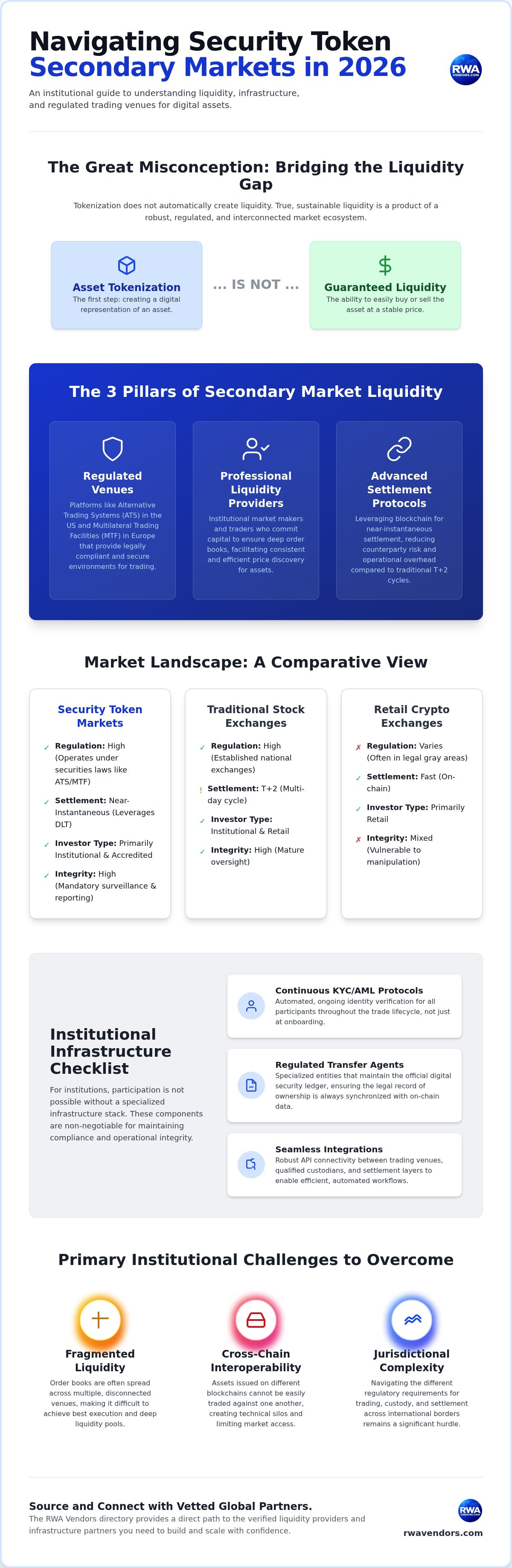
These markets differ fundamentally from both traditional stock exchanges and retail cryptocurrency platforms. Traditional exchanges often rely on complex, multi-day settlement cycles; conversely, security token venues leverage blockchain technology for near-instantaneous settlement. While retail crypto exchanges frequently operate in regulatory gray areas, security token secondary markets must adhere to strict financial oversight. They function as Alternative Trading Systems (ATS) in the United States or Multilateral Trading Facilities (MTF) in Europe. This ensures every transaction meets legal standards for investor protection and market integrity.
The Evolution of Digital Security Trading
The transition from manual bulletin boards to automated matching engines has been rapid. Early iterations of the industry relied on "over-the-counter" style listings that lacked transparency and speed. By 2026, the ecosystem has shifted toward high-frequency matching engines and institutional liquidity providers. This evolution is driven by the implementation of the Markets in Crypto-Assets (MiCA) regulation in the EU and updated SEC ATS rules. These frameworks provide the legal certainty required for major financial institutions to commit significant capital. It's this regulatory clarity that makes 2026 a definitive turning point for RWA trading volume.
Key Components of a Regulated Market
A functional secondary market requires a specialized infrastructure stack to maintain compliance and operational integrity. The following components are non-negotiable for institutional participation:
- KYC/AML Protocols: Identity verification is not a one-time event. Secondary venues utilize automated checks to ensure that both buyers and sellers remain compliant with jurisdictional requirements throughout the trade lifecycle.
- Transfer Agents: These entities play a vital role by updating the official digital security ledger. They ensure the legal record of ownership matches the on-chain data in real-time.
- Infrastructure Integration: Successful trading depends on seamless connections between venues, custodians, and settlement layers. For a deeper look at these relationships, consult our Institutional Guide to Digital Asset Infrastructure Providers in 2026.
The Pillars of Secondary Market Liquidity
In 2026, liquidity within security token secondary markets is no longer a theoretical goal but a structured reality supported by three fundamental pillars: regulated venues, professional liquidity providers, and advanced settlement protocols. While the primary issuance phase creates the digital asset, these pillars ensure that the asset remains viable for institutional portfolios. Without a coordinated interaction between these components, even the most high-quality real-world asset (RWA) remains static. Institutional participants now prioritize infrastructure that offers transparency, regulatory compliance, and deep order books.
Regulated Trading Venues (ATS & MTF)
Regulated trading venues serve as the primary gateways for institutional participation. Alternative Trading Systems (ATS) in the United States and Multilateral Trading Facilities (MTF) in Europe operate under established securities laws to provide a secure environment for digital asset exchange. These venues are characterized by their rigorous surveillance and reporting requirements, which protect against market manipulation. In 2026, the most successful venues offer robust API connectivity, allowing institutional order management systems (OMS) to route trades with minimal friction. While some platforms explore decentralized matching engines for increased transparency, centralized engines remain the institutional preference due to their superior throughput and low-latency execution.
The Role of Institutional Market Makers
Professional liquidity providers are the lifeblood of security token secondary markets. Without their presence, assets often suffer from wide bid-ask spreads that deter large-scale entry and exit. These firms commit capital to maintain continuous quotes, ensuring that tokenized fund structures or real estate interests remain tradable throughout market cycles. Incentive structures, such as liquidity rebates or direct participation in issuance fees, encourage these providers to support newer tokens. Their interaction with tokenized assets provides the necessary depth for institutional investors to execute significant orders without causing excessive slippage.
Beyond traditional matching and market making, 2026 has seen the rise of DeFi-inspired mechanisms adapted for regulated environments. Permissioned liquidity pools allow for automated market making (AMM) while ensuring all participants are KYC-verified. This hybrid approach combines the efficiency of on-chain protocols with the safety of traditional finance. Parallel to this innovation is the move toward atomic settlement. By enabling T+0 settlement cycles, the industry has effectively eliminated the counterparty risk inherent in legacy T+2 systems. This shift to real-time delivery versus payment (DvP) is a defining feature of the current landscape. Identifying the right partners to facilitate these complex trades is essential; many firms choose to list their services within verified directories to simplify the connection process between issuers and liquidity providers.
Institutional Challenges in Secondary Trading
Institutional adoption of security token secondary markets faces several structural obstacles that can impede capital efficiency. While the infrastructure is more robust than in previous years, participants must still manage the complexities of a transitioning financial landscape. Identifying these challenges early allows firms to implement more resilient trading and custody strategies. It's no longer enough to simply issue a token; firms must actively manage the environment in which that token trades.
Fragmented liquidity remains a significant hurdle. When assets are listed on multiple siloed platforms without shared order books, market depth suffers. This isolation prevents the formation of a unified global price and increases slippage for large institutional orders. Without a centralized hub or interconnected network, liquidity remains trapped within individual walled gardens. This fragmentation often leads to price discrepancies between venues, creating inefficiencies that institutional traders must navigate with sophisticated routing tools.
Interoperability and regulatory friction further complicate the environment. If a security token exists on one blockchain but a trading venue operates on another, moving that asset requires complex bridging or wrapping protocols. These technical hurdles can fragment liquidity further across different chain ecosystems. Simultaneously, managing global investor access requires a dynamic approach to compliance. Venues must verify that every participant meets specific jurisdictional requirements, which often vary by asset class and investor type. This creates a high barrier to entry for cross-border trading volume.
Solving the Fragmentation Problem
To address these silos, 2026 has seen the rise of liquidity aggregators. These institutional tools sit above individual venues to provide a consolidated view of order books across multiple security token secondary markets. Standardization is also critical. Utilizing protocols like ERC-3643 ensures that tokens move between platforms while maintaining embedded compliance rules. This technical alignment is a core component of Compliant Asset Tokenization, which reduces the friction associated with moving assets between different secondary venues.
Real-Time Valuation for Secondary Markets
Accurate valuation is essential for trading traditionally illiquid real-world assets. Traditional private market valuations are often periodic and opaque, leading to significant information asymmetry. In 2026, digital oracles provide 24/7 valuation by feeding verified on-chain and off-chain data directly into trading environments. This transparency helps manage the bid-ask spread by providing a reliable reference price for both buyers and sellers. Key valuation factors include:
- On-chain transparency: Real-time access to the underlying asset's performance data through smart contracts.
- Oracle integration: Automated price feeds from trusted third-party providers that bridge off-chain appraisals with on-chain markets.
- Market depth analysis: Constant evaluation of the order book to determine the impact of large trades on the asset's current price.
Transparent pricing mechanisms ensure that even emerging RWA markets maintain the integrity required for institutional-grade trading. By leveraging these technologies, firms can mitigate the risks associated with price volatility and illiquidity. This shift toward real-time data is what allows private assets to trade with the frequency and transparency typically reserved for public markets.
Evaluating Secondary Market Infrastructure Providers
Selecting a robust infrastructure partner is a critical decision for any issuer or asset manager. In 2026, security token secondary markets are defined by the quality and reliability of their vetted providers. Due diligence must extend beyond surface-level features to include a deep analysis of regulatory standing and technical resilience. A failure in the infrastructure layer can lead to trapped liquidity or compliance breaches, both of which carry significant institutional risk.
Verification of jurisdictional licenses is the primary step in any evaluation. A provider operating as an Alternative Trading System (ATS) in the United States or a Multilateral Trading Facility (MTF) in Europe must demonstrate active compliance with SEC, FINRA, or ESMA requirements. The technology stack must offer seamless custody integration to ensure that assets remain secure throughout the trade lifecycle. Settlement speed is equally vital. High-performing providers demonstrate a clear path to atomic settlement, which effectively eliminates the counterparty risk inherent in legacy financial systems.
An institutional track record is evidenced by consistent order book depth and historical volume. Assess how the provider handles compliance automation. Effective whitelist management ensures that only eligible investors can trade specific tokens. This automated oversight is essential for maintaining the regulatory integrity of the asset across different jurisdictions. Historical performance data serves as a proxy for future reliability; therefore, evaluate the bid-ask spreads across various market conditions to understand how the provider’s liquidity partners perform during periods of volatility.
A Checklist for Infrastructure Due Diligence
Not all platforms are optimized for every asset class. A venue specializing in real estate may not have the necessary framework for complex private equity structures. Consider the following criteria during your selection process:
- Asset Class Compatibility: Does the provider support the specific legal and technical requirements of your asset class?
- Fee Transparency: What is the fee structure for both issuers, such as listing and maintenance fees, and investors, including trading commissions?
- Corporate Action Management: How does the platform automate distributions, such as dividends or interest payments, and manage shareholder voting?
Connectivity and Ecosystem Integration
A provider's value is often determined by the breadth of its partner network. Connectivity with Institutional Digital Asset Partners ensures full-lifecycle support from issuance through to secondary trading. This interconnectedness allows for smoother transitions between different service providers. Additionally, evaluate the ease of data extraction. Institutional users require precise reporting tools for tax, accounting, and regulatory disclosures. A closed system that hinders data portability creates significant operational risk and complicates the audit process.
Navigating the Secondary Market Ecosystem via RWA Vendors
RWA Vendors functions as the central infrastructure directory for the digital securities industry. It provides a structured environment where asset issuers can identify and connect with vetted service providers across the entire lifecycle of a real-world asset. In 2026, the success of security token secondary markets depends on the strength of these partnerships. The platform serves as an active connector, empowering businesses to scale by providing access to a curated ecosystem of technology, legal, and compliance experts.
Finding Your Secondary Market Partners
Navigating the directory is a methodical process designed for efficiency. Users can browse the "Trading & Secondary Markets" category to find venues and liquidity providers that match their specific operational needs. The platform allows for granular filtering, ensuring that issuers find partners with the correct regulatory licenses for their target jurisdictions. When evaluating vendor profiles, pay close attention to the verification status and the depth of their institutional service offerings. This organized taxonomy helps firms move from broad industry overviews to specific, actionable solutions with surgical precision.
The directory is particularly valuable for addressing cross-border infrastructure needs. By providing a global view of capital market providers, RWA Vendors helps issuers bridge the gap between fragmented regional markets. This facilitates the creation of more liquid, interconnected trading environments. Every listing in the directory has been reviewed to ensure it meets the professional standards expected by sophisticated B2B audiences. This vetting process reduces the research burden on asset managers and allows them to focus on core investment strategies.
Join the Institutional RWA Ecosystem
Infrastructure providers and technology vendors gain significant strategic value by maintaining a verified listing on the platform. It positions their firm within a professional landscape alongside other industry leaders. Founding Members, in particular, benefit from a higher level of visibility and trust within the community. This brand alignment with The STO Foundation, an organization established in 2017, signals to the market that a provider is a reliable and stable partner in a complex financial sector. It's an essential step for firms looking to capture lead generation and referrals within the institutional tokenization space.
The commitment of The STO Foundation to a transparent and professional ecosystem ensures that RWA Vendors remains the definitive reference for the industry. By fostering these connections, the platform actively drives the global liquidity of tokenized assets. Explore the directory today to find your next strategic partner and build the infrastructure required for resilient secondary trading.
Architecting the Future of Digital Asset Liquidity
The path to deep liquidity for real-world assets requires more than technical issuance; it demands a rigorous commitment to institutional-grade infrastructure and regulatory alignment. By 2026, the maturity of security token secondary markets has proven that success is built on the strength of a verified partner network. Evaluating trading venues based on their jurisdictional licensing, atomic settlement capabilities, and ecosystem integration is essential for maintaining market integrity and investor trust.
As the official directory of The STO Foundation, RWA Vendors provides the curated environment necessary to navigate this complex landscape. Accessing a global ecosystem of verified capital market partners ensures that your digital asset strategy is supported by the industry's most reliable architects. This structured approach transforms fragmented trading environments into a cohesive, liquid reality for institutional participants worldwide. Utilizing a vetted directory simplifies the due diligence process and connects you with the infrastructure driving global volume.
Establishing a resilient secondary market is a long-term strategic endeavor. We invite you to leverage these institutional resources to scale your operations with confidence and precision.
Frequently Asked Questions
What is the difference between a primary and secondary market for security tokens?
The primary market is where security tokens are initially created and sold to investors to raise capital for an issuer. In contrast, security token secondary markets facilitate the subsequent trading of these digital assets among investors after the initial offering. While the primary market involves the issuer directly, secondary trading occurs on regulated venues like Alternative Trading Systems. This distinction is critical for understanding the lifecycle of a digital security and how valuation shifts from issuance to active market trading.
How is liquidity generated in security token secondary markets?
Liquidity in security token secondary markets is generated through a combination of institutional market makers, regulated trading venues, and diverse order books. These elements work together to ensure that bid-ask spreads remain tight and that large orders can be executed with minimal slippage. In 2026, the integration of automated matching engines and liquidity aggregators further enhances this process by consolidating volume across multiple siloed platforms to create a deeper, more resilient trading environment.
Are security token secondary markets regulated like traditional stock exchanges?
Yes, these markets operate under strict regulatory frameworks that mirror or extend traditional exchange standards to ensure investor protection. In the United States, these venues are typically registered as Alternative Trading Systems (ATS) overseen by the SEC and FINRA. In Europe, Multilateral Trading Facilities (MTF) comply with MiCA regulations. These structures ensure that all participants undergo rigorous KYC/AML verification while maintaining high standards for market surveillance, jurisdictional compliance, and transparent reporting.
Can retail investors participate in institutional secondary markets?
Participation in institutional secondary markets is often restricted to accredited or institutional investors depending on the specific jurisdictional regulations and the asset class being traded. While some 2026 frameworks have expanded access for certain retail segments, many institutional-grade venues prioritize qualified participants to maintain compliance with private placement exemptions. Investors should verify the specific eligibility requirements of each platform, as these are dictated by the underlying securities laws and the issuer’s whitelist.
What role do market makers play in digital security trading?
Market makers provide the continuous buy and sell quotes necessary for maintaining a liquid and efficient trading environment. By committing capital to the market, these institutional firms ensure that investors can enter or exit positions at predictable prices. Their presence is vital for reducing volatility and narrowing the spread between bid and ask prices. In the digital security space, market makers often interact with tokenized fund structures to provide the depth required for institutional-scale transactions.
How does atomic settlement improve secondary market efficiency?
Atomic settlement improves efficiency by enabling the instantaneous exchange of assets and payments, effectively moving the industry toward a T+0 cycle. This real-time delivery versus payment (DvP) eliminates the counterparty and settlement risks inherent in traditional T+2 systems. By utilizing blockchain technology, the transfer of ownership and the movement of funds occur simultaneously. This reduces the capital requirements for participants and ensures that the digital security ledger is updated without the need for manual reconciliation.
Where can I find a list of vetted secondary market infrastructure providers?
You can find a comprehensive list of vetted infrastructure providers through the RWA Vendors directory. As the official directory of The STO Foundation, our platform connects asset issuers with verified capital market partners across the global tokenization ecosystem. The directory allows you to filter for specific categories, such as trading venues and liquidity providers, ensuring that you engage with partners that meet institutional standards for security, compliance, and technical resilience.
Disclaimer
This article is provided by RWAVendors.com for general informational and educational purposes only. It does not constitute legal, financial, investment, tax, regulatory or other professional advice, or an offer, solicitation, recommendation or endorsement of any company, product, service, token, security or investment. RWAVendors.com is an informational vendor directory and does not sell, issue, broker, custody or facilitate transactions involving cryptocurrencies, digital tokens, tokenized assets, securities or investment products. Some vendor listings and references may involve paid advertising, sponsored placement or membership relationships. These relationships do not guarantee a vendor’s qualifications, regulatory status, performance or suitability. Information may be incomplete, outdated or subject to change. You should independently verify all information, conduct your own due diligence and consult qualified professionals before making any business or investment decision. RWAVendors.com is not responsible for the content, services, representations or actions of third-party vendors or linked websites.


