
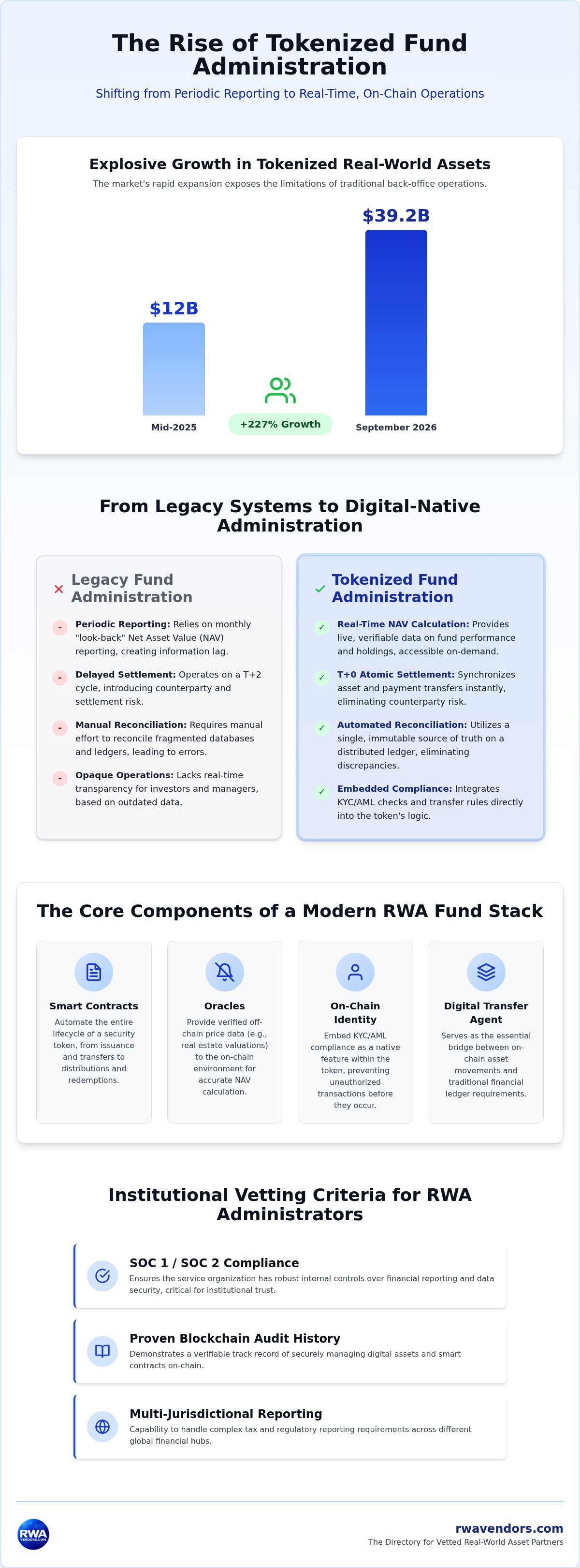
By September 2026, the total value of distributed tokenized real-world assets reached approximately $39.2 billion, representing a massive surge from just $12 billion in mid-2025. This explosive growth has exposed the structural limitations of traditional back-office operations. You've likely felt the frustration of trying to reconcile instantaneous on-chain data with rigid, legacy accounting systems that weren't designed for digital securities. The lack of transparency in standard monthly NAV reporting is no longer acceptable for institutional investors who expect real-time oversight and verified data integrity.
The shift toward tokenized fund administration services is transforming these "look-back" functions into automated, real-time infrastructure layers. You'll discover exactly how tokenization is revolutionizing the fund lifecycle and learn the critical criteria for selecting vetted institutional partners in 2026. We'll provide a clear framework for vetting blockchain-capable administrators, analyze the necessary technology stack for RWA funds, and examine the impact of the SEC's 2026 modernization of transfer agent rules. This guide ensures your firm is prepared to move from periodic to real-time administration with confidence and technical precision.
Key Takeaways
- Understand how the role of the Digital Transfer Agent serves as the essential bridge between on-chain asset movements and traditional financial ledger requirements.
- Identify the core technological requirements for tokenized fund administration services, specifically the transition to T+0 atomic settlement and automated AI compliance monitoring.
- Evaluate the operational advantages of event-driven, digital-native administration over the opaque reporting models used by legacy fund structures.
- Establish a robust framework for institutional due diligence, prioritizing SOC 1/SOC 2 compliance alongside proven blockchain audit histories.
- Utilize the RWA Vendor Directory to streamline the discovery of verified, STO Foundation-vetted partners capable of complex multi-jurisdictional reporting.
Defining Tokenized Fund Administration in the Modern Capital Markets
Tokenized fund administration represents the structural convergence of traditional fund accounting and blockchain-based asset management. While legacy administration relies on fragmented databases and manual reconciliation, tokenized fund administration services utilize a single, immutable source of truth. This shift is necessary to support the $39.2 billion tokenized real-world asset market recorded in September 2026. By moving the record-keeping function onto a distributed ledger, administrators can eliminate the discrepancies that typically occur between an investment manager’s books and the fund’s official register.
A central component of this evolution is the role of the Digital Transfer Agent. In a traditional tokenized private placement or public fund structure, the transfer agent maintains the list of shareholders. In the digital-native model, this function is automated through smart contracts. The Digital Transfer Agent manages the entire lifecycle of a security token, from initial issuance to secondary market transfers and final redemptions. This automation enables the transition from periodic, look-back reporting to real-time Net Asset Value (NAV) calculations. Investors no longer wait for monthly statements; they access live data reflecting the fund’s current performance and holdings.
The Core Components of a Tokenized Fund Stack
The modern administration stack integrates smart contracts directly with the fund's general ledger. This architecture ensures that every transaction is recorded and reconciled simultaneously. Oracles play a critical role here by providing verified off-chain price data to the on-chain environment, which is essential for valuing illiquid real-world assets. Additionally, on-chain identity solutions have turned KYC and AML compliance into native features. Compliance is no longer a separate check but a prerequisite embedded within the token’s transfer logic, preventing unauthorized transactions before they occur.
Regulatory Evolution and Global Standards
The year 2026 marks a turning point for institutional adoption, driven by increased regulatory clarity in major financial hubs. The SEC’s September 2026 proposal to modernize transfer agent rules has established higher standards for operational and cyber resilience. Similarly, the UK’s Financial Conduct Authority is finalizing policy statements that provide a clear roadmap for tokenized fund models. These standards have replaced experimental pilots with production-grade infrastructure, fostering greater investor confidence across the global ecosystem.
Tokenized Fund Administration is the automated management of security tokens and their underlying assets on a distributed ledger.
Key Trends Shaping Tokenized Fund Administration Services in 2026
The evolution of capital markets has accelerated the demand for high-velocity tokenized fund administration services. One of the most significant shifts in 2026 is the transition from traditional T+2 settlement cycles to T+0, or atomic settlement. By synchronizing the transfer of assets and payment on a distributed ledger, administrators eliminate the counterparty risk associated with delayed settlement. This capability is supported by global regulatory frameworks, as detailed in the IOSCO Report on Financial Asset Tokenization, which emphasizes the role of technology in maintaining market integrity. Atomic settlement is no longer a theoretical benefit; it's a functional requirement for global liquidity.
Beyond settlement speed, AI-driven compliance monitoring is now integrated directly into the administration layer. These systems analyze on-chain transactions in real time to detect anomalies or potential sanctions violations before they finalize. Simultaneously, "Waterfall Automation" has streamlined complex profit-sharing models. Smart contracts now execute distributions automatically based on pre-defined hurdles and catch-up provisions, removing the administrative burden of manual calculations for private equity and credit funds. This automation ensures that multi-chain interoperability is maintained, allowing fund managers to report across various networks without data silos.
From Batch Processing to Real-Time Verification
Tokenization removes the historical reliance on manual reconciliation between custodians, brokers, and administrators. Instead of waiting for batch processing at the end of a business day, digital-native systems provide continuous verification. "Proof of Reserve" has emerged as the industry standard for transparency. This mechanism allows investors to verify that on-chain tokens are backed by the fund's underlying assets at any given moment. For fund managers, this level of oversight is essential for managing 24/7 liquidity requirements in an increasingly globalized market. If you are a service provider operating in this space, you can get listed in our directory to reach issuers seeking these advanced capabilities.
The Democratization of Institutional-Grade Assets
The efficiency of tokenized fund administration services has significantly lowered the operational overhead required to manage a fund. These cost savings allow managers to reduce minimum investment thresholds, opening institutional-grade assets like private equity and real estate to a broader investor base. What was once restricted to ultra-high-net-worth individuals is now accessible through fractionalized structures. To understand the technology required to support these models, refer to our asset tokenization platform comparison. This resource provides a granular look at the tech stacks currently defining the 2026 landscape.
Legacy Systems vs. Digital-Native Administration: A Comparative Analysis
Traditional fund administration relies on a "look-back" model characterized by manual data entry and periodic reconciliation. This process creates a significant lag between market events and reporting. In contrast, tokenized fund administration services operate on an event-driven architecture. Every on-chain transaction, whether an issuance, a secondary market transfer, or a dividend distribution, triggers an instantaneous update to the fund’s accounting records. This shift eliminates the discrepancies inherent in legacy batch processing, where data is often fragmented across multiple siloed databases.
The transparency gap between these two models is stark. Legacy reporting often functions as a "black box," providing investors with a Net Asset Value (NAV) that is already outdated by the time it is published. Digital-native administration utilizes public or private ledgers to provide a verifiable, real-time view of fund holdings. While some institutional actors cite blockchain as a perceived risk, the reality is that legacy systems are vulnerable to high-frequency human error and manual reconciliation failures. By September 2026, the industry has recognized that audited smart contracts provide a more deterministic and reliable framework than traditional manual entry.
Operational cost-efficiency is another primary differentiator. Research indicates that launching a standalone tokenized fund in 2026 typically requires an initial investment between $100,000 and $500,000. While the initial setup requires specialized technical expertise, the long-term reduction in headcount and manual processing leads to a significantly lower total cost of ownership. These efficiency gains enable fund managers to scale their operations without a linear increase in administrative overhead.
The Interoperability Gap
A significant hurdle for many firms is that traditional ERP and accounting software are not designed to read or interpret smart contract data natively. This "interoperability gap" has led to the emergence of specialized middleware solutions. These tools act as a translation layer, converting complex on-chain events into a format that legacy financial systems can ingest. Leading digital asset infrastructure providers are now focusing on these bridge solutions to ensure that tokenized funds can coexist with an institution's existing technology stack.
Risk Management and Security
Security in a digital-native environment requires a shift from traditional cybersecurity to smart contract vulnerability management. While legacy systems focus on perimeter defense, tokenized funds prioritize audited code. Regular audits by reputable third-party firms are a non-negotiable standard for any institutional-grade administrator. The 2026 market has also seen a rise in specialized insurance products designed to back tokenized fund operations, providing an additional layer of protection against operational or technical failures. This multi-layered approach to risk ensures that the integrity of the fund is maintained throughout its entire lifecycle.
Selecting a Tokenized Fund Administrator: Institutional Vetting Criteria
Identifying a partner for tokenized fund administration services requires a dual-track due diligence process. Traditional fund administrators often lack the technical depth to manage on-chain events, while pure-play technology firms may lack the rigorous regulatory frameworks required by institutional investors. A primary requirement is a demonstrated history of SOC 1 and SOC 2 Type II compliance, supplemented by a comprehensive blockchain audit history. In light of the SEC’s September 2026 proposal for transfer agents, administrators should also be vetted on their ability to maintain separate "for the benefit of" (FBO) accounts and demonstrate high levels of operational cyber resilience.
Asset class expertise remains a critical differentiator. Administrators must demonstrate specific experience managing the nuances of Real Estate, Private Credit, or Venture Capital within a digital framework. For instance, a private credit fund requires complex waterfall automation for distribution, whereas real estate funds focus on fractionalized title management. Additionally, the administrator's fee structure must be transparent regarding on-chain transaction costs. On-chain interaction costs can erode fund performance if they aren't properly accounted for in the initial service level agreement.
Technical Due Diligence
Institutional managers should prioritize providers that offer an API-first approach. This allows for real-time data extraction and seamless integration with existing internal risk management systems. The administrator must also have a documented protocol for handling "hard forks" or major network upgrades to prevent operational disruptions. It's essential to verify the administrator's capability to manage compliant asset tokenization tech, ensuring that investor eligibility and transfer restrictions are enforced at the protocol level across all secondary market platforms.
Operational Continuity
Assessing a provider's track record in the digital asset space is vital for long-term stability. A dedicated help desk is necessary to resolve complex on-chain reconciliation issues that automated systems might miss. Verify that a provider’s smart contract audits are performed by reputable third-party security firms to ensure the highest level of technical integrity. Deep integration with institutional custodians and secondary market venues is the final pillar of a robust selection process, ensuring the fund can operate across a unified global ecosystem.
Navigating the RWA Ecosystem: Finding Verified Administration Partners
Building a successful tokenized fund requires more than just a robust technical stack; it requires a network of verified partners who understand the institutional requirements of global finance. The RWA Vendor Directory serves as a central pillar in this ecosystem, streamlining the discovery of service providers. By utilizing a curated platform, asset issuers can bypass the noise of "hype-driven" startups and engage directly with established firms. This structured approach to vendor selection is essential for maintaining the integrity of a fund’s operational lifecycle.
The STO Foundation, established in 2017, operates the directory with a rigorous vetting process designed to reduce institutional search costs. This oversight provides a layer of security that manual searches cannot replicate. When you evaluate tokenized fund administration services, prioritize vendors with "Founding Member" status. This designation signals industry leadership and a proven commitment to the stability of the digital security market. Selecting institutional digital asset partners from a verified pool ensures that your administration layer is compatible with the broader market infrastructure.
The Value of a Vetted Directory
Manual searches for blockchain vendors often lead to unverified firms that lack the specialized knowledge required for fund accounting. RWA Vendors solves this by categorizing providers into specific functional areas, such as legal, infrastructure, and administration. This taxonomy allows you to efficiently cross-reference potential administrators with how to find digital securities listing providers. Ensuring that your administrator and listing provider are technically aligned is a critical step in preventing reconciliation errors and data silos.
Next Steps for Fund Issuers
Effective discovery begins with creating a targeted shortlist of administrators who specialize in your specific asset class and jurisdiction. Use the directory’s filters to narrow your search based on technical capabilities, such as API availability and multi-chain support. Once you've identified potential partners, the platform facilitates the discovery of complementary services, including specialized legal counsel and digital custodians. This holistic view of the vendor landscape ensures that every component of your fund stack is verified and interoperable. Browse the directory today to find verified tokenized fund administration services and begin building your institutional-grade RWA infrastructure.
Securing the Future of Digital Fund Infrastructure
The transition from legacy batch processing to real-time, event-driven administration is no longer a peripheral innovation; it's an operational necessity. As global markets move toward atomic settlement and 24/7 liquidity, the adoption of tokenized fund administration services provides the transparency and efficiency required to scale complex RWA funds. Success in this landscape depends on selecting partners who meet rigorous institutional standards, including SOC compliance and verified blockchain audit histories.
By leveraging a vetted ecosystem, fund issuers can significantly reduce the technical and regulatory friction associated with digital securities. The STO Foundation has curated a global directory of institutional-grade providers to ensure that every stage of the RWA lifecycle is supported by reliable expertise. This structured approach to vendor selection protects the integrity of your fund and positions your firm for long-term growth in a digital-first capital market.
Establishing a robust partnership today ensures your infrastructure remains resilient as the regulatory and technological landscape continues to mature. This proactive approach to due diligence is the most effective way to safeguard investor interests and maintain a competitive advantage.
Frequently Asked Questions
What is tokenized fund administration?
Tokenized fund administration is the automated management of security tokens and their underlying assets on a distributed ledger. This process replaces manual, periodic reconciliation with a single, immutable source of truth shared between custodians and managers. By utilizing tokenized fund administration services, issuers ensure that every issuance, transfer, and redemption is recorded instantaneously. This architecture allows for higher operational precision and reduces the risk of data fragmentation inherent in legacy capital market structures.
How does tokenization reduce fund administration costs?
Tokenization reduces costs by automating high-friction back-office tasks such as settlement, profit distributions, and compliance monitoring. Traditional funds often face significant overhead from manual data entry and third-party reconciliation. Digital-native systems utilize smart contracts to execute "Waterfall Automation" and atomic settlement, which minimizes the need for large administrative teams. These efficiencies allow fund managers to lower minimum investment thresholds while maintaining institutional-grade oversight and reporting standards across the fund lifecycle.
Can traditional fund administrators handle tokenized assets?
Traditional administrators can only handle tokenized assets if they have integrated specialized digital-native stacks or middleware solutions. Most legacy ERP systems struggle to read smart contract data natively, creating an "interoperability gap." While some traditional firms offer digital asset services as an "add-on," institutional issuers often prefer tokenized fund administration services designed specifically for blockchain environments. These providers ensure that on-chain events are accurately reflected in the fund's general ledger without manual intervention.
What is real-time NAV in tokenized funds?
Real-time NAV (Net Asset Value) is the continuous, live valuation of a fund's holdings and performance data. Unlike traditional funds that provide monthly or quarterly "look-back" reports, tokenized funds use oracles and on-chain data to update valuations instantly. This transparency provides investors with immediate insight into their holdings' value. It eliminates the "black box" nature of legacy reporting, allowing for better-informed investment decisions and more efficient secondary market trading of fund interests.
Are tokenized fund administration services regulated?
Yes, tokenized fund administration services are subject to rigorous regulatory oversight. In the United States, tokenized securities fall under existing federal securities laws as clarified by the SEC in 2026. Administrators must also comply with specialized rules regarding transfer agents and safeguarding client funds. Global standards, such as the EU's MiCA regulation and the UK's FCA policy statements, provide additional frameworks for operational resilience, cybersecurity, and multi-jurisdictional compliance for digital-native fund structures.
What is the role of a transfer agent in a tokenized fund?
The transfer agent in a tokenized fund serves as the official keeper of the shareholder register, but this role is largely automated. Known as a Digital Transfer Agent, they utilize smart contracts to manage issuances and enforce transfer restrictions in real time. This ensures that only whitelisted, KYC-verified investors can hold or trade the tokens. Under the SEC's 2026 modernization rules, these agents are also responsible for enhanced operational resilience and maintaining separate accounts for client funds.
How does blockchain technology improve fund auditability?
Blockchain technology improves auditability by creating a permanent, immutable record of every transaction and administrative action. Auditors can use "Proof of Reserve" standards to verify that on-chain tokens are accurately backed by the fund's underlying assets at any specific timestamp. This eliminates the need for sampling and manual document verification. The result is a deterministic audit trail that reduces the time and cost of annual reviews while increasing the reliability of financial disclosures.
What should I look for in a tokenization technology partner?
You should prioritize partners with a proven track record in both traditional finance and blockchain infrastructure. Key criteria include SOC 1 and SOC 2 Type II compliance, an API-first technical architecture, and a history of successful smart contract audits by reputable third-party firms. It's also essential to choose providers vetted by industry architects. Utilizing the RWA Vendors directory allows issuers to identify administrators who are part of a verified, institutional-grade ecosystem backed by The STO Foundation.
Disclaimer
This article is provided by RWAVendors.com for general informational and educational purposes only. It does not constitute legal, financial, investment, tax, regulatory or other professional advice, or an offer, solicitation, recommendation or endorsement of any company, product, service, token, security or investment. RWAVendors.com is an informational vendor directory and does not sell, issue, broker, custody or facilitate transactions involving cryptocurrencies, digital tokens, tokenized assets, securities or investment products. Some vendor listings and references may involve paid advertising, sponsored placement or membership relationships. These relationships do not guarantee a vendor’s qualifications, regulatory status, performance or suitability. Information may be incomplete, outdated or subject to change. You should independently verify all information, conduct your own due diligence and consult qualified professionals before making any business or investment decision. RWAVendors.com is not responsible for the content, services, representations or actions of third-party vendors or linked websites.


