
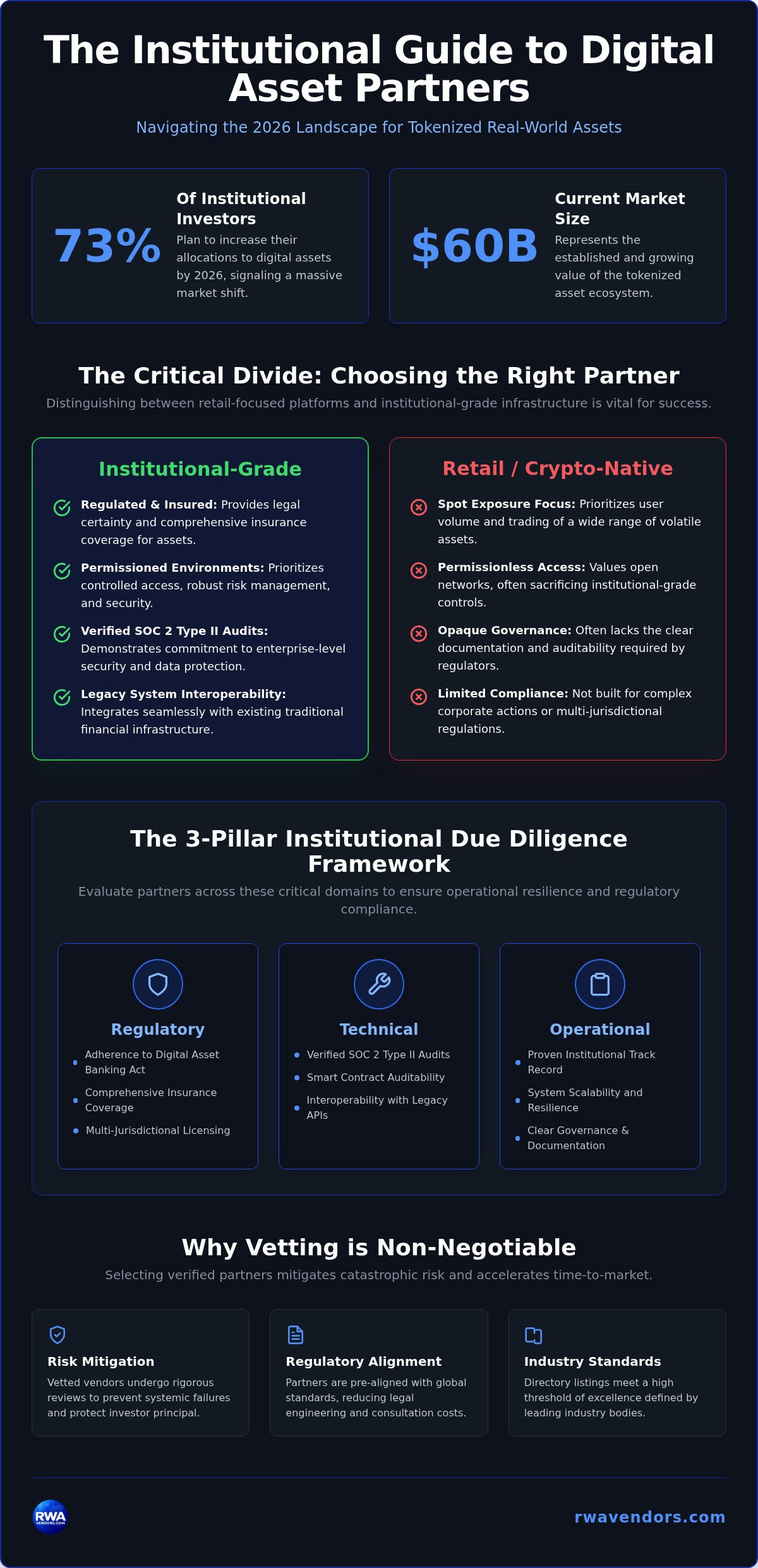
Recent data shows that 73% of institutional investors plan to increase their allocations to digital assets in 2026. While the appetite for tokenization is at an all-time high, the complexity of the vendor landscape remains a significant barrier to entry. Identifying reliable institutional digital asset partners is no longer just a technical choice; it's a critical decision that impacts your regulatory standing and operational resilience. As the Digital Asset Banking Act of 2026 forces a convergence between traditional banking and distributed ledger technology, the ability to distinguish between "crypto-native" platforms and "institutional-grade" infrastructure providers has become the ultimate competitive advantage.
You likely understand that the friction between multi-jurisdictional regulations and complex tech stacks can delay a launch by months. This guide simplifies that process by offering a curated directory of vetted providers and a clear framework for institutional due diligence. We'll examine the specialized partners required to build, secure, and scale your tokenized ecosystem within the current $60 billion market. By following this selection guide, you'll reduce your time-to-market and ensure your digital security offerings are built on a foundation of verified excellence.
Key Takeaways
- Define the distinction between regulated infrastructure providers and retail-focused services to ensure your ecosystem meets capital market standards.
- Map the core ecosystem of necessary vendors, understanding that jurisdictional requirements often necessitate a multi-partner approach for compliance and security.
- Implement a rigorous due diligence framework to evaluate institutional digital asset partners across regulatory, technical, and operational pillars.
- Leverage the RWA Vendors directory to filter verified providers by asset class and region, significantly reducing the time required for partner selection.
- Discover how industry leaders use Founding Membership to signal expertise and strategic alignment with global tokenization standards.
Defining Institutional Digital Asset Partners for Capital Markets
In the evolving landscape of global finance, digital assets have transitioned from speculative retail instruments to core components of institutional portfolios. Institutional digital asset partners are regulated entities that provide the underlying infrastructure for the issuance, custody, and trading of tokenized securities. Unlike retail-focused crypto exchanges that prioritize user volume and direct spot exposure, these partners focus on the rigorous requirements of capital markets. This distinction is vital; while a retail platform might offer liquidity for a thousand tokens, an institutional partner provides the legal certainty and technological robustness required to manage billions in real-world assets.
To be considered "institutional-grade" in 2026, a partner must demonstrate more than just functional code. They must provide comprehensive insurance coverage, adhere to strict regulatory frameworks such as the Digital Asset Banking Act, and maintain verified SOC 2 Type II audits. These safeguards ensure that asset managers can scale their ecosystems without compromising fiduciary duties. RWA Vendors serves as the central directory for identifying these specialized entities, offering a curated marketplace where issuers connect with verified technology and legal providers.
The Shift from Crypto-Native to Institutional-Grade
Traditional capital markets demand security protocols that go far beyond the decentralized finance (DeFi) experiments of the early 2020s. While retail platforms often value permissionless access, institutional-grade infrastructure prioritizes permissioned environments, robust risk management, and interoperability with legacy systems. Enterprise-ready blockchain solutions now focus on finality and throughput rather than just censorship resistance. They must handle complex corporate actions and dividend distributions automatically. In 2026, the institutional-grade standard is defined as a technology stack that integrates multi-jurisdictional compliance directly into the smart contract layer while maintaining full auditability for regulators.
Why Vetting is Non-Negotiable for RWA Issuers
The risks associated with unvetted technology in regulated markets are catastrophic. A single failure in a custody solution or a bug in an issuance protocol can lead to total loss of investor principal and severe legal repercussions. Using vetted institutional digital asset partners significantly reduces the operational burden on internal compliance and legal teams. By selecting partners from a verified directory, firms avoid the "crypto-native" traps of poor documentation and opaque governance.
- Risk Mitigation: Vetted vendors have already undergone rigorous technical and legal reviews to prevent systemic failures.
- Regulatory Alignment: Partners are often pre-aligned with global standards, reducing the need for custom legal engineering and expensive consultations.
- Industry Standards: The STO Foundation, established in 2017, provides the framework for these standards, ensuring that every vendor listed in the RWA Vendors directory meets a high threshold of excellence.
This structured approach to partner selection allows issuers to focus on their core business of asset management rather than the complexities of infrastructure due diligence.
The Core Ecosystem: Essential Partner Categories for 2026
Building a robust digital asset ecosystem requires a modular approach to infrastructure. In most global jurisdictions, no single vendor can legally or technically provide the entire stack for a tokenized security project. Instead, issuers must assemble a constellation of specialized institutional digital asset partners that prioritize interoperability. This modularity ensures that each component, from custody to compliance, meets the rigorous standards of an institutional-grade digital assets framework. For a comprehensive mapping of these technical layers, refer to our Institutional Guide to Digital Asset Infrastructure Providers in 2026.
Digital Asset Custody and Sub-Custody Solutions
Institutional custody has evolved beyond simple key management. You must distinguish between qualified custodians, which are regulated financial institutions, and technology-only wallet providers. Qualified custodians offer the legal protections and fiduciary oversight mandated by the Digital Asset Banking Act of 2026. Sub-custody models are also essential for global distribution, allowing regional banks to provide local access while leveraging the security of global infrastructure leaders. Evaluate these partners based on their use of Multi-Party Computation (MPC) technology, the depth of their insurance coverage, and their specific regulatory licenses.
Tokenization Platforms and Lifecycle Management
Tokenization platforms serve as the engine for the entire asset lifecycle. Their role extends far beyond initial issuance to include automated corporate action management. This includes the programmatic distribution of dividends, management of shareholder voting, and execution of redemptions. When selecting a platform, consider whether a white-label solution fits your speed-to-market goals or if an API-first approach is necessary to integrate with your existing internal ledgers. The goal is to ensure that the platform can handle the asset from inception through to secondary market maturity.
Regulatory Compliance and KYC/AML Specialists
Secondary market liquidity depends on compliant asset tokenization tech that enforces rules on-chain. Specialized KYC/AML partners now provide identity solutions that link real-world credentials to digital wallets. This allows for automated compliance enforcement, ensuring that tokens only move between eligible participants. These partners often integrate directly with transfer agents to maintain an accurate and legally binding cap table. Organizations that provide these critical services can register their profile to connect with institutional issuers seeking verified infrastructure.
Due Diligence Framework for Digital Asset Partnerships
Selecting institutional digital asset partners requires a methodical approach that prioritizes risk mitigation over experimental features. A professional due diligence framework centers on the Three Pillars of Trust: Regulatory, Technical, and Operational. This structure ensures that every vendor in your stack contributes to the overall stability of the ecosystem rather than creating a single point of failure. Operational due diligence involves scrutinizing the management team's track record, the firm's financial stability, and the presence of comprehensive insurance policies to protect against cyber incidents or internal errors. In the RWA space, a partner’s regulatory standing is as critical as their technical uptime. By utilizing the structured data available in the RWA Vendors directory, issuers can accelerate the initial "long-list" phase, moving directly to a short-list of partners that meet specific institutional criteria.
Assessing Jurisdictional Expertise and Licensing
Regulatory compliance is not a generic checkbox; it is jurisdiction-specific. You must verify that a vendor's licensing aligns with the geographic location of your target investors and the legal domicile of the underlying asset. For instance, a partner licensed under the Hong Kong Stablecoin Regulation may be essential for fiat-referenced projects in Asia, whereas Luxembourg's "Blockchain Law IV" provides a specific framework for dematerialized securities in Europe. Deep experience in specific asset classes is also vital. A partner that understands the nuances of private equity fund tokenization may not have the specialized workflows required for fractionalized real estate. Vetting for global reach versus local regulatory specialization allows you to build a resilient, multi-jurisdictional stack.
Technical Interoperability and Multi-Chain Support
The technical pillar focuses on a partner's ability to operate across diverse blockchain environments. Evaluate whether a provider supports the specific protocols required for your project, including public chains, private ledgers, or dedicated app-chains. Interoperability is essential to prevent vendor lock-in and to ensure liquidity across different venues. Oracles and data providers play a critical role here, maintaining the link between the "real world" asset value and the on-chain representation. For institutional integration, prioritize partners who offer robust API documentation and high-quality technical support. This ensures that the digital asset infrastructure can communicate seamlessly with your existing internal systems and legacy financial databases.
A structured evaluation process reduces the risk of technical debt and regulatory friction. By aligning your vendor selection with these pillars, you create a foundation capable of supporting long-term growth in the tokenized capital markets.
Navigating the Global RWA Vendor Directory
The RWA Vendors platform functions as a surgical tool for capital market professionals. It allows users to bypass the noise of generalist technology databases and focus exclusively on specialized infrastructure. Finding the right institutional digital asset partners requires a multi-dimensional approach to search. By utilizing a structured taxonomy, you can identify providers that align with your specific asset class and jurisdictional needs. The platform is designed to facilitate the rapid assembly of a project stack, ensuring that every component is compatible with the rigorous standards of global finance.
Filtering by Asset Class and Service Category
Tokenization is not a monolithic process. A project involving fractionalized real estate requires different legal and technical parameters than a tokenized private equity fund or a sophisticated debt instrument. The directory allows you to filter by these specific asset classes, ensuring the vendors you find have relevant, documented experience. More importantly, the platform facilitates the practical "bundling" of services. You can use category filters to build a complete project stack simultaneously. For example, you can identify a legal firm in Luxembourg, a technology provider in Singapore, and a qualified custodian in the United States. This global reach is essential for cross-border initiatives where regulatory alignment across multiple regions is mandatory.
Leveraging Verified Profiles for Accelerated Onboarding
The "Verified" status on RWA Vendors serves as a critical trust signal for institutional users. It implies that the provider has been reviewed for their standing within the ecosystem and their active involvement with The STO Foundation. These curated listings significantly reduce the time spent on basic vendor discovery, allowing your internal teams to move directly to the technical evaluation and deep-dive due diligence phases. Instead of manually vetting hundreds of "crypto-native" startups, you can access a shortlist of providers that have already demonstrated a commitment to institutional standards. This accelerated onboarding is vital for reducing time-to-market in a competitive landscape where 63% of institutional investors are actively seeking tokenized asset exposure.
Once you identify a suitable partner, the platform provides a direct channel to initiate contact. This streamlined lead generation ensures that your inquiries reach the correct institutional desk, facilitating a more professional engagement from the first interaction. For service providers, maintaining an active and detailed profile is the most effective way to signal market leadership.
Founding Membership: Strategic Alignment for Industry Leaders
For service providers, the challenge in the current market is not merely offering a technical solution; it's proving institutional readiness to a sophisticated audience. Establishing your firm as one of the premier institutional digital asset partners requires more than just functional excellence. It demands a visible commitment to the standards that govern the tokenized capital markets. RWA Vendors serves as the primary lead generation engine for this industry, connecting high-value asset issuers with the infrastructure they need to scale. By joining the platform as a Founding Member, service providers align their brand with a curated ecosystem that prioritizes verification and professional integrity.
The Role of The STO Foundation in Partner Verification
The STO Foundation, established in 2017, acts as an industry architect for the digital securities space. It provides the structural framework that allows the industry to move past experimental phases and toward global adoption. Being part of this professional organization is a significant differentiator. It separates your firm from generic lists of "crypto" startups and places you within a structured taxonomy of verified professionals. Ecosystem participation offers long-term growth opportunities that go beyond simple visibility. It facilitates networking with other market leaders, allowing for the creation of the multi-vendor stacks that issuers now require for complex, multi-jurisdictional projects.
Securing Enhanced Visibility for Market Leaders
Strategic placement within the directory is essential for capturing high-intent leads. Most asset issuers utilize the RWA Vendors directory when they are in a critical "Buying Stage," having already committed to a tokenization project and now seeking the specific partners to execute it. Founding Membership ensures that your firm is discovered during this decision-making window. Featured status and corporate sponsorship drive visibility among issuers who are actively vetting for custody, legal, and issuance technology. This premium positioning signals market leadership and stability, two traits that are non-negotiable for institutions managing billions in real-world assets. As the tokenized asset market continues its trajectory toward a projected $10 trillion valuation by 2030, early alignment with the industry's central directory provides a definitive competitive advantage.
Become a Founding Member or list your firm in the RWA Vendor Directory today
Building the Future of Tokenized Capital Markets
The transition toward a tokenized financial system has moved beyond experimentation into a phase of rigorous operational execution. Success in this landscape depends on the assembly of a modular ecosystem where every component meets defined standards of security and legal compliance. By utilizing a structured due diligence framework and prioritizing jurisdictional expertise, you ensure that your platform remains resilient against technical failures and shifting regulatory requirements. Identifying the most reliable institutional digital asset partners is the critical first step in building a sustainable and compliant market presence.
RWA Vendors provides the essential infrastructure to facilitate these connections. It serves as a centralized resource where institutional asset issuers engage with specialists vetted by The STO Foundation. The directory offers comprehensive global coverage of tokenization specialists, ensuring that your team can move from discovery to implementation with surgical precision. Trusted by the industry's leading issuers, this marketplace provides the transparency required to navigate a complex and high-stakes environment.
The infrastructure required to modernize global capital markets is now accessible. We are committed to providing the transparency and verification necessary for you to build and scale your tokenized ecosystem with absolute confidence.
Frequently Asked Questions
What are institutional digital asset partners?
Institutional digital asset partners are regulated entities that provide the essential infrastructure for the tokenized capital markets. These partners include qualified custodians, issuance platforms, and compliance specialists that adhere to rigorous financial standards. Unlike retail providers, they focus on institutional-grade requirements such as SOC 2 Type II audits and multi-jurisdictional licensing. They enable asset managers to securely issue and manage tokenized securities while maintaining their fiduciary duties within a regulated environment.
How do I vet a tokenization service provider for an RWA project?
Vetting a provider requires a multi-layered due diligence framework focusing on regulatory, technical, and operational pillars. You should verify their licensing against your target jurisdiction and check for specific experience in your asset class, such as real estate or private equity. Utilizing a curated marketplace allows you to review verified profiles that have already undergone initial screening. This systematic approach reduces the operational burden on your internal legal and compliance teams.
What is the difference between a crypto custodian and an institutional digital asset partner?
A crypto custodian focuses specifically on the secure storage of digital keys, whereas institutional digital asset partners represent a broader ecosystem of infrastructure providers. These partners include not only custodians but also transfer agents, legal counsel, and lifecycle management platforms. While a custodian manages the asset's safety, a partner ecosystem ensures the entire tokenization project remains compliant with securities laws and interoperable with existing institutional financial systems.
Why should I use a specialized RWA directory instead of a general blockchain list?
Specialized directories provide a filtered view of the market, removing the noise of retail-focused or non-financial blockchain startups. A dedicated RWA directory focuses on partners that understand the nuances of securities law and capital market infrastructure. This niche focus ensures that search results are relevant to asset issuers, providing access to vendors that maintain the high standards of excellence required for regulated financial products and institutional workflows.
How much does it cost to list a business on RWA Vendors?
Listing a business involves recurring vendor membership fees that support the maintenance of a verified profile in the global directory. These fees vary based on the level of visibility and the number of industry sectors a provider chooses to occupy. For firms seeking market leadership, Founding Membership options offer enhanced branding and featured status. To receive a detailed breakdown of current membership tiers, service providers should contact the platform directly.
Can RWA Vendors help with legal or financial advisory for my tokenization project?
RWA Vendors is an infrastructure directory and does not provide direct legal, financial, or tax advisory services. The platform functions as a connector, allowing asset issuers to find and vet specialized legal and compliance partners independently. While we provide the marketplace to discover these professionals, all advisory and brokerage services are handled directly between the issuer and the chosen service provider listed in our global directory.
What jurisdictions are covered in the RWA Vendor Directory?
The directory provides global coverage, listing tokenization specialists and infrastructure providers across all major financial jurisdictions. This includes vendors familiar with the Digital Asset Banking Act in the United States, Luxembourg's "Blockchain Law IV", and the Hong Kong Stablecoin Regulation. This global scope is essential for cross-border projects where issuers must coordinate with partners that possess local regulatory expertise in multiple regions simultaneously to ensure full compliance.
How does The STO Foundation verify vendors in the directory?
The STO Foundation utilizes a vetting process that reviews vendor profiles for their standing within the digital securities ecosystem. This includes reviewing their technical capabilities, regulatory licenses, and overall alignment with established industry standards. Vendors that achieve "Verified" status or join as Founding Members signal a higher level of commitment to professional integrity. This curation process ensures that the directory remains a trusted resource for institutional-grade asset issuers and investors.
Disclaimer
This article is provided by RWAVendors.com for general informational and educational purposes only. It does not constitute legal, financial, investment, tax, regulatory or other professional advice, or an offer, solicitation, recommendation or endorsement of any company, product, service, token, security or investment. RWAVendors.com is an informational vendor directory and does not sell, issue, broker, custody or facilitate transactions involving cryptocurrencies, digital tokens, tokenized assets, securities or investment products. Some vendor listings and references may involve paid advertising, sponsored placement or membership relationships. These relationships do not guarantee a vendor’s qualifications, regulatory status, performance or suitability. Information may be incomplete, outdated or subject to change. You should independently verify all information, conduct your own due diligence and consult qualified professionals before making any business or investment decision. RWAVendors.com is not responsible for the content, services, representations or actions of third-party vendors or linked websites.


