
As of January 1, 2026, the transition period for digital asset reporting has officially ended, replaced by a rigorous mandate for wallet-by-wallet cost basis tracking and mandatory Form 1099-DA filings. For institutional issuers, the complexity of managing thousands of global token holders across fragmented on-chain and off-chain data sets represents more than just an administrative burden; it's a significant barrier to capital market scalability. You likely recognize that manual reporting and uncertain cross-border withholding obligations create unacceptable levels of regulatory risk and operational friction.
This guide empowers you to master digital security tax compliance by navigating the technical requirements and specialized vendor landscape required for tokenized assets. We'll examine the essential infrastructure components, identify the specific vendor categories needed to bridge the gap between blockchain transactions and tax records, and establish a scalable framework for global reporting. By the end of this analysis, you'll possess the roadmap to select verified partners that ensure your platform meets the high standards of 2026 regulatory expectations.
Key Takeaways
- Define the role of the "Tax Identity" on-chain to enable the automated identification and reporting of obligations for tokenized assets.
- Transition from legacy T+2 settlement models to atomic tax withholding to handle the complexities of a 24/7 secondary market environment.
- Master the technical requirements for digital security tax compliance, including wallet-by-wallet cost basis tracking and cross-border withholding for global investor pools.
- Implement strategic criteria for vendor selection by verifying jurisdictional coverage and evaluating API compatibility with existing institutional ERP systems.
- Access the RWA Vendor Directory to identify vetted compliance providers and reporting software tailored for the tokenized capital markets.
Defining Digital Security Tax Compliance in 2026
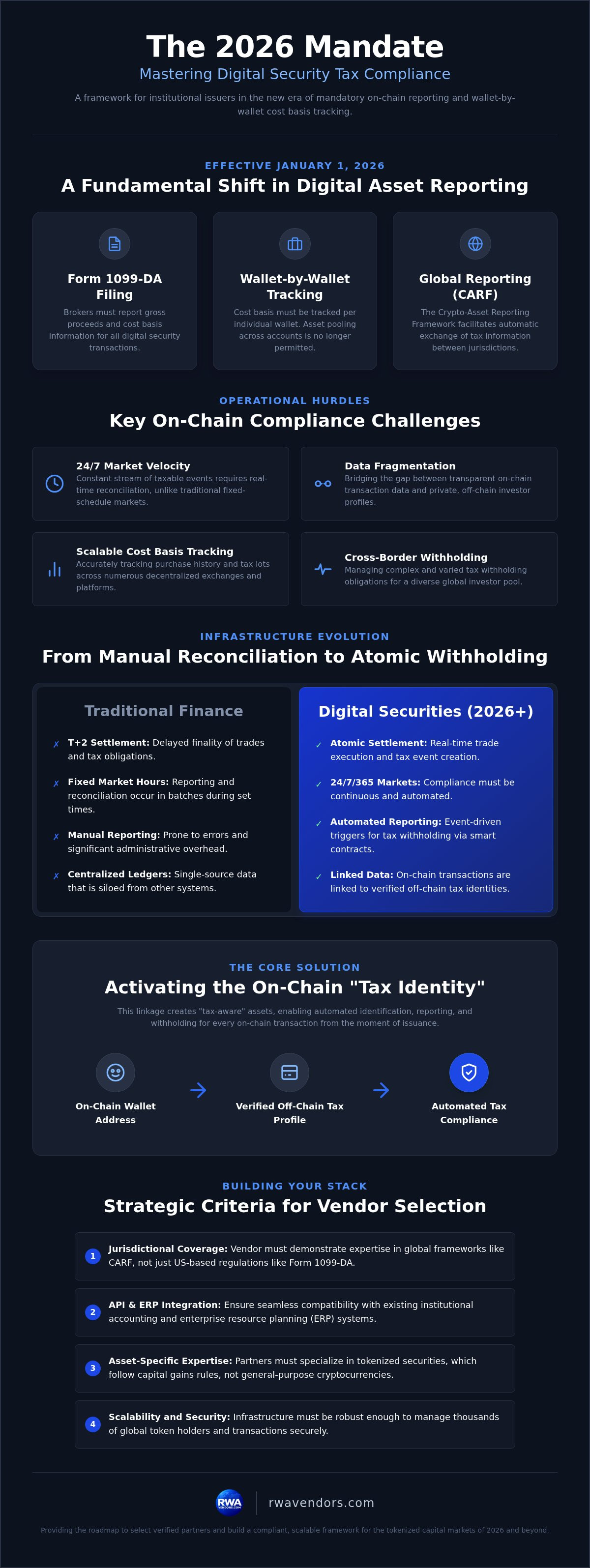
Institutional digital security tax compliance is defined as the automated identification, reporting, and withholding of tax obligations for tokenized assets. It moves beyond the manual reconciliation of the past, using smart contracts and oracle-verified data to ensure every transaction triggers the correct fiscal response. This process relies on a "Tax Identity" on-chain, which links specific wallet addresses to verified, off-chain tax profiles. This linkage ensures that tax authorities receive accurate data while maintaining the privacy standards required by sophisticated investors. It's the infrastructure that allows a security to be "tax-aware" from the moment of issuance.
While the broader Taxation of digital goods provides a foundational framework for digital services, digital securities demand a more specialized approach. 2026 marks a definitive turning point because it's the first year where cost basis reporting is fully mandated for digital asset brokers under Treasury regulations. The maturation of international frameworks has shifted the industry from "voluntary disclosure" to "automated enforcement," making compliance a core feature of the asset's technical stack rather than an afterthought.
The Distinction Between Tokens and Securities
Digital securities are not synonymous with general-purpose cryptocurrencies. They represent fractional ownership in real-world assets, meaning they follow established capital gains and dividend rules. Managing these obligations requires compliant asset tokenization tech to track cost basis across secondary market trades. This technology ensures that every transfer of ownership is recorded with the necessary metadata to satisfy global auditors. The nexus between on-chain ownership and off-chain tax liability is established the moment a tokenized asset is transferred, triggering a reporting event for the issuer.
Regulatory Reporting Standards in 2026
The regulatory landscape is now anchored by IRS Form 1099-DA in the United States. Starting with the 2026 tax year, brokers must report both gross proceeds and cost basis information for digital security transactions. On a global scale, the Crypto-Asset Reporting Framework (CARF) facilitates the automatic exchange of tax information between participating jurisdictions to prevent tax evasion. Digital security transfer agents serve as the ultimate record of truth, providing the verified data that tax authorities require to validate investor filings. These agents integrate directly with on-chain registries, ensuring that digital security tax compliance remains consistent across all jurisdictions. This integration reduces the burden on issuers by automating the generation of secure, digitally authenticated tax compliance reports.
Key Challenges in On-Chain Tax Reporting and Withholding
Achieving digital security tax compliance involves overcoming significant technical and operational hurdles that don't exist in traditional finance. The primary friction point is the continuous nature of digital asset markets. Legacy exchanges operate on fixed schedules. Blockchain doesn't. This 24/7 environment creates a constant stream of taxable events that must be reconciled against the specific tax lot of the investor in real-time. Additionally, there is a persistent gap between on-chain transaction data and the granular records required by institutional accounting software. Blockchain explorers provide transparency into movement, but they don't inherently carry the jurisdictional metadata or investor profiles needed for accurate reporting.
Cost Basis Tracking at Scale
Tracking the purchase price across multiple decentralized exchanges (DEXs) is a primary concern for institutional issuers. According to IRS Digital Asset Guidance, brokers are now required to report the cost basis of digital asset sales for transactions occurring on or after January 1, 2026. This mandate necessitates a wallet-by-wallet tracking approach, as pooling assets across different accounts is no longer permitted. Implementing robust KYC AML for digital securities is critical here; it provides the identity layer required to link specific on-chain transactions to an investor’s historical tax lots. While Notice 2026-20 offers temporary relief for specific identification instructions through the end of 2026, institutions must prioritize automated systems over manual adjustments to maintain audit readiness.
Cross-Border Withholding Complications
The "Withholding Nightmare" arises when a single tokenized asset pool contains investors from dozens of different jurisdictions. Each investor may be subject to a different treaty-based withholding rate for dividends or interest payments. Modern digital security infrastructure aims to solve this by embedding withholding logic directly into smart contracts, though this requires real-time access to a comprehensive tax treaty database. Digital transfer agents play a vital role in this ecosystem by acting as the distributor of net dividends, ensuring that the correct amount is withheld before the funds reach the investor’s wallet. This is especially complex for tokenized funds where the "Look-Through" principle requires issuers to identify the tax status of ultimate beneficial owners rather than just the immediate token holder. Service providers that offer these specialized capabilities can get listed in our directory to connect with issuers facing these challenges.
Comparing Traditional and Digital Security Tax Infrastructure
Traditional tax workflows are tethered to the T+2 settlement cycle. This legacy model relies on manual batching and retrospective reconciliation, which often leads to reporting lags and increased operational risk. Digital security infrastructure enables atomic tax withholding. This means that tax obligations are calculated and settled simultaneously with the asset transfer. By integrating tax logic directly into the transaction layer, issuers can significantly improve their digital security tax compliance posture. This shift reduces the "Tax Gap" because obligations are met at the source. Issuers don't have to chase data months after a trade occurs.
The Shift to Real-Time Tax Logic
Programmable tax represents a fundamental advancement in capital market operations. By embedding compliance rules directly into a token's smart contract, issuers can automate complex withholding requirements based on an investor's verified profile. Modern digital security transfer agents are evolving into sophisticated tax oracles. These entities provide the real-time data feeds necessary to trigger tax events on-chain while maintaining the integrity of the official shareholder registry. This automation eliminates the need for massive year-end manual adjustments. It ensures that every trade is compliant from its inception.
Auditability and Transparency
Blockchain serves as an immutable "Golden Record" for tax authorities. Every transaction is timestamped and cryptographically secured, providing an audit trail that's far superior to traditional spreadsheets or siloed databases. To maintain the highest standards of data security, institutions should align their infrastructure with established federal guidelines, such as those found in IRS Publication 1075. These standards ensure that agencies handling tax information maintain rigorous technical controls. Vetted blockchain vendors provide the necessary data integrity to satisfy institutional-grade audits, reducing the time and cost associated with regulatory inquiries. Zero-knowledge proofs may protect investor privacy by allowing participants to prove their tax compliance status without revealing sensitive underlying personal data to the public ledger.
The ROI of this transition is substantial. While the initial setup of an automated digital security tax compliance stack requires an investment in specialized technology, the long-term savings in administrative labor and penalty avoidance are clear. Automating these workflows through vetted vendors allows firms to scale their tokenized offerings without a linear increase in compliance headcount. Efficiency becomes a competitive advantage rather than a regulatory burden.
Strategic Criteria for Selecting Tax Compliance Vendors
Selecting a vendor for digital security tax compliance requires a rigorous due diligence process that transcends basic software evaluation. Institutional issuers must ensure that their compliance partners operate with the same precision as traditional financial auditors while maintaining the technical agility of a blockchain-native platform. The following criteria form the baseline for an institutional-grade selection process:
- Verify Jurisdictional Coverage: A vendor must possess a comprehensive, real-time database of international tax treaties to manage withholding across 50+ jurisdictions.
- Evaluate API Integration: The software must offer robust API endpoints that connect seamlessly with existing ERP and accounting systems like SAP or Microsoft Dynamics.
- Assess RWA Complexity: The platform needs specific logic to handle diverse asset classes, such as the depreciation schedules of real estate or the carried interest structures of private equity.
- Confirm Security Standards: Demand SOC 2 Type II compliance and adherence to institutional data security protocols to protect sensitive investor information.
- Review Regulatory History: Prioritize vendors with a documented track record of successful filings and interactions with global tax authorities.
Evaluating Technical Integration
Effective compliance relies on the precision of data inputs. Issuers must utilize "Oracle" services that provide real-time tax rate feeds to the transaction layer, ensuring that every trade reflects current statutory requirements. It's essential to verify that your tax vendor integrates directly with your chosen digital asset infrastructure providers to avoid data silos. A modular compliance stack allows institutions to swap specific components as regulatory environments evolve without necessitating a full system overhaul. This flexibility is vital for maintaining long-term operational efficiency.
Jurisdictional and Legal Expertise
The fragmented nature of global tax law makes a centralized directory essential for identifying region-specific experts. Many institutions now opt for "Tax-as-a-Service" models, where a vendor provides both the software and the underlying tax logic for global token offerings. While these platforms automate the heavy lifting, internal or external legal counsel must still validate the vendor’s tax logic against the specific parameters of the issuance. This dual-layer approach ensures that automated systems remain aligned with the latest legal interpretations of digital security tax compliance mandates. Relying on vetted providers reduces the friction of cross-border expansion.
Building Your Compliance Stack via the RWA Vendor Directory
The RWA Vendor Directory serves as the central hub for identifying and vetting the professional services required for digital security tax compliance. It categorizes vendors into distinct functional groups, including Legal, Tax, Reporting, and Transfer Agents. This taxonomy allows issuers to navigate a complex ecosystem with surgical precision. By focusing on "Founding Members," users can identify providers with a proven institutional track record and established history in the tokenized capital markets. These vendors are evaluated against standards set by The STO Foundation, which has operated as a pillar of industry integrity since 2017. Selecting a provider from a vetted global directory ensures that your infrastructure aligns with the high standards of excellence required for global finance.
The platform acts as a bridge between traditional structures and modern innovation, appearing as a knowledgeable guide that has already done the hard work of organizing a complex landscape. It's not a passive observer but an active connector that empowers other businesses to build and scale. This gatekeeper sensibility implies a high standard of excellence and a commitment to maintaining the integrity of the ecosystem it represents. Issuers can utilize the directory to discover verified providers for every stage of real-world asset tokenization, ensuring that every component of the compliance stack is institutional-grade.
Navigating the Global Ecosystem
Complex RWA projects, such as tokenized real estate or private equity funds, often require a multi-vendor stack rather than a single monolithic solution. The directory enables issuers to filter for specific jurisdictional expertise or asset-class specialization, which is essential for managing the withholding obligations described earlier. Vetted status is a critical indicator of quality; it reduces issuer risk by ensuring that the technology and legal logic have been subjected to professional scrutiny. This is especially important when reconciling on-chain transactions under the temporary relief of Notice 2026-20, issued March 18, 2026. The directory provides the necessary connectivity to bridge the gap between on-chain data and digital security tax compliance obligations.
Next Steps for Asset Issuers
Transitioning from theory to implementation requires a methodical approach to vendor engagement. Issuers should begin by creating a shortlist of tax compliance vendors that meet the SOC 2 and API integration criteria discussed in the previous sections. The RWA Vendors platform facilitates direct communication, allowing you to reach out to verified providers to discuss your specific issuance needs. It's vital to prioritize vendors that understand the FTC Safeguards Rule, as tax preparers are now classified as financial institutions under the Gramm-Leach-Bliley Act. Issuers should also seek vendors capable of generating the new digitally authenticated Tax Compliance Reports launched by the IRS in August 2026. Establishing these partnerships early is the most effective way to ensure your platform remains compliant as global standards like CARF continue to evolve.
Browse vetted compliance vendors in the RWA Directory
Securing Your Institutional Position in the 2026 Tax Landscape
The transition toward automated, real-time reporting represents the definitive maturation of tokenized capital markets. Issuers who successfully implement a "tax-aware" technical stack will eliminate the operational risks associated with manual reconciliation and retrospective data patching. By prioritizing digital security tax compliance from the moment of issuance, your organization can meet the rigorous demands of 2026 mandates like Form 1099-DA and the Global Crypto-Asset Reporting Framework with surgical precision.
Establishing a resilient infrastructure requires more than just software; it demands a curated network of professional partners who understand the nuances of fractional ownership and jurisdictional withholding. A modular stack of vetted providers ensures that your platform remains adaptable as regulatory standards continue to evolve. Accessing a global directory of institutional providers allows you to identify experts who have already undergone the hard work of verification.
Building a compliant ecosystem today positions your firm as a leader in the next generation of global finance. With the right infrastructure in place, you can focus on scaling your assets while maintaining the highest standards of integrity and security.
Frequently Asked Questions
What is digital security tax compliance?
Digital security tax compliance refers to the automated framework used to identify, report, and withhold tax obligations for tokenized assets. It ensures that every on-chain transaction aligns with global fiscal regulations by linking digital wallets to verified investor profiles. This system utilizes a "Tax Identity" to bridge the gap between anonymous blockchain data and institutional records. It's essential for maintaining the integrity of capital markets as they transition to blockchain infrastructure.
Do digital securities have different tax rules than traditional stocks?
No, digital securities generally follow the same capital gains and dividend rules as traditional stocks. The primary difference lies in the reporting and settlement infrastructure used to meet these obligations. While traditional securities rely on retrospective batching, digital securities allow for atomic withholding at the moment of trade. Issuers must ensure their reporting systems can handle the 24/7 nature of secondary markets while adhering to established tax law for real-world assets.
How do smart contracts handle tax withholding for RWAs?
Smart contracts handle tax withholding by embedding compliance logic directly into the asset's code. When a dividend or interest payment is triggered, the contract consults a tax oracle to determine the correct withholding rate based on the investor's jurisdiction. The contract then automatically deducts the tax before distributing the net funds. This process reduces the administrative burden on issuers and ensures immediate compliance with global tax treaties without manual intervention.
What is the Crypto-Asset Reporting Framework (CARF)?
The Crypto-Asset Reporting Framework (CARF) is an international standard developed by the OECD for the automatic exchange of tax information. It requires service providers to collect and report data on digital asset transactions to ensure transparency across borders. By 2026, CARF implementation has become a critical component of global tax enforcement. It aims to prevent tax evasion by facilitating seamless data sharing between participating national tax authorities across the globe.
Can a transfer agent handle international tax reporting for token holders?
Yes, modern digital security transfer agents are equipped to manage international tax reporting for token holders. They act as the definitive record of truth for the shareholder registry and integrate with specialized tax software to generate necessary filings. These agents ensure that withholding rates are accurately applied across multiple jurisdictions. Using a vetted transfer agent from a global directory helps issuers manage complex cross-border compliance without increasing internal headcount or operational risk.
What tax forms are required for digital security issuers in 2026?
In 2026, U.S. based digital security issuers and brokers must primarily utilize Form 1099-DA for reporting transactions. This form requires the disclosure of both gross proceeds and cost basis information for digital asset dispositions. Additionally, issuers must comply with international standards such as CARF for non-U.S. investors. Maintaining accurate records is vital, as the IRS now requires secure, digitally authenticated compliance reports to verify tax standing for all digital asset participants.
How does cost basis tracking work for tokenized assets on secondary markets?
Cost basis tracking for tokenized assets is now mandated on a wallet-by-wallet basis for transactions occurring on or after January 1, 2026. This means that the purchase price and holding period must be tracked specifically for each digital account. While Notice 2026-20 provides temporary relief for certain identification instructions through the end of 2026, institutions must adopt automated systems. These systems reconcile on-chain trades with historical tax lots to ensure accurate capital gains reporting.
Why do I need a specialized vendor for digital security tax compliance?
A specialized vendor for digital security tax compliance is necessary to bridge the technical gap between blockchain data and institutional accounting systems. Traditional tax software isn't designed to handle 24/7 secondary market trading or atomic withholding logic. Specialized providers offer the "Tax-as-a-Service" infrastructure required to manage global withholding across 50+ jurisdictions. Utilizing vetted vendors from the RWA Vendor Directory ensures your compliance stack meets institutional security and data integrity standards.
Disclaimer
This article is provided by RWAVendors.com for general informational and educational purposes only. It does not constitute legal, financial, investment, tax, regulatory or other professional advice, or an offer, solicitation, recommendation or endorsement of any company, product, service, token, security or investment. RWAVendors.com is an informational vendor directory and does not sell, issue, broker, custody or facilitate transactions involving cryptocurrencies, digital tokens, tokenized assets, securities or investment products. Some vendor listings and references may involve paid advertising, sponsored placement or membership relationships. These relationships do not guarantee a vendor’s qualifications, regulatory status, performance or suitability. Information may be incomplete, outdated or subject to change. You should independently verify all information, conduct your own due diligence and consult qualified professionals before making any business or investment decision. RWAVendors.com is not responsible for the content, services, representations or actions of third-party vendors or linked websites.


