

With global financial crime compliance costs exceeding $206 billion annually, the margin for error when implementing KYC AML for digital securities has effectively vanished. You likely recognize that fragmented global regulations and the friction of integrating legacy systems with blockchain protocols represent the primary hurdles to institutional scale. It's a high-stakes environment where a single compliance failure can jeopardize an entire issuance. This guide provides the technical and regulatory certainty required to build a resilient framework.
You'll master the complexities of these requirements through a comprehensive, institutional-grade checklist designed specifically for the 2026 landscape. We'll examine the final July 1 MiCA authorization deadlines, analyze the $3,000 FinCEN Travel Rule thresholds, and establish a rigorous framework for selecting verified technology partners. This roadmap ensures your platform achieves seamless investor onboarding while maintaining full alignment with the EU's new Digital Identity Wallet standards. By the end of this article, you'll have a definitive strategy for maintaining compliance across multiple jurisdictions without sacrificing operational efficiency.
Key Takeaways
- Establish a robust regulatory foundation by aligning asset issuance with the specific dual-mandates of national securities laws and global AML/CTF frameworks.
- Optimize investor onboarding with a dual-phase verification process covering both individual liveness detection and complex corporate beneficial ownership structures.
- Adopt real-time transaction monitoring and wallet screening to ensure persistent KYC AML for digital securities throughout the entire asset lifecycle.
- Evaluate compliance infrastructure providers using standardized criteria including jurisdictional reach, API stability, and verified institutional track records.
- Enforce secondary market compliance by integrating automated transfer restrictions directly into token smart contracts for continuous regulatory adherence.
The Regulatory Framework for Digital Securities Compliance
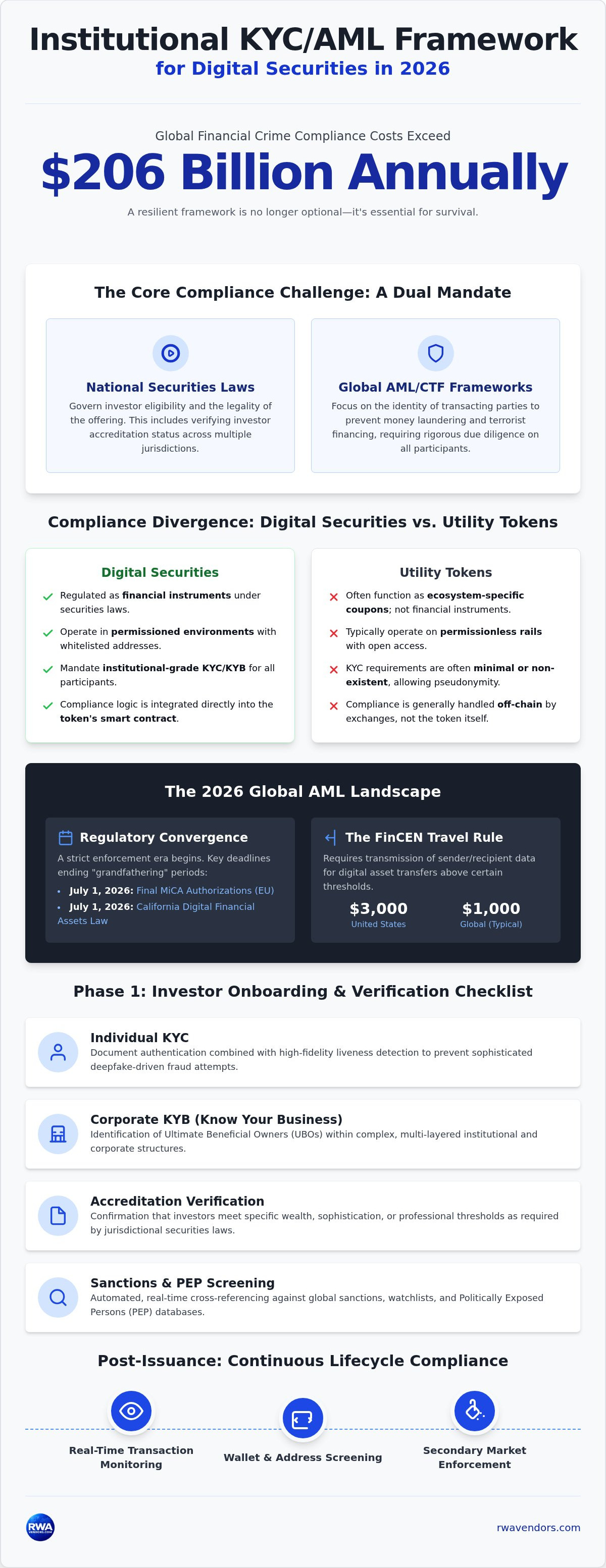
Digital securities represent fractionalized ownership of real-world assets, ranging from commercial real estate to private equity funds. Unlike utility tokens, which often function as ecosystem-specific coupons, digital securities are regulated financial instruments. This distinction mandates a significantly higher threshold for Know Your Customer (KYC) protocols. The issuer remains the primary responsible party for all due diligence, ensuring that every participant in the asset's lifecycle is fully verified. The July 2026 FATF update emphasizes that "freeze-resistant" stablecoins and AI-driven financial crimes require issuers to move beyond static checks toward proactive, technology-led enforcement.
The dual-mandate for KYC AML for digital securities requires balancing Anti-Money Laundering and Counter-Terrorist Financing (AML/CTF) laws with national securities regulations. While AML laws focus on the identity of the transacting parties, securities laws govern the eligibility of investors and the legality of the offering itself. This creates a complex overlap where an issuer must verify not only who the investor is but also whether they meet accreditation standards across different jurisdictions. Failure to reconcile these two pillars can lead to severe penalties or the forced freezing of an entire asset class.
Digital Securities vs. Utility Tokens: Compliance Divergence
Institutional digital securities cannot operate on purely permissionless rails. Regulatory bodies like the SEC in the United States and ESMA in the European Union require issuers to maintain control over who can hold, transfer, or trade these assets. This necessity drives the adoption of compliant asset tokenization tech that integrates compliance logic directly into the smart contract. Permissioned environments ensure that only whitelisted addresses, belonging to verified entities, can interact with the security. This structure balances the efficiency of blockchain with the legal certainty required by global capital markets.
The 2026 Global AML Landscape
The regulatory landscape in 2026 is defined by increased convergence and strict enforcement. The implementation of the California Digital Financial Assets Law on July 1, 2026, and the final July 1, 2026, deadline for MiCA authorization in the EU signal the end of regulatory "grandfathering" periods. Cross-border tokenization adds complexity as issuers must navigate the specific licensing requirements of multiple jurisdictions simultaneously. The Travel Rule requires financial institutions to transmit specific sender and recipient information for digital asset transfers, typically triggered at thresholds of $1,000 globally or $3,000 within the United States. Adopting a robust framework for KYC AML for digital securities allows issuers to automate this data exchange, reducing the risk of regulatory friction during cross-border settlement. FinCEN's shift toward "effectiveness-based" programs means that simply checking a box is no longer sufficient; firms must demonstrate that their compliance systems actually detect and prevent illicit activity.
Phase 1 Checklist: Investor Onboarding and Identity Verification
Investor onboarding is the primary defense against regulatory sanctions and reputational damage. While utility tokens may occasionally permit pseudonymity, KYC AML for digital securities requires a granular understanding of every participant's identity and financial standing. This phase establishes the legal foundation for the issuance, ensuring that only eligible, verified entities enter the ecosystem. Scholarly Approaches to Anti-Money Laundering Compliance for Digital Assets highlight the necessity of integrating these checks directly into the issuance lifecycle to mitigate risk effectively.
The onboarding checklist for 2026 must include:
- Individual KYC: Document authentication combined with high-fidelity liveness detection to prevent deepfake-driven fraud.
- Corporate KYB: Identification of Ultimate Beneficial Owners (UBO) within complex, multi-layered institutional structures.
- Accreditation Verification: Confirmation that investors meet specific wealth or sophistication thresholds required by securities laws.
- Sanctions and PEP Screening: Automated, real-time checks against global watchlists, including OFAC and UN consolidated lists.
Automated Identity Verification (IDV) Standards
Manual verification is no longer viable for institutional scale. Advanced Optical Character Recognition (OCR) technology must process global passports and national IDs with surgical precision. By the end of 2026, the availability of the EU Digital Identity (EUDI) Wallet will further streamline this process for European participants. Systems must utilize biometric matching and anti-spoofing technology to ensure the person presenting the document is its rightful owner. These processes must remain compliant with data privacy frameworks like GDPR and CCPA, ensuring that sensitive identity data is stored securely and handled with strict confidentiality.
Institutional KYB and UBO Discovery
Institutional participation requires mapping intricate corporate hierarchies to identify who actually controls the funds. Verifying Legal Entity Identifiers (LEI) is a standard requirement for digital security participants in 2026. This isn't a one-time event. You must implement ongoing monitoring to detect changes in corporate structure or ownership that might alter the entity's risk profile. If a pattern of activity totaling $5,000 or more appears suspicious, it triggers immediate reporting obligations. Compliance providers looking to reach asset issuers can apply for a verified directory listing to showcase their institutional-grade solutions to a global audience. Effective KYB ensures that the "gatekeeper" function of the issuer remains intact throughout the investment term.
Phase 2 Checklist: Transaction Monitoring and KYT
Securing the perimeter through identity verification is only the first step. Ongoing oversight is the cornerstone of a resilient KYC AML for digital securities strategy. While Phase 1 establishes who the investor is, Phase 2 focuses on the flow of value throughout the asset's lifecycle. Know Your Transaction (KYT) protocols provide a forensic layer of oversight by analyzing the source and destination of funds in real time. This process ensures that issuers don't inadvertently interact with high-risk or sanctioned addresses. Institutional frameworks must now incorporate behavioral analytics to identify sophisticated patterns, such as structuring or wash trading, which traditional systems might overlook. If these systems detect patterns of activity totaling $5,000 or more that indicate potential criminal conduct, the framework must trigger automated Suspicious Activity Report (SAR) generation to maintain compliance with FinCEN and global equivalents.
- Source of Wealth/Funds: Documenting the origin of capital to prevent the integration of illicit proceeds.
- Real-time Wallet Screening: Continuous monitoring of whitelisted addresses against updated global sanctions lists.
- Risk-Based Scoring: Assigning dynamic risk profiles to transactions based on metadata and counterparty history.
- Automated SAR Filing: Streamlining the reporting process for activities that meet the $5,000 regulatory threshold.
On-Chain vs. Off-Chain Monitoring
Institutional compliance requires a unified view of both blockchain data and traditional bank-level records. Integrating these datasets allows for "time-of-transaction" risk scoring, which is essential for immediate settlement. The EU Anti-Money Laundering Authority (AMLA) is required to issue final guidelines on ongoing transaction monitoring by July 10, 2026, further standardizing these expectations. Managing privacy-preserving technologies, such as ZK-proofs, presents a unique challenge. Issuers must select vendors capable of maintaining compliance without compromising the inherent privacy features of the underlying blockchain architecture.
The Travel Rule for Digital Securities
The Travel Rule is a critical component of the global KYC AML for digital securities landscape. It requires the seamless exchange of originator and beneficiary information during asset transfers. The Financial Action Task Force (FATF) recommends a $1,000 threshold for these requirements, while FinCEN maintains a $3,000 trigger for U.S. institutions. Achieving compliance requires interoperability between different messaging protocols to ensure data moves as fast as the assets. The FATF's July 2026 update emphasizes that effective enforcement of these standards is now a baseline expectation for all virtual asset service providers and security issuers.
Selecting and Vetting Compliance Vendors
Building a robust framework for KYC AML for digital securities requires more than just software integration. It demands a strategic partnership with providers who understand the intersection of traditional finance and distributed ledger technology. Issuers must decide between all-in-one platforms, which offer a unified dashboard, and best-of-breed modularity, which allows for specialized vendors in different jurisdictions. With the California Digital Financial Assets Law (DFAL) and the EU's MiCA regulation both reaching full enforcement in July 2026, jurisdictional coverage is the most critical evaluation metric. A vendor's ability to provide high-fidelity data across these diverse regulatory zones determines the scalability of your offering.
The RWA Vendor Directory serves as a primary resource for identifying these specialized partners. By focusing on "Verified" profiles, issuers can bypass the initial friction of vetting unknown entities. You should prioritize vendors who demonstrate a proven track record with securities regulators like the SEC or ESMA. This institutional-grade verification ensures that the compliance stack doesn't just meet a technical requirement but also satisfies the rigorous "effectiveness-based" standards now expected by FinCEN and other global authorities.
Interoperability with Digital Asset Infrastructure
Compliance systems don't exist in a vacuum. Your KYC provider must integrate seamlessly with your chosen digital asset infrastructure providers to ensure that identity data flows directly into the asset's lifecycle management. This interoperability allows for smart contract-based whitelisting, where compliance logic is enforced at the protocol level. An API-first approach is essential; it reduces friction in the investor portal and allows for real-time updates to an investor's eligibility status. Without this deep technical alignment, the risk of "broken" compliance during secondary market transfers increases significantly.
Vendor Due Diligence Framework
An institutional due diligence framework must go beyond a simple feature list. You should demand proof of rigorous security standards, specifically SOC2 Type II or ISO 27001 certifications, to protect sensitive investor data. Assess the vendor’s history with securities regulators to ensure they haven't been the subject of enforcement actions related to data handling or screening failures. Scalability is equally vital. Your chosen partner must demonstrate the capacity to handle high-volume institutional issuances without latency. Ask for specific case studies where the vendor managed complex corporate KYB for multi-billion dollar funds to verify their suitability for the KYC AML for digital securities requirements of 2026.
Post-Issuance Compliance and Lifecycle Management
Compliance is a perpetual obligation that extends far beyond the initial capital raise. For KYC AML for digital securities, the post-issuance phase focuses on maintaining the integrity of the cap table during secondary market activity. This requires a shift from static, one-time verification to dynamic, ongoing due diligence. The Digital Security Transfer Agent plays a critical role here, acting as the official master of the cap table and ensuring that every peer-to-peer transfer or exchange trade aligns with the original offering's restrictions. Without a dedicated Transfer Agent to oversee these movements, an issuer risks losing sight of their investor base, which can lead to catastrophic regulatory breaches.
Audit readiness is another pillar of lifecycle management. Regulators expect issuers to maintain immutable records of all compliance actions, from initial onboarding to subsequent transaction flags. While blockchain provides a transparent ledger, these records must be organized into standardized reporting formats for inspections by bodies like the SEC or ESMA. Periodic reviews are essential to catch changes in investor risk profiles, especially as global sanctions lists update in real-time. Moving to an "always-on" audit posture reduces the friction of annual reviews and demonstrates a commitment to institutional-grade transparency.
Smart Contract Enforcement of KYC
The most effective way to manage secondary market compliance is to make the token "identity-aware" at the protocol level. Smart contracts can enforce token-level restrictions, ensuring that a transfer only executes if both the sender and receiver are on an active whitelist. This automation handles complex requirements like lock-up periods and investor concentration limits without manual intervention. In a regulated environment, the system must also account for "lost" or "stolen" tokens. Unlike permissionless assets, digital securities infrastructure allows for the burning and reissuance of tokens to verified owners, provided the legal requirements for such actions are met and documented by the Transfer Agent.
Reporting and Regulatory Liaison
Effective lifecycle management requires a dedicated compliance officer who understands both traditional securities law and the nuances of digital assets. This individual serves as the primary liaison with regulators, managing the flow of Suspicious Activity Reports and general audit inquiries. Standardizing reporting formats across different jurisdictions is a significant challenge, but it's necessary for global offerings. Utilizing a unified directory allows you to source vetted lifecycle vendors who offer interoperable reporting tools, streamlining the entire regulatory process. By integrating these specialized partners, you ensure that your compliance framework remains as scalable as the technology that powers your assets.
Future-Proofing Your Institutional Compliance Architecture
Establishing a resilient framework for KYC AML for digital securities is no longer an optional hurdle; it's the primary driver of institutional liquidity. You've seen how the 2026 regulatory environment demands a shift from simple identity checks to dynamic transaction monitoring and protocol-level enforcement. Success in this landscape requires integrating verified identity standards with automated smart contract logic to ensure secondary market compliance remains intact throughout the asset lifecycle. By moving beyond static onboarding to a model of continuous due diligence, you protect your platform from the high cost of compliance failures while ensuring a seamless experience for global investors.
The complexity of jurisdictional requirements makes selecting the right partners critical. You can now access the STO Foundation’s curated list of global compliance experts to find providers that match your specific technical and legal needs. These resources allow you to filter vendors by jurisdiction and institutional service type, ensuring your compliance stack is built on a foundation of verified expertise. Connecting with Founding Members of the RWA ecosystem provides the reliability and security needed to scale your digital asset issuance with confidence.
Take the next step in securing your digital securities issuance by engaging with partners who have already done the hard work of vetting and organizing this complex landscape. Your path to regulatory certainty starts with the right connections.
Frequently Asked Questions
Is KYC mandatory for all digital security offerings?
Yes, because digital securities are regulated financial instruments. Unlike utility tokens, they fall under national securities laws and global AML/CTF frameworks. Issuers must verify the identity of every investor to ensure compliance with the Bank Secrecy Act and similar international mandates. This requirement applies regardless of whether the offering is public or private, as the issuer remains the primary responsible party for maintaining a compliant cap table.
How does the Travel Rule affect the transfer of digital securities between wallets?
The Travel Rule requires the transmission of specific originator and beneficiary data during asset transfers. In 2026, this rule applies to transactions exceeding $1,000 globally or $3,000 within the United States. For digital securities, this means the underlying infrastructure must exchange verified identity data between the sending and receiving institutions. If the receiving wallet is unhosted or the counterparty cannot provide the necessary data, the transaction may be blocked to maintain regulatory alignment.
Can I use the same KYC provider for both retail and institutional investors?
You can, but the provider must offer specialized workflows for both categories. Retail KYC focuses on document authentication and liveness detection, while institutional KYC requires robust Know Your Business (KYB) processes. This includes mapping complex corporate hierarchies and identifying Ultimate Beneficial Owners (UBO). Selecting a provider from a vetted directory ensures the vendor has the technical capacity to handle both high-volume retail onboarding and granular institutional due diligence.
What is the difference between KYC and KYT in the context of digital assets?
KYC focuses on the identity of the person or entity, while KYT analyzes the behavior and origin of the funds. KYC AML for digital securities begins with onboarding but requires KYT for ongoing monitoring. KYT uses blockchain analytics to screen wallets for links to sanctioned addresses or suspicious patterns. Both layers are essential; identity verification ensures you know who the investor is, while transaction monitoring ensures their activity remains within legal boundaries.
How do smart contracts automate AML compliance for digital securities?
Smart contracts automate compliance by integrating transfer restrictions directly into the asset's code. The contract references a whitelist of verified addresses and only permits transfers if both the sender and receiver meet predefined criteria. This eliminates manual oversight for secondary market trades and enforces lock-up periods or investor limits automatically. By embedding compliance logic into the token, issuers ensure the security remains identity-aware across all blockchain-based interactions.
What happens if an investor’s status changes after they have purchased digital securities?
If an investor's status changes, such as becoming a Politically Exposed Person (PEP) or falling under a sanctions list, the issuer must update their eligibility status. The integrated compliance system should automatically trigger a flag and restrict the investor's ability to transfer or sell their holdings. This dynamic approach to KYC AML for digital securities ensures the cap table remains compliant in real-time, preventing the asset from being held by unauthorized or high-risk entities.
How long must I retain KYC/AML records for digital security transactions?
Most jurisdictions, including the United States under the Bank Secrecy Act, require financial institutions to retain KYC and transaction records for at least five years. This period often begins after the business relationship has ended or the account is closed. Because digital securities involve long-term ownership, issuers must maintain immutable, audit-ready records of all due diligence and monitoring activities to satisfy regulatory inspections and demonstrate the effectiveness of their compliance programs.
Are there privacy-compliant ways to handle KYC on a public blockchain?
Yes, privacy-preserving technologies like Zero-Knowledge (ZK) proofs allow for compliant verification without exposing sensitive data on-chain. An investor can prove they've passed KYC and meet eligibility requirements without revealing their actual identity or personal documents to the public ledger. This approach satisfies regulatory mandates for identity verification while adhering to data privacy laws like GDPR. Issuers must select vendors capable of bridging these cryptographic proofs with traditional institutional reporting requirements.
Disclaimer
This article is provided by RWAVendors.com for general informational and educational purposes only. It does not constitute legal, financial, investment, tax, regulatory or other professional advice, or an offer, solicitation, recommendation or endorsement of any company, product, service, token, security or investment. RWAVendors.com is an informational vendor directory and does not sell, issue, broker, custody or facilitate transactions involving cryptocurrencies, digital tokens, tokenized assets, securities or investment products. Some vendor listings and references may involve paid advertising, sponsored placement or membership relationships. These relationships do not guarantee a vendor’s qualifications, regulatory status, performance or suitability. Information may be incomplete, outdated or subject to change. You should independently verify all information, conduct your own due diligence and consult qualified professionals before making any business or investment decision. RWAVendors.com is not responsible for the content, services, representations or actions of third-party vendors or linked websites.


