
The projected market for tokenized assets is expected to reach up to $16 trillion by 2030, but this growth depends on the reliability of digital asset oracle providers to solve the oracle problem. For institutional issuers, the risk of data manipulation in smart contracts and the lack of interoperability between networks are fundamental threats to capital preservation. You require a system where the offchain value of a property, bond, or commodity is reflected onchain with absolute precision and minimal latency.
This guide demonstrates how these infrastructure partners bridge the gap between real-world data and blockchain systems to power secure, compliant tokenization. We provide a methodical framework for selecting vetted providers and analyze how modern architectures, such as those supporting the $8 trillion in tokenized assets on the Canton Network, ensure the integrity of the ecosystem. You'll gain a clear understanding of oracle architectures and how they support emerging 2026 trends like agentic commerce. This analysis provides the technical and strategic foundation needed to integrate reliable data infrastructure into your institutional RWA strategy.
Key Takeaways
- Understand how secure middleware ensures that the valuation and legal status of real-world assets remain synchronized with on-chain records.
- Analyze the technical trade-offs between push and pull architectures to optimize for high-frequency liquidity or institutional cost efficiency.
- Implement a rigorous vetting framework for digital asset oracle providers that prioritizes data source diversity and node operator reputation.
- Leverage advanced functionalities like Proof of Reserve to automate collateral verification for stablecoins and tokenized commodities.
- Utilize the RWA Vendors directory to streamline the selection of infrastructure partners vetted for institutional readiness and specific asset classes.
The Critical Role of Digital Asset Oracle Providers in RWA Tokenization
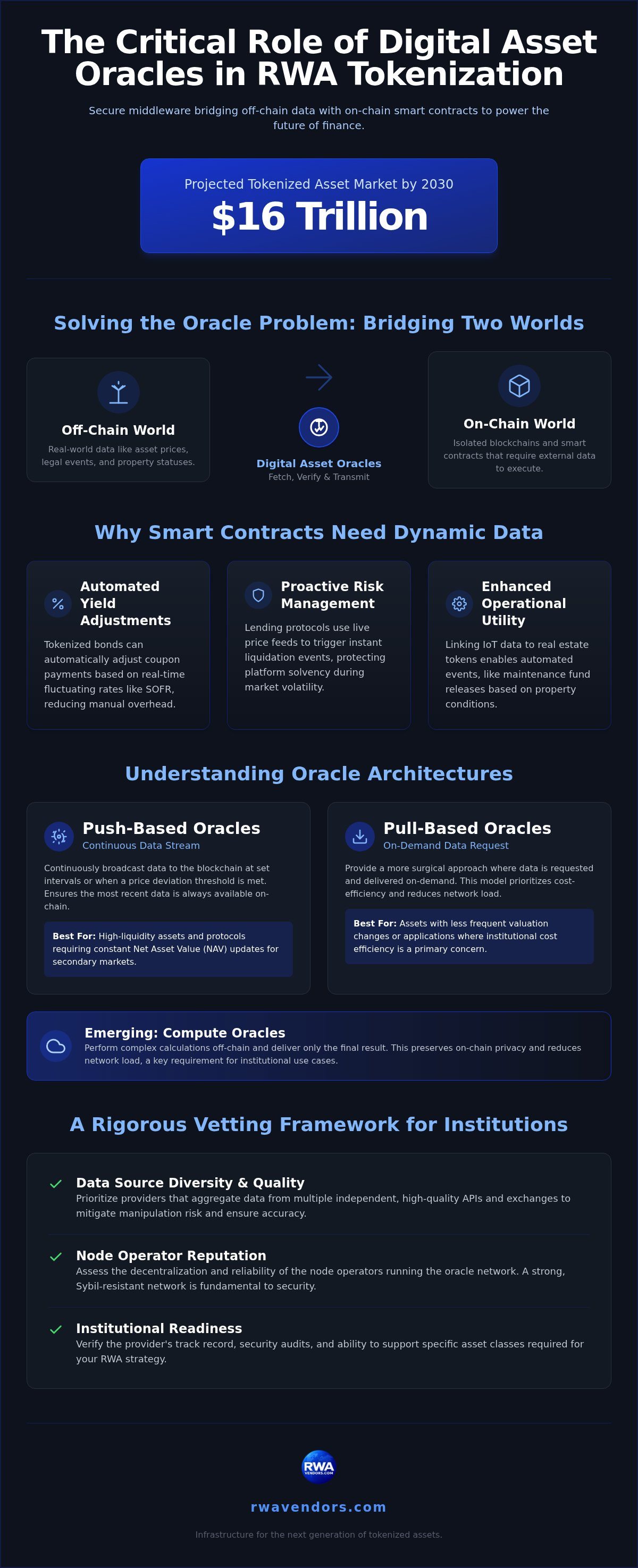
A Blockchain oracle serves as the secure middleware required to fetch, verify, and transmit off-chain data points to on-chain smart contracts. Without this connectivity, real-world assets essentially become static records that fail to reflect the volatility and complexity of global markets. Specialized digital asset oracle providers transform these entries into responsive digital securities that react to external triggers with precision. This functionality is a cornerstone of the modern digital asset infrastructure providers ecosystem, enabling the automation of workflows that previously required manual reconciliation.
Bridging the On-Chain and Off-Chain Gap
Blockchain environments are inherently isolated, meaning they cannot natively confirm the current price of a commodity or the outcome of a legal event. This "connectivity problem" represents a significant hurdle for institutional issuers who must maintain absolute data integrity for audit trails and regulatory reporting. By utilizing digital asset oracle providers, firms ensure that every on-chain action is backed by verified, high-fidelity data sourced from the traditional financial world. This verification layer is essential for maintaining the trust of institutional investors and global regulators.
Digital asset oracles represent the authoritative bridge that translates complex, real-world capital market data into executable code for smart contracts.
Why Smart Contracts Need Dynamic Data
The utility of a smart contract depends on its ability to execute based on accurate, real-time information. If a contract manages a tokenized debt instrument, it needs to know the exact moment a payment is due or when an interest rate benchmark changes. Static tokens cannot support these complex financial maneuvers. Instead, oracles provide the triggers necessary for high-level automation:
- Automated Yield Adjustments: Tokenized bonds can adjust coupon payments in real-time based on fluctuating rates like SOFR.
- Risk Management: Lending protocols use price feeds to trigger liquidation events instantly, protecting the solvency of the platform.
- Operational Utility: Linking IoT data to real estate tokens allows for automated maintenance fund releases based on actual property conditions.
By integrating these data streams, oracles reduce operational overhead and eliminate the latency inherent in legacy settlement systems.
Understanding Oracle Architectures: Push vs. Pull Mechanisms
Selecting the right data delivery model is a strategic decision for any institutional issuer. Digital asset oracle providers generally utilize two primary architectures: push-based and pull-based mechanisms. The choice between these dictates the balance of latency, operational cost, and decentralization within an RWA ecosystem. While push oracles provide a constant stream of data, pull oracles offer a more surgical approach that prioritizes efficiency. Every architecture carries specific trade-offs that impact the long-term viability of a tokenized asset.
Beyond simple data delivery, compute oracles are emerging as a specialized category. These systems perform complex off-chain calculations before transmitting only the final result to the blockchain. This preserves on-chain privacy and reduces the computational load on the network; it's a necessity for institutional privacy requirements where sensitive underlying data shouldn't be exposed to the public ledger.
Push-Based Oracles for Real-Time Valuation
Push-based oracles continuously broadcast data to the blockchain at specific intervals or when a price deviation threshold is met. This model is ideal for high-liquidity trading pairs and assets that require constant Net Asset Value (NAV) updates for secondary market participants. It ensures that the most recent valuation is always available on-chain for immediate execution without requiring the user to initiate a data request.
Reliability in this model depends on data source diversity. Institutions should verify that providers aggregate data from multiple independent APIs and exchanges to mitigate the risk of price manipulation. However, push models face challenges during periods of extreme market volatility. High network activity can lead to gas fee spikes, potentially delaying updates when they're needed most. This makes it vital to assess how a provider manages network congestion risks.
Pull-Based Oracles for On-Demand Compliance
Pull-based architectures allow users to fetch data only when it's required for a specific transaction. This on-demand approach offers significant gas-cost savings because the blockchain doesn't need to process frequent, unnecessary updates. It's particularly effective for automating KYC and AML status checks during a secondary market transfer. The data is "pulled" into the smart contract exactly when the trade occurs, ensuring compliance without constant overhead.
By keeping non-essential data off-chain until a trade is initiated, issuers reduce "on-chain noise" and maintain a cleaner ledger. This architecture aligns strategically with blockchain payment solutions for RWAs, where settlement triggers the need for immediate data verification. For infrastructure partners seeking to demonstrate their technical readiness for these complex workflows, securing a Vendor Directory Listing is a critical step in establishing institutional trust within the marketplace.
Vetting Digital Asset Oracle Providers: A Framework for Institutions
Institutions entering the tokenization space must apply a rigorous vetting process to their infrastructure partners. Unlike retail-focused protocols, institutional RWA projects require data that is both resilient to manipulation and compliant with global financial standards. Evaluating digital asset oracle providers involves analyzing several critical pillars of performance and security to ensure long-term stability.
- Data Source Diversity: A robust oracle doesn't rely on a single API or exchange. It aggregates data from multiple high-quality sources, using weighted averages or median-based logic to filter out outliers. This prevents "flash loan" attacks or exchange-specific glitches from affecting the on-chain valuation.
- Node Operator Reputation: The security of an oracle network is only as strong as its participants. Institutions should prioritize networks with a proven history of uptime and node operators with established reputations in cybersecurity. Decentralization is a risk mitigation strategy against collusion and censorship.
- Latency and Throughput: Speed requirements vary by asset class. While foreign exchange (FX) and high-frequency trading pairs require sub-second updates, a tokenized real estate fund might only need a Net Asset Value (NAV) update once per day. Matching oracle throughput to the specific liquidity profile of the asset prevents unnecessary gas costs while maintaining market accuracy.
- Economic Security: Malicious reporting must be financially ruinous for the provider. Effective digital asset oracle providers utilize staking and slashing mechanisms. By requiring node operators to lock up capital, the network ensures that the cost of an attack far outweighs any potential gain from data manipulation.
Security and Data Integrity Standards
Data integrity is further enhanced by the integration of Zero-Knowledge Proofs (ZKP). This technology allows an oracle to verify that a data point is correct without exposing the sensitive underlying information to the public. For example, a provider can prove a user's credit score exceeds a threshold without revealing the actual score. Resilience against Sybil and man-in-the-middle attacks is equally vital; providers must demonstrate advanced cryptographic authentication for every message. In 2026, ISO 20022 compatibility has become a key requirement for institutional messaging, ensuring that digital asset data integrates seamlessly with legacy banking systems.
Interoperability and Cross-Chain Capabilities
RWA issuance is rarely confined to a single network. Oracles must support multi-chain deployments to ensure global reach and liquidity. Protocols like the Cross-Chain Interoperability Protocol (CCIP) facilitate the secure movement of assets and data between disparate blockchains. A critical feature for institutional trust is Proof of Reserve (PoR). This automated verification ensures that on-chain tokens are backed 1:1 by physical or digital collateral held in RWA custody solutions. On September 2, 2026, the Wyoming Stable Token Commission adopted PoR to provide on-chain verification for the reserves backing the Frontier Stable Token (FRNT). This real-time visibility eliminates the reliance on manual, point-in-time audits.
Advanced Use Cases: Proof of Reserve and Agentic Commerce
The evolution of digital asset oracle providers has shifted from simple price delivery to the facilitation of complex, autonomous financial operations. As institutional adoption matures, oracles are now the primary engine for verifying collateral and enabling machine-to-machine commerce. These advanced use cases transform tokenized assets from passive certificates into active participants in the global economy. By integrating real-time data directly into the asset's lifecycle, issuers eliminate the trust gaps that historically plagued private markets.
Proof of Reserve (PoR) for Tokenized Funds
Traditional fund management relies on periodic, manual audits that offer only a point-in-time snapshot of solvency. In contrast, Proof of Reserve (PoR) provides 24/7 visibility into fund holdings by cryptographically linking on-chain tokens to verified off-chain assets. This transition replaces quarterly reports with a continuous, tamper-proof stream of truth. On September 2, 2026, the Wyoming Stable Token Commission demonstrated this shift by adopting Chainlink Proof of Reserve for the Frontier Stable Token (FRNT), ensuring reserves exceed federal requirements. Proof of Reserve is the gold standard for institutional RWA transparency in 2026. It allows investors to verify the 1:1 backing of stablecoins or tokenized gold in real-time, significantly reducing counterparty risk.
Preparing for AI-Driven Agentic Payments
The rise of agentic commerce represents the next frontier for digital infrastructure. In this model, autonomous AI agents execute trades and rebalance portfolios based on macro data delivered by digital asset oracle providers. These agents require high-fidelity inputs to avoid "hallucinating" financial data, which could lead to catastrophic execution errors. Oracles serve as the essential verification layer, ensuring that AI-driven engines operate within pre-defined compliance guardrails and market parameters. By feeding sentiment analysis and economic indicators directly into execution engines, oracles enable a level of responsive treasury management that was previously impossible.
Beyond payments, oracles are automating programmable corporate actions. Dividends, voting rights, and redemptions can now be triggered by specific real-world events, such as a company reaching a revenue milestone or a bond reaching maturity. In supply chain finance, the intersection of IoT sensors and oracles allows for the instant release of capital upon the verified arrival of goods. This connectivity ensures that tokenized infrastructure remains dynamic and responsive to the physical world.
Navigating the Oracle Ecosystem via the RWA Vendor Directory
Selecting the correct data infrastructure is a critical step in the tokenization lifecycle. The market for digital asset oracle providers is increasingly fragmented, making it difficult for issuers to distinguish between retail-grade protocols and institutional-ready systems. RWA Vendors provides a structured taxonomy to simplify this selection process. It categorizes providers based on technical architecture, such as the push and pull models discussed earlier, and specific asset class expertise. This organization allows capital market participants to conduct surgical due diligence without the inefficiency of manual market mapping.
The value of ecosystem alignment through The STO Foundation's directory cannot be overstated. Since its establishment in 2017, the foundation has focused on building a curated environment where quality and verification are prioritized. By using this central resource, issuers can move beyond the "hype" of emerging tech and engage with infrastructure partners that have already demonstrated a commitment to maintaining the integrity of the capital markets.
Identifying Institutional-Grade Oracle Partners
Due diligence for oracle selection must extend beyond technical uptime. It requires a deep dive into regulatory compliance and verified track records within specific jurisdictions. RWA Vendors enables users to filter vendors based on these professional criteria, allowing for a direct comparison between decentralized networks and enterprise-centralized solutions. For providers, securing a "Founding Membership" within the directory serves as a powerful signal of institutional readiness. This status highlights a provider's role as a central pillar in the industry, helping issuers identify partners capable of supporting high-stakes financial workflows and complex legal requirements.
Streamlining Infrastructure Integration
Building a tokenization stack is not an isolated task. An oracle provider must integrate seamlessly with other layers of the ecosystem, including RWA custody solutions and secondary market trading platforms. The RWA Vendors directory allows issuers to visualize these connections before committing to a vendor. By selecting from a pre-vetted stack of technology and professional service providers, institutions can significantly reduce their time-to-market. This methodical approach ensures that every component of the infrastructure—from data delivery to asset storage—is aligned with the rigorous standards of global finance.
Discover vetted digital asset oracle providers in the RWA Vendors Directory
Securing the Future of Tokenized Capital Markets
The transition from static tokenized assets to dynamic, responsive financial instruments is driven by the integration of robust data infrastructure. Selecting reputable digital asset oracle providers is no longer a technical choice but a strategic imperative for institutional risk management. By implementing a rigorous vetting framework and utilizing advanced functionalities like Proof of Reserve, issuers ensure their tokenized offerings remain compliant and verifiable in real-time. These systems provide the transparency needed to bridge the gap between traditional finance and blockchain efficiency.
The RWA Vendors directory, operated by The STO Foundation, provides comprehensive coverage of institutional-grade infrastructure partners. This global resource allows you to identify vetted vendors that meet the high-stakes requirements of global finance. Aligning your technology stack with these verified providers reduces time-to-market and establishes a foundation of trust for future innovations like agentic commerce. This curated ecosystem ensures you're building on reliable, professional-grade pillars.
Take the next step in building a resilient, data-driven tokenization ecosystem and secure your position in the evolving digital landscape.
Frequently Asked Questions
What is the 'Oracle Problem' in digital asset tokenization?
The oracle problem describes the inability of blockchains to natively access external data, creating a trust gap for real-world assets. Because smart contracts are isolated, they can't verify off-chain valuations or ownership without an external bridge. This creates a risk where the token's value decouples from the physical asset. Reliable digital asset oracle providers solve this by fetching and verifying data before transmitting it to the ledger.
How do digital asset oracle providers ensure data accuracy?
Accuracy is maintained through multi-source aggregation and decentralized node networks. Providers fetch data from independent APIs and exchanges, calculating a median or weighted average to eliminate outliers. Malicious reporting is disincentivized through staking and slashing mechanisms. For example, Pyth Network uses over 138 publisher institutions to ensure high-fidelity pricing. This institutional-grade redundancy prevents single points of failure and minimizes the risk of price manipulation across the ecosystem.
Are decentralized oracles secure enough for institutional use?
Decentralized oracles are specifically designed to meet institutional security standards by removing central points of failure. They utilize cryptographic authentication and distributed consensus to ensure data integrity. Many networks now incorporate Zero-Knowledge Proofs and ISO 20022 compatibility for seamless banking integration. When vetting infrastructure partners, institutions should evaluate the reputation of node operators and the economic security provided by the network's collateralization and slashing protocols.
What is the difference between a push-based and a pull-based oracle?
Push-based oracles continuously broadcast data to the blockchain at set intervals or deviation thresholds, which is ideal for high-liquidity trading. Pull-based oracles allow users to fetch data on-demand only when a transaction occurs. This "pull" model offers significant gas-cost savings for institutional issuers who don't require constant updates. It reduces on-chain noise by keeping non-essential data off-chain until the moment of execution or settlement.
How does Proof of Reserve (PoR) work for real-world assets?
Proof of Reserve provides 24/7 on-chain verification that tokenized assets are backed 1:1 by physical collateral. It replaces manual, point-in-time audits with real-time, cryptographically verified data feeds. For instance, the Wyoming Stable Token Commission adopted Chainlink PoR in September 2026 to verify reserves for the Frontier Stable Token. This automated transparency ensures that the value of on-chain tokens remains accurately collateralized by off-chain bank balances or physical assets.
Can oracles help with regulatory compliance for digital securities?
Oracles facilitate compliance by automating KYC and AML status checks during secondary market transfers. They act as a gatekeeper, ensuring that smart contracts only execute trades between verified participants. By pulling real-time identity data and sanctions lists, oracles enable issuers to maintain legal compliance across multiple jurisdictions. This automation reduces the administrative burden of manual oversight while ensuring that digital securities adhere to frameworks like the GENIUS Act.
What role do oracles play in agentic commerce?
In agentic commerce, oracles provide the high-fidelity data that autonomous AI agents need to execute financial transactions. These agents rely on real-time macro data and market sentiment to rebalance portfolios or trigger payments. Oracles ensure these AI-driven engines operate within pre-defined compliance guardrails, preventing execution errors based on "hallucinated" data. By delivering verified external triggers, oracles transform AI agents from simple assistants into proactive participants in institutional capital markets.
How do I choose the right oracle provider for my tokenization project?
Selection should be based on data source diversity, node reputation, and technical alignment with your asset class. It's essential to match oracle latency to your liquidity needs, as real estate and FX require different update frequencies. RWA Vendors provides a global directory of vetted digital asset oracle providers to streamline this due diligence. Using a curated resource ensures that you engage with infrastructure partners that demonstrate institutional readiness and professional-grade security.
Disclaimer
This article is provided by RWAVendors.com for general informational and educational purposes only. It does not constitute legal, financial, investment, tax, regulatory or other professional advice, or an offer, solicitation, recommendation or endorsement of any company, product, service, token, security or investment. RWAVendors.com is an informational vendor directory and does not sell, issue, broker, custody or facilitate transactions involving cryptocurrencies, digital tokens, tokenized assets, securities or investment products. Some vendor listings and references may involve paid advertising, sponsored placement or membership relationships. These relationships do not guarantee a vendor’s qualifications, regulatory status, performance or suitability. Information may be incomplete, outdated or subject to change. You should independently verify all information, conduct your own due diligence and consult qualified professionals before making any business or investment decision. RWAVendors.com is not responsible for the content, services, representations or actions of third-party vendors or linked websites.


