
In 2026, the distinction between a secure digital wallet and a qualified custodian isn't just a technical preference. It's a fundamental requirement for legal enforceability. You've likely found that distinguishing between retail-grade crypto storage and institutional real-world asset infrastructure remains a significant challenge. The dense terminology surrounding Multi-Party Computation (MPC) and Multi-sig often obscures the more critical questions of regulatory compliance and bankruptcy remoteness that institutional stakeholders demand.
This guide provides the framework you need to conduct a professional RWA custody vendor comparison, ensuring your chosen partner secures both the digital key and the underlying legal title. You'll master the technical, regulatory, and strategic criteria required to vet providers effectively. We'll examine the specific architecture of leading global custodians, establish a rigorous due diligence checklist for your legal team, and analyze the cost-to-security ratios necessary for managing institutional-grade tokenized assets.
Key Takeaways
- Identify the critical differences between crypto-native storage and the institutional-grade custody required to synchronize legal title with digital security.
- Evaluate the technical merits of MPC and Multi-Sig architectures to balance operational efficiency with the rigorous security demands of cold storage.
- Conduct a systematic RWA custody vendor comparison using a vetted checklist that prioritizes jurisdictional licensing and SOC 2 Type II compliance.
- Analyze the strategic advantages of direct custody versus sub-custody models to determine the most cost-effective path for your specific tokenization project.
- Leverage the RWA Vendor Directory to streamline your search for verified custody partners who meet high standards of institutional excellence.
Beyond Private Keys: Why RWA Custody Requires a New Standard
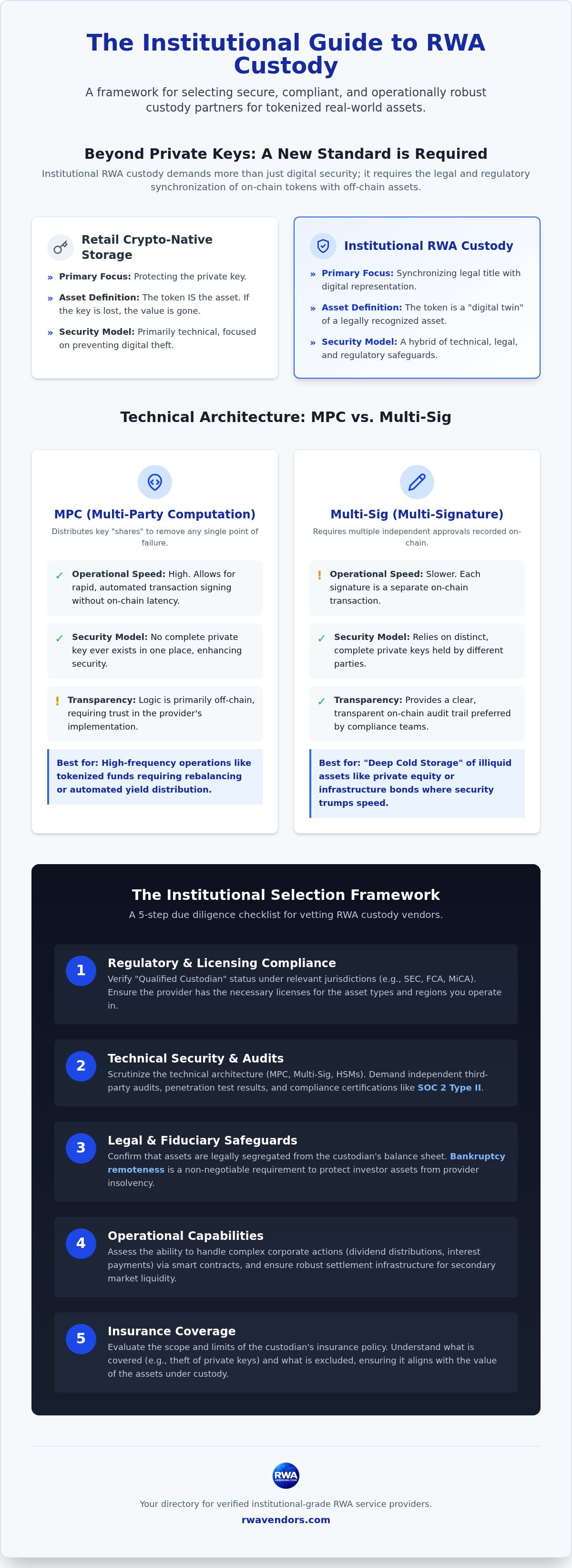
In the evolving capital markets of 2026, digital asset custody has transitioned from a technical necessity to a legal imperative. While early crypto-native solutions focused almost exclusively on the protection of private keys, institutional RWA custody involves a broader mandate. It requires the synchronization of on-chain activity with off-chain legal ownership. When performing an RWA custody vendor comparison, it's essential to recognize that the custodian is no longer just a digital vault. They are the primary link between a distributed ledger and the physical or financial asset it represents.
The distinction between crypto-native and institutional RWA custody is stark. In the crypto-native world, the token is the asset. If the key is lost, the value is gone. In the RWA sector, the token is a digital twin of an underlying security or physical property. Therefore, the custodian's role includes managing the legal documentation and ensuring that the tokenized representation remains valid across all jurisdictions. Modern 2026 standards demand real-time auditing and cryptographic proof-of-reserve capabilities to provide investors with continuous assurance that the underlying assets exist and remain unencumbered.
The Role of Custody in the RWA Lifecycle
The custodial framework supports the entire lifecycle of a tokenized asset. During the issuance phase, the custodian secures the primary mint and ensures the underlying asset is properly locked or escrowed. As assets move into secondary markets, the custodian facilitates institutional liquidity by providing the settlement infrastructure required for high-volume trading. Beyond mere storage, these providers now manage complex corporate actions, such as dividend distributions and interest payments, directly through smart contract interactions. This end-to-end involvement ensures that the digital representation never drifts from the legal reality of the asset.
Regulatory Compliance and "Qualified Custodian" Status
Achieving "Qualified Custodian" status in 2026 requires more than a robust firewall. It necessitates a jurisdictional footprint that aligns with global financial regulations, including specific licenses from authorities like the SEC, FCA, or MiCA-compliant entities. For institutional issuers, bankruptcy remoteness is a non-negotiable requirement. This ensures that the assets held in custody are legally segregated from the custodian's own balance sheet, protecting investors in the event of provider insolvency. A thorough RWA custody vendor comparison must prioritize these fiduciary duties, as they form the bedrock of institutional trust and regulatory approval. Without these legal safeguards, the technical security of the platform becomes irrelevant for regulated financial products.
Technical Architecture: Comparing MPC, Multi-Sig, and HSM
Selecting the right technical foundation is a pivotal step in any RWA custody vendor comparison. The choice between MPC, Multi-Sig, and HSM determines the balance between operational speed and long-term security. While many providers specialize in one specific technology, institutional RWA issuers often require a hybrid approach that accommodates both high-velocity trading and static, long-term holdings. Understanding the underlying cryptographic mechanisms is essential for aligning your infrastructure with your asset's liquidity profile.
The MPC Revolution in 2026
MPC has emerged as the preferred standard for high-frequency RWA operations. By utilizing threshold cryptography, it removes the need for a whole private key to exist in any single location. MPC is the mathematical division of private keys into multiple encrypted shares distributed across separate parties. This architecture allows for rapid transaction signing without the latency associated with traditional multi-signature approvals. It's particularly effective for tokenized funds that require frequent rebalancing or automated yield distribution. If you're a provider offering these advanced architectures, you should get listed in our directory to connect with institutional issuers searching for modern solutions.
Cold Storage and Air-Gapped Solutions
For illiquid tokenized assets like private equity or infrastructure bonds, "Deep Cold" storage remains the gold standard. These air-gapped environments prioritize maximum asset security over instant liquidity. While MPC offers speed, Multi-Sig provides a transparent on-chain audit trail that many compliance officers prefer for long-term holdings. In 2026, insurance coverage limits often vary significantly between hot and cold environments. Cold storage typically commands higher indemnity thresholds because the assets are disconnected from the internet, significantly reducing the potential attack surface for cyber threats.
Traditional finance institutions still rely heavily on Hardware Security Modules (HSMs) to meet rigorous physical security standards. These FIPS 140-2 Level 3 certified devices provide a tamper-resistant environment for cryptographic processing. Beyond the hardware, evaluate how your custodian handles interoperability across different blockchain protocols. As RWA deployments move across Ethereum, Polygon, and various institutional subnets, your infrastructure must remain chain-agnostic. This flexibility prevents vendor lock-in and ensures that your custodial framework can scale alongside the evolving digital asset ecosystem.
Evaluating Custody Models: Direct vs. Sub-Custody vs. Hybrid
Choosing a custodial model is a strategic decision that impacts your balance sheet and regulatory standing. An effective RWA custody vendor comparison must weigh the desire for internal control against the benefits of outsourcing liability to specialized third parties. In 2026, the market has matured to offer distinct paths based on an issuer's operational capacity and the specific regulatory requirements of their asset class.
Direct Custody: Pros, Cons, and Operational Requirements
Direct custody involves building your own infrastructure using licensed technology providers. This model offers maximum control over your private keys and operational workflows. It's often preferred by large financial institutions that want to integrate digital asset management into their existing core banking systems. However, it shifts the full burden of security and regulatory compliance onto your internal team. You'll need dedicated cybersecurity experts and a robust operational framework to manage the technology safely. For a deeper look at the tech stack required, consult our Institutional Guide to Digital Asset Infrastructure Providers in 2026. The primary trade-off is the significant upfront implementation cost and the ongoing internal liability.
The Rise of the Sub-Custody Model for RWAs
Sub-custody is the preferred route for most regulated investment funds. By leveraging a third-party regulated bank or trust company, you inherit their regulatory status and insurance coverage. This model simplifies the due diligence process for your investors; they trust the custodian's established reputation. In 2026, the focus has shifted toward auditing the sub-custodian’s own technology partners. You must ensure their infrastructure can handle specific RWA requirements, such as secondary market settlement and complex corporate actions. Transparency and reporting standards are critical. Your provider should offer real-time data feeds that integrate directly with your accounting systems.
Hybrid models offer a middle ground. They allow firms to maintain internal signing authority while using a third party for disaster recovery or regulatory oversight. This approach provides a safety net without sacrificing operational independence. When evaluating costs, distinguish between one-time implementation fees and recurring AUM-based pricing. Direct models usually involve higher CapEx but lower OpEx as assets scale. Conversely, sub-custody models often feature lower entry costs but can become expensive as the total value of assets under management grows. A comprehensive RWA custody vendor comparison requires a three-to-five-year total cost of ownership projection to ensure long-term viability.
The Institutional Selection Framework: A 5-Step Due Diligence Checklist
Transitioning from conceptual models to vendor selection requires a standardized evaluation framework. An institutional RWA custody vendor comparison must move beyond surface-level features to scrutinize the underlying operational and legal foundations. This five-step checklist ensures that your chosen partner can meet the rigorous demands of global capital markets in 2026.
- Step 1: Assessing Regulatory Alignment. Verify the provider's specific licenses and jurisdictional footprint to ensure they meet local requirements for tokenized securities.
- Step 2: Technical Security Audit. Confirm the existence of SOC 1 and SOC 2 Type II reports to validate the provider's internal control environment.
- Step 3: Operational Resilience. Evaluate disaster recovery protocols and the availability of 24/7 institutional-grade support for critical transaction windows.
- Step 4: Insurance and Liability. Scrutinize the insurance stack for adequate coverage limits and verify the credit rating of the underlying underwriters.
- Step 5: Ecosystem Integration. Test API quality and ensure compatibility with your existing RWA issuance and management platforms.
Vetting the Legal and Compliance Pillar
Regulatory status remains the most significant hurdle for institutional adoption. You must verify that a provider maintains "Qualified Custodian" status as defined by the SEC or ESMA to ensure compliance with fund management mandates. This status implies a higher level of fiduciary responsibility and strict asset segregation rules. Additionally, review how the custodian integrates AML/KYC data with on-chain tokens. SOC 2 Type II reports provide an independent assessment of a service organization's security controls over a specific period, verifying that they're both designed and operating effectively. This documentation is essential for internal risk committees and external auditors.
Evaluating the Insurance Stack
Insurance in digital asset custody is complex and often misunderstood. You should distinguish between "Crime" insurance, which covers theft and internal fraud, and "Specie" insurance, which provides broader coverage for physical loss or damage to private keys held in cold storage. In-transit coverage is equally vital for RWAs, as it protects assets during the signing process when they're most vulnerable. Always request a summary of the policy to verify the underlying underwriters. Ensure the policy is active and tailored to the specific risks of tokenized real-world assets rather than generic cryptocurrency storage.
Operational resilience extends beyond software uptime. It involves the physical security of the data centers and the geographical distribution of key shards in an MPC or Multi-Sig setup. A thorough RWA custody vendor comparison includes a review of the provider's business continuity plan. This ensures that even in extreme market volatility or technical failure, you retain access to your assets and can fulfill your obligations to investors.
Navigating the Vetted Landscape: Selecting Partners via the RWA Vendor Directory
Finding a reliable partner in the digital asset space shouldn't be a shot in the dark. The RWA Vendor Directory serves as a central pillar for institutional due diligence, allowing issuers to conduct a systematic RWA custody vendor comparison without the bias of software-specific sales pitches. By providing a curated marketplace of infrastructure providers, we help businesses transition from the confusion of early-stage research to the execution of a professional RFP process.
Leveraging the RWA Vendor Directory for Due Diligence
The platform utilizes advanced filters to categorize providers by asset class, including real estate, private equity, and debt instruments. This granularity is essential because a custodian's expertise in securing tokenized physical property may not translate to the complexities of private credit or sovereign bonds. You should look for the "Verified" status on provider profiles. This designation indicates that our team has reviewed the vendor's credentials, ensuring they meet the baseline standards for institutional service. Our vetting process focuses on verifying jurisdictional licenses and technical certifications, providing a reliable starting point for your internal risk committees.
Identifying founding members and industry-leading infrastructure partners is straightforward through our curated interface. You can discover custody providers that offer integrated tokenization platforms, which significantly reduces the technical friction between the initial issuance and long-term asset storage. This integration is often the deciding factor for firms looking to minimize the number of vendors in their technology stack.
From Infrastructure to Issuance
Custody is a critical component of the digital securities lifecycle, but it doesn't exist in a vacuum. It must integrate seamlessly with legal frameworks and compliance protocols to be effective. Use the directory to find legal and compliance partners who've documented experience working with your chosen custodian. This holistic approach ensures that your entire infrastructure stack is synchronized from day one, preventing costly integration delays during the launch phase.
Once you've narrowed your shortlist, the next step is moving from preliminary research to a formal Request for Proposal (RFP). The directory provides the contact data and service overviews needed to initiate these high-level discussions with vetted institutional partners. By utilizing a centralized resource, you avoid the fragmentation of the legacy market. You can compare providers side-by-side based on their technical architecture and regulatory alignment, ensuring your final selection is grounded in verified data. This structured path minimizes operational risk and accelerates your time-to-market in the competitive 2026 landscape.
Securing the Future of Tokenized Capital Markets
Success in the 2026 RWA landscape depends on aligning advanced cryptographic security with stringent regulatory compliance. You've explored how the shift from crypto-native storage to institutional custody requires a deep understanding of MPC architecture, bankruptcy remoteness, and qualified custodian status. These elements protect the legal integrity of your assets and the interests of your stakeholders throughout the entire issuance lifecycle.
Performing a thorough RWA custody vendor comparison is the only way to ensure your infrastructure supports the full complexity of tokenized securities while maintaining investor trust. By utilizing the RWA Vendor Directory, you gain direct access to a global ecosystem of infrastructure partners vetted by our specialists. These institutional-grade provider profiles offer the transparency needed to verify regulatory status and technical resilience with surgical precision.
As the market matures, the right custodial partner will act as a foundational pillar for your long-term scaling strategy. We invite you to engage with our curated community of experts to build a secure and compliant future for tokenized finance.
Frequently Asked Questions
What is the difference between a digital asset custodian and a crypto wallet?
A digital asset custodian provides a professional fiduciary service that includes legal responsibility for asset safety, whereas a crypto wallet is simply a technical tool for managing private keys. For institutional issuers, the custodian acts as a regulated gatekeeper that ensures assets are held in bankruptcy-remote accounts. This model effectively shifts the liability from the issuer to the provider. In contrast, self-custody wallets place the entire burden of security and loss prevention on the user.
Does my RWA project need a Qualified Custodian by law?
Regulatory requirements for a Qualified Custodian typically depend on your jurisdiction and whether you're managing a regulated investment fund. In many markets, such as the United States under SEC rules or Europe under MiCA, holding tokenized securities for third parties requires specific licensing. You should consult legal counsel to determine if your specific RWA structure mandates a licensed fiduciary. Using an RWA custody vendor comparison helps identify providers who already hold these necessary certifications.
How much do institutional digital asset custody providers typically charge?
Institutional custody pricing generally follows two primary structures: basis points on Assets Under Management (AUM) or fixed monthly platform fees. Implementation costs often apply for direct custody technology setups. While specific rates vary based on asset volume and transaction frequency, sub-custody models usually involve higher recurring costs due to the regulatory liability the provider assumes. Asset issuers must evaluate the total cost of ownership over a multi-year period to ensure the model remains sustainable as the project scales.
What is MPC technology and why is it used in RWA custody?
Multi-Party Computation (MPC) is a cryptographic protocol that allows multiple parties to collectively sign a transaction without any single party ever holding the full private key. It's widely used in RWA custody because it eliminates the single point of failure associated with traditional key management. This technology enables high-speed transaction processing and scalability, making it ideal for tokenized assets that require frequent secondary market trading or automated distribution of dividends and interest payments.
Can I use a traditional bank for digital asset custody in 2026?
Many traditional banks have established digital asset custody divisions by 2026, often acting as sub-custodians for institutional clients. These banks typically integrate specialized technology from infrastructure partners to manage the blockchain-specific elements of the service. Choosing a traditional financial institution can provide a sense of stability and easier integration with legacy banking systems. However, issuers must verify that the bank's digital unit maintains the same rigorous security standards as specialized crypto-native custodians.
How does custody insurance work for tokenized real-world assets?
Custody insurance for tokenized assets is usually split between crime and specie coverage. Crime insurance protects against internal fraud, collusion, or external hacks of active systems. Specie insurance covers the physical loss or damage of private key shards held in cold storage. When conducting an RWA custody vendor comparison, you should verify the credit rating of the underlying underwriters. It's essential to understand whether the policy covers assets at rest, in transit, or during the signing process.
What is the difference between hot and cold storage for institutions?
Hot storage refers to digital asset environments that are connected to the internet, allowing for near-instant transaction processing and high liquidity. Cold storage involves air-gapped systems where private keys are stored offline to provide maximum protection against cyberattacks. Institutions often use a tiered approach, keeping a small percentage of assets in hot or warm wallets for daily operations while securing the majority of long-term holdings in deep cold storage to mitigate risk.
How do I verify if a digital asset custody provider is actually regulated?
You can verify a provider's regulatory status by searching the public registries of financial authorities such as the SEC in the US or the FCA in the UK. Most legitimate custodians prominently display their license numbers and the specific jurisdictions where they're authorized to operate. The RWA Vendor Directory simplifies this process by listing verified providers whose regulatory claims have been reviewed by industry specialists. Always request a formal Qualified Custodian attestation as part of your final due diligence.
Disclaimer
This article is provided by RWAVendors.com for general informational and educational purposes only. It does not constitute legal, financial, investment, tax, regulatory or other professional advice, or an offer, solicitation, recommendation or endorsement of any company, product, service, token, security or investment. RWAVendors.com is an informational vendor directory and does not sell, issue, broker, custody or facilitate transactions involving cryptocurrencies, digital tokens, tokenized assets, securities or investment products. Some vendor listings and references may involve paid advertising, sponsored placement or membership relationships. These relationships do not guarantee a vendor’s qualifications, regulatory status, performance or suitability. Information may be incomplete, outdated or subject to change. You should independently verify all information, conduct your own due diligence and consult qualified professionals before making any business or investment decision. RWAVendors.com is not responsible for the content, services, representations or actions of third-party vendors or linked websites.


