
With the global asset tokenization market reaching an estimated $3.01 trillion in 2026, the primary challenge for issuers has shifted from technical feasibility to institutional compatibility. Many organizations struggle with how to find tokenization service providers that can actually navigate the complex boundary between blockchain infrastructure and SEC compliance. It's often difficult to distinguish between simple payment processors and the sophisticated partners required for real-world asset (RWA) securities.
You've likely realized that a failed due diligence process doesn't just waste time. It creates significant regulatory exposure and sunk costs that can derail a project before the first token is issued. This guide provides a professional framework to identify, vet, and select partners that fit your specific asset class and ecosystem. You'll gain a repeatable due diligence methodology to minimize risk and build a short-list of verified vendors capable of handling the legal and technical complexities of modern RWA issuance. We'll examine the critical pillars of custodial integration, regulatory adherence, and technical interoperability required for a successful launch.
Key Takeaways
- Distinguish between payment-based tokenization and institutional asset tokenization to ensure your infrastructure supports the specific compliance requirements of digital securities.
- Master the professional methodology for how to find tokenization service providers by utilizing curated industry resources like the RWA Vendors directory.
- Evaluate potential partners based on rigorous regulatory benchmarks, including jurisdiction-specific licenses and the ability to interoperate with legacy financial systems.
- Implement a structured five-step sourcing framework that moves from internal requirement mapping to the assembly of a vetted long-list of service providers.
- Understand the necessity of a modular ecosystem, where specialized legal, technical, and custodial partners collaborate to manage the full real-world asset lifecycle.
Defining Your Needs: Payment vs. Asset Tokenization Providers
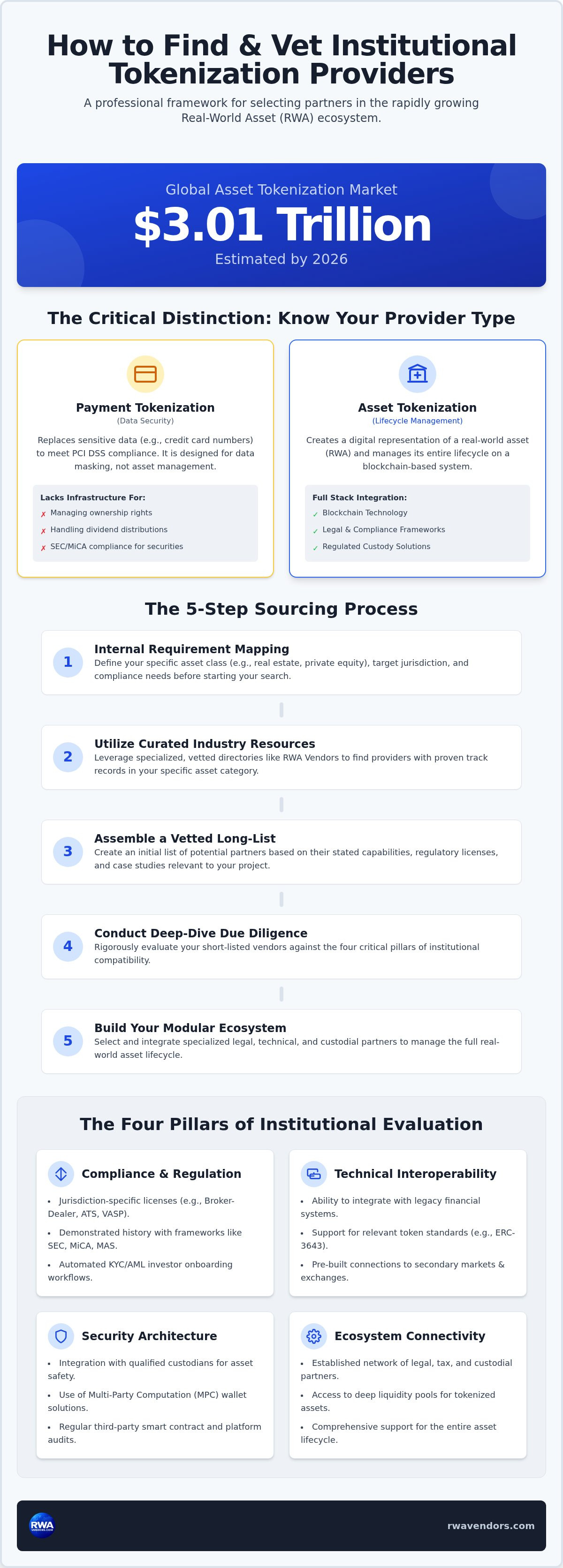
The term "tokenization" is frequently used in two distinct contexts: data security and asset representation. Understanding this bifurcation is the first step in learning how to find tokenization service providers that align with your institutional goals. Traditional Tokenization (data security) focuses on replacing sensitive data, such as credit card numbers, with non-sensitive equivalents to satisfy PCI DSS requirements. While essential for cybersecurity, these payment token service providers (TSPs) lack the infrastructure to handle the lifecycle of a financial security. They're designed for data masking, not for managing ownership rights or dividend distributions.
An Asset Tokenization Service Provider isn't a data masker; they're a lifecycle manager. They facilitate the issuance, management, and distribution of digital representations of real-world assets. The RWA Tokenization Stack is the seamless integration of blockchain technology, legal compliance frameworks, and regulated custody solutions into a single operational environment. Organizations searching for how to find tokenization service providers must prioritize vendors that offer this full stack rather than isolated technical components.
The Scope of Asset Tokenization in 2026
The market has matured beyond experimental proofs-of-concept into institutional-grade issuance. Primary asset classes now include real estate, private equity, corporate debt, and fine art. Each asset class imposes unique technical and legal constraints. For instance, real estate requires specific handling of title deeds, while private equity demands complex cap table management. Your specific asset class dictates your choice of technology provider. Specialized platforms often build custom logic tailored to the nuances of these underlying markets. The global asset tokenization market is estimated to reach up to $3.01 trillion in 2026, reflecting a shift toward permanent, scalable digital finance.
Why a 'General' Blockchain Vendor Won't Suffice
Generic blockchain developers often lack the specialized knowledge required for financial compliance. Institutional finance operates under strict frameworks like the SEC in the United States, MiCA in Europe, or MAS in Singapore. A general vendor may provide a functional ledger but fail to implement the necessary "Regulated" infrastructure required for digital securities. This distinction is critical. Regulated infrastructure ensures that every transaction complies with KYC and AML protocols at the protocol level. Standards like ERC-3643 have become central to this movement. They allow for conditional transfers and identity verification directly within the smart contract. Using unregulated, generic solutions for institutional assets risks significant legal exposure and operational failure.
Key Criteria for Evaluating Tokenization Service Providers
Selecting an institutional partner requires a methodology that moves beyond generic software reviews. When researching how to find tokenization service providers, your evaluation must center on four critical pillars: regulatory standing, technical interoperability, security architecture, and ecosystem connectivity. A provider's ability to integrate with qualified custodians and utilize Multi-Party Computation (MPC) wallet solutions is non-negotiable for institutional safety. You must also confirm their pre-built links to secondary markets and liquidity pools, as a tokenized asset without a path to liquidity fails to deliver its primary value proposition.
The Compliance Pillar: Legal and Jurisdictional Vetting
Regulatory adherence is the most significant variable in project success. On March 17, 2026, the SEC and CFTC issued joint guidance classifying crypto assets into distinct categories, including digital securities and commodities. Your chosen provider must demonstrate a clear history of compliance within these frameworks. This includes holding relevant licenses such as Broker-Dealer status, Alternative Trading System (ATS) registrations, or Virtual Asset Service Provider (VASP) certifications.
The distinction between white-label solutions and Platform-as-a-Service (PaaS) legal wrappers is equally vital. You should verify if their investor onboarding workflows automate identity verification (KYC) and anti-money laundering (AML) checks. Current industry data from early 2026 indicates that basic KYC costs typically range from $2 to $15 per investor, while verifying accredited status for Rule 506(c) offerings costs between $50 and $100 per person. If you are a service provider that meets these rigorous standards, you may wish to apply for a directory listing to reach qualified issuers.
Technical Robustness and Scalability
Institutional finance demands a level of technical maturity that generic blockchain vendors cannot provide. You must scrutinize a provider's smart contract audit history and the depth of their bug bounty programs. For financial institutions, the ERC-1400 standard has become a benchmark for regulated security tokens because it allows for granular control over asset tranches and off-chain legal documentation.
Future-proofing is another essential consideration. Ensure the provider supports multi-chain environments and has a clear strategy for chain migrations or network forks. Their API documentation should be comprehensive enough to allow for seamless integration with your existing legacy financial systems. A robust technical stack should handle the full lifecycle of the asset, from initial issuance to secondary trading and corporate actions, without requiring a complete infrastructure overhaul when regulations evolve.
Where to Find Vetted Tokenization Vendors
Identifying institutional-grade partners requires a departure from standard procurement methods. The digital asset landscape is currently saturated with fragmented information, making the discovery process both time-consuming and high-risk. To establish a robust ecosystem, you must look toward industry-specific resources that prioritize verification over marketing volume. Effective sourcing strategies involve a combination of curated directories, institutional networking through organizations like The STO Foundation, and direct verification via regulatory registries. These registries provide lists of authorized service providers in specific jurisdictions, ensuring that your long-list consists only of firms with the necessary legal standing to operate.
Visualizing the market through RWA Ecosystem Maps is another professional tactic. These maps illustrate the technical and legal interdependencies between technology providers, legal counsel, and capital providers. By understanding these connections, you can ensure that your chosen vendor isn't an isolated entity but a functional component of the broader capital markets value chain.
The Limitations of General Search Engines
Searching for how to find tokenization service providers on the open web often leads to a dead end of irrelevant payment security firms. Because the term "tokenization" is deeply embedded in the PCI DSS payment sector, general search algorithms prioritize data-masking services over asset-backed security platforms. This creates significant noise that can stall a project for months.
Beyond the noise, there's the pervasive risk of "vaporware." Many firms in the blockchain space maintain sophisticated websites but lack the underlying licenses or technical maturity to execute an institutional issuance. Unvetted search results don't distinguish between a startup with a whitepaper and a regulated provider with a five-year track record. Utilizing targeted directories eliminates this initial research burden by providing a pre-filtered list of participants who have already demonstrated technical and legal competency.
Using the RWA Vendors Directory as a Strategic Shortcut
The RWA Vendors directory serves as an institutional gatekeeper, having already performed the heavy lifting of categorization and verification. Our platform provides a precise solution for how to find tokenization service providers by organizing the market into a logical taxonomy. You can navigate specific listings for Legal, Custody, Trading, and Infrastructure with surgical precision.
The primary value lies in the "Verified" status. This designation confirms that a vendor has been reviewed by the STO Foundation, which has been a central pillar of the industry since 2017. The directory's advanced filtering allows you to sort providers by asset class, such as real estate or private equity, and geographic coverage. This ensures that the vendors you engage are not only technically capable but are also legally authorized to operate within your specific target jurisdiction. This structured approach transforms an overwhelming search into a methodical selection process.
The 5-Step Sourcing Process for Tokenization Partners
Adopting a methodical approach to procurement ensures that your digital asset initiative remains compliant and scalable. When organizations evaluate how to find tokenization service providers, they often rush into technical demos before defining their institutional constraints. A structured five-step process mitigates this risk by filtering candidates through increasingly rigorous benchmarks. This journey begins with internal mapping and concludes with a functional sandbox environment where claims are tested against reality.
- Step 1: Internal Requirement Mapping: Define your specific asset class, such as real estate or private equity. Identify your target investor base and the primary jurisdictions for issuance.
- Step 2: Initial Discovery: Utilize the RWA Vendors directory to build a comprehensive long-list of providers who specialize in your asset type.
- Step 3: Preliminary Vetting: Conduct a high-level review of regulatory licenses and technical compatibility with your existing financial systems.
- Step 4: RFP Issuance: Distribute a formal Request for Proposal containing specific KPIs tailored to real-world asset issuance.
- Step 5: Final Due Diligence and Sandbox Testing: Perform deep-dive legal reviews and test the provider's technology in a controlled, non-production environment.
Crafting Your RFP for Tokenization Services
A standard IT RFP is insufficient for the complexities of blockchain-based finance. Your document must include granular questions regarding data privacy, key management architecture, and disaster recovery protocols. Ask providers to demonstrate proof of successful previous issuances within your specific asset class. This is also the time to evaluate their roadmap for 2026 and beyond. In light of the SEC's proposed "Regulation Crypto Assets" on August 18, 2026, you should ask how they plan to utilize the conditional investment contract safe harbor. Understanding how to find tokenization service providers that are already preparing for these specific regulatory shifts is a major competitive advantage.
Conducting Technical and Legal Due Diligence
The final stage of selection requires verifying the provider's operational integrity. Review their SOC2 compliance reports and third-party security audits to ensure their internal controls meet institutional standards. You should also interview the provider's legal counsel to understand the regulatory assumptions baked into their platform's logic. Don't rely on slide decks alone. Test the investor experience through a comprehensive demo environment. This allows your team to evaluate the ease of onboarding, the clarity of the interface, and the efficiency of the administrative dashboard before committing to a long-term contract.
Building Your Tokenization Ecosystem with RWA Vendors
Successful asset tokenization relies on a modular architecture rather than a single monolithic provider. Most institutional issuers require a suite of specialized partners to manage the legal, technical, and custodial requirements of the digital security lifecycle. RWA Vendors facilitates these essential connections across the entire capital markets value chain. By acting as a central hub, we enable issuers to identify strategic partners who are already integrated into a professional network. Our Founding Members and strategic partners represent the vanguard of this industry. They provide the stability and expertise necessary for high-stakes financial operations. Distributing risk across multiple specialized vendors ensures that your project isn't dependent on a single point of technical or legal failure.
The journey of how to find tokenization service providers concludes with the assembly of your core ecosystem. You shouldn't search for a partner that claims to do everything. Instead, you should seek those who excel in their specific niche while offering seamless interoperability with other providers. RWA Vendors organizes these specialists into a logical taxonomy, allowing you to build a custom stack that fits your specific asset class and jurisdiction. This modular approach is the standard for institutional-grade issuances in 2026.
Moving Beyond Discovery to Implementation
Once you understand how to find tokenization service providers, the focus shifts to implementation and ongoing management. The RWA Vendors directory provides the granular data needed for competitive benchmarking. You can compare the service offerings, jurisdictional coverage, and regulatory licenses of multiple vetted vendors simultaneously. This data-driven approach ensures that your ecosystem remains efficient and compliant as market conditions evolve. For organizations that have already established their expertise, joining the platform as a verified vendor or institutional partner offers a direct route to connecting with qualified issuers globally. The directory serves as a living resource for ongoing vendor monitoring and ecosystem expansion.
The Institutional Path Forward
The institutional path forward requires a transition from theoretical research to practical partnership. You've mastered the framework for identifying and vetting, but the execution begins with identifying your first three critical pillars: a legal architect, a technology provider, and a qualified custodian. RWA Vendors has simplified this process by organizing the global landscape into a searchable, verified taxonomy. This methodical approach reduces the risk of failed due diligence and accelerates your time to market. The global asset tokenization market, projected to reach $3.01 trillion in 2026, rewards those who move with precision and institutional rigor.
Explore the RWA Vendor Directory to start your search today
Securing Your Position in the Tokenization Economy
The evolution of global finance toward digital representations of real-world assets is no longer a speculative trend. It's a multi-trillion dollar reality that rewards organizations with the foresight to build modular, compliant ecosystems. Mastering how to find tokenization service providers requires a shift from general search queries to institutional vetting frameworks. You must prioritize partners that demonstrate deep regulatory adherence, technical interoperability, and verified track records in your specific asset class.
By utilizing a structured sourcing process, you eliminate the high cost of failed due diligence and project delays. Curated resources like the RWA Vendors directory, operated by The STO Foundation, provide the necessary transparency to identify specialists across legal, technical, and custodial pillars. This comprehensive global directory ensures that your infrastructure is prepared for the complex regulatory landscape of 2026 and beyond. A specialized focus on real-world assets allows you to move with confidence from initial discovery to final implementation.
The complexity of modern capital markets demands a professional approach to vendor discovery. You're now equipped with the methodology to build a secure, scalable foundation for your digital asset initiative.
Frequently Asked Questions
What is the difference between a tokenization platform and a token service provider?
A tokenization platform manages the issuance and lifecycle of digital securities, including cap table management and investor portals. In contrast, a Token Service Provider (TSP) usually focuses on payment data security, such as PCI DSS compliance. For those researching how to find tokenization service providers, it's vital to choose a platform that supports financial compliance rather than just data masking. Platforms handle ownership rights, while TSPs focus on securing sensitive credit card information.
How do I know if a tokenization vendor is regulated?
You can verify a vendor's status by checking regulatory registries for licenses such as Broker-Dealer, ATS, or VASP status. In the United States, use the SEC and FINRA databases, while European firms should be listed under MiCA-compliant national registries. The SEC and CFTC provided joint guidance on March 17, 2026, which helps categorize these assets. Always request a provider's specific registration numbers and cross-reference them with the issuing financial authority to ensure legal standing.
Can one provider handle the entire RWA tokenization process?
A single vendor rarely possesses the legal, technical, and custodial licenses required to manage the entire lifecycle alone. Most successful issuers build a modular ecosystem by connecting specialized vendors. For example, you might use one firm for the primary issuance platform and another for qualified custody. This approach prevents vendor lock-in and ensures that each component of your capital markets stack is handled by a dedicated specialist with the proper jurisdictional authorization.
What are the typical costs associated with hiring a tokenization provider in 2026?
Upfront platform costs for institutional tokenization in 2026 typically range from $50,000 to $100,000. Legal fees for a standard Regulation D Rule 506(c) offering often fall between $30,000 and $75,000, while more complex Regulation A+ filings can exceed $100,000. Annual maintenance for digital transfer agents and cap table services generally ranges from $5,000 to $25,000. These figures vary significantly based on the asset class and the specific regulatory requirements of your target market.
Which blockchain is best for institutional asset tokenization?
The choice depends on your specific regulatory and technical requirements. Ethereum remains a dominant force due to the ERC-1400 and ERC-3643 standards, which are specifically designed for regulated security tokens. These frameworks allow for features like distinguishing between asset tranches and referencing off-chain legal documentation. Many institutions also utilize Layer 2 solutions or specialized private-permissioned chains to achieve better scalability and privacy while maintaining interoperability with existing legacy financial systems.
How long does it take to integrate a tokenization service provider?
Integration timelines usually range from three to six months depending on the complexity of your legacy systems. The technical deployment of a smart contract can happen quickly, but the legal structuring and investor onboarding workflows require significant lead time. Researching how to find tokenization service providers with pre-built API connectors can accelerate this process. A phased rollout allows you to test compliance logic in a sandbox environment before going live with a full issuance.
What happens if my tokenization provider goes out of business?
Your digital assets should ideally exist on a public or interoperable blockchain, ensuring they remain accessible even if the provider's interface fails. Institutional-grade contracts often include "recovery" features that allow issuers to migrate their cap table to a new platform. You must verify that your provider uses non-custodial or independent custodial arrangements. This ensures that the legal ownership of the underlying assets is decoupled from the technology vendor's solvency and operational status.
Do I need a separate custodian if my tokenization provider offers vaulting?
Yes, institutional issuers typically require a "qualified custodian" to meet regulatory standards, even if a technology provider offers technical vaulting. Technical vaulting refers to the software used to manage private keys, whereas a qualified custodian provides the legal and fiduciary framework for asset protection. Separating these roles is a key security best practice. It ensures that no single entity has total control over the assets and the records of ownership, reducing internal risk.
Disclaimer
This article is provided by RWAVendors.com for general informational and educational purposes only. It does not constitute legal, financial, investment, tax, regulatory or other professional advice, or an offer, solicitation, recommendation or endorsement of any company, product, service, token, security or investment. RWAVendors.com is an informational vendor directory and does not sell, issue, broker, custody or facilitate transactions involving cryptocurrencies, digital tokens, tokenized assets, securities or investment products. Some vendor listings and references may involve paid advertising, sponsored placement or membership relationships. These relationships do not guarantee a vendor’s qualifications, regulatory status, performance or suitability. Information may be incomplete, outdated or subject to change. You should independently verify all information, conduct your own due diligence and consult qualified professionals before making any business or investment decision. RWAVendors.com is not responsible for the content, services, representations or actions of third-party vendors or linked websites.


