
If a blockchain token points to a patent, does its holder own the patent? Not necessarily. Intellectual property tokenization can create a digital record or represent an interest tied to IP, but the token itself doesn’t define or transfer legal rights. Those rights depend on the agreements, ownership records, and governance behind the issuance.
That distinction matters to creators, rights holders, and organizations assessing tokenized IP. A token may relate to ownership, a license, access, or revenue participation, and each model carries different obligations and limits. Read the governing documents to understand exactly what the token grants, rather than relying on its label or technical design.
This article explains the main IP tokenization models, what a token holder may receive, and the legal, technical, and operational components an issuance can involve. It also maps the supporting ecosystem, from rights management and compliance to blockchain infrastructure and payments. For organizations identifying providers, RWA Vendors offers a global directory of tokenization platforms and professional services across the broader digital asset market.
Key Takeaways
- Intellectual property tokenization can represent different kinds of claims; the governing documents and rights design determine what a token means.
- Map the relevant rights, define the token’s role, and document its terms before implementing blockchain records or smart-contract functions.
- Separate copyright ownership from licensing, access, and royalty interests to assess what a token holder may receive.
- Identify the distinct roles a project may need, including legal and compliance, tokenization technology, custody, payments, and trading.
- Use RWA Vendors’ global directory to discover providers across the tokenized IP infrastructure ecosystem.
What Is Intellectual Property Tokenization, and What Does the Token Represent?
Intellectual property tokenization is the creation of a blockchain-based digital representation of an IP asset or a defined claim connected to it. The token is a technical record, not the intellectual property itself. Its meaning depends on the rights it is designed to represent, the governing documents, and applicable law.
Keep three things distinct: the underlying IP, the blockchain record, and any contractual entitlement associated with the token. A digital copy of a patent document or copyright record is a digitized file. A token may point to that file or record activity related to it, but that alone doesn’t establish ownership, grant a license, or create a right to income. The issuance documents must define what, if anything, the token holder is entitled to do.
Which intellectual property assets might be represented?
Copyrights, patents, and trademarks are different categories of rights, with distinct ownership records, uses, and restrictions. A token could also relate to a licensing interest, such as permission to use protected material under stated terms. These possibilities aren’t interchangeable. A token representing a license doesn’t necessarily represent ownership of the underlying IP.
Suitability depends on the asset, who holds the relevant rights, and the intended use. Before designing a token, identify the specific work, invention, mark, or licensing interest involved, along with existing agreements and limits on transfer. Describe precisely which rights are in scope rather than treating “the IP” as a single, undivided asset.
What can a token holder receive?
State the token’s intended role plainly. Depending on the arrangement, a holder might receive:
- Documented ownership: a recorded or contractually defined ownership interest, if the relevant transfer is properly established.
- A license: permission to use specified IP under stated conditions, such as limits on purpose, duration, or territory.
- Access: the ability to use a platform, file, or other resource, without ownership of the associated IP.
- Governance rights: a defined role in certain decisions, if the governing terms provide for it.
- An economic interest: a contractual claim to specified revenue or royalties, subject to the terms and applicable law.
Token possession by itself doesn’t establish any of these entitlements. The token’s metadata, issuer statements, and smart-contract code may help identify or administer an arrangement, but they don’t replace clear governing documents.
Illustrative example, not legal advice: A creator issues tokens linked to a song. The documents could grant holders a limited listening-access benefit, a defined royalty interest, or no rights beyond holding a digital collectible. The blockchain record might track token transfers, but the terms determine which arrangement applies.
How Intellectual Property Tokenization Connects Rights, Records, and Blockchain
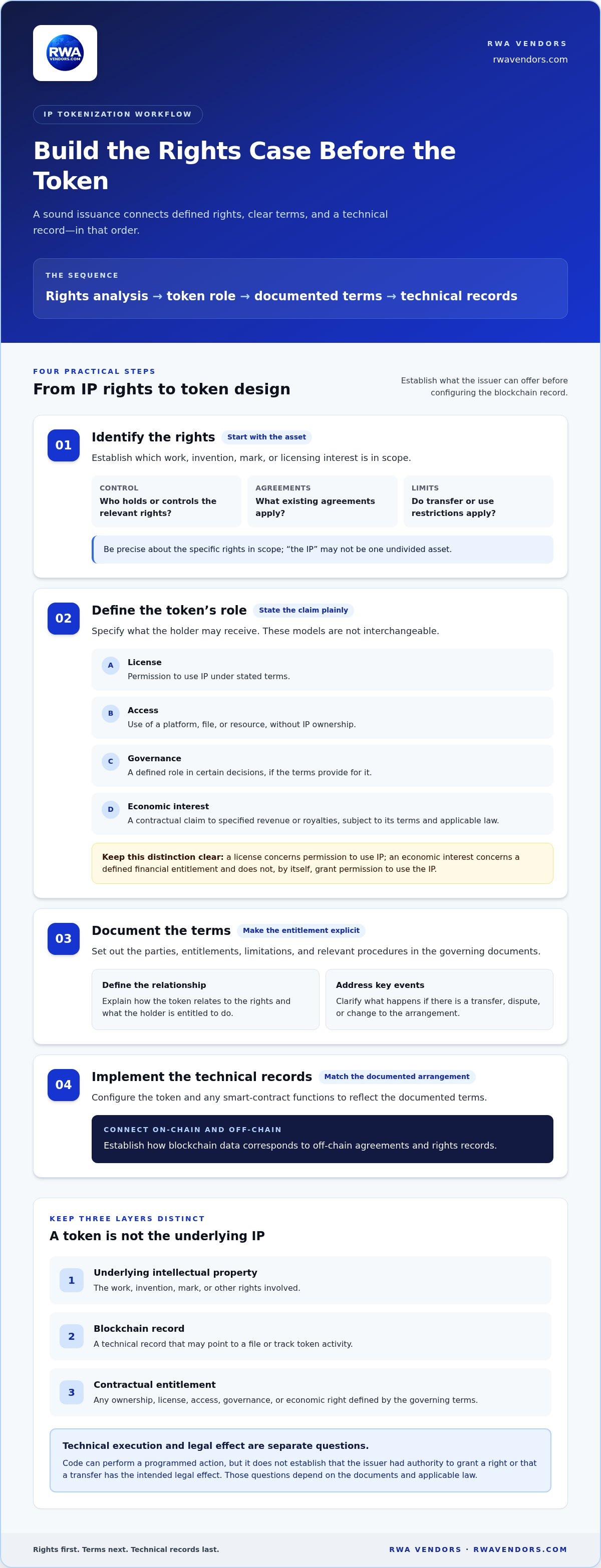
A sound issuance connects a defined set of rights to clear terms and a technical record. Start by establishing what the issuer can offer, then design the token. Reversing that order risks creating a blockchain record that doesn’t match the underlying agreements. A practical workflow moves from rights analysis to implementation.
- Identify the rights. Establish which work, invention, mark, or licensing interest is in scope. Review who controls it, what existing agreements apply, and whether transfer or use restrictions affect the proposed arrangement.
- Define the token’s role. State whether it records a license, access permission, governance function, or economic interest. These models aren’t interchangeable. A license sets terms for using IP; an economic interest concerns a defined financial entitlement and doesn’t, by itself, grant permission to use the IP.
- Document the terms. Set out the parties, entitlements, limitations, and relevant procedures in the governing documents. Clarify how the token relates to the rights and what happens if a transfer, dispute, or change to the arrangement occurs.
- Implement the technical records. Configure the token and any smart-contract functions to reflect the documented arrangement. Establish how on-chain data will correspond to off-chain agreements and rights records.
Technical execution and legal effect are separate questions. Code can perform a programmed action, but that doesn’t establish that the issuer had authority to grant a right or that a particular transfer has the intended legal effect. Those questions depend on the documents and applicable law.
From IP rights analysis to token design
Ownership is only one part of the design. Existing licenses may grant others permission to use the IP, territorial scope may limit where rights apply, and encumbrances may constrain transfer or use. Each factor can shape what a token can represent. For example, a token linked to a defined license in one territory shouldn’t be described as conveying worldwide ownership. Jurisdictional outcomes vary, so a universal token template can’t resolve every project’s legal questions.
The role of smart contracts and supporting records
A smart contract is code that executes specified rules on a blockchain, such as recording transfers or applying a defined distribution process. It can automate functions only within its technical design. Agreements define the underlying entitlements the code is intended to support; code alone can’t establish them. Metadata can point to relevant terms or identify an IP record, while separate rights databases and signed agreements may supply supporting details. Use consistent identifiers and a process for reflecting amendments so users can reconcile the token with current documentation.
For instance, a patent holder might issue tokens associated with a license that permits use in a specified field. The agreement defines the scope; the token record can help track the license interest or related transactions. If the license terms change, the records and any automated functions may also need updating. This is an illustrative workflow, not legal advice. RWA Vendors’ directory helps organizations discover providers supporting blockchain infrastructure, legal and compliance, and related operations. Service providers can also seek directory visibility.
Does Tokenizing Intellectual Property Transfer Copyright or Guarantee Royalties?
No. Minting or holding a token doesn’t automatically transfer copyright or guarantee royalty payments. Token ownership is not the same as ownership of the underlying intellectual property. A blockchain can record a token’s creation or movement, but that entry alone doesn’t establish who owns a work, what rights were granted, or whether revenue is owed.
Intellectual property tokenization may support programmable recordkeeping and transaction workflows. These functions can help track defined events or apply specified rules, but they don’t settle questions of legal interpretation, authorization, or enforcement. A royalty arrangement still depends on clear terms, reliable administration, and applicable law. If revenue isn’t generated, reported, or payable under the agreement, a token can’t create it by itself.
Token ownership is not automatically copyright ownership
A transfer or license needs clear terms and an appropriate legal mechanism. A blockchain entry may document a token transfer, while copyright assignment or license documentation describes the rights being transferred or permitted. These records serve different purposes, and one shouldn’t be treated as a substitute for the other. Applicable formalities and legal effects vary by jurisdiction, so a token’s technical design alone can’t establish a universal outcome.
For example, a token could be transferable while the associated license remains personal, limited, or non-transferable under its terms. A new holder might receive the token without acquiring permission to reproduce, distribute, adapt, or commercially use the work. The issuance documents should explain whether rights follow the token, require separate approval, or aren’t granted at all.
Royalties, fractional interests, and practical limitations
A royalty arrangement should specify what revenue is covered and how it is administered. Key terms may include:
- Calculation: which receipts count, and what deductions or exclusions apply.
- Reporting: who supplies revenue information, and how it is documented.
- Payment conditions: when an amount becomes payable and how distributions are handled.
- Changes and disputes: how corrections, disagreements, or amendments are addressed.
Smart contracts may automate parts of a defined calculation or distribution process, but their output depends on the inputs and rules they receive. If sales data comes from outside the blockchain, someone or some system must report it accurately. The contractual arrangement also needs to explain how errors, late reports, or contested amounts are handled.
Fractional tokenization can divide an economic interest into smaller units, but it doesn’t automatically divide copyright or resolve who controls the underlying rights. The documents must define the interest, decision-making process, and any consent needed from rights holders. Holding a fraction doesn’t, by itself, grant creative control, voting power, or a guaranteed share of future income. Treat token design, contractual rights, and revenue administration as connected but distinct parts of the arrangement.
What Roles and Infrastructure Support an Intellectual Property Tokenization Project?
An intellectual property tokenization project can involve distinct legal, technical, and operational functions. The provider mix depends on the asset, the rights being represented, the intended participants, transaction design, and relevant jurisdictions. Not every project needs every category. Define each provider’s role before assigning responsibilities.
Map project requirements to vendor categories
Use the project’s requirements to identify relevant provider functions. These categories describe general roles, not a required package of services.
| Project need | Relevant vendor category | General function |
|---|---|---|
| Rights documentation and compliance planning | Legal and compliance | Support rights documentation and assess applicable compliance considerations for the proposed structure and participants. |
| Issuance, token records, and blockchain operations | Tokenization technology and blockchain infrastructure | Provide systems for creating and managing token records and supporting on-chain processes. |
| Safekeeping or administration of digital assets | Custody | Support the safekeeping and operational management of assets, where the project design calls for it. |
| Movement of funds | Payments | Support payment flows associated with subscriptions, settlements, or distributions, as applicable. |
| Transfer or secondary transaction activity | Trading | Provide relevant transaction infrastructure where the issuance and applicable rules allow it. |
Keep these functions distinct in the project plan. A technology provider may operate issuance software, for example, while rights documentation and compliance responsibilities sit elsewhere. Custody, payment processing, and trading infrastructure address separate operational needs. Including them doesn’t establish that a token can be traded or that a market will exist.
For broader reading, the article Compliant Asset Tokenization: 2026 Institutional Guide provides context on compliance considerations in tokenized asset projects. Specific requirements depend on the project’s design and jurisdictions, so the article is background rather than a substitute for project-specific assessment.
Organize the project before engaging the ecosystem
Prepare a short project brief to focus the provider search. Separate decisions already made from open design questions, and assign each workstream to an owner. Include:
- Asset: the specific work, patent, mark, or other IP involved, and the available ownership records.
- Intended rights: the proposed license, access, governance, or economic interest, with known limits.
- Participants: the intended issuer, rights holders, and target token participants.
- Jurisdictions: the locations relevant to the asset, issuer, participants, and planned activity.
- Operations: expected issuance, recordkeeping, custody, payments, and any potential transfer processes.
Flag transfer restrictions, participant eligibility, and the relationship between token records and off-chain documents for project review. For infrastructure background, Institutional Guide to Digital Asset Infrastructure Providers in 2026 covers provider functions across the broader digital asset ecosystem. RWA Vendors’ directory helps organizations discover providers across legal and compliance, blockchain infrastructure, custody, payments, and trading.
How RWA Vendors Helps the Intellectual Property Tokenization Ecosystem Connect
Intellectual property tokenization can involve providers from several parts of the digital asset ecosystem. RWA Vendors helps issuers discover tokenization platforms and professional service providers through a global directory focused on tokenized capital markets. The platform helps organizations map provider capabilities relevant to their projects.
Find ecosystem providers by capability
Browse and filter the directory to narrow a broad market to provider types related to a project’s needs. For IP-related initiatives, relevant categories may include legal and compliance, blockchain infrastructure, custody, payments, and trading. These roles connect IP projects with wider real-world asset and digital-securities infrastructure, while keeping each provider’s function distinct.
- Legal and compliance: providers supporting documentation and compliance-related project needs.
- Blockchain infrastructure: technology providers supporting token records and blockchain operations.
- Custody: providers supporting digital asset safekeeping and related operations.
- Payments: providers supporting payment flows connected with project activity.
- Trading: providers supporting transaction infrastructure where relevant to the project design.
These categories offer a starting point for discovery. An issuer can use the directory to identify relevant provider capabilities, then assess how they align with its project requirements, structure, and jurisdictions.
Make a vendor visible to the tokenization market
Technology firms and professional-service providers can use directory visibility to reach organizations working across tokenized capital markets. A clear listing helps issuers understand a provider’s area of focus and how it fits into the broader infrastructure landscape. This is relevant to providers serving IP-related projects as well as firms supporting other real-world assets and digital securities.
RWA Vendors connects issuers with providers across the ecosystem, including legal and compliance, custody, trading, blockchain infrastructure, and payments. Issuers can use these categories to map the market; providers can use a listing to increase their visibility among businesses seeking tokenization-related services.
For service providers working in this ecosystem, a directory listing is a direct way to pursue visibility among asset issuers.
Turn the Rights Framework Into a Project Roadmap
The next step for intellectual property tokenization isn’t to begin with a platform shortlist. Turn the project’s purpose into a concise roadmap that helps stakeholders align priorities, surface dependencies, and sequence decisions. Assign clear ownership for each workstream, and set review points so changes to project assumptions are reflected across the people, records, and systems involved.
For providers in this market, visibility matters too. RWA Vendors supports global vendor discovery across tokenized capital markets, with categories spanning legal and compliance, custody, trading, blockchain infrastructure, and payments. A directory listing can introduce relevant capabilities to issuers mapping the ecosystem for their projects.
Build on a well-defined project brief, communicate your organization’s role clearly, and make it easier for prospective partners to understand where your expertise fits. A coordinated approach helps stakeholders make informed decisions as the project develops.
Get listed in the RWA Vendors directory
Make your expertise visible to organizations building within the tokenized capital markets ecosystem. Get listed in the RWA Vendors directory.
Frequently Asked Questions
Does intellectual property tokenization transfer copyright?
No. Creating or transferring a token doesn’t, by itself, transfer copyright. For intellectual property tokenization, the documentation should identify the rights holder, the specific work, and the intended effect of a token transfer. For example, a buyer might receive a token linked to a song without receiving permission to reproduce or distribute it. Keep token transaction records distinct from assignment or license documents, and account for jurisdiction-specific requirements.
Can a patent or trademark be tokenized?
A blockchain record can be designed to reference patent or trademark rights, but it doesn’t replace the records or processes that establish those rights. A practical design should distinguish the registered asset from any related license, territory, or field of use. For example, a token could be associated with permission to use a mark for a defined product line, rather than ownership of the mark itself. Legal effects vary by jurisdiction.
Is intellectual property tokenization the same as creating an NFT?
No. An NFT is a token format; intellectual property tokenization describes a broader approach to representing or administering an IP-related right or interest. An NFT might point to a digital artwork, while a separate agreement defines whether the holder can display it, reproduce it, or use it commercially. Before interpreting an NFT’s significance, identify the linked asset and the applicable terms. The token label alone doesn’t answer those questions.
Can tokenized intellectual property generate royalties?
It can be structured to support royalty processes, but a token doesn’t create guaranteed income. A practical arrangement needs to address how usage or sales are reported, who checks the information, and how corrections are handled. For example, if royalties depend on streaming activity recorded outside the blockchain, that data needs a reliable path into the payment process. The agreement should define the obligation and the conditions that trigger payment.
Does fractionalizing intellectual property tokens give each holder ownership of the IP?
No. Fractional token holdings may represent a defined economic interest without giving each holder ownership of the underlying copyright, patent, or trademark. The project documents should clarify whether holders receive decision-making rights, how collective decisions work, and whether transfers need approval. For instance, dividing royalty proceeds among holders doesn’t necessarily give them authority to approve adaptations or licensing deals. The structure and applicable jurisdiction shape the result.
Which vendors may be involved in an intellectual property tokenization project?
Potential roles include legal and compliance, tokenization technology, blockchain infrastructure, custody, payments, and trading. A project brief can help distinguish required capabilities from optional ones by listing the asset, intended rights, participant groups, relevant jurisdictions, and planned transaction flows. RWA Vendors’ directory helps organizations discover providers across tokenized capital markets, with categories that include these capabilities.
Disclaimer
This article is provided by RWAVendors.com for general informational and educational purposes only. It does not constitute legal, financial, investment, tax, regulatory or other professional advice, or an offer, solicitation, recommendation or endorsement of any company, product, service, token, security or investment. RWAVendors.com is an informational vendor directory and does not sell, issue, broker, custody or facilitate transactions involving cryptocurrencies, digital tokens, tokenized assets, securities or investment products. Some vendor listings and references may involve paid advertising, sponsored placement or membership relationships. These relationships do not guarantee a vendor’s qualifications, regulatory status, performance or suitability. Information may be incomplete, outdated or subject to change. You should independently verify all information, conduct your own due diligence and consult qualified professionals before making any business or investment decision. RWAVendors.com is not responsible for the content, services, representations or actions of third-party vendors or linked websites.


