
What if a tokenization project’s biggest compliance risk isn’t a missing policy, but uncertainty over who owns each decision? For issuers, finding compliance consultants for tokenization is only the first step. The work must connect asset-specific and jurisdictional obligations to the issuance model, operating processes, and accountable teams.
That challenge is familiar: legal, compliance, technology, and operations teams may each understand part of the project, while the boundaries between their responsibilities remain unclear. A consultant can help define the compliance work, identify relevant controls, and coordinate with internal stakeholders and counsel. The consultant’s role should remain distinct from legal advice, regulatory decisions, and technology delivery.
This guide explains where specialist consultants can add value, what expertise to look for, and how to shape a mandate with clear scope, outputs, stakeholders, and decision rights. It also shows how a structured industry directory can help issuers discover providers by service category. RWA Vendors connects issuers with compliance and other tokenization specialists, supporting provider discovery without replacing professional advice.
Key Takeaways
- Define how compliance consulting differs from legal opinions and software implementation before assigning project responsibilities.
- Map consultant input and issuer decisions across the asset lifecycle, from initial scoping through post-launch review.
- Compare compliance consultants for tokenization by asset expertise, jurisdictional experience, defined deliverables, and operating-model fit.
- Set engagement boundaries, stakeholders, required outputs, and decision owners before work begins.
- Use RWA Vendors’ global directory to discover providers across compliance and related tokenization categories. Treat directory discovery separately from regulatory endorsement or professional advice.
What Do Tokenization Compliance Consultants Do?
Tokenization compliance consultants help issuers turn compliance considerations into project decisions, controls, responsibilities, and documented processes. They can organize implementation support, but their work is not a legal opinion or software development. A consultant helps the issuer identify what needs analysis, which teams need to act, and how the operating model should reflect advice from qualified counsel.
Tokenized instruments bring several connected questions into one issuance. The underlying asset and its associated rights inform how the instrument is structured. The issuance model affects investor onboarding and transfers. The operating model determines how controls work in practice. A consultant can coordinate these workstreams so compliance planning is not treated as a standalone checklist or assumed to be solved by the token’s technical design.
The mandate depends on the asset, structure, target markets, and rules relevant to the project. A real estate issuance, a fund interest, and a digital security may involve different stakeholders and operating requirements. The word “tokenization” also has distinct uses: Tokenization (data security) describes a data-security concept, while tokenizing an asset involves representing interests or rights through digital infrastructure. The compliance scope should match the project’s actual purpose and structure.
Where compliance consulting fits in a tokenization project
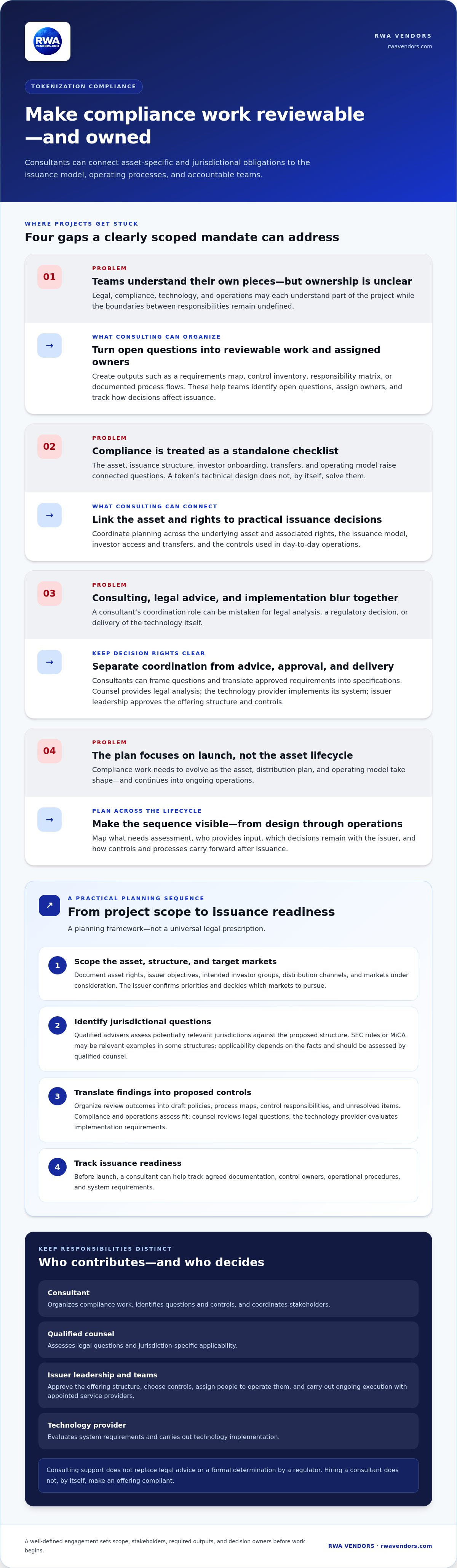
Consultants can organize work into reviewable outputs, such as a requirements map, control inventory, responsibility matrix, or documented process flows. These outputs help issuer teams identify open questions, assign owners, and track how decisions affect the issuance. The consultant may coordinate with issuer counsel on legal analysis, technology teams on system requirements, and compliance officers on internal controls.
- Regulatory analysis: Identify issues for assessment and coordinate jurisdiction-specific questions with counsel.
- Platform configuration: Translate approved requirements into specifications for the technology provider. Implementation remains with that provider.
- Operations: Document proposed workflows and control ownership. The issuer and its appointed service providers carry out ongoing execution.
What a consultant does not replace
Consulting support does not replace jurisdiction-specific legal advice or a formal determination by a regulator. A consultant can help frame questions, organize evidence, and connect operational design to counsel’s conclusions. Documents should distinguish working assumptions from points requiring legal review and decisions reserved for the issuer.
Issuer leadership remains accountable for approving the offering structure, choosing which controls to adopt, and assigning people to operate them. Hiring a consultant does not, by itself, make an offering compliant. A well-defined engagement gives legal, compliance, technology, and operations teams work they can review and use, with clear responsibility for each decision.
How Tokenization Compliance Consulting Follows the Asset Lifecycle
Compliance work spans design, issuance, and ongoing operations. It should evolve as the asset, distribution plan, and operating model take shape. For issuers, the value of compliance consultants for tokenization partly lies in making the sequence visible: what needs assessment, who provides input, and which decisions remain with the issuer. The steps below are a planning framework, not a universal legal prescription.
Scoping the asset, structure, and target markets
Start by documenting the rights attached to the asset, the issuer’s objectives, intended investor groups, distribution channels, and markets under consideration. The consultant can organize these facts into a review scope and identify questions for counsel. Qualified advisers assess potentially relevant jurisdictions against the proposed structure. The issuer confirms its priorities and decides which markets the project will pursue.
- Assess the proposed structure. The consultant gathers asset and issuance details, maps open compliance questions, and identifies dependencies between investor access, transfers, and operations. The issuer validates the assumptions and approves the project’s objectives and boundaries.
- Identify jurisdictional questions. Advisers consider which jurisdictions may be relevant based on the asset, issuer, distribution, and investor base. SEC rules or MiCA may be relevant examples in some structures, but applicability depends on the facts and should be assessed by qualified counsel. The issuer determines the intended markets and obtains the legal analysis needed for those decisions.
- Translate findings into proposed controls. The consultant organizes review outcomes into draft policies, process maps, control responsibilities, and unresolved items. The issuer’s compliance and operations teams assess whether the proposed processes fit their capacity. Counsel reviews legal questions, and the technology provider evaluates implementation requirements.
- Confirm issuance readiness. Before launch, the consultant can help track whether agreed documentation, control owners, operational procedures, and system requirements are accounted for. The issuer makes the readiness decision, resolves outstanding issues, and coordinates handoffs among counsel, compliance officers, technology vendors, and other appointed service providers.
- Review after launch. The issuer’s teams monitor how established processes work in practice. A consultant may help assess changes to the asset, distribution model, target markets, or operating arrangements and identify where further review or revised documentation may be needed. The issuer decides how to respond and assigns ongoing owners.
From readiness assessment to ongoing controls
Each handoff should identify the input, decision-maker, and party responsible for execution. For example, a consultant may document a transfer-control requirement, counsel may assess its legal basis, the technology vendor may configure a relevant function, and the issuer’s compliance team may define how the process is monitored. The issuer retains responsibility for approving and operating its controls.
The sequence varies by project. A fund interest and a property-related instrument can involve different asset rights and operating arrangements. Distribution to a limited set of investors also differs from a broader cross-border plan. Compliance specialists supporting issuers through these lifecycle stages can use a vendor directory listing to improve visibility among tokenization market participants.
How to Compare Tokenization Compliance Consulting Expertise
A polished proposal or broad service menu does not establish that a firm fits your issuance. Compare compliance consultants for tokenization against the asset, intended distribution, relevant jurisdictions, and operating model you actually plan to use. Look for evidence of relevant experience and clearly defined work products, not technology credentials alone. Blockchain expertise may support implementation, but it does not by itself demonstrate regulatory or compliance advisory expertise.
Match experience to the asset and distribution model
Look for experience that aligns with the rights being tokenized and how the instrument is expected to reach investors. Work involving real estate may differ from work involving fund interests or securities because of the underlying documentation, transfer processes, and operational dependencies. Experience in one structure can provide useful context, but it does not automatically establish a fit for another. Compare how each firm’s proposed work accounts for investor eligibility, distribution channels, transfer restrictions, and post-issuance needs.
Asset expertise: Does the firm describe experience relevant to your asset class and the rights represented, rather than tokenization in general?
Jurisdictional experience: Does the proposed work identify the markets and structures it covers, and where local counsel’s analysis is needed?
Deliverables: Are the outputs named and reviewable, such as a requirements map, control inventory, process documentation, or issues log?
Operating-model fit: Does the proposal account for your issuer team, distribution approach, technology provider, and other service-provider handoffs?
Use the same criteria for each firm. Record the evidence provided, unanswered questions, and assumptions that affect scope. This makes differences visible without relying on unsupported rankings or promises about outcomes.
Compare scope, outputs, and accountability
A useful proposal sets boundaries before work begins. It should identify the objective, work products, assumptions, exclusions, review points, and decision owners. Check whether each deliverable can be assessed by the people expected to use it. “Compliance support” is too broad on its own. A defined output should state what it covers and how it connects to issuer decisions.
- Legal analysis: Identify where the engagement coordinates with jurisdiction-specific counsel and what requires counsel’s review.
- Compliance-program design: Specify proposed policies, controls, responsibilities, or documented procedures.
- Technical configuration: Separate advisory specifications from platform development or system configuration.
- Operational support: Clarify whether the work documents processes, advises internal teams, or includes ongoing execution.
Technology credentials and expansive service menus may be relevant, but neither proves regulatory expertise. Assess each firm against the same criteria and map proposed work to clear owners on your side. That comparison can expose gaps, overlaps, and handoffs before they become project assumptions.
How to Scope a Compliance Consultant Engagement for Tokenization
A well-scoped engagement turns a broad request for compliance support into defined work, decision rights, and usable outputs. Before appointing compliance consultants for tokenization, document what the issuer needs assessed, what falls outside the mandate, and how recommendations will be reviewed. This gives internal teams and external advisers a shared reference as the project develops.
Define the mandate before work begins
Prepare a short engagement brief describing the proposed asset and structure, target markets, intended distribution, project timeline, and internal decision-makers. Use it to agree on the following:
- Objectives: State the decisions the engagement should inform, such as identifying open compliance questions or documenting proposed controls.
- Deliverables: Name the expected work products, their intended users, and what makes each ready for review.
- Boundaries: Record assumptions, dependencies, exclusions, and matters reserved for legal counsel, issuer leadership, or implementation teams.
- Review and escalation: Set review points, identify who resolves conflicting feedback, and specify how significant issues are raised to leadership.
- Change control: Define how changes to the asset, structure, investor group, distribution plan, or target markets trigger a scope review.
For example, if a distribution plan expands into another market, the engagement plan should identify who assesses the impact, who obtains any required legal analysis, and who approves changes to the project scope. Revisit the original assumptions when the design changes rather than treating them as permanent.
Coordinate advisers and implementation owners
Build a responsibility map for each material control or workstream. Name the party that advises, approves, configures, operates, and maintains it. One team may hold several roles, but each role should have a clear owner. This prevents recommendations from being mistaken for implemented controls and makes handoffs visible.
- Issuer leadership: Approves objectives, risk decisions, and adopted controls.
- Legal counsel: Provides jurisdiction-specific legal analysis and advice.
- Compliance consultant: Organizes assessments, proposed control design, and documentation within the agreed mandate.
- Technology provider and internal teams: Configure, operate, and maintain systems and processes according to assigned responsibilities.
Agree on handoff formats, review dates, escalation contacts, and how unresolved items will be tracked. For specialist firms, a clear service profile also supports relevant discovery by issuers. State the asset classes served, jurisdictional focus, advisory scope, typical deliverables, operating-model experience, and the work handled by counsel or technology partners. Specific descriptions help distinguish compliance expertise from general tokenization or software capabilities.
Discover Tokenization Compliance Consultants Through RWA Vendors
Once an issuer has defined its scope, the next task is finding specialists whose expertise aligns with the project. RWA Vendors is a global directory connecting issuers with providers across legal compliance and adjacent tokenization categories, including custody, trading, blockchain infrastructure, and payments. The directory supports provider discovery. It does not provide legal advice, determine regulatory obligations, or implement compliance controls.
How issuers can use a specialist directory
Start with the project need, not a broad search for a vendor that “does tokenization.” If the open question concerns compliance advisory, begin with that category. If the scope also depends on custody arrangements, trading capabilities, or technical infrastructure, explore those adjacent categories to identify related providers and understand the wider service landscape.
Categories and directory tools help narrow discovery, but they are starting points rather than assessments of suitability. Compare provider profiles with the project brief: asset focus, target markets, distribution model, operating requirements, and the specific outputs the engagement calls for. A profile can help identify relevant areas of work, but it is not a legal opinion or proof that a provider’s approach fits a particular issuance. Directory inclusion is not regulatory endorsement and does not guarantee compliance outcomes.
For broader context, issuers can consult the compliant asset tokenization guide alongside their own project analysis. Use that context to sharpen discovery criteria, then compare potential providers with the mandate and decision rights already defined for the engagement.
How compliance firms can improve industry visibility
A focused profile helps issuers understand what a specialist does. Firms can describe their service categories, relevant asset focus, markets served, and how their work relates to counsel, technology providers, or internal compliance teams. Clear scope helps issuers distinguish advisory support from legal analysis, technical delivery, or ongoing operations.
Specificity matters more than a broad list of capabilities. A profile that explains the kinds of projects a firm supports and the work it undertakes gives prospective clients a stronger basis for discovery. The digital asset infrastructure providers guide can also help clarify how compliance specialists fit alongside infrastructure vendors in a tokenization project.
RWA Vendors connects issuers and providers through a structured marketplace and directory. Explore relevant service categories or create a directory listing to make your firm’s expertise visible to tokenization market participants. Discovery can start a conversation; project-specific decisions remain with issuers and their professional advisers.
Turn Your Compliance Plan Into a Clear Next Step
A well-defined mandate gives issuers a stronger basis for coordinating expertise as tokenization plans develop. The right compliance consultants for tokenization should fit the project’s asset, markets, and operating model, with responsibilities and outputs that stay clear as those factors evolve.
For issuers, RWA Vendors offers a global discovery point for providers across tokenization service categories. Compliance expertise sits alongside legal, custody, trading, infrastructure, and payment providers, helping teams explore connected needs without treating directory discovery as advice or endorsement. For specialist firms, a clear profile can make their service focus and market experience easier for relevant participants to understand.
Make your expertise discoverable to issuers exploring tokenization providers.
Clear scope and relevant connections help tokenization projects move forward with greater confidence.
Frequently Asked Questions
What does a compliance consultant for tokenization deliver?
Deliverables depend on the engagement, asset, and markets involved. They may include an assessment of project-specific requirements, control or process recommendations, a responsibility map, and documented implementation considerations. Useful review criteria include whether each recommendation identifies an owner, an open question, and required follow-up. The scope should separate consulting work from legal opinions, platform configuration, and issuer decisions. A report alone does not establish compliance.
Does hiring a tokenization compliance consultant guarantee regulatory compliance?
No. A consultant can help identify relevant questions, assess risks, and inform control design, but hiring one does not guarantee regulatory approval or a compliant outcome. A recommendation may need to be evaluated by counsel, then adopted and operated by the issuer. Applicability depends on the asset, structure, activities, and jurisdictions. Issuers remain responsible for decisions and should coordinate the engagement with qualified counsel and accountable internal teams.
When should an issuer engage a compliance consultant for tokenization?
Engage compliance expertise during early project scoping, before choices about investor access, distribution, or technology become difficult to revise. Early involvement can surface dependencies, such as whether a planned transfer process fits the intended investor model. Plan further reviews before issuance and during operations. Reassessment may be useful if the asset, business model, distribution plan, or relevant rules change, so outdated assumptions do not carry into later project decisions.
Can one compliance consultant cover every jurisdiction for a tokenized asset?
Not necessarily. A consultant’s coverage depends on its experience and the markets in scope. Coordinating a multi-jurisdiction review does not establish expertise or authority in every location. The engagement scope should identify the jurisdictions, activities, and work products covered, as well as how local legal analysis will be provided and differing advice reconciled. For example, an issuer considering expansion should identify who evaluates the new market before changing distribution plans.
How is a compliance consultant different from a tokenization platform?
A consultant provides advisory support on compliance questions, controls, and operating processes within an agreed mandate. A tokenization platform supplies technology for functions such as issuance or lifecycle operations, depending on its capabilities. For example, a consultant might document a control requirement while the technology provider assesses how its system can support it. The issuer should assign clear owners for advice, legal analysis, system configuration, and process operations.
Do tokenization compliance consultants handle KYC and AML processes?
Some engagements address how identity checks and anti-money-laundering controls fit into a project’s operating model; others may focus elsewhere. The engagement scope should state whether the consultant will assess relevant requirements, recommend control design, evaluate technology needs, or support ongoing operations. Documenting an onboarding workflow differs from performing identity checks or operating a monitoring system. The right division depends on the issuer’s structure, providers, and agreed scope, not a universal setup.
How can compliance consulting firms reach tokenization issuers?
Firms can improve discoverability by describing their service categories, asset focus, relevant markets, and engagement scope precisely. RWA Vendors provides a global directory where issuers can browse providers across compliance and adjacent tokenization categories. A clear profile helps prospective clients understand the firm’s focus and where its work fits. Directory visibility does not guarantee referrals, new clients, or engagements, so capability statements should remain specific and supportable.
Disclaimer
This article is provided by RWAVendors.com for general informational and educational purposes only. It does not constitute legal, financial, investment, tax, regulatory or other professional advice, or an offer, solicitation, recommendation or endorsement of any company, product, service, token, security or investment. RWAVendors.com is an informational vendor directory and does not sell, issue, broker, custody or facilitate transactions involving cryptocurrencies, digital tokens, tokenized assets, securities or investment products. Some vendor listings and references may involve paid advertising, sponsored placement or membership relationships. These relationships do not guarantee a vendor’s qualifications, regulatory status, performance or suitability. Information may be incomplete, outdated or subject to change. You should independently verify all information, conduct your own due diligence and consult qualified professionals before making any business or investment decision. RWAVendors.com is not responsible for the content, services, representations or actions of third-party vendors or linked websites.


