
The most expensive STO delays often begin with a decision made in the wrong order. A security token offering project plan should connect legal structuring, the operating model, and technology selection before one workstream locks in assumptions that force others to be rebuilt.
Investor eligibility, transfer rules, servicing requirements, and target markets can shape both token design and provider selection. Treating these as separate checklists can leave critical dependencies unresolved until launch preparation is already underway.
This guide sets out a practical sequence of decisions, deliverables, owners, and review gates for an issuer-led STO. It explains how to align legal, operational, and technical workstreams, surface launch risks early, and map project requirements to provider categories such as tokenization platforms, compliance, custody, blockchain infrastructure, and payments. At each stage, advance only when the relevant dependencies have been reviewed and resolved.
Key Takeaways
- Start the security token offering project plan by defining the asset, issuer objectives, intended investors, and target jurisdictions.
- Separate legal structuring, offering documentation, token design, infrastructure, and issuance operations so each has clear responsibilities.
- Use a decision matrix to document prerequisites, accountable owners, evidence, and downstream impacts before committing to an approach.
- Organize delivery into phases with defined inputs, outputs, dependencies, and approval criteria at each stage gate.
- Map project requirements to provider categories such as legal, compliance, custody, trading, blockchain, and payments.
What a Security Token Offering Project Plan Must Define Before Work Begins
A security token offering project plan is a coordinated roadmap for structuring, issuing, administering, and supporting tokenized securities. It connects the issuer’s business objective to the legal analysis, operating model, and technical delivery needed to pursue that objective. An STO is not simply a blockchain deployment: the token is intended to represent an asset or economic interest, with investor rights and ongoing administration to consider. For foundational context, see What is a Security Token Offering (STO)?
An STO project plan aligns offering requirements, operational controls, and technical delivery. Start with scope, not a platform shortlist. Before comparing infrastructure, establish what the issuer intends to offer, to whom, and in which jurisdictions. These boundaries guide legal review and give technology and operations teams a shared set of requirements.
Which project boundaries should an issuer set first?
Define the asset or economic interest the token is intended to represent, then document the issuer’s objective, such as raising capital or enabling a particular ownership structure. Identify intended investor types, anticipated transfer limitations, and target jurisdictions for qualified legal review. Keep business goals distinct from legal classification, token design, and implementation choices. Assign an accountable decision-maker and record the evidence needed for each.
Capture the starting assumptions in a project brief. Include:
- Scope: The asset, rights under consideration, and intended investor segment.
- Boundaries: Target jurisdictions, known exclusions, and decisions outside the project’s remit.
- Governance: An owner for each decision and the role responsible for approval.
- Open items: Unresolved questions, the evidence needed to address them, and who will obtain it.
For example, an issuer considering fractional interests in a property should record whether the project concerns ownership interests, a debt claim, or another economic arrangement. Keep that business question open until the appropriate decision-makers resolve it. A preliminary technical preference should not settle it by default.
How does an STO differ from a technology-only launch?
A technology-only launch can focus on deploying a network and application. An STO must also account for the security’s terms, investor rights, eligibility processes, transfer controls, records, and ongoing administration. Blockchain can support parts of this operating model, but using it does not by itself establish regulatory compliance or determine how the offering should be structured.
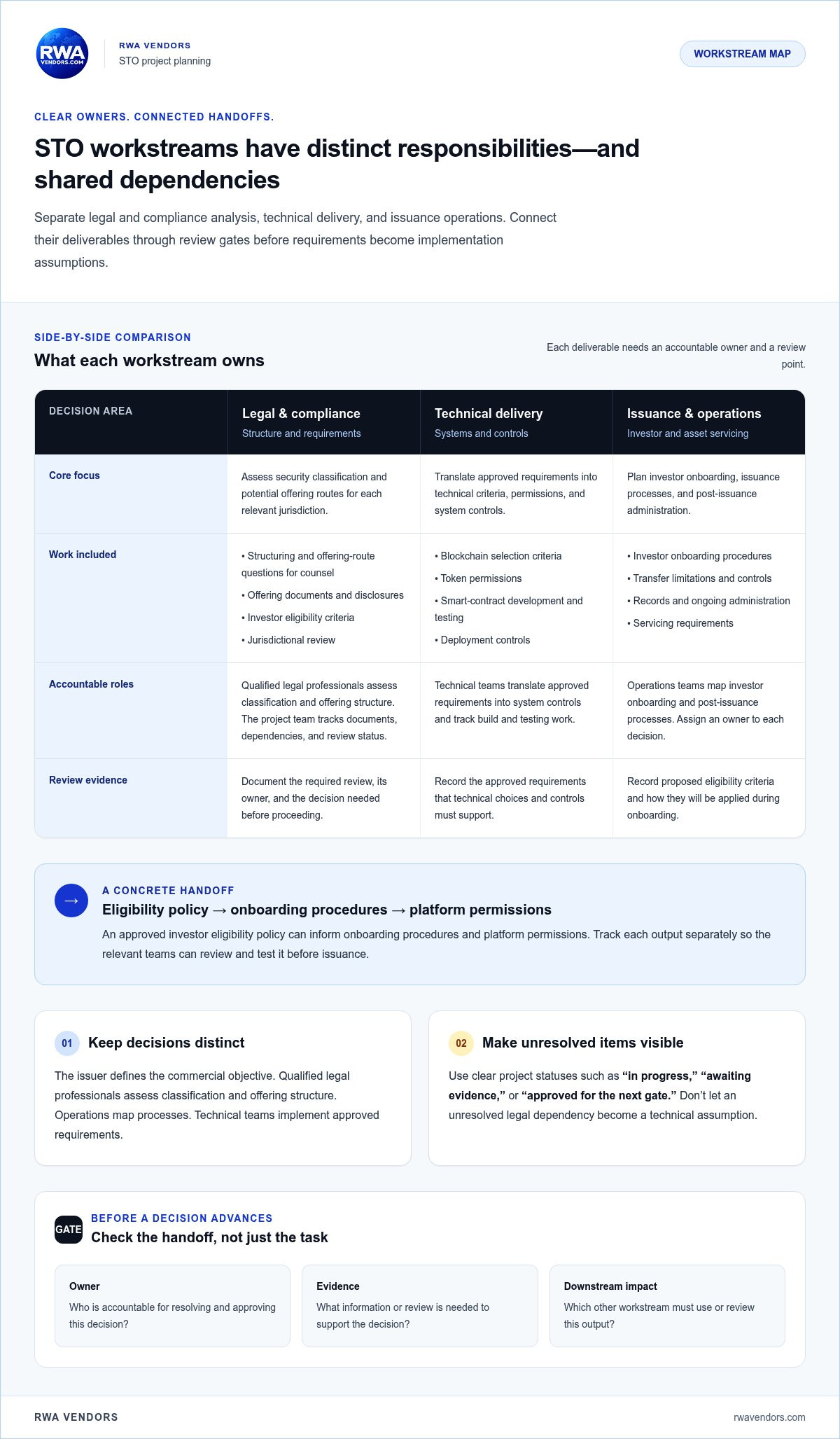
Keep the decisions connected but distinct. The issuer defines the commercial objective; qualified legal professionals assess classification and offering structure for relevant jurisdictions; operations teams map investor onboarding and post-issuance processes; technical teams translate approved requirements into system controls. Give each decision an owner and a review point before it becomes an implementation assumption.
This sequence helps prevent the selection of infrastructure that cannot support the intended investor group, transfer limitations, or administration model. It also creates a shared starting brief: what the offering is meant to achieve, what remains undecided, and which workstream must resolve each dependency before build decisions proceed.
The Core Workstreams in a Security Token Offering Project Plan
Once the offering’s scope is established, translate it into parallel workstreams with defined handoffs. The security token offering project plan should distinguish legal and compliance analysis from token engineering, issuance operations, and post-issuance administration. The workstreams interact, but each has distinct deliverables and needs an accountable owner.
An STO workstream map should connect each deliverable to an accountable owner and review gate. For example, an approved investor eligibility policy may inform onboarding procedures and platform permissions. Track those outputs separately so the relevant teams can review and test each one before issuance.
Which legal and compliance activities belong on the plan?
Track legal structuring and compliance as linked but distinct activities. Qualified counsel should assess security classification and potential offering routes for each relevant jurisdiction. The project team can then manage documents, dependencies, and review status without treating general project guidance as a legal determination.
- Structuring: Record the classification and offering-route questions requiring counsel review.
- Documentation: Track offering documents, disclosures, and the parties responsible for drafting and review.
- Investor eligibility: Document proposed criteria and the process for applying them during onboarding.
- Jurisdictional review: List each target market, the required review, its owner, and the decision needed before proceeding.
Use a clear status for each item, such as “in progress,” “awaiting evidence,” or “approved for the next gate.” This makes unresolved legal dependencies visible and prevents technical teams from treating them as settled requirements.
Which technical and operating activities support issuance?
Technical delivery includes blockchain selection criteria, token permissions, smart-contract development and testing, and deployment controls. Track these as separate tasks. Choosing a network does not define who may hold or transfer a token, and a tested contract does not establish that investor records and operating procedures are ready.
Assign operational owners for the full investor and asset lifecycle. Map who coordinates identity checks and KYC/AML processes, custody arrangements, investor records, servicing, reporting, and transfer administration. Specify handoffs between the issuer and relevant providers, including the information or confirmation each party supplies and when it is needed.
- Build and test: Document permission requirements, test scenarios, defect resolution, and deployment approval.
- Onboard and issue: Define process ownership for investor intake, eligibility outcomes, allocation records, and issuance instructions.
- Administer: Set responsibilities for servicing, investor communications, reporting, and transfer requests.
- Respond and change: Record incident escalation, system changes, access controls, and post-issuance support procedures.
At each review gate, require evidence appropriate to the workstream, such as signed-off documents, test results, reconciled records, or an approved operating procedure. Issuers can use a categorized provider directory to find relevant capabilities. STO service providers can explore directory listing.
How to Resolve STO Project Dependencies Before Choosing an Approach
Technology choices become costly to revisit when they are made before the offering’s requirements are settled. Use a decision matrix to show how each major choice depends on earlier decisions and affects later work. This gives legal, compliance, technical, and operations teams a shared view of what is ready to proceed and what still needs review.
For every decision, record its prerequisite, accountable owner, supporting evidence, approval gate, and downstream impact. For example, investor eligibility criteria may depend on legal review of the offering approach. Those criteria then inform onboarding checks, token permissions, transfer administration, and potentially platform configuration. If a prerequisite remains open, mark the dependent choice as provisional rather than treating an assumption as an approved requirement.
Which decisions have the greatest downstream impact?
Start with decisions that shape multiple workstreams. Assess the jurisdictional offering approach before finalizing investor onboarding and distribution processes. Then connect the rights represented by the token and its transfer rules to smart-contract requirements, investor records, and transfer procedures. Assign legal and compliance owners to review the requirements, and technical and operations owners to confirm how approved requirements will be implemented and maintained.
Custody, servicing, and any intended secondary-market activity also depend on one another. A proposed transfer process may affect recordkeeping and coordination between relevant parties; servicing needs may shape the data and reporting processes required after issuance. Document these dependencies together, then have the relevant functional owners approve the operating design before implementation.
How should issuers compare infrastructure options?
Compare public and permissioned blockchain approaches against documented project requirements, not presumed advantages. A public network may suit some requirements for access and interoperability; a permissioned environment may align with other requirements for controlled participation. Neither label alone determines whether the full offering and operating model is suitable. Assess each option against the intended asset, investor journey, and lifecycle tasks.
Use consistent criteria to make the comparison useful:
- Permissioning: Can the proposed design support the approved investor and transfer rules?
- Security controls: Are access, transaction approval, testing, and deployment controls defined?
- Interoperability: Does the option meet documented integration needs for relevant systems and counterparties?
- Lifecycle support: Can the operating model address issuance, recordkeeping, servicing, reporting, and changes?
Record evidence for each criterion, such as documented capabilities, workflow demonstrations, or test results, and identify who reviews it. The security token offering project plan should also flag decisions that require cross-functional approval. Legal review may define permissible offering parameters; compliance may validate investor controls; technical teams may assess implementation; operations may confirm that processes can be run consistently.
Advance an infrastructure choice only when its prerequisites and review owners are clear. This makes it easier to compare providers against the same requirements and exposes gaps before they become build assumptions.
How to Turn the STO Project Plan Into Phases, Owners, and Stage Gates
Convert the workstreams into a sequence of phases, each with an accountable owner, defined inputs, outputs, dependencies, and approval criteria. The issuer’s project lead coordinates the plan, while functional owners remain accountable for their deliverables. This makes progress visible without allowing a schedule to substitute for substantive review.
A stage gate is a documented decision point that authorizes, revises, or pauses project work. Record the evidence reviewed, approvers, open issues, and resulting decision at every gate. If a legal, operational, or technical assumption remains unresolved, pause dependent work or mark it provisional rather than building against it.
What should each project phase deliver?
Set phase outputs before assigning dates. The exact evidence will depend on the offering, but each phase should leave a record that supports a clear decision to proceed, revise, or hold.
- Feasibility and requirements: The issuer’s project lead coordinates the asset scope, objectives, target jurisdictions, and preliminary operating requirements. The gate confirms that the project has a defined scope and identifies open questions for review.
- Structuring and design: Legal and compliance owners coordinate relevant reviews and offering documentation; product and operations owners define proposed rights, investor processes, and administration needs. Proceed when critical requirements are documented and decision owners are clear.
- Build and configuration: Technical owners deliver the agreed token design, infrastructure configuration, and smart-contract controls. The gate checks that implementation traces to approved requirements and that test coverage is defined.
- Testing and remediation: Technical and operational owners record test results, defects, resolutions, and outstanding risks. Review material issues before moving to issuance readiness.
- Issuance readiness and operations: Operations owners provide evidence for onboarding, issuance procedures, investor records, incident response, and ongoing administration. The gate confirms that responsibilities and escalation paths are documented.
- Post-issuance: Assign owners for continued servicing, reporting, change management, and operational reviews. Track unresolved issues through an agreed process rather than closing the project at issuance.
How can project teams track progress and manage risk?
Maintain four working records: a responsibility matrix showing who performs and approves each task; a decision log with rationale and evidence; an assumptions register with review status; and a dependency tracker linking prerequisites to downstream deliverables. Keep them current at project reviews so teams can identify changes that affect scope, approvals, or delivery.
For each material risk, record an owner, trigger, mitigation action, and escalation route. For example, a delay in jurisdictional review could trigger a hold on dependent onboarding configuration. Keep dates indicative until scope, reviews, and delivery dependencies are established. A security token offering project plan is useful when it reflects real decision points, not just target launch dates.
Find STO Project Vendors by Workstream and Prepare for the Next Step
Vendor discovery is most useful after the issuer has translated project requirements into defined roles and deliverables. A security token offering project plan can use a vendor map to connect each workstream with provider categories that may support it, while making handoffs and dependencies visible. This avoids treating any single platform or service provider as the entire issuance solution.
For each category, record the project role, expected output, dependencies, and the issuer-side owner responsible for coordination. For example, legal structuring informs compliance procedures, while approved token permissions affect blockchain configuration. The issuer retains ownership of project decisions and coordinates how each provider’s work fits the wider operating model.
How can an issuer map vendors to STO workstreams?
Match categories to responsibilities, then document the interfaces between them. Legal and compliance providers may support structuring and investor controls; blockchain and tokenization providers may support infrastructure and issuance technology; custody, trading, and payments providers may support distinct lifecycle functions. Define each provider’s scope and handoff so responsibilities do not fall between teams or become duplicated.
- Legal and compliance: Identify the review and documentation needs tied to the offering and intended markets.
- Blockchain and tokenization: Map infrastructure, token configuration, testing, and deployment requirements.
- Custody and trading: Note relevant custody coordination and any planned trading-related processes.
- Payments: Define payment-flow requirements and their operational and technical interfaces.
Use the map to list required deliverables, dependencies, and acceptance owners, not just provider names. Issuers can browse and filter a global, categorized directory to discover providers across tokenization, legal, compliance, custody, trading, blockchain infrastructure, and payments. This makes provider discovery more structured while keeping selection and project governance with the issuer.
What is the next step for STO ecosystem vendors?
For service providers supporting STO projects, a directory profile presents the organization’s category and capabilities to businesses exploring the tokenization ecosystem. Clear positioning helps issuers understand where a provider may fit within a workstream map, whether that relates to compliance, infrastructure, custody, payments, or another relevant function.
RWA Vendors connects issuers with providers across the real-world asset tokenization lifecycle. Providers can use the listing process to present their business in a global vendor directory. Issuers can discover providers across relevant categories, while providers can apply for a listing.
Move From Planning to Coordinated Delivery
A strong security token offering project plan is more than a launch schedule. Treat it as a working governance document: revisit assumptions when evidence changes, record decisions where teams can find them, and keep unresolved dependencies visible. This gives the issuer a practical basis for coordinating next steps without mistaking progress for approval.
Provider discovery can support that coordination. RWA Vendors connects businesses across real-world asset tokenization and digital securities ecosystems through a global directory spanning legal, compliance, custody, trading, blockchain infrastructure, and payments. For providers supporting STO projects, a directory profile presents relevant capabilities to businesses searching across these categories.
Build the project deliberately, keep ownership clear, and let each approved decision inform the work that follows. RWA Vendors helps issuers discover relevant providers and gives service providers a place to present their capabilities.
Frequently Asked Questions
How long does it take to complete a security token offering project?
There is no universal duration for an STO project. Timing depends on factors such as asset complexity, jurisdictions, offering structure, documentation, technology choices, and operating arrangements. In a security token offering project plan, treat early dates as planning assumptions, not commitments. For example, a delayed review or unresolved integration can move later milestones. Update the schedule as approvals, test results, and readiness evidence become available.
Is a security token offering the same as an initial coin offering?
No. An STO involves tokens treated as securities or representing investment interests, while “ICO” is a broader fundraising label that does not determine a token’s legal status. The distinction depends on the rights involved, the circumstances of the offering, and applicable law. A project’s marketing name alone cannot establish how a token should be treated. Issuers should document the legal analysis relevant to their offering and target jurisdictions.
Can an STO use a public blockchain?
Yes, an STO can use a public blockchain if the network and surrounding systems support the project’s requirements. Assess how investor access, token permissions, transfer controls, security measures, interoperability, and administration work together. A practical test is to trace a proposed investor journey from onboarding through a permitted transfer and recordkeeping. The network choice is a technical decision; it does not itself establish that the offering meets applicable securities requirements.
Does an STO require a white paper?
Not necessarily. Documentation requirements depend on the offering structure and applicable jurisdictions, and may include formal offering materials, disclosures, investor-facing explanations, or other records. Calling a document a “white paper” does not make it a substitute for required legal documentation. For example, if public materials describe token rights differently from the formal offering documents, address that inconsistency before distribution. Coordinate document review with the project’s legal and compliance workstreams.
Can international investors participate in an STO?
Potentially, but participation depends on the offering structure, investor eligibility rules, relevant jurisdictions, and applicable securities requirements. A website or token accessible across borders does not make an offering available worldwide. An issuer considering investors in multiple markets should identify intended countries and investor categories, then account for those decisions in distribution materials and onboarding design. Do not open access to a new market solely because the technology can technically support it.
What happens if an STO project changes its token design after development begins?
A material change can affect legal analysis, offering documents, investor disclosures, smart contracts, testing, and operating procedures. Treat the proposal as a controlled change, not a minor code update. For example, changing transfer permissions may require updated requirements and fresh scenario testing. Record the reason, decision owner, affected deliverables, and approvals; then revise the relevant documentation and evidence before authorizing the new design for use.
What is the difference between issuing a security token and listing it for trading?
Issuance creates and distributes tokens under the offering’s terms. Listing for trading is a separate activity with its own market, eligibility, transfer, and operational considerations. Completing issuance does not automatically create a trading venue, secondary market, or liquidity. If trading is part of the issuer’s objectives, plan it as a distinct workstream, with its own legal and operational review, dependencies, and readiness criteria.
Disclaimer
This article is provided by RWAVendors.com for general informational and educational purposes only. It does not constitute legal, financial, investment, tax, regulatory or other professional advice, or an offer, solicitation, recommendation or endorsement of any company, product, service, token, security or investment. RWAVendors.com is an informational vendor directory and does not sell, issue, broker, custody or facilitate transactions involving cryptocurrencies, digital tokens, tokenized assets, securities or investment products. Some vendor listings and references may involve paid advertising, sponsored placement or membership relationships. These relationships do not guarantee a vendor’s qualifications, regulatory status, performance or suitability. Information may be incomplete, outdated or subject to change. You should independently verify all information, conduct your own due diligence and consult qualified professionals before making any business or investment decision. RWAVendors.com is not responsible for the content, services, representations or actions of third-party vendors or linked websites.


