

What if the biggest onboarding bottleneck is not one compliance check, but the handoffs between checks, documents, and accounts? Investor onboarding for digital securities can involve identity verification, eligibility review, document collection, and account activation. When those steps sit in disconnected systems, investors may receive repeated requests while teams reconcile records and try to maintain a clear audit trail.
Issuers need effective controls, but a process that is hard to complete can slow the journey from application to approval. The answer is not to remove necessary checks. It is to make each step visible, connected, and proportionate to the offering and investor.
This guide maps the journey from application through approval and account activation, with practical control points for balancing usability and compliance. It covers how identity, eligibility, document, payment, custody, and technology workflows can connect, and what vendor capabilities and integrations can support a coherent process. Use it to identify owners, clarify handoffs, and build more consistent records with fewer avoidable requests.
Key Takeaways
- Map each onboarding stage from application to account activation, including the information and decisions it requires.
- Automate routine steps, but route exceptions for appropriate review. Automation alone does not establish effective controls.
- Design investor onboarding for digital securities around connected systems, clear process ownership, and consistent records.
- Identify where legal, compliance, infrastructure, custody, and payment capabilities fit into the wider workflow.
- Use a directory of vetted tokenization providers to discover capabilities across the digital securities ecosystem.
What investor onboarding for digital securities covers, and why it matters
Investor onboarding is the controlled process of establishing who an investor is, assessing whether they can participate in an offering, documenting the decision, and maintaining an accurate record. It connects investor information with the operational steps that move an application toward an approved account.
Investor onboarding for digital securities is the process of collecting, validating, reviewing, and maintaining investor records so an issuer can make and document participation decisions. Depending on the offering and operating model, the process can include identity checks, eligibility assessment, investor agreements, payment-related information, and account setup.
Onboarding is not the same as issuing a security, holding assets in custody, facilitating trading, or providing ongoing investor servicing. Those activities may rely on related systems and providers, but onboarding focuses on the investor record and the decision to proceed. Set clear boundaries so teams know who owns each step and do not mistake an approval for completed issuance or account activation.
Which participants and decisions shape the onboarding journey?
The investor supplies information and documents. The issuer defines the process and remains accountable for its operating model. An administrator may collect materials, maintain records, or coordinate tasks. A compliance team or designated reviewer assesses the information against the offering’s criteria. Technology providers can support application capture, verification, workflow, and recordkeeping. The process should specify who reviews applications, resolves exceptions, and records each outcome.
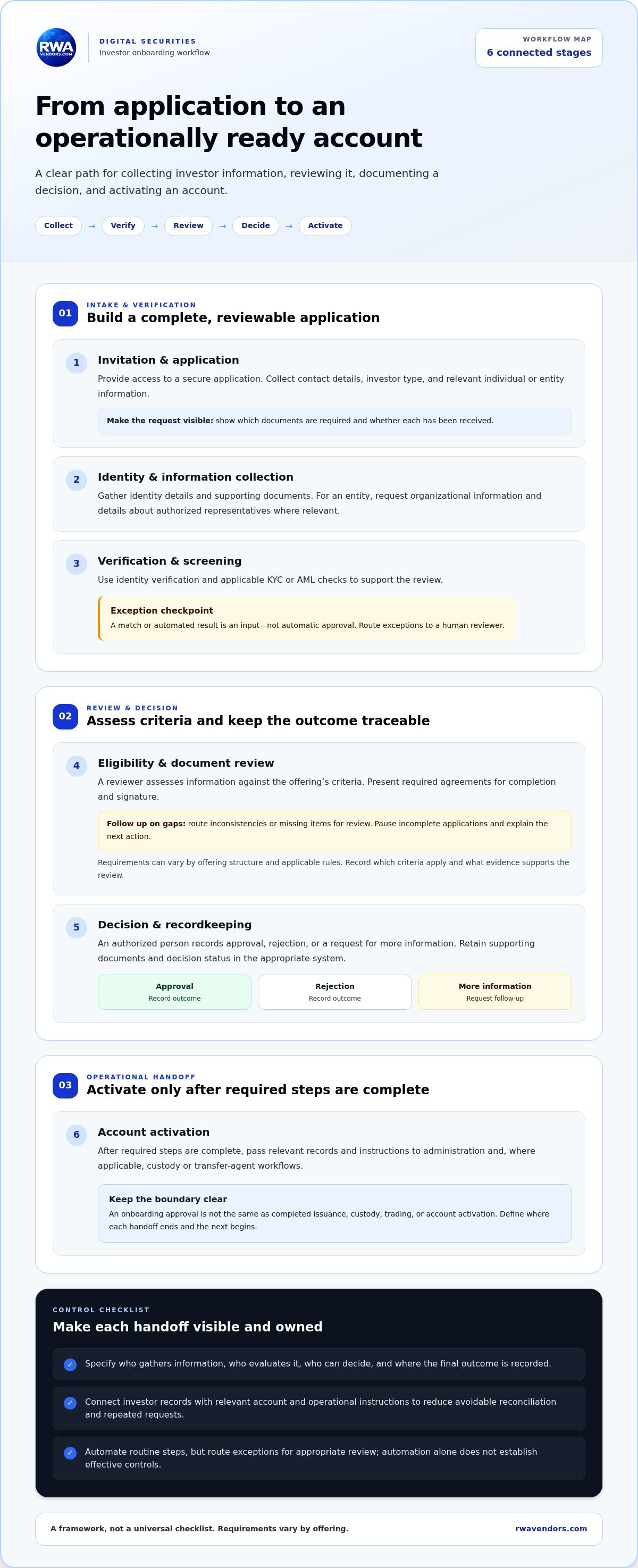
Responsibilities vary by operating model. An issuer may manage onboarding directly or assign operational tasks to an administrator or other service providers. In either case, document who gathers information, who evaluates it, who can make the decision, and where the final approval or rejection is recorded. This makes handoffs easier to manage and reduces uncertainty when an application needs follow-up.
What makes digital-securities onboarding distinct?
Digital systems connect investor records with securities operations, so accurate, consistent data can affect more than the application itself. A mismatch between identity details, account records, or transaction instructions can create operational friction. The wider evolution of Financial technology helps explain how digital systems have become part of financial activity, but digitization alone does not define the controls an offering needs.
Eligibility requirements depend on the offering structure and applicable rules, which can differ across jurisdictions. Do not treat one market’s criteria as universal. Document which criteria apply, what evidence supports the review, who makes the decision, and how the record is maintained. This gives teams a consistent operating reference without implying that every digital offering follows the same onboarding rules.
How the digital securities investor onboarding workflow operates
A defined workflow gives each application a clear path from invitation to an operationally ready account. Investor onboarding typically moves from invitation and information collection to verification, eligibility review, document execution, approval, and account activation, with specific requirements varying by offering.
Use the stages below as a framework, not a universal checklist. The SEC’s overview of Tokenized Securities provides context on how securities can be represented and transacted using digital systems. The onboarding process still needs to reflect the offering’s structure and applicable requirements.
- 1. Invitation and application: Give the investor access to a secure application and collect contact details, investor type, and relevant individual or entity information.
- 2. Identity and information collection: Gather identity details and supporting documents. For an entity, request organizational information and details about authorized representatives where relevant.
- 3. Verification and screening: Use identity verification and applicable KYC or AML checks to support review. Treat a match or automated result as an input, not as automatic approval.
- 4. Eligibility and document review: Have a reviewer assess the information against the offering’s criteria. Present required agreements for completion and signature, and route inconsistencies or missing items for follow-up.
- 5. Decision and recordkeeping: Have an authorized person record approval, rejection, or a request for more information. Retain supporting documents and decision status in the appropriate system.
- 6. Account activation: After the required steps are complete, pass relevant records and instructions to administration and, where applicable, custody or transfer-agent workflows.
From investor application to verification
Use a secure form that collects the information needed for the process, then show investors which documents are required and whether each has been received. If a name differs across records, a document is unreadable, or required fields are incomplete, pause the application and explain the next action. Route exceptions to a human reviewer rather than allowing an automated check to decide the outcome without oversight.
From approval to account activation
Approval should produce a usable operational record, not just a changed status label. Make the decision, completed documents, and relevant investor details available to the teams responsible for the next step. Define what information passes at each handoff and who accepts it. Investors can then see whether action is needed, while operations teams can distinguish applications awaiting review from accounts that have been approved and activated.
For providers building tools or services that support these workflows, listing onboarding capabilities helps issuers discover relevant services across the digital securities ecosystem.
How to balance automation, compliance controls, and investor experience
Automation can make investor onboarding for digital securities more consistent, but it does not make a process compliant or controlled by itself. A system can route forms and flag missing fields; people still need clear authority to assess exceptions, make decisions, and record the reasons. Controls depend on how technology, procedures, and accountable teams work together.
Design for routine applications and cases that fall outside the expected path. Straight-through processing can reduce repetitive work when information is complete and checks return expected results. But a mismatch or unclear document should not disappear into an automated queue or trigger an unexplained rejection. Before launch, define who reviews exceptions, what information they can access, and how they record the outcome.
Where automation helps, and where human review remains important
Automate repeatable tasks such as routing applications, checking required fields, sending reminders, and transferring data between connected systems. Set clear escalation rules for incomplete submissions, inconsistent details, or results that need further assessment. A visible status such as “review required” gives staff a clear next action and tells investors that their application is being assessed rather than silently blocked.
Give human reviewers enough context to resolve exceptions without relying on scattered email threads or duplicate records. Record the issue, reviewer, action, and decision in the appropriate system. Make sure the workflow distinguishes a mechanical completeness check from a substantive approval decision.
How to reduce friction without weakening controls
Where the system and process allow, ask for relevant information once and reuse it only when appropriate. Explain why each document is requested, what format is accepted, and what happens next. Progress indicators and clear requests for missing items reduce uncertainty without removing review steps. Keep the process proportionate to the offering, and have qualified advisers assess applicable requirements rather than treating a generic workflow as a universal standard.
Build reliable evidence into the workflow:
- Access control: Limit access to investor information according to each user’s role, and review permissions as responsibilities change.
- Data quality: Use consistent fields and validation rules to identify missing or conflicting details before they spread across systems.
- Recordkeeping: Retain relevant consent, document versions, timestamps, decision rationale, and status changes in an accessible record.
- Auditability: Make it possible to trace who handled an application, what changed, and how an exception was resolved.
These design choices can make the investor journey easier to follow while preserving accountable decision-making. Review where applicants pause, repeat information, or need help. Then improve the instructions or handoffs at those points without weakening the controls the process depends on.
How to design a connected onboarding workflow for digital securities
Start with the investor’s journey, then trace the systems and people supporting each step. For investor onboarding for digital securities, map every touchpoint from application through post-approval handoffs. Record what information enters the process, where it moves, who owns each decision, and which system holds the resulting record. This can reveal gaps before they lead to repeated data requests or conflicting statuses.
Checklist: assign an owner to every workflow step, define how data flows between systems, make exceptions visible, and retain a traceable record of each decision.
Map responsibilities, systems, and handoffs
List investor communications, information collection, verification, approval, and record updates. Assign an accountable owner to each activity, even when a service provider performs the work. Then map how information moves between the onboarding platform, compliance tools, administration systems, and any relevant custody or transfer-agent workflows. Mark each point where information is re-entered, a task changes hands, or investor status changes. These points can reveal duplication, unclear ownership, or applications that appear stalled without explanation.
Interfaces can pass approved data between systems, while shared field definitions help ensure that terms such as investor name, account status, and approval date mean the same thing across platforms. Define which system is authoritative for each record and how updates are reconciled. For a broader view of how these components fit into institutional operations, see the institutional digital asset infrastructure guide.
Connect onboarding to compliance and ongoing operations
Onboarding records inform downstream processes, including investor servicing and operational reporting. Consistent records help teams understand an account’s status and refer back to the documented basis for a decision. Connect the process design to the wider controls described in the compliant asset tokenization guide, and have qualified advisers assess requirements applicable to the offering and jurisdictions involved.
Plan security alongside integration. Apply role-based access, limit data visibility to operational needs, and establish how access changes are reviewed. Document how systems handle updates, exceptions, and record retention so information remains traceable as it moves between teams. The tokenization cybersecurity guide provides further context on security considerations across the ecosystem.
For providers supporting connected onboarding workflows, a directory listing helps issuers discover relevant digital asset infrastructure and services.
How RWA Vendors supports discovery across the digital securities ecosystem
Investor onboarding depends on more than a single platform. Issuers may need capabilities across compliance, legal, blockchain infrastructure, custody, administration, and payments to support different steps in the investor journey. RWA Vendors helps issuers discover vetted tokenization platforms and service providers through a global directory focused on the tokenized capital markets ecosystem.
This cross-category view is useful when an issuer is mapping a workflow and identifying which functions need support. The institutional digital asset partners guide provides related context on the provider landscape and how different capabilities can fit into institutional operations.
Which provider categories can contribute to onboarding?
Each provider category can support a distinct part of the operating model. Compliance capabilities may help teams structure review workflows, while legal providers can support offering documentation and process design. Define these roles clearly so operational support is not confused with the issuer’s approval responsibilities or with professional advice.
Blockchain infrastructure connects digital asset operations with systems that record and manage activity. Custody and administration capabilities may support related account and record workflows, depending on the structure. Payment providers may be relevant when the offering’s transaction process includes payment flows. The right combination depends on the issuer’s design, and not every workflow needs the same providers.
How vendors can make their capabilities discoverable
A useful directory profile tells issuers what a provider does, which service categories it supports, and where its capabilities fit in a workflow. Be precise about responsibilities and integrations. For example, distinguish a tool that collects application information from a service that supports identity review or infrastructure that connects approved records to downstream operations. Clear descriptions help issuers compare relevant capabilities without assuming one provider covers every stage.
For vendors serving digital securities issuers, a directory listing makes relevant capabilities easier to discover across a marketplace of tokenization technology and professional services. Describe your role accurately and explain how your offering relates to issuer needs.
Build a More Connected Onboarding Journey
Effective investor onboarding for digital securities brings identity checks, eligibility review, documents, decisions, and account activation into a coordinated journey. Map who owns each step, where information flows, and how decisions are recorded so investors and operations teams can follow progress.
Automation can streamline repeatable tasks, but clear escalation paths and accountable human review remain important for exceptions. Connected systems and consistent data practices can reduce duplicate entry while supporting reliable records for downstream operations.
Finding the right capabilities may involve several parts of the tokenized capital markets ecosystem. RWA Vendors connects issuers with vetted providers across categories including compliance, custody, blockchain infrastructure, and payments. The directory also helps relevant service providers become more discoverable to issuers.
With clear ownership, connected workflows, and relevant ecosystem partners, providers can contribute to more coherent digital securities operations. Make your capabilities easier for issuers to find by applying to join the RWA Vendors directory.
Frequently Asked Questions
What is investor onboarding for digital securities?
Investor onboarding for digital securities is the process of collecting, validating, reviewing, approving, and maintaining investor records for an offering. It can include identity information, eligibility assessment, required documents, and account setup. The issuer’s workflow should make clear who supplies information, who reviews it, and where decisions are recorded. Onboarding is distinct from issuing a security, custody, trading, and ongoing investor servicing, even when it connects operationally to those activities.
How does digital securities investor onboarding work?
It usually begins when an investor receives an invitation and completes an application. The process then gathers and verifies relevant information, reviews eligibility and documents, routes exceptions for further assessment, and records an approval or other outcome. After approval, the completed record can be passed to account administration and other relevant operational systems. The precise sequence and steps depend on the offering, operating model, and applicable requirements.
Which information is usually collected during investor onboarding?
Information may include an investor’s contact details, identity data, investor type, and supporting identity documents. For an entity, the process may also collect organization details and information about authorized representatives. Eligibility-related information and signed offering documents may be requested where relevant. Issuers should define what information the workflow needs, explain document requests clearly, and avoid treating one data checklist as universal across offerings or jurisdictions.
Can investor onboarding for digital securities be automated?
Yes. Automation can route applications, check form completeness, send reminders, transfer data between connected systems, and flag records for review. It can improve consistency in repeatable tasks, but it does not make decisions accountable by itself or guarantee a controlled process. Set escalation rules for mismatches, incomplete records, and unusual cases, and ensure an appropriate reviewer can assess and document the outcome. Keep automated status updates clear to investors and operations teams.
How do KYC and AML checks fit into investor onboarding?
KYC and AML checks can form part of the verification and review stages where they are relevant to the offering’s operating model and applicable obligations. Define their purpose and handling within the issuer’s process, including how results are assessed and when a case needs further review. A system result alone should not be treated as automatic approval. Issuers should consult qualified advisers about requirements that apply to their specific circumstances.
What causes delays in digital securities investor onboarding?
Common causes include incomplete applications, missing or unreadable documents, mismatches between submitted details and supporting records, and unclear ownership of review tasks. Delays can also occur when teams re-enter information across disconnected systems or investors cannot see what action is needed. Clear instructions, visible application statuses, consistent data fields, and defined escalation paths help teams identify the cause and move the application to the right next step.
How should an issuer connect onboarding with other digital securities systems?
Start by mapping the application journey, system owners, data transfers, approval decisions, and records. Define which system is authoritative for each data element, then use interfaces and shared field definitions to reduce duplicate entry and reconciliation. Map handoffs to relevant compliance, administration, custody, and transfer-agent workflows, as applicable. Set access permissions and preserve traceable decision records. Review the design with qualified advisers and operational stakeholders against the offering’s needs.
Disclaimer
This article is provided by RWAVendors.com for general informational and educational purposes only. It does not constitute legal, financial, investment, tax, regulatory or other professional advice, or an offer, solicitation, recommendation or endorsement of any company, product, service, token, security or investment. RWAVendors.com is an informational vendor directory and does not sell, issue, broker, custody or facilitate transactions involving cryptocurrencies, digital tokens, tokenized assets, securities or investment products. Some vendor listings and references may involve paid advertising, sponsored placement or membership relationships. These relationships do not guarantee a vendor’s qualifications, regulatory status, performance or suitability. Information may be incomplete, outdated or subject to change. You should independently verify all information, conduct your own due diligence and consult qualified professionals before making any business or investment decision. RWAVendors.com is not responsible for the content, services, representations or actions of third-party vendors or linked websites.


