
What if the strongest case for tokenization has less to do with blockchain and more to do with a process that’s already slowing your business down? The business case for real world asset tokenization starts with a defined friction point, such as complex ownership records, fragmented workflows, or limited access to distribution channels. Then it tests whether tokenization can address that issue measurably.
It’s reasonable to ask whether the benefits justify the costs, operational changes, and new dependencies. Tokenization alone doesn’t resolve legal constraints, create buyers, or guarantee liquidity. Its value depends on the asset, the existing process, the target users, and the capabilities needed to support issuance and ongoing operations.
This article explains how to assess potential use cases, establish baselines, and compare realistic scenarios rather than rely on broad claims. It also covers implementation costs and risks, assumptions to validate, and ecosystem partners a project may need across technology, legal and compliance, custody, trading, and payments. The aim is a credible decision framework that shows where tokenization may create business value and what must be true for that value to materialize.
Key Takeaways
- Frame the business case for real world asset tokenization as a testable comparison between current and proposed operations, with clear measures and assumptions.
- Assess potential value across issuance, administration, settlement, investor servicing, and distribution by identifying the friction and baseline in each workflow.
- Compare full-process economics, timelines, control points, and accountable owners. Tokenization doesn’t guarantee positive ROI, lower costs, or liquidity.
- Build the assessment in five steps: define the problem, map the process, test feasibility, quantify scenarios, and set decision gates.
- Translate validated requirements into an ecosystem plan that may include legal and compliance, custody, trading, infrastructure, and payment capabilities.
What the Business Case for Real-World Asset Tokenization Should Actually Prove
A credible business case for real world asset tokenization begins with a specific operational or commercial friction point, not with the choice of blockchain. Compare the current operating model with a proposed tokenized model, then test whether the change could improve a defined outcome, such as reducing reconciliation work or shortening an investor-servicing workflow.
Tokenization creates a digital representation of rights or claims connected to an asset; it does not, by itself, change the underlying asset, legal arrangement, or rights of its holders. A token is a record within a technology system. The documents, processes, and arrangements that establish and administer the underlying rights remain central to the business case.
The term tokenization is also used in data security, where it can describe substituting sensitive information with a token. That concept is related at a broad technical level, but it shouldn’t be confused with representing asset-related rights or claims digitally. A project assessment needs to define exactly what its tokens represent and how that representation connects to relevant records and processes.
Which business problems might tokenization address?
Start with a workflow where the current model creates measurable friction. Potential hypotheses include fragmented records that require repeated verification, manual reconciliation between participants, slow investor servicing, or limited access to a target investor group. Specify who experiences the problem, how the process works today, and what evidence would show improvement. For example, if reconciliation is the issue, document the current steps, responsible teams, and error or exception measures before comparing them with a proposed process.
Relevance depends on the asset type, operating model, participants, and applicable rules. Fractional representation, programmability, and access to continuous markets may be design features, but they aren’t automatically commercial benefits. Each needs a practical use case and evidence that it addresses a real need.
What tokenization does not prove on its own
An on-chain record doesn’t, by itself, establish ownership, enforceability, or the rights attached to a token. Nor does it remove off-chain work, such as maintaining supporting records, handling investor inquiries, or coordinating processes among participants. The proposed model must explain how digital records relate to the asset’s governing arrangements and existing operational controls.
Tokenization also doesn’t guarantee secondary-market demand or liquidity. A digital representation may make a transfer technically possible, but buyers, permitted participation, market infrastructure, and operating arrangements still matter. Treat every claimed benefit as a project-specific hypothesis: define the baseline, identify the evidence needed, and set a decision threshold before treating the claim as established. A technology pilot can test whether a system functions; a commercial case must also connect that capability to a defined business objective and measurable outcome.
Where Real-World Asset Tokenization Could Create Measurable Business Value
Assess potential value workflow by workflow, starting with the friction, the people affected, and a baseline. Tokenization may change how records or instructions move between participants, but any improvement depends on data quality, system integration, operating controls, participant adoption, and the asset’s legal and commercial structure.
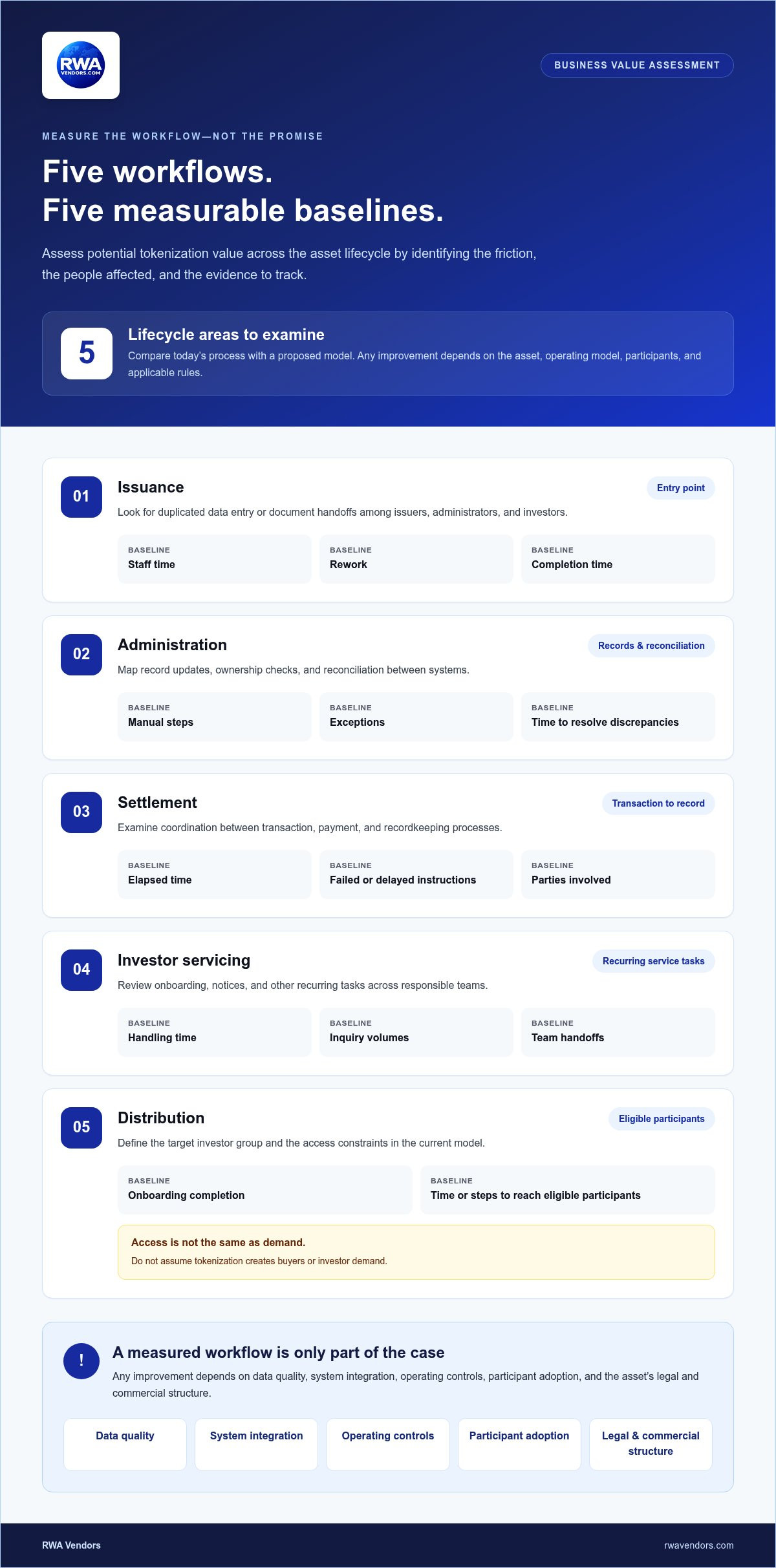
Tokenization value depends on the process improved and the participants able to use it. Test that proposition across the full lifecycle:
- Issuance: Identify duplicated data entry or document handoffs among issuers, administrators, and investors. Baseline staff time, rework, and completion time before assessing a digital issuance workflow.
- Administration: Map record updates, ownership checks, and reconciliation between systems. Track the number of manual steps, exceptions, and time needed to resolve discrepancies.
- Settlement: Examine coordination between transaction, payment, and recordkeeping processes. Measure elapsed time, failed or delayed instructions, and the number of parties involved.
- Investor servicing: Review onboarding, notices, and other recurring service tasks. Establish handling time, inquiry volumes, and handoffs across responsible teams.
- Distribution: Define the target investor group and current access constraints. Measure onboarding completion and the time or steps required to reach eligible participants, without assuming tokenization creates demand.
Operational efficiency and lifecycle management
Repeated manual tasks, duplicate records, and reconciliation delays can point to opportunities to test shared records or programmable workflows. For example, if administrators maintain separate ownership records, compare the existing update and verification process with a proposed integrated approach. Any reduction in handoffs depends on reliable source data, compatible systems, clear responsibilities, and effective operational controls. For more on the supporting capabilities, see this institutional digital asset infrastructure guide.
Distribution, access, and settlement hypotheses
Digital issuance could change how investor onboarding, transfers, or settlement coordination are handled. Measure each process independently. A technically possible transfer doesn’t establish that a distribution is permitted, that participants will adopt the process, or that buyers will be available. Access and liquidity depend on the asset, operating arrangements, applicable rules, and market participation. This security token secondary markets guide provides context for evaluating transfer and market-access assumptions.
For the business case for real world asset tokenization, record the baseline first, then define a measurable outcome and the evidence needed to validate it. Service providers supporting these workflows can gain visibility with businesses exploring tokenization.
Does Tokenization Deliver ROI? Compare the Full Economics and Constraints
Tokenization doesn’t guarantee positive ROI, lower costs, or liquidity. The result depends on whether the proposed operating model measurably improves a process and whether the benefits outweigh implementation, integration, and ongoing operating requirements.
A positive case depends on verified process improvements and adoption, not token issuance alone. Compare the current and proposed models using project-specific inputs rather than assumed savings. Keep one-time implementation, integration, ongoing operations, compliance, and participant onboarding as distinct cost categories so decision-makers can see what drives the result.
| Comparison area | Current model | Proposed model | Evidence and owner |
|---|---|---|---|
| Process | Document existing steps and handoffs | Map which steps would change | Process map, owned by operations |
| Costs | Record attributable and shared costs | Include implementation, integration, operations, compliance, and onboarding assumptions | Cost model, owned by finance with relevant teams |
| Time | Measure workflow and settlement timing | Forecast only where a process change supports the assumption | Timestamped records, owned by operations |
| Controls | Identify approvals, records, and exceptions | Define proposed control points and responsibilities | Control map, owned by risk and operations |
Build a defensible baseline before forecasting
Use available records to measure workflow volumes, manual effort, error or exception rates, settlement timing, and servicing workload where relevant. Separate directly attributable costs from shared expenses that are difficult to allocate. If data is incomplete, flag the gap and state how it affects confidence in the forecast. Treat projected efficiencies as hypotheses, not realized savings.
Then build conservative, base, and upside scenarios using inputs supplied and validated by the project team. Vary assumptions such as adoption, transaction volume, integration effort, and the share of work that could actually change. Show which assumptions move the result most and document the evidence behind each one. Don’t substitute generic market estimates for project evidence.
Account for constraints that can change the result
Include legal structure, compliance obligations, custody arrangements, cybersecurity, interoperability, and governance in the assessment. Their scope depends on the asset, jurisdictions, participants, and operating model. Test whether investors, administrators, and counterparties can participate in the proposed workflow, and identify the controls and integrations participation requires.
Liquidity needs a separate assessment. Token divisibility or transfer functionality doesn’t establish market demand. The business case for real world asset tokenization should distinguish technical capability from the market structure and participant activity needed to support transfers. If a key dependency remains untested, make it a decision gate rather than counting its potential benefit as certain.
How to Build a Credible Tokenization Business Case in Five Steps
Build the case around a decision, not a technology demonstration. Select one asset class and workflow, define what evidence would justify proceeding, and make ownership of each assumption explicit. The sequence below gives decision-makers a reviewable path from business problem to stop, revise, or scale.
- Define the problem. The business sponsor identifies a specific operational or commercial friction and the outcome that matters. Evidence might include workflow records, stakeholder interviews, or service data. The output is a concise problem statement with an accountable owner and baseline measures.
- Map the process. Operations documents the current workflow, including handoffs, systems, control points, exceptions, and responsible teams. The evidence is a validated process map, reviewed by the participants who perform or oversee the work. The output identifies which steps a proposed model could change and which remain necessary.
- Test feasibility. Project, technology, and risk owners assess whether the proposed operating model can support issuance, lifecycle servicing, custody, transfers, and reporting. Record assumptions about legal rights, applicable requirements, data quality, participant adoption, interoperability, information security, and exception handling. The output is a feasibility assessment with unresolved dependencies clearly marked. This compliant asset tokenization guide offers further context on compliance and controls.
- Quantify scenarios. Finance works with operations and technology teams to model conservative, base, and upside cases using validated project inputs. Separate implementation, integration, compliance, onboarding, and ongoing operating assumptions. The output is a scenario model that shows what evidence supports each input and how uncertainty affects the result.
- Set decision gates. The executive sponsor and relevant control owners define measurable success criteria, review points, and evidence required before the project begins. A bounded pilot is appropriate only if it tests a material assumption, such as whether a workflow can reduce reconciliation effort, and has a defined scope and success threshold. The output is a documented decision to stop, revise, or consider scaling.
Make each gate a real decision
Before implementation, agree on baseline measures, target outcomes, accountable owners, and review timelines. Validate the operating model against realistic scenarios, including failed instructions, incomplete data, and participant handoffs. If evidence misses the threshold, revise the design or stop. Completing a pilot isn’t proof that production deployment is justified.
A credible business case for real world asset tokenization makes assumptions visible and lets decision-makers distinguish demonstrated results from projected benefits. Keep unresolved risks in the decision record rather than presenting them as settled.
Service providers supporting tokenization workflows can increase their visibility with businesses exploring tokenization.
Turn the Business Case into an Ecosystem Plan for RWA Tokenization
A validated business case should lead to a capability map, not a generic shopping list. Translate each approved workflow and control requirement into the expertise, technology, and operating responsibilities needed to deliver it. The asset, legal structure, jurisdiction, participants, and operating model all influence which providers are relevant.
Map project requirements to provider capabilities
Connect each capability to a documented requirement. For example, a defined compliance workflow may call for legal and compliance expertise, while a recordkeeping or integration need may point to blockchain infrastructure. Custody, trading, and payment capabilities may also be relevant depending on how the asset and its transactions are structured.
Separate essential launch requirements from capabilities that may only be needed if the project expands. A project focused on issuance and administration may have different initial needs from one that also plans to support transfers or secondary-market activity. Record why each capability is in scope, its accountable owner, and the business-case assumption it supports. This keeps provider discovery tied to a real requirement and makes later changes easier to assess.
Use RWA Vendors to increase provider visibility
RWA Vendors is a global directory connecting asset issuers with providers across tokenized capital markets, including legal and compliance, custody, trading, blockchain infrastructure, and payments. Issuers can use the directory to discover companies whose capabilities relate to different stages of tokenization. For providers serving this ecosystem, directory visibility can help businesses exploring tokenization find relevant services.
Discovery is a starting point for research, not a suitability assessment. Directory inclusion doesn’t establish that a provider fits a particular project or guarantee an outcome. Institutions still need to evaluate capabilities, responsibilities, dependencies, and fit against their own requirements and governance processes. The business case for real world asset tokenization should guide provider research, while project-specific due diligence informs selection.
As the plan develops, keep a capability register that records the need, business objective, accountable owner, dependencies, and whether it is required at launch or later. This makes gaps visible and helps teams coordinate across provider categories without assuming every project needs the same ecosystem or technical design.
Providers can also get listed in the RWA Vendors directory to make their capabilities easier for businesses exploring tokenization to discover.
Move from Tokenization Thesis to Evidence-Based Action
A sound business case for real world asset tokenization begins with a defined business problem and a measurable baseline. Compare the current process with a proposed model, include implementation and operating dependencies, and treat benefits as assumptions until project evidence supports them.
Keep the decision practical: test whether tokenization addresses a material friction, assess the full economics and constraints, then set clear criteria to stop, revise, or consider scaling. A successful technology pilot alone isn’t proof of commercial value. The case also depends on the asset, operating model, and participants’ ability to use the proposed workflow.
Execution may require capabilities across several areas. RWA Vendors is a global directory of providers serving tokenized capital markets, with categories including legal and compliance, custody, trading, infrastructure, and payments. For service providers, a directory listing offers a way to gain visibility with businesses exploring tokenization. Discovery supports research, while project teams remain responsible for assessing fit.
For providers looking to reach businesses evaluating tokenization, get listed in the RWA Vendors directory.
With clear assumptions and an ecosystem map, providers can make their capabilities easier for relevant businesses to find as they evaluate their next steps.
Frequently Asked Questions
What is the business case for real-world asset tokenization?
The business case for real world asset tokenization is a testable comparison between an asset’s current operating model and a proposed tokenized model. It should identify a defined business problem, establish baseline measures, and assess whether a change could improve a workflow or outcome. It should also account for implementation requirements and risks. A digital representation of asset-related rights doesn’t, by itself, change the underlying legal arrangements or prove commercial value.
Can tokenization reduce the cost of issuing or managing real-world assets?
It may reduce some process costs, but lower costs aren’t guaranteed. Potential efficiencies could come from fewer manual reconciliation steps or more integrated recordkeeping, if the systems and participants can support those changes. Assess the full cost of implementation, integration, compliance, ongoing operations, and participant onboarding against the current model. Use project data to distinguish actual savings from forecasts, and include any continued off-chain work that the proposed process won’t remove.
Does tokenization guarantee liquidity for real-world assets?
No. A token can support digital transfer functionality, but that alone doesn’t create buyers, market demand, or active trading. Liquidity depends on factors such as the asset, applicable rules, market structure, distribution, and participant adoption. Fractional representation may change how an asset can be represented, but it doesn’t ensure that investors will participate or that transfers can occur in every context. Treat liquidity as a separate hypothesis that requires project-specific evidence.
How do you measure the ROI of asset tokenization?
Measure ROI by comparing the proposed model’s full costs and evidenced benefits with a reliable baseline for current operations. Start with relevant workflow volumes, staff effort, exception rates, servicing workload, and process timing. Include implementation, integration, compliance, onboarding, and ongoing operating assumptions. Model conservative, base, and upside scenarios using validated inputs, and identify data gaps. Keep projected benefits separate from realized results, then set decision thresholds before a pilot or rollout.
What are the main costs and risks of tokenizing real-world assets?
Costs may include initial implementation, integration with existing systems, ongoing operations, compliance-related work, and participant onboarding. Risks and dependencies can include unclear or mismatched records, cybersecurity, interoperability, governance, and whether investors, administrators, and counterparties can participate in the proposed model. The scope varies by asset and operating structure. A credible assessment documents these assumptions, identifies accountable owners, and flags unresolved issues instead of treating uncertain costs or benefits as settled.
Which assets are suitable for tokenization?
Suitability depends on whether a digital representation addresses a defined problem for a particular asset, structure, and operating model. Assess the clarity and quality of underlying records, the processes required to maintain and service the asset, participant needs, and relevant jurisdictional considerations. Real estate, funds, securities, and other assets may be explored, but no category is automatically suitable. The assessment should establish what rights or claims a token represents and how related records and operations will be managed.
What providers are needed to tokenize a real-world asset?
Provider needs depend on the asset, structure, jurisdiction, and operating model. Potential capabilities include legal and compliance, custody, trading, blockchain infrastructure, and payments, alongside any technology or operational roles required for the project. Map each need to a specific workflow, control, or documented assumption, then assess provider fit through institutional due diligence. RWA Vendors is a global directory that helps businesses discover providers across tokenized capital markets; it doesn’t itself tokenize assets or provide advisory services.
Disclaimer
This article is provided by RWAVendors.com for general informational and educational purposes only. It does not constitute legal, financial, investment, tax, regulatory or other professional advice, or an offer, solicitation, recommendation or endorsement of any company, product, service, token, security or investment. RWAVendors.com is an informational vendor directory and does not sell, issue, broker, custody or facilitate transactions involving cryptocurrencies, digital tokens, tokenized assets, securities or investment products. Some vendor listings and references may involve paid advertising, sponsored placement or membership relationships. These relationships do not guarantee a vendor’s qualifications, regulatory status, performance or suitability. Information may be incomplete, outdated or subject to change. You should independently verify all information, conduct your own due diligence and consult qualified professionals before making any business or investment decision. RWAVendors.com is not responsible for the content, services, representations or actions of third-party vendors or linked websites.


