
What happens when a token moves on-chain, but the issuer’s ownership records haven’t caught up? That mismatch is a central challenge in managing cap tables for tokenized assets. A blockchain transaction can show where a token moved, but it doesn’t establish which record governs ownership or whether the new holder’s identity and eligibility have been verified.
When tokenized interests and traditional records coexist, reconciliation can’t be an occasional spreadsheet exercise. Define which system records each event, how wallet addresses connect to verified investor identities, and who approves and records updates. A token is part of the ownership picture, not a substitute for the legal and operational records around it.
This guide explains how to coordinate on-chain and off-chain records, create repeatable processes for transfers, distributions, governance events, and reconciliations, and identify the technology and specialist roles involved. It also covers practical ways to reduce inconsistencies while keeping ownership data accurate, auditable, and useful across tokenization operations.
Key Takeaways
- Define which ownership details your cap table must coordinate, including holders, rights, balances, and ownership events.
- Assign distinct roles to token ledgers, issuer records, identity systems, and administration platforms so updates remain traceable.
- When managing cap tables for tokenized assets, treat blockchain history as one source of evidence, not a complete answer to every ownership question.
- Establish a repeatable workflow for issuance, transfers, cancellations, corrections, and ongoing review, with clear approvals and accountable owners.
- Match technology and specialist functions to the asset lifecycle and operational needs instead of assuming every project requires the same providers.
What managing cap tables for tokenized assets actually involves
A conventional capitalization table organizes a company’s ownership interests and related details. For tokenized assets, managing cap tables means coordinating records of holders, rights, balances, and ownership events across blockchain and traditional systems. The token balance is one data point in that model, not necessarily a complete statement of who holds a particular legal or economic interest.
The records needed depend on the asset. A token might represent an interest in a fund, a claim linked to an asset, or another defined right. These interests aren’t interchangeable: their terms, transfer conditions, and distribution arrangements can differ. The issuer’s recognized ownership record and applicable controls depend on the asset structure and governing arrangements.
Which information belongs in a tokenized asset cap table?
At a minimum, the recordkeeping model should connect holder identity references with token balances and issuance history, while capturing rights or restrictions relevant to the interest. Preserve material ownership events, such as an issuance, approved transfer, cancellation, or correction, so each current position can be traced back through its history.
An asset-level register may track holders in a particular fund or issuance. A company-wide shareholder cap table, by contrast, may describe the company’s overall equity, including interests that aren’t represented by those asset tokens. Keep the records connected where needed, but don’t treat them as the same register. Analytics and investor communications can support administration, but should remain distinguishable from core ownership data.
Why a wallet list is not a complete ownership record
A wallet address identifies a blockchain account. On its own, it may not identify the beneficial holder, establish that holder’s eligibility, or explain which rights attach to the balance. Identity information and access controls may sit in separate systems, particularly where public-chain data should not expose private investor details.
A token balance is a ledger entry. A reconciled ownership record links that entry to a verified holder, the applicable rights and restrictions, and the issuer’s recorded ownership events. For example, if tokens move between addresses, the ledger can show the transaction. The ownership process must also establish whether the transfer was authorized under the applicable arrangements, connect the receiving address to the relevant identity record, and update the issuer’s records as required.
There isn’t a universal source of truth for every tokenized asset. Define which record governs each ownership question, how supporting records relate to it, and how discrepancies are investigated and documented. This gives operational processes a reliable foundation.
How on-chain and off-chain ownership records work together
A reliable operating model gives each system a defined role. The blockchain records token transactions according to the network’s technical rules, while issuer or administrator records capture ownership and asset information needed to manage the issuance. An identity system connects authorized people or entities to wallet activity. An administration platform may coordinate data and workflows across these records, but its role and authority depend on the asset’s design and governing arrangements.
What each record system is responsible for
- Token ledger: Shows recorded token activity, such as issuance or a transfer between addresses. It provides transaction evidence, but doesn’t independently establish the holder’s identity or every right attached to a token.
- Issuer or administrator records: Maintain relevant investor, asset, and ownership information, including documented approvals and event history.
- Identity and eligibility records: Link a person or entity to an authorized wallet and preserve information needed to apply the asset’s transfer controls.
- Administration platform: Supports recordkeeping and coordination, with capabilities shaped by the platform and the issuer’s operating model.
These systems should exchange enough information to create a traceable chain of events without treating them as interchangeable. For an issuance, authorization and allocation records should connect to the resulting ledger entry and the holder’s identity reference. For an approved transfer, retain the approval, update the relevant ownership record, and link it to the on-chain transaction. Cancellations and corrections also need a documented reason and corresponding updates, rather than an unexplained change to a balance.
How reconciliation keeps records aligned
Reconciliation is a controlled comparison of token balances, authorized transfers, issuer-maintained records, exceptions, approvals, and documented resolutions. It’s an ongoing process, not a one-time import. Set a defined review cadence and event-based checks suited to the asset’s operations. Record the comparison date, responsible reviewer, discrepancies found, and how each was resolved.
A mismatch might arise if a transfer appears on-chain but the associated approval or identity update is missing from the administration records. Log the exception, investigate the relevant evidence, and record who reviewed and approved the resolution. Preserve the original event history so the correction is auditable rather than obscuring what happened.
Architecture depends on asset design, platform capabilities, and applicable governance requirements. Before implementation, assign owners for ledger monitoring, identity updates, approval records, and reconciliation. Document how information moves between systems and which record governs each operational question. Organizations building this ecosystem can use the RWA Vendors directory to discover providers across technology, compliance, custody, and payment functions. Providers supporting ownership-record workflows can explore a directory listing.
Does blockchain automatically make a tokenized cap table accurate?
No. A blockchain can preserve a transaction history under its technical rules, but that history doesn’t answer every ownership question. It may show that tokens moved between addresses, but it doesn’t necessarily identify the beneficial holder, establish which rights apply, or confirm that required approvals and off-chain updates took place. For managing cap tables for tokenized assets, ledger visibility is useful evidence, not a substitute for the full administrative record.
Blockchain transaction history versus an administrable cap table
Compare what a ledger can record with the additional information an issuer or administrator may need to maintain. The precise relationship depends on the asset and its governing arrangements.
| Record area | What the ledger may show | What administration may also need |
|---|---|---|
| Balances | Token quantities held by addresses | Reconciled positions tied to relevant holder records |
| Identity | Addresses involved in transactions | Identity references connecting authorized addresses to people or entities |
| Rights | Token activity, depending on system design | Applicable economic or governance rights and their terms |
| Transfer status | A transaction’s recorded status | Approval evidence and any required eligibility checks |
| Supporting documents | Transaction data or references, if implemented | Relevant agreements, approvals, and administrative records |
Transaction visibility and the interpretation of an asset holder’s rights are distinct. A completed ledger transaction doesn’t, by itself, establish how ownership is recognized under a particular asset structure. Any jurisdiction-dependent conclusion about legal ownership should be reviewed by qualified counsel. Don’t assume that a particular blockchain or token standard alone determines legal status or compliance.
Where discrepancies and control failures can emerge
Differences can arise when a wallet is linked to the wrong identity, an event is processed late, or duplicate records persist across systems. Administrative corrections or other processes outside the chain can also leave the ledger and issuer records temporarily out of sync. Weak access controls and undocumented manual adjustments make it harder to establish who changed a record, why, and under what approval.
Give each exception a named owner, a recorded date, and a clear escalation path. The owner should gather relevant transaction, identity, and approval evidence, document the resolution and its authorization, then reconcile the affected records again. Preserve the discrepancy and its resolution history rather than silently overwriting data. This makes a mismatch a controlled investigation and leaves an auditable trail for later review.
A practical operating workflow for tokenized cap table management
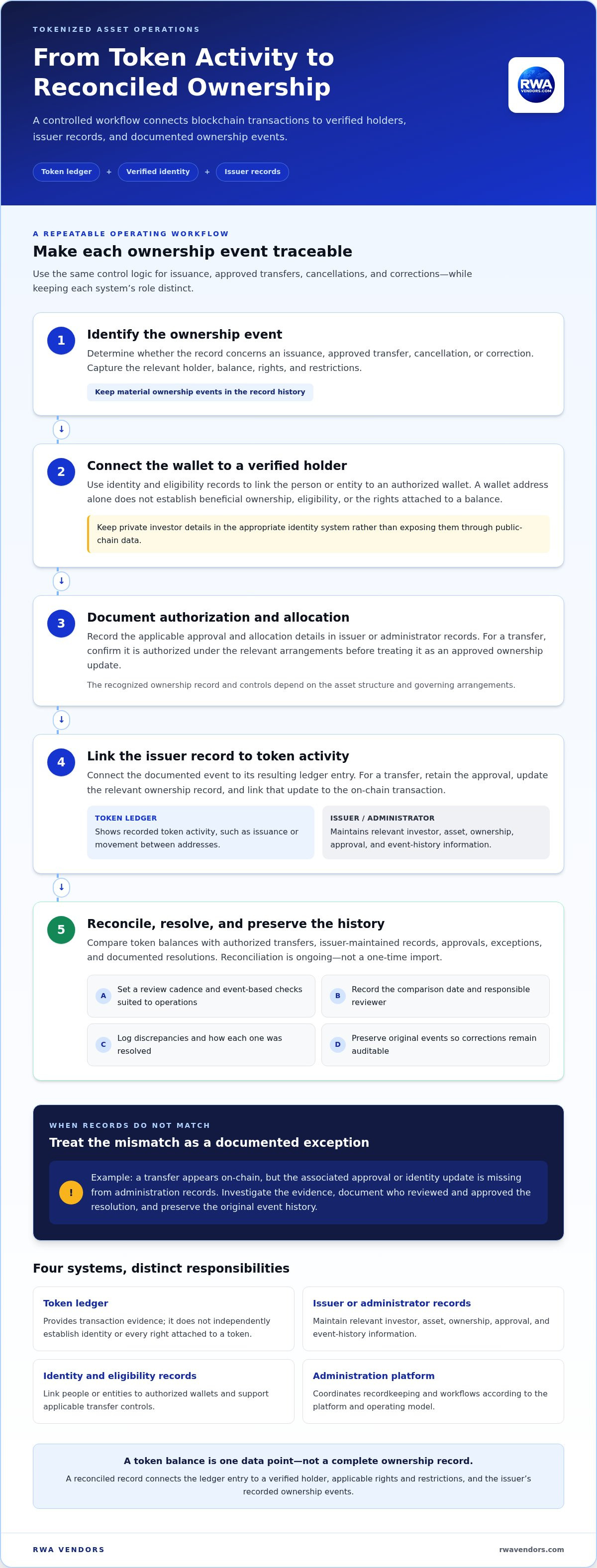
A dependable process assigns an owner to each event, records the required approval, and links the resulting administrative update to relevant ledger activity. The sequence below provides a framework for managing cap tables for tokenized assets. Adapt responsibilities, controls, and review timelines to the asset’s structure and applicable requirements.
Set up records, responsibilities, and permissions
Before issuance, identify who owns the records, who approves changes, who administers updates, and where unresolved issues escalate. Define how identity references connect holders to authorized wallet activity, and restrict access according to each role. Document the asset’s issuance process, transfer rules, correction procedures, and relevant corporate or asset-level events. This gives staff a consistent basis for routine activity and exceptions.
Reconcile transfers, distributions, and governance events
Use a repeatable workflow to carry the asset from setup through ongoing review:
- 1. Establish the asset record. Define the interests being tracked, related rights and restrictions, the record owner, and the systems that will hold relevant data.
- 2. Authorize issuance. Capture the approval, allocation, holder identity reference, and authorized wallet details before or alongside recording issuance activity. Assign an administrator to verify that the resulting records agree.
- 3. Process transfers and corrections. Record required approval and identity checks, assign responsibility for updating issuer records, and link the update to ledger activity. Document corrections with their rationale and approval history.
- 4. Handle asset-level events. Where the asset design provides for distributions, voting, redemptions, or other events, define who prepares the event, who approves it, which records must change, and how completion is evidenced.
- 5. Reconcile and report. Compare relevant ledger activity with approved event records and administrator data on a defined schedule and after significant events. Log discrepancies, assign an owner and escalation route, retain resolution evidence, and repeat the comparison after updates.
Reporting should distinguish confirmed records from open exceptions, so decision-makers can see the current position and any items requiring resolution. Retain approvals, event records, reconciliation results, and correction histories under the issuer’s recordkeeping process. For a broader discussion of compliance considerations, see compliant asset tokenization guidance.
Providers supporting tokenized ownership-record workflows can review the RWA Vendors directory listing process.
Build the right tokenized cap table ecosystem around your operating model
Cap table operations sit within a wider asset lifecycle. Depending on the asset and its design, an issuer may need technology for issuance and ledger activity, administration for ownership records, compliance processes for investor and transfer controls, custody functions, or payment capabilities for distributions. These roles support different tasks. They don’t automatically belong in one platform, and not every project needs every provider.
Match provider functions to the cap table workflow
Start with the events your asset must support, then map capabilities to each step. Tokenization platforms and blockchain infrastructure may support issuance, transfers, and ledger-related activity. Administration functions can coordinate holder records, approvals, and event documentation. Compliance capabilities may support identity and eligibility processes, while custody and payment functions may be relevant to how assets or distributions are handled. Define the handoffs between these roles, including which system records each event and who resolves exceptions.
The right architecture depends on the asset lifecycle, not a checklist of vendor categories. An issuance with no planned secondary transfers may have different operational needs from an asset designed for ongoing transfers, voting, or distributions. For related infrastructure considerations, see the digital asset infrastructure guide.
Turn operational requirements into clear next steps
Before implementation, document the asset structure, the owner of each record, the systems involved, approval and access controls, and the process for investigating exceptions. Then map those requirements to the functions needed at each lifecycle stage. This helps teams define integration points and responsibilities without assuming a single platform or provider can address every operational need.
For organizations managing cap tables for tokenized assets, partner coordination is part of the control environment. Issuers can use the RWA Vendors directory to discover providers serving tokenized capital markets, including technology, compliance, custody, trading, and payment functions. Explore the broader partner landscape in the institutional digital asset partner guidance.
Providers supporting ownership-record workflows can find out how to get listed in the RWA Vendors directory.
Build a More Reliable Ownership Record
Effective cap table management for tokenized assets depends on coordination, not a wallet list alone. Define how on-chain activity connects to issuer records, verified identities, applicable rights, and approved ownership events. Then assign clear owners for updates, reconciliation, and exception resolution.
Keep the operating model tied to the asset lifecycle. The systems and specialist functions supporting issuance, transfers, administration, and distributions should work together, with responsibilities and controls documented before activity begins. A disciplined approach helps keep ownership records accurate and useful as operations evolve.
RWA Vendors is a global directory connecting businesses with vetted providers across tokenized capital markets. Its categories span compliance, custody, trading, blockchain infrastructure, and payments, helping organizations discover ecosystem partners relevant to their needs.
For providers supporting tokenization and cap table workflows, a directory listing offers a way to connect with organizations building these operations. Use the RWA Vendors directory to present your services to businesses seeking partners across the tokenized capital markets ecosystem.
Frequently Asked Questions
What is a cap table for a tokenized asset?
A cap table for a tokenized asset is a structured record of holders, balances, and relevant ownership events. Managing these cap tables may involve connecting blockchain transaction data with issuer, administrator, and identity records. The asset-level record may differ from a company’s shareholder cap table, which tracks company equity. Which records govern particular rights depends on the asset’s structure and applicable documentation.
Is a blockchain wallet address enough to identify an asset owner?
No. A wallet address identifies an account on a blockchain, but it doesn’t necessarily identify the person or entity controlling it or establish the rights associated with a token. A cap table process may use controlled identity references to link authorized wallet activity with relevant holder records. Design these links with privacy, access controls, and applicable requirements in mind, and avoid exposing personal information unnecessarily.
How do you reconcile on-chain and off-chain cap table records?
Start by defining which systems record balances, identity information, approvals, and ownership events. Compare relevant ledger balances and activity with approved events and issuer or administrator records. Investigate discrepancies, document decisions and corrections, and retain approval evidence. Assign responsibility for performing and reviewing the reconciliation, set an escalation process for exceptions, and verify that resolutions appear across affected systems. Choose a review cadence suited to the asset and operating model.
Can token transfers change a cap table automatically?
A transfer can change an on-chain balance, but it may not update every record needed for administration. Other records can depend on identity, authorization, restrictions, and the asset’s operating process. Whether a transfer triggers updates elsewhere depends on system design and controls. Document how approved transfers are recognized, who is responsible for updating related records, and how exceptions are handled. Reconcile records instead of assuming every ledger event synchronizes automatically.
What should a tokenized asset cap table include?
Common fields include holder identity references, token balances, issuance and transfer history, and relevant rights or restrictions. Depending on the asset, records may also cover approvals, distributions, voting, redemptions, or other lifecycle events. Define the fields according to the asset structure and its administration needs. Keep essential ownership information distinct from supporting analytics, limit access appropriately, and establish clear responsibilities for retaining and updating records.
What happens if the blockchain record and issuer records do not match?
Treat the difference as an exception to investigate, not as a reason to overwrite a record without evidence. Identify the event involved, review relevant transaction, approval, and processing records, then document the decision and any authorized correction. Assign responsibility for follow-up and reconcile affected systems after the update. Retain the discrepancy and resolution history. For questions about legal ownership or rights, seek guidance from qualified counsel.
Do all tokenized assets use the same cap table process?
No. A tokenized fund interest, real estate interest, and digital security may involve different rights, administrators, transfer processes, and reporting needs. Begin with the asset structure and its documented requirements, then define the records, systems, responsibilities, and controls that support it. A reusable operational framework can promote consistency, but it shouldn’t be treated as a universal legal or technical template for every asset.
Disclaimer
This article is provided by RWAVendors.com for general informational and educational purposes only. It does not constitute legal, financial, investment, tax, regulatory or other professional advice, or an offer, solicitation, recommendation or endorsement of any company, product, service, token, security or investment. RWAVendors.com is an informational vendor directory and does not sell, issue, broker, custody or facilitate transactions involving cryptocurrencies, digital tokens, tokenized assets, securities or investment products. Some vendor listings and references may involve paid advertising, sponsored placement or membership relationships. These relationships do not guarantee a vendor’s qualifications, regulatory status, performance or suitability. Information may be incomplete, outdated or subject to change. You should independently verify all information, conduct your own due diligence and consult qualified professionals before making any business or investment decision. RWAVendors.com is not responsible for the content, services, representations or actions of third-party vendors or linked websites.


