
The most recognizable blockchain credentials do not necessarily make a lawyer the right fit for your project. When finding legal counsel for digital assets, focus on matching expertise to the instrument, jurisdictions, and decisions your business must address, rather than relying on general familiarity with distributed ledger technology. Counsel should understand the technology, but the legal work may also involve securities, licensing, intellectual property, tax, and operational questions.
This guide explains how to define the legal work before you begin your search, assess counsel’s experience against your specific asset and transaction, and compare candidates using consistent criteria. It also shows why legal advice should account for the asset’s full lifecycle, from structuring and issuance through transfers and ongoing operations. RWA Vendors supports provider discovery through a global directory where businesses can browse and filter vendors, including legal-service providers in tokenized capital markets. Directory research can help you identify potential providers, while choosing counsel calls for project-specific evaluation and a considered engagement decision.
Key Takeaways
- Start by identifying the asset, transaction, jurisdictions, and decisions that define your legal needs.
- Map legal work across structuring, issuance, operations, and transfers to identify the expertise your project may require.
- Assess counsel by relevant matter experience, instrument familiarity, lifecycle coverage, and jurisdictional scope, not blockchain familiarity alone.
- Use a repeatable process for finding legal counsel for digital assets: document the project, define workstreams, compare relevant provider profiles, and record your assessment.
- Browse and filter RWA Vendors’ global directory to discover providers serving tokenization and digital securities, including legal-compliance vendors.
Finding Legal Counsel for Digital Assets Starts with Defining the Matter
Before approaching a law firm, identify the decisions your project needs legal support to make. Digital-asset counsel can advise on the rights associated with an asset, the structure and terms of transactions involving it, and the business obligations connected to issuing, holding, transferring, or servicing it. The phrase What is a Digital Asset? covers a broad category. The legal questions depend on what the asset represents and how people interact with it.
Tokenization can raise questions that blockchain expertise alone does not resolve. A project may need to determine what rights a token conveys, how those rights are created or documented, who may hold or transfer it, and what contractual arrangements support its operation. The relevant scope depends on the asset, transaction structure, parties, and jurisdictions involved. A token representing an interest in a fund, for example, may raise different questions from a token used to record rights under a commercial agreement.
Technology expertise helps explain how a system works; relevant legal experience helps assess a specific instrument, its rights, and its transactions. This distinction keeps your search focused on experience related to the actual legal mandate, rather than broad claims of blockchain familiarity.
Which digital-asset matters may require legal counsel?
Potential legal work can involve token issuance, digital securities, asset representation, and commercial agreements with issuers, platforms, or service providers. Counsel may be asked to analyze an instrument’s structure, review how its rights are described in documents, or assess how contracts allocate responsibilities among participants. These are legal questions, not simply technical design decisions.
Keep the workstreams distinct. Technical teams implement systems, compliance teams may manage operational processes, and legal professionals assess legal rights, obligations, and risks. The same project may need coordination across all three. Applicable rules vary with the facts and relevant jurisdictions, so no single structure or conclusion applies universally.
Why does the asset and transaction structure matter?
Separate three elements at the outset: the underlying asset, the token design, and the contractual relationship. The underlying asset is what the arrangement concerns, such as a fund interest or a property-related right. The token design describes how a digital record is created and used. Contracts establish the parties’ rights and obligations. These elements may connect, but they are not interchangeable.
A token might record or refer to a right without explaining the full legal relationship between the holder and the issuer. The governing documents and transaction structure matter because they may identify who owes performance, what a transfer is intended to accomplish, and how the arrangement operates after issuance. Counsel needs enough detail to assess these connections rather than treating the token as the entire asset.
Prepare a short matter brief before beginning finding legal counsel for digital assets. Describe the asset, intended rights, proposed participants, transaction stages, and operating jurisdictions. This gives prospective counsel a concrete mandate to assess. For broader context on structuring considerations, consult the compliant asset tokenization guide.
Map Digital-Asset Legal Work Across the Project Lifecycle
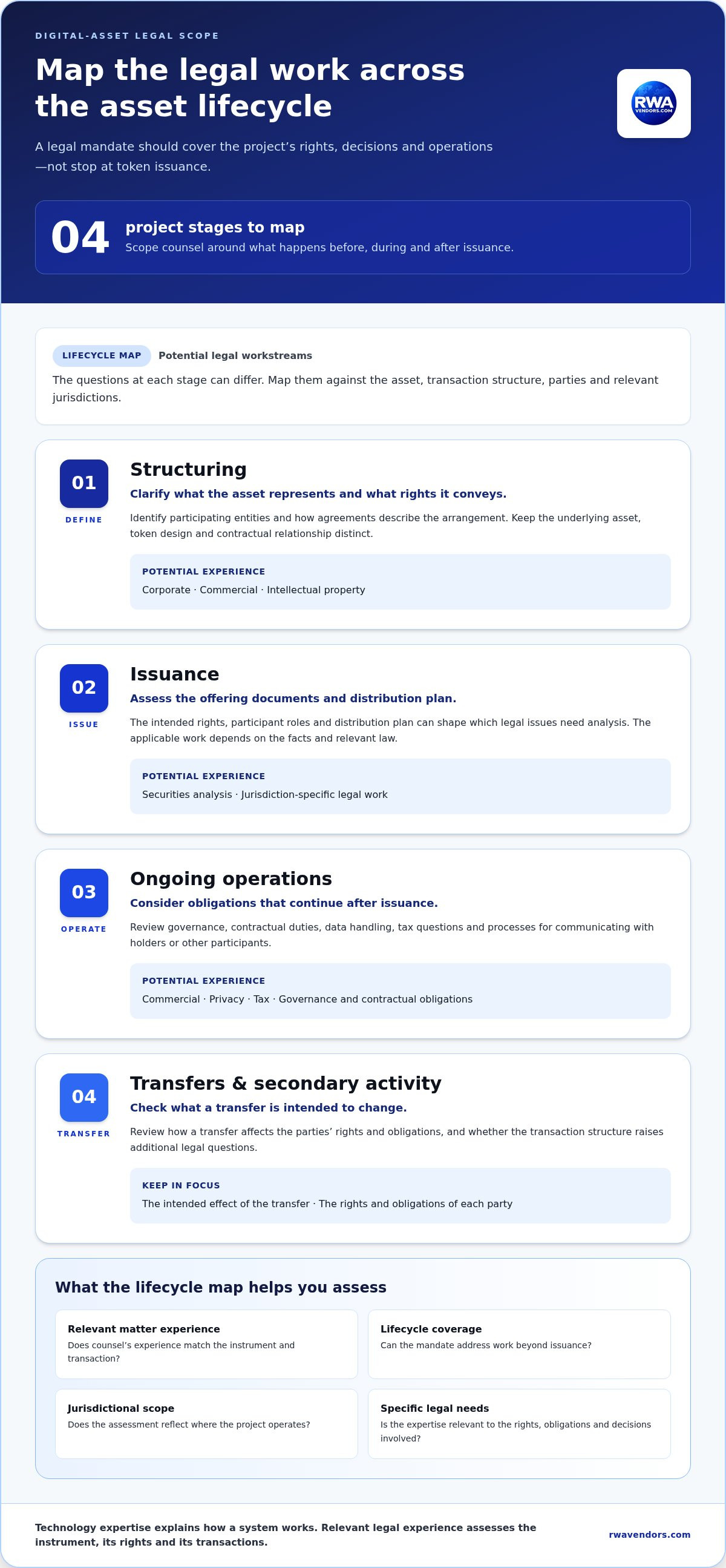
A legal mandate should follow the project lifecycle and the rights attached to the asset, rather than stop when a token is issued. The questions involved in structuring an instrument may differ from those that arise when it is offered, operated, or transferred. Mapping those stages helps an issuer identify where counsel may need to advise and whether the work calls for securities, corporate, commercial, privacy, tax, or intellectual-property experience.
Use the project sequence to scope potential workstreams:
- Structuring: Clarify the rights associated with the asset, the roles of participating entities, and how agreements describe the arrangement. Corporate, commercial, and intellectual-property questions may arise.
- Issuance: Assess offering documentation and distribution plans. Depending on the facts and applicable law, securities analysis or other jurisdiction-specific work may be relevant.
- Ongoing operations: Consider governance, contractual duties, data handling, tax questions, and processes for communicating with holders or other participants.
- Transfers and secondary activity: Review how a transfer is intended to affect the parties’ rights and obligations, and whether the transaction structure raises additional legal questions.
What legal questions arise before issuance?
Before an asset is issued, potential work includes analyzing the rights connected to it, assessing the issuer’s structure, preparing or reviewing offering documentation, and planning distribution. These questions are connected: intended rights and participant roles can affect how the transaction is documented and which legal issues merit analysis.
Labels alone do not settle legal classification. A project’s structure, terms, participants, and distribution plan must be considered under the law applicable to the facts and jurisdictions involved. A token or offering should not be assigned a fixed legal status based only on its name or technical format.
What may require attention after launch?
Issuance is one stage, not the whole mandate. Ongoing work may involve governance processes, contractual performance, transfers, reporting, privacy considerations, tax analysis, and planning for disagreements. Which issues apply depends on the arrangement, the parties, and the jurisdictions involved. These are possible workstreams, not universal requirements.
Changes can also affect the questions counsel needs to assess. A revised distribution approach, a new participant, changed token functionality, or expansion into another operating jurisdiction may alter the original analysis. Set review points around material changes so the legal scope can be reconsidered as the project develops.
Keep legal advice distinct from the roles of infrastructure, custody, trading, or payments providers. Those providers support different parts of the operating environment; the digital asset infrastructure guide offers related context. Carry your lifecycle map into the search for relevant expertise. Legal-service providers serving tokenized capital markets can also explore getting listed in the RWA Vendors directory to increase visibility with businesses researching providers.
Evaluate Digital-Asset Counsel Beyond General Blockchain Familiarity
Blockchain knowledge can help counsel understand a system, but it does not establish experience with the legal questions raised by a particular instrument or transaction. A lawyer familiar with distributed ledgers may not have handled the relevant asset type, issuance structure, operating stage, or jurisdictions. When finding legal counsel for digital assets, compare evidence of matter fit instead of treating broad technology familiarity as a proxy for legal expertise.
Assess candidates across four dimensions: comparable matters, familiarity with the instrument, coverage of the project lifecycle, and experience in relevant jurisdictions. Look for substantive legal work, such as analyzing rights, structuring a transaction, or preparing legal documentation. Separate that work from technology implementation, compliance software, and general advisory claims. These functions may support a project, but they do not demonstrate the same legal experience.
What evidence indicates relevant matter experience?
Give more weight to specific descriptions of asset types, transactions, and legal responsibilities than to general statements about innovation or blockchain. Evidence is most useful when it relates to the project’s actual stage and intended business model. For example, experience advising on issuance may be relevant to a pre-launch mandate, but may not demonstrate experience with post-launch transfers or ongoing governance.
Record what each available profile or matter description establishes, along with what remains unclear. Do not assume that a broad practice label proves experience with a particular instrument. The goal is a documented view of fit, not a ranking based on firm size, reputation, or technology vocabulary.
How should a buyer assess scope and team fit?
Start with the legal workstreams identified for the project, then map each one against stated experience. A useful comparison matrix can track:
- Relevant matter: Comparable asset, transaction, and project stage. Note the evidence and any gaps.
- Instrument familiarity: Demonstrated work involving the instrument or rights at issue, rather than blockchain exposure alone.
- Lifecycle coverage: Stated experience across the stages included in the mandate.
- Jurisdictional fit: Relevant experience compared with the project’s actual operating footprint.
- Team scope: Disciplines covered and specialist contributions that may be needed.
This matrix helps show where a team’s experience aligns with the mandate and where additional specialist input may be appropriate. Do not assume one lawyer or firm covers every discipline. Securities, tax, privacy, corporate, commercial, and intellectual-property work may call for distinct expertise, depending on the matter.
Keep the comparison evidence-based: record supported strengths, unanswered questions, and scope gaps without turning them into an unsupported score. Broader partner-selection considerations, including non-legal roles, are covered in the institutional digital asset partners guide. Use it to distinguish legal counsel’s mandate from the technology and other service-provider roles around the project.
Use a Repeatable Process for Finding Digital-Asset Legal Counsel
A defined search process turns a complex mandate into comparable candidates. Before finding legal counsel for digital assets, create a concise project brief and apply the same criteria to each provider. This keeps the search focused on the work required, rather than broad claims or general familiarity with blockchain technology.
How should a project brief support the search?
Summarize the asset type, business model, transaction stage, expected operating jurisdictions, and rights the arrangement is intended to establish. List legal workstreams separately from technical implementation, custody, and compliance-system requirements. Mark unresolved legal questions clearly instead of treating assumptions as settled facts. This brief gives your team a consistent reference for discovery and comparison.
How can directory discovery support a shortlist?
Use category filters to identify providers in legal compliance and related tokenized-capital-markets work. Review provider profiles against the project brief and evaluation criteria, noting relevant experience, stated scope, and jurisdictional fit. Directory discovery can help surface candidates for further consideration, but it does not replace legal judgment, due diligence, or the decision to engage counsel.
Follow this workflow:
- Define the project. Record the asset type, rights involved, business model, intended participants, transaction stage, and operating jurisdictions. Be specific enough to distinguish the project from a general blockchain initiative.
- Scope the legal work. Identify the decisions or documents that may need legal analysis, such as structuring, issuance, commercial agreements, ongoing operations, or transfers. Keep technical build requirements, custody needs, and compliance operations in separate categories.
- Identify relevant provider categories. Use your workstream map to determine which legal disciplines may be relevant. A project might need securities analysis alongside corporate or commercial work, while another matter may call for different expertise. Treat categories as discovery starting points, not conclusions about what the project legally requires.
- Compare profiles consistently. Apply the same matrix to each candidate: comparable asset or transaction experience, relevant lifecycle stage, stated legal responsibilities, jurisdictional experience, and any apparent scope gaps. Distinguish specific evidence from general descriptions of digital-asset capability.
- Document fit and open questions. Summarize why a candidate appears aligned, which workstreams may need additional specialists, and what remains unresolved. Use this record to guide further evaluation and an informed engagement decision.
Keep the brief current as the project develops. A change to the asset, transaction stage, participating parties, or operating footprint may alter which experience and legal workstreams matter. Revisit the criteria when those facts change instead of relying on an earlier shortlist by default.
Legal-service providers seeking visibility with businesses researching tokenized-capital-markets vendors can apply for directory visibility.
Find Digital-Asset Legal Providers Through the RWA Vendors Directory
A directory can make provider discovery more structured by bringing relevant categories together. RWA Vendors connects businesses with providers across tokenization, digital securities, and related services, including legal-compliance providers. Users can browse and filter vendors globally by category, then review relevant profiles as part of a project-specific search.
For teams finding legal counsel for digital assets, the directory is a research starting point, not a legal assessment. A category or profile can help identify providers to consider, but it does not establish that a firm’s experience matches a particular instrument, transaction, or jurisdiction. The engagement decision should follow a careful evaluation of the project’s legal needs and the provider’s stated scope.
How does a vendor directory fit into counsel discovery?
Legal compliance is one part of a wider tokenization ecosystem that also includes technology, custody, trading, and payments providers. This broader view can help issuers understand the provider roles around a project while keeping their mandates distinct. A legal-service provider evaluates legal questions; infrastructure and other vendors perform different functions. Directory discovery supports research, but it is not legal advice and does not replace counsel, due diligence, or an engagement decision.
Use category browsing to develop a shortlist, then assess each relevant profile against your project brief. Consider the asset and transaction involved, the workstreams you have identified, the project stage, and the operating jurisdictions. A provider appearing in a relevant category is a discovery lead, not a guarantee of suitability, a particular outcome, or a referral.
How can legal-service providers increase ecosystem visibility?
Law firms and other legal-service vendors serving tokenized capital markets can use directory visibility to reach businesses exploring providers for tokenization and digital-securities work. A listing places their profile within a broader vendor-discovery context, alongside categories issuers may consider across a project. It does not guarantee inquiries or engagements, but it gives prospective clients a way to find and review relevant provider information.
For buyers, keep the evaluation disciplined. Compare profiles using the same criteria, note what the available information supports, and identify gaps for further assessment. For legal-service providers, clear visibility in a relevant category can help businesses researching the ecosystem recognize the services they offer.
RWA Vendors is a discovery resource that connects issuers with providers; it does not provide legal services or determine which counsel a project should engage. The final selection remains a project-specific decision informed by the asset, transaction, operating footprint, and required legal work. Use the directory to organize discovery, then base engagement decisions on your own documented evaluation.
Turn Your Legal Search into a Clear Next Step
A focused search starts by identifying what counsel needs to help your project resolve next. Turn that priority into a concise brief, then use it to guide conversations and assess whether a provider’s experience aligns with the work. A directory can make discovery more organized. RWA Vendors brings together providers across legal compliance and other tokenized-capital-markets categories, with global browsing and filters to help businesses find relevant profiles. It supports research; legal judgment and engagement decisions remain project-specific.
Finding legal counsel for digital assets is not about selecting the most prominent blockchain practice. It is about building a working relationship around the asset, transaction, and legal mandate your business actually has. Start with a clear scope, then reassess it as the project evolves.
For law firms and legal-service vendors serving digital-asset businesses, directory visibility can help make their services discoverable to organizations researching providers.
A well-defined search creates a stronger foundation for thoughtful decisions and steady project progress.
Frequently Asked Questions
Can a lawyer with blockchain experience advise on securities-law questions?
Possibly, but blockchain experience alone does not establish securities-law experience. Look for evidence that the lawyer has handled securities analysis relevant to the instrument, transaction, and jurisdictions at issue. For example, a firm may understand how tokens are issued technically but have limited experience analyzing offering documents or issuer obligations. Treat technology knowledge as useful context, then assess the lawyer’s substantive legal work separately.
Does every tokenized asset require securities counsel?
No universal answer applies to every tokenized asset. Whether securities counsel is relevant depends on the asset, rights, transaction structure, participants, and applicable law. A token’s name or technical format does not determine its legal treatment on its own. If a project involves offering interests or rights to participants, include securities analysis as a question for qualified counsel rather than assuming a classification in advance.
Can one law firm cover every digital-asset legal issue?
Not necessarily. A firm may coordinate several workstreams, but a project could call for distinct experience in areas such as securities, tax, privacy, intellectual property, or commercial contracts. Ask how responsibility is allocated across the proposed team and whether outside specialists may be involved. Clear roles help prevent gaps, duplicated work, and assumptions that a broad digital-assets practice label covers every issue.
What information should a business organize before searching for digital-asset counsel?
Prepare a concise project file with a plain-language description of the asset, intended rights, business model, transaction stage, participants, and operating jurisdictions. Add current drafts of relevant agreements or offering materials, a simple flow diagram of how the asset and funds move, and a list of decisions awaiting legal input. Note which details are tentative so counsel can distinguish design assumptions from approved plans.
How much does digital-asset legal counsel cost?
There is no single cost that applies across digital-asset matters. Fees depend on the defined scope, complexity, jurisdictions, project stage, and specialists involved. Before engagement, request a written description of deliverables, assumptions, exclusions, staffing, and how changes to scope will be handled. Comparing proposals is more useful when each firm responds to the same project brief and set of requested workstreams.
What happens if a digital asset’s legal classification or operating model changes?
A material change warrants a fresh legal review; it does not automatically mean the existing structure is invalid. Record what changed, when it changed, and which documents, participants, jurisdictions, or processes may be affected. For example, a revised transfer model or new participant group could raise questions that were not part of the original analysis. Share the updated facts with qualified counsel before relying on earlier conclusions for the changed model.
Disclaimer
This article is provided by RWAVendors.com for general informational and educational purposes only. It does not constitute legal, financial, investment, tax, regulatory or other professional advice, or an offer, solicitation, recommendation or endorsement of any company, product, service, token, security or investment. RWAVendors.com is an informational vendor directory and does not sell, issue, broker, custody or facilitate transactions involving cryptocurrencies, digital tokens, tokenized assets, securities or investment products. Some vendor listings and references may involve paid advertising, sponsored placement or membership relationships. These relationships do not guarantee a vendor’s qualifications, regulatory status, performance or suitability. Information may be incomplete, outdated or subject to change. You should independently verify all information, conduct your own due diligence and consult qualified professionals before making any business or investment decision. RWAVendors.com is not responsible for the content, services, representations or actions of third-party vendors or linked websites.


