
What changes when a venture fund interest is recorded and administered on a blockchain, and what stays the same? That distinction sits at the center of venture capital fund tokenization. A digital token may represent an interest in a fund or feeder vehicle, while the governing documents and applicable legal structure continue to define investor rights, transfer limits, and fund governance.
Tokenization may change some operational processes, but it does not automatically simplify administration, widen investor access, or create liquidity. Those outcomes depend on the fund’s structure, service providers, legal requirements, and market conditions. A token alone does not make an interest freely transferable or guarantee a buyer.
This guide follows the main structures and lifecycle stages involved, from fund setup and investor onboarding to recordkeeping and potential transfers. It distinguishes plausible operational benefits from outcomes that depend on legal, commercial, or market conditions, and outlines the provider categories that may contribute to a tokenized fund ecosystem. Use it to identify what tokenization could change in a specific workflow, and what it leaves in place.
Key Takeaways
- Trace a tokenized fund interest through structuring, issuance, investor onboarding, administration, transfers, and wind-down to see where responsibilities sit.
- Assess potential recordkeeping and workflow benefits alongside the operational and market conditions they depend on.
- Use a decision framework to examine fund objectives, investor operations, governance, transfer policy, reporting, and technical integration.
- Map the distinct provider capabilities that can support venture capital fund tokenization, from legal and compliance services to blockchain infrastructure and payments.
- Use a specialist directory to explore the provider ecosystem and identify organizations whose capabilities align with the fund’s operating needs.
What venture capital fund tokenization represents, and what a token stands for
Venture capital fund tokenization uses digital records, often maintained on a blockchain, to represent a defined fund-related interest or position. The token is a digital representation, not the portfolio company investment itself, and it does not determine the holder’s rights on its own. Those rights and obligations depend on the relevant fund or vehicle structure and its governing arrangements.
Venture capital fund tokenization is the digital representation of a specified fund-related interest, while the underlying documents and arrangements continue to define what that interest means. The phrase “tokenized fund” therefore needs a precise follow-up: what exactly does the token represent, and which entity or record establishes the holder’s position?
A private placement may use digital records as part of its issuance and administration model, but the technology does not replace the offering’s substantive terms. The general concept of a tokenized private placement helps frame the distinction between a digital format and the investment arrangement it represents. For a venture fund, the subject could be a fund interest, a commitment record, or an interest in a separate vehicle.
Which venture fund interests or structures may be represented digitally?
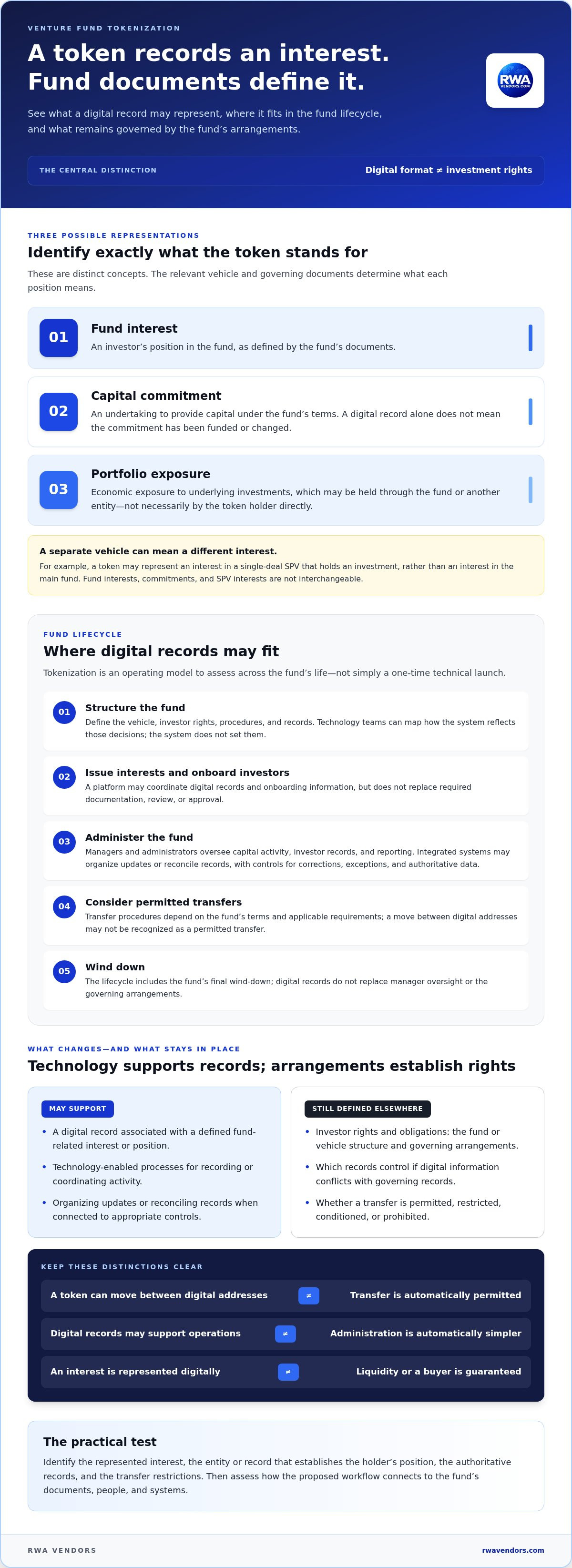
Start by distinguishing three concepts. A fund interest is an investor’s position in the fund as defined by its documents. A capital commitment is an undertaking to provide capital under the fund’s terms; a digital record of that commitment does not, by itself, mean the commitment has been funded or changed. Portfolio exposure describes economic exposure to underlying investments, which may be held through the fund or another entity rather than directly by the token holder.
A single-deal special purpose vehicle (SPV) is another possible subject. A token might represent an interest in that SPV, which in turn holds an investment, rather than an interest in the main fund. The legal entity and documents matter: a fund interest, a commitment, and an SPV interest are not interchangeable. Each structure serves a different purpose, so identify the intended interest before assessing the technology.
What does a token change, and what remains governed by fund arrangements?
A token can provide a digital record associated with an interest and may support technology-enabled processes for recording or coordinating activity. But it is not automatically a substitute for subscription agreements, fund documents, registers, or other governing records. The structure needs to establish how the digital record relates to those documents and which records control if information conflicts.
Technical transfer capability is also distinct from permission to transfer. A system may allow a token to move between digital addresses, while the fund’s terms or applicable requirements restrict, condition, or prohibit that transfer. The holder, manager, or administrator may need to follow specified procedures before a transfer is recognized. Assess the represented interest, controlling records, and applicable restrictions together. The token format alone settles none of these questions.
How venture capital fund tokenization can fit into the fund lifecycle
Assess tokenization across the fund’s operating life, not as a one-time technical launch. At each stage, the manager remains responsible for fund decisions and oversight; technology may support defined records and workflows. The practical design question is how those workflows connect to existing documents, people, and systems.
Digital records may support a venture fund from structuring and issuance through investor administration, permitted transfers, and final wind-down, while managers and administrators retain their established responsibilities. A system can execute a defined instruction, but it cannot independently determine whether that instruction is appropriate under the fund’s governing arrangements.
From fund design to investor onboarding
The lifecycle begins with the sponsor defining which interest or vehicle the digital record will represent and how that record relates to the fund’s documents and official records. The Emergence of Tokenized Investment Funds provides broader context for assessing how tokenized fund models may differ operationally from traditional arrangements.
- Structure the fund. The manager and relevant professional teams determine the vehicle, investor rights, operating procedures, and records. Technology teams can map how the proposed system will reflect those decisions, but the system does not set them.
- Issue interests and onboard investors. The manager oversees offering documents, investor acceptance, and applicable eligibility processes. A platform may coordinate digital records and onboarding information, but it does not replace required documentation, review, or approval.
- Administer the fund. Managers and administrators oversee capital activity, investor records, and reporting. Integrated systems may help organize updates or reconcile records, provided the process includes controls for corrections, exceptions, and authoritative data.
Ongoing administration, distributions, and records
Once a fund is operating, technology may support the recording of approved ownership changes, reporting events, or distribution instructions. A smart contract can automate a defined instruction, such as applying a pre-established rule after an authorized event. It does not independently decide that a distribution should occur, resolve disputed data, or replace manager or administrator oversight.
For example, a system might prepare or route a distribution instruction after an authorized party records the relevant event. The manager or administrator still oversees the underlying decision, confirms the applicable records, and handles exceptions. The institutional digital asset infrastructure guide outlines the wider operating environment, including the technology and service-provider categories that may connect these workflows.
- Manage transfers. The manager applies the fund’s transfer process; technology may record an approved change. A technically possible transfer is not automatically permitted or recognized.
- Wind down the fund. The manager oversees final accounting, distributions, and closure. Digital records may help preserve or reconcile the history, but they do not make the fund’s closeout decisions.
Providers building tools or services for these workflows can use a directory listing for tokenized-market providers to describe their capabilities to businesses mapping fund infrastructure.
Potential benefits versus the limits of tokenizing a venture fund
Venture capital fund tokenization may change how certain records and processes are handled. Whether those changes create operational value depends on the fund’s structure, the systems it uses, and how responsibilities are divided among managers, administrators, and technology providers. Test each proposed benefit against its conditions rather than treating digitization as an automatic improvement.
Where tokenization may improve fund operations
Shared digital records may give authorized participants a more consistent view of defined information and help coordinate updates across connected workflows. Programmable instructions may support repeatable processes when they reflect approved fund procedures and include appropriate oversight. Neither feature guarantees fewer errors or less administrative effort. Results depend on implementation, data quality, integration, and the operating model.
Potential operational benefit
Constraint or dependency
Record visibility: A shared digital record may help participants review relevant ownership or event information from a consistent source.
Reconciliation: Different systems may still hold separate records. Teams need an agreed process for resolving discrepancies and identifying authoritative information.
Workflow coordination: Digital instructions may organize handoffs, approvals, and status updates among fund participants.
Process design: Coordination depends on clear responsibilities and reliable connections between technology and existing administrative systems.
Investor administration: Structured records may support the handling of investor information and fund events.
Oversight remains: Managers and administrators still manage exceptions, review records, and carry out their fund-level responsibilities.
Programmable instructions: Defined rules may support repeatable steps, such as routing an approved instruction.
Rules need governance: Automation follows configured inputs. It does not independently validate a decision or resolve an ambiguous situation.
Why tokens do not guarantee liquidity or simpler governance
A token does not create a secondary market. A functioning market requires willing participants, a process for matching buyers and sellers, operational support, and transfers that are permitted under the relevant fund arrangements and applicable requirements. Even when a transfer is technically possible, it may be restricted or subject to approval. The existence of a token is not evidence of liquidity.
Digitization does not remove governance either. Fund managers remain responsible for decisions under the fund’s arrangements, and investors’ rights and obligations remain tied to the applicable structure and documents. Technology may help record or route an approved action, but it does not replace decision-making, oversight, or the handling of exceptions.
Evaluate each claimed benefit against its implementation assumptions: which records are shared, who can update them, how errors are corrected, and how the digital workflow connects to fund administration. Do not treat liquidity, performance, efficiency, or cost outcomes as guaranteed. The practical case is strongest when a specific workflow can be improved without obscuring the governance and controls around it.
How to assess whether a tokenized structure fits a venture fund
Start with the fund’s objective, not a platform demonstration. A disciplined assessment of venture capital fund tokenization asks what operational issue the fund aims to address, which rights or records are in scope, and how investors will interact with the fund. This is a strategic readiness framework, not legal or financial advice; structuring decisions require appropriate professional review.
Questions to resolve before choosing a tokenization model
Define the intended outcome in operational terms. Is the priority to coordinate investor records, improve access to fund information, or connect a specific administrative workflow? A broad aim such as “modernize the fund” is difficult to test. A defined problem gives the team a basis for comparing models and deciding whether technology adds a useful capability.
Next, specify what the digital record represents and how it relates to existing fund arrangements. A fund interest, a commitment record, and an interest in a separate vehicle can have different operating requirements. Set out the intended transfer policy, approval steps, investor reporting expectations, and governance controls before comparing technical options. This keeps the selected model tied to the fund’s actual operating needs.
Regulatory considerations also belong in the readiness discussion, but they depend on the structure and relevant jurisdictions. The compliant asset tokenization guide provides additional context for understanding compliance as part of the broader design process.
Map the capabilities required across the operating model
Assess each provider capability as a distinct workstream. A tokenization platform may coordinate issuance and investor-facing workflows; blockchain infrastructure supports the digital record layer; custody concerns how relevant digital assets are safeguarded; compliance capabilities support required controls; payments address movement of funds; and fund administration covers investor records, reporting, and operational processes. The division of responsibilities varies by structure.
Then map the interfaces. Determine which system is authoritative for investor records, how information moves between the platform and administration workflows, who reviews transfer requests, and how exceptions are handled. Define how payment instructions connect with approvals, and how compliance processes relate to onboarding and ongoing updates. A useful capability map identifies accountable parties as well as technology components.
- Governance: Identify decision-makers, approval points, and escalation paths.
- Administration: Map ownership records, investor updates, and reconciliation responsibilities.
- Transfer and reporting: Document permitted processes, review steps, and information delivery.
- Technical integration: Specify data flows, system interfaces, and exception handling.
A structure is more credible when these workstreams fit together across issuance, ongoing operations, and eventual wind-down, rather than relying on one platform to cover every function. Use the map to expose gaps, clarify dependencies, and define how the team will assess success before implementation.
Where to find the venture fund tokenization ecosystem, and how providers can participate
Venture capital fund tokenization can involve several distinct capabilities, from digital infrastructure to professional services. The fund’s operating model determines which capabilities are relevant and how they need to work together. Mapping those roles helps asset-market businesses identify where each capability fits without assuming that one provider covers every part of the lifecycle.
Provider categories that may support a tokenized fund
Relate each category to a specific fund requirement. The provider mix can vary with the fund design, jurisdictions, and operating arrangements.
- Tokenization platforms: May support the digital representation of fund-related interests and associated workflows.
- Blockchain infrastructure: Provides the underlying network and technical components used to create and maintain digital records.
- Legal and compliance providers: Support the fund’s structuring, documentation, and compliance workstreams. Their role is distinct from the technology layer.
- Custody providers: May support safeguarding arrangements for relevant digital assets, depending on the structure and assigned responsibilities.
- Trading providers: May support trading-related functions where the fund’s structure and permitted operating model include them. Their presence does not itself establish transfer permission or create market liquidity.
- Payment providers: May support payment-related processes, with the required workflows shaped by the fund’s operations.
- Fund administrators: May support investor records, reporting, and other fund administration activities. Their systems and responsibilities need to fit the wider operating model.
These capabilities are not interchangeable. Blockchain infrastructure can support digital records, for example, while fund administration covers a different set of operating processes. Clear responsibility boundaries and workable interfaces matter as much as the individual components.
How ecosystem providers can improve their discoverability
For technology and professional-services companies, a clear directory profile helps asset-market businesses identify relevant capabilities as they map fund requirements. Describe the category you serve, the role your organization can play, and the tokenized-capital-markets workflows your capabilities relate to. Specific, accurate descriptions make it easier for readers to distinguish infrastructure, professional services, and operational support.
RWA Vendors is a global directory connecting businesses with vetted providers across tokenization technology and professional services, including legal compliance, custody, trading, blockchain infrastructure, and payments. A directory listing supports provider discovery; it is not an endorsement of investment outcomes and does not replace a fund’s own assessment of its operating needs.
Providers serving tokenized capital markets can present their capabilities to relevant businesses through a directory listing.
Build the next phase of your tokenized-fund strategy
Turn your venture capital fund tokenization objectives into a concise operating brief. State the business need, the capabilities required, and how different functions must work together. This gives internal teams a common reference point and helps technology and professional-services organizations explain where their expertise fits.
For organizations serving tokenized capital markets, visibility starts with making those capabilities easy to understand. RWA Vendors connects businesses with vetted providers through a global directory spanning technology and professional-service categories relevant to tokenized assets. A clear profile helps asset-market businesses identify providers whose capabilities align with their project requirements.
Set out your organization’s role and areas of expertise so businesses building in this ecosystem can discover what you offer.
A clear plan and a well-mapped provider ecosystem help your organization explain where it fits in tokenized capital markets.
Frequently Asked Questions
What is venture capital fund tokenization?
Venture capital fund tokenization represents defined fund interests or related rights in digital-token form on a blockchain. The exact subject depends on the fund structure and governing arrangements. For example, a token might be associated with an interest in a fund or a separate investment vehicle. To understand what a holder’s position means, distinguish the digital record from the fund’s documents, operating procedures, and records used to administer the interest.
Can tokenized venture capital fund interests be traded on a secondary market?
They may be transferable under some arrangements, but tokenization alone does not create a market or guarantee liquidity. A potential transfer depends on the fund’s terms, applicable requirements, platform capabilities, and whether participants are willing to transact. For example, a system may technically support a transfer while the fund’s process requires review or approval. Investors should not assume they can exit whenever they choose simply because an interest has a digital representation.
Does tokenization change a venture fund’s legal structure?
Tokenization can change how an interest is represented or how certain workflows are recorded, but it does not automatically replace the fund’s structure or governing arrangements. The selected model matters: a digital record linked to a fund interest may operate differently from one associated with a separate vehicle. Fund documents and applicable requirements remain central to understanding rights, responsibilities, and transfer processes. The implications depend on the structure and should be assessed with appropriate professional advice.
How can smart contracts be used in a tokenized venture fund?
Smart contracts can encode defined instructions, such as transaction rules or steps in a distribution workflow, when the surrounding systems and arrangements support them. For example, a contract might route an instruction after an authorized update. It cannot independently make investment decisions or resolve every exception. Reliable use depends on clear rules, accurate inputs, system connections, and appropriate oversight, including a process for handling incorrect data or situations the programmed instructions do not address.
Does tokenizing a venture capital fund broaden investor access?
Tokenization may support different distribution or onboarding workflows, but it does not automatically make a fund available to every investor. Access depends on the fund’s design, investor eligibility, applicable requirements, and operating arrangements. A platform’s ability to represent interests digitally is separate from permission to offer or transfer them. A streamlined digital application process still needs to operate within the fund’s established acceptance and documentation procedures.
What providers may be involved in venture capital fund tokenization?
Depending on the operating model, provider capabilities may include tokenization technology, blockchain infrastructure, legal-compliance services, custody, trading, payments, and fund administration. These are distinct roles, and the required mix varies with the fund’s structure and processes. A directory such as RWA Vendors helps businesses discover providers by category. It supports provider discovery and does not indicate investment outcomes.
Are tokenized venture capital funds automatically cheaper to administer?
No. A fund should not assume that tokenization will reduce administration costs. Digital workflows may support particular tasks, but implementation, integration, oversight, and ongoing operations also require resources. For a practical comparison, identify which existing processes might change, which activities remain, and what new systems or controls are needed. Treat any efficiency or cost benefit as a hypothesis to assess against the fund’s current processes and chosen operating model, not a guaranteed result.
Disclaimer
This article is provided by RWAVendors.com for general informational and educational purposes only. It does not constitute legal, financial, investment, tax, regulatory or other professional advice, or an offer, solicitation, recommendation or endorsement of any company, product, service, token, security or investment. RWAVendors.com is an informational vendor directory and does not sell, issue, broker, custody or facilitate transactions involving cryptocurrencies, digital tokens, tokenized assets, securities or investment products. Some vendor listings and references may involve paid advertising, sponsored placement or membership relationships. These relationships do not guarantee a vendor’s qualifications, regulatory status, performance or suitability. Information may be incomplete, outdated or subject to change. You should independently verify all information, conduct your own due diligence and consult qualified professionals before making any business or investment decision. RWAVendors.com is not responsible for the content, services, representations or actions of third-party vendors or linked websites.


