
The market for tokenized U.S. Treasuries surpassed $12 billion in aggregate issuance by July 2026, yet many institutions still find themselves tethered to legacy T+2 settlement cycles. You're likely aware that the friction of cross-border transaction costs and the evolving complexity of global regulations, such as the full implementation of MiCA as of July 2026, create significant hurdles for scaling digital asset portfolios. It's frustrating to manage high-stakes financial instruments using payment infrastructure that hasn't seen a meaningful update since the late 1970s.
This guide demonstrates how blockchain payment solutions for RWAs are transforming these workflows through atomic transactions and institutional-grade stablecoins. You'll discover the mechanics of blockchain-native payment rails and learn how to achieve near-instant settlement for tokenized assets. We'll also examine the current regulatory landscape, including the SEC’s September 2026 proposals for transfer agents, and show you how to identify vetted payment vendors through a curated global directory. By the end of this resource, you'll have a clear framework for integrating compliant, high-velocity payment systems into your institutional tokenization strategy.
Key Takeaways
- Transition from legacy T+2 settlement cycles to blockchain-native rails to achieve near-instant, atomic transaction finality.
- Evaluate the technical requirements of institutional-grade stablecoins and tokenized deposits as the primary blockchain payment solutions for RWAs.
- Navigate the complexities of global regulatory frameworks, including MiCA compliance and Travel Rule requirements for cross-border asset transfers.
- Identify high-performance payment infrastructure by assessing vendor scalability and the depth of smart contract API integrations.
- Utilize the RWA Vendors directory to source and filter vetted payment providers based on specific jurisdictional and asset-class requirements.
The Evolution of Payment Rails for Tokenized Real-World Assets
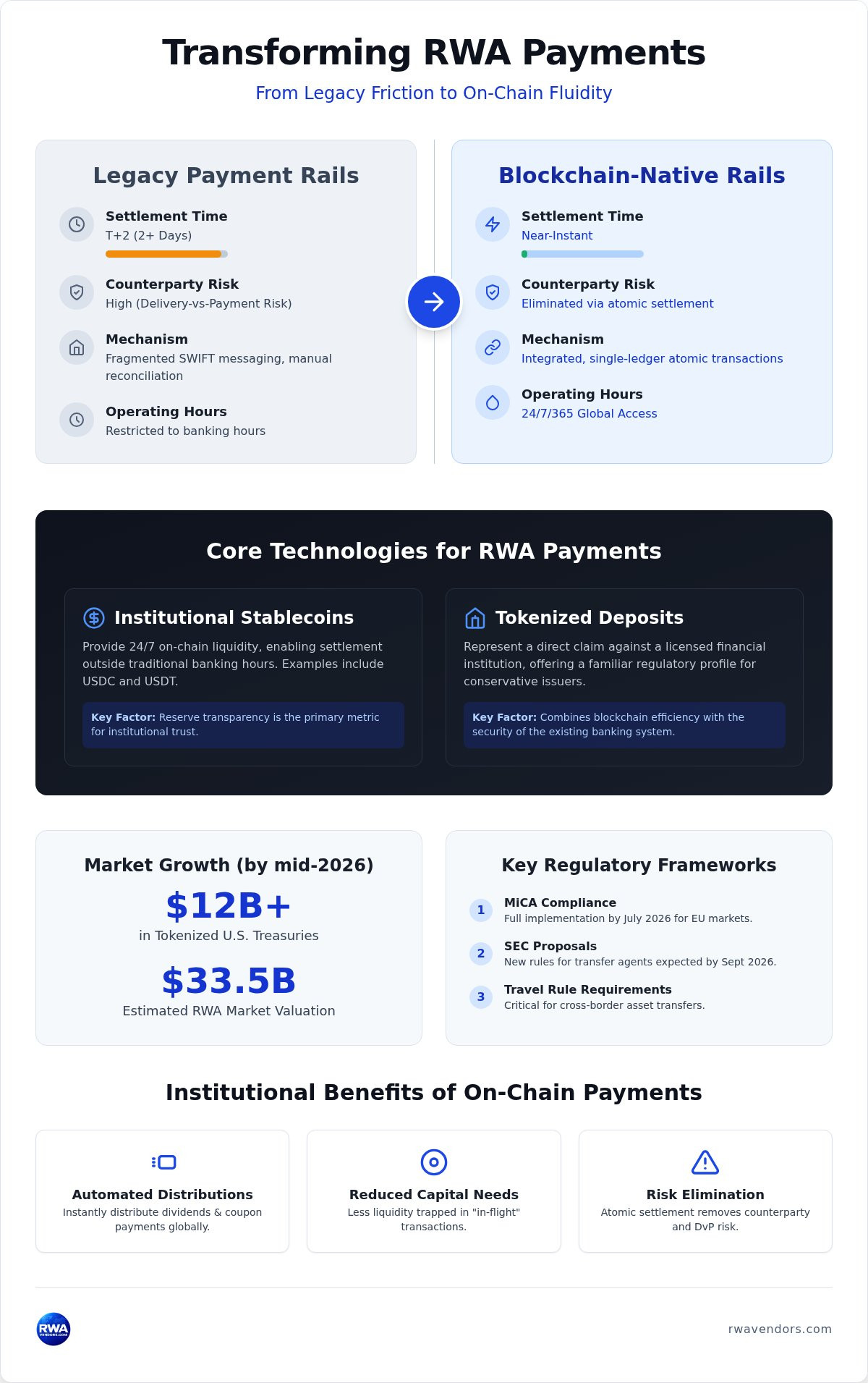
The transition toward tokenized capital markets necessitates a fundamental redesign of how value moves. Blockchain payment solutions for RWAs serve as the digital infrastructure required for near-instant asset settlement, replacing the fragmented messaging protocols of the past. While traditional finance relies on messaging systems like SWIFT to initiate transfers that take days to finalize, blockchain-native rails integrate the payment directly into the ledger where the asset resides. This move away from legacy T+2 cycles toward real-time transaction finality isn't merely an incremental speed improvement; it's a structural change that allows tokenized assets to function as liquid financial instruments rather than static digital records.
Without a specialized payment layer, the benefits of tokenization remain largely theoretical. High-velocity markets require that the transfer of ownership and the transfer of value occur in a single, synchronized event. By embedding payment capabilities into the blockchain layer, issuers can bypass the delays inherent in correspondent banking networks and reduce the administrative burden associated with cross-border transactions.
From Legacy Systems to Atomic Settlement
Traditional asset markets are plagued by the friction of manual reconciliation. Because the transfer of the asset and the transfer of funds happen on separate, disconnected systems, intermediaries must verify each step to prevent defaults. This creates delivery-versus-payment (DvP) risk, where one party fulfills their obligation while the other fails. The tokenization process addresses this by enabling atomic settlement. Atomic settlement is the simultaneous exchange of asset and payment. By ensuring that both sides of a trade execute as a single, indivisible transaction, institutions eliminate counterparty risk and the need for expensive clearinghouse services.
Why Institutional Issuers are Prioritizing Payment Infrastructure
Institutional issuers are increasingly focused on payment rails to enhance the investor experience. For example, issuers of tokenized private credit or real estate can automate dividend and coupon payments, distributing yield to thousands of global investors instantly without the administrative overhead of wire transfers. Shortening settlement timeframes also reduces the capital requirements for market participants, as less liquidity is trapped in "in-flight" transactions. To scale these operations effectively, issuers rely on digital asset infrastructure providers to bridge the gap between on-chain assets and regulated payment environments. As the RWA market grows toward its estimated mid-2026 valuation of up to $33.5 billion, robust blockchain payment solutions for RWAs become the primary driver of operational efficiency and global liquidity.
Core Technologies Powering RWA Transaction Infrastructure
The architecture of blockchain payment solutions for RWAs relies on a multi-layered technological stack designed for institutional stability. At the foundation, the market currently favors USD-pegged stablecoins such as USDC and USDT for their deep liquidity and established integration with digital asset ecosystems. However, the infrastructure is maturing. We're seeing a shift toward tokenized deposit solutions and Central Bank Digital Currencies (CBDCs) that offer a more familiar regulatory profile for traditional banks. These technologies don't just move money. They transform capital into programmable data.
This evolution enables the industry to move beyond simple trade execution. By utilizing interoperability protocols, institutions can now bridge payments across disparate blockchain networks. This ensures that an asset on one ledger can be settled using a payment token on another, preventing liquidity fragmentation and ensuring the ecosystem remains cohesive as it scales toward institutional volume.
Stablecoins and Tokenized Deposits
Fiat-backed stablecoins provide the 24/7 liquidity necessary for global markets, allowing settlement to occur outside of traditional banking hours. For institutions, reserve transparency is the primary metric for trust. While stablecoins offer speed, regulated tokenized bank deposits are emerging as a preferred vehicle for conservative issuers. These deposits represent a claim against a licensed financial institution, combining the efficiency of blockchain rails with the security of the existing banking system. This hybrid approach allows for high-speed transfers while maintaining the rigorous compliance standards of the traditional finance sector.
Programmable Payments for Asset Lifecycles
Traditional payment systems struggle to handle the complex lifecycle events of real-world assets. Blockchain payment solutions for RWAs solve this by using smart contracts to automate payment logic directly on-chain. This automation extends far beyond the initial purchase. It covers the entire duration of the asset's life.
- Dividend Distributions: Systems can automatically calculate and disperse payments based on real-time cap table data.
- Coupon Payments: Tokenized bonds can trigger interest payments to holders at predefined intervals without manual intervention.
- Tax Withholding: Smart contracts can handle automated tax withholding at the payment rail level, ensuring compliance across multiple jurisdictions.
This level of precision reduces operational risk and lowers the cost of asset servicing. To stay ahead of these technological shifts, providers should consider how their services are represented to institutional issuers. If you offer specialized infrastructure, you can get listed in our directory to connect with asset issuers seeking verified payment partners. As the market matures, the ability to handle these granular lifecycle events will distinguish market leaders from generic payment processors.
Navigating Regulatory Compliance for Payment Solutions
The regulatory landscape for blockchain payment solutions for RWAs reached a critical milestone on July 1, 2026, with the full implementation of the EU’s Markets in Crypto-Assets (MiCA) regulation. This framework mandates that all service providers offering payment or exchange capabilities within the EU must possess a MiCA license. Such regulations provide the legal certainty institutional issuers require to move from pilot programs to production-scale tokenization. Compliance isn't just a legal hurdle; it's a prerequisite for market liquidity and institutional trust.
Beyond regional frameworks, global standards like the Financial Action Task Force (FATF) Travel Rule now dictate how cross-border blockchain transactions are handled. Payment providers must ensure that identifying information for both originators and beneficiaries is transmitted alongside the transaction. This necessitates the integration of robust KYC (Know Your Customer) and AML (Anti-Money Laundering) protocols directly at the payment gateway level. Every dollar moved must be fully accounted for to meet the standards of modern global finance.
The Institutional Compliance Framework
Building a compliant payment rail requires more than just a license. Institutions must integrate sophisticated identity solutions with payment wallets to create "permissioned" transaction environments. These systems ensure that only verified participants can interact with the RWA smart contracts. To maintain the integrity of the ecosystem, providers utilize chain analysis tools to monitor payment flows in real-time. These tools detect and flag suspicious activity, allowing institutions to maintain a clean audit trail. It's essential that any partner you select holds the necessary Money Service Business (MSB) or Virtual Asset Service Provider (VASP) licenses in their respective jurisdictions.
Counterparty Risk and Vendor Vetting
Verifying the regulatory status of a payment vendor is the most effective way to mitigate counterparty risk. Using non-vetted or "gray market" payment rails introduces significant legal and operational dangers that can jeopardize the entire asset issuance. If a payment provider operates without oversight, your institution faces potential asset freezes or regulatory sanctions. To ensure you've covered every technical and legal requirement, consult our tokenization due diligence checklist. Vetted vendors provide the transparency and accountability needed to protect your reputation and your investors' capital. Choosing a partner with a proven track record of regulatory adherence is not optional; it's a core component of institutional-grade infrastructure.
Key Criteria for Evaluating RWA Payment Vendors
Selecting blockchain payment solutions for RWAs requires a rigorous evaluation of technical robustness and operational reliability. Institutions cannot rely on generic payment processors that lack the specific hooks needed for tokenized asset lifecycles. A viable vendor must demonstrate the capacity to handle high-frequency institutional volume without degradation in performance. This includes maintaining near-perfect uptime during critical market events, such as large-scale dividend distributions or asset redemptions. Furthermore, the ease of converting stablecoins to fiat currency through reliable on and off-ramps is essential for maintaining liquidity across the ecosystem.
Integration depth serves as a primary differentiator between retail-focused processors and institutional-grade infrastructure. The vendor’s API should support direct, automated interaction with RWA smart contracts to enable the atomic settlement discussed earlier. Security infrastructure must reflect the high stakes of global finance; it should utilize multi-signature protocols and Hardware Security Modules (HSMs) to protect sensitive transaction signing keys. These features ensure that payment flows remain secure even as the total value of on-chain tokenized real-world assets continues to climb toward its mid-2026 projections.
Connectivity and Interoperability
Effective payment rails must offer broad connectivity across multiple blockchain networks, including Ethereum, Polygon, and Base. This prevents liquidity silos and allows issuers to reach a wider investor base regardless of the underlying ledger. Seamless movement between payment rails and RWA custody solutions is essential for maintaining a unified operational workflow. Developer teams should prioritize vendors that provide comprehensive SDKs and robust documentation to accelerate the deployment of these integrations. Without interoperability, institutions risk being locked into a single ecosystem that may not suit all asset classes.
The "Total Cost of Payment" Analysis
Institutions often focus on headline transaction percentages while overlooking the hidden costs of slippage and gas fees in high-value transfers. Slippage can significantly erode value during the conversion of stablecoins to fiat if the vendor lacks deep liquidity pools. There is also a persistent trade-off between transaction speed and cost; faster deterministic finality often requires higher priority fees on public networks. Asset issuers should audit vendor fee schedules for tiered volume discounts to ensure long-term cost efficiency as their portfolios scale. By analyzing the total cost of payment, firms can better predict the margins of their tokenized products. Efficient blockchain payment solutions for RWAs should provide transparent reporting that accounts for every cent of slippage and network overhead.
Accessing Vetted Payment Solutions via the RWA Vendors Directory
The RWA Vendors global directory serves as the definitive resource for identifying and vetting blockchain payment solutions for RWAs. As the market transitions toward tens of billions in on-chain assets, the complexity of finding compliant infrastructure increases. This directory simplifies that process by organizing a fragmented landscape into a structured taxonomy of professional services. It acts as an active connector between asset issuers and the technology providers capable of supporting institutional-grade settlement. By providing a centralized location for discovery, the platform empowers businesses to build and scale their tokenization efforts with confidence.
A central pillar of the directory is the "Verified" status. This designation is a critical indicator of reliability, signifying that a vendor has undergone a professional review process to mitigate institutional infrastructure risk. In a sector where counterparty risk can jeopardize entire asset pools, engaging with verified providers ensures a high standard of excellence. This "gatekeeper" sensibility maintains the integrity of the ecosystem, allowing issuers to focus on growth rather than manual vendor due diligence.
Navigating the Payment Solutions Category
To identify the appropriate infrastructure partner, users should navigate to the "Payment Solutions" category. This section is organized to allow for surgical precision during the search process. You can use the internal filtering system to narrow down providers based on specific operational requirements. For example, you can filter vendors by jurisdiction to ensure compliance with regional frameworks such as the EU's MiCA or U.S. money transmitter laws. You can also filter by asset type to identify vendors with specialized experience in sectors like Real Estate or Private Equity.
Comparing featured vendors within these categories allows for a granular assessment of technical fit. Some providers focus exclusively on institutional-grade stablecoin issuance, while others offer broader programmable payment logic for complex asset lifecycles. This structured approach ensures that you find a partner whose API and liquidity profiles align with your specific tokenization strategy.
Leveraging Vetted Partnerships for Growth
The RWA Vendors ecosystem is operated by the Security Token Offering (STO) Foundation, providing a global reach that spans the entire tokenization lifecycle. Choosing vendors who are active members of this community offers a distinct advantage. These providers are often at the forefront of industry evolution, contributing to the development of RWA payment standards that prioritize security and interoperability. Founding Members, in particular, play a vital role in shaping these standards, acting as authoritative architects within the digital capital markets.
By leveraging these vetted partnerships, institutions can accelerate their time-to-market while ensuring their payment rails remain robust and compliant. The directory is not a passive list; it's a tool for strategic scaling. It allows you to move beyond experimental pilots and into full-scale production with the support of a curated professional network.
Explore the global RWA payment solutions directory to find your next infrastructure partner.
Scaling Institutional RWA Infrastructure
The transition to blockchain-native payment rails represents a fundamental shift in how global capital markets operate. By replacing legacy T+2 cycles with atomic settlement, institutions can eliminate counterparty risk and unlock significant operational efficiencies. Implementing robust blockchain payment solutions for RWAs is no longer a pilot project; it's a strategic necessity for any issuer seeking to compete in a 24/7 digital economy.
Success in this evolving market depends on selecting partners that offer deep technical integration, regulatory transparency, and high-frequency scalability. As global frameworks like MiCA provide the necessary legal certainty, the ability to deploy vetted infrastructure becomes a primary competitive advantage. Our global directory, operated by the STO Foundation, provides verified vendor profiles to help you navigate this landscape with surgical precision.
We're committed to facilitating the connections that empower your business to build and scale. Start your search today to find the infrastructure that aligns with your institutional standards.
Frequently Asked Questions
What are the main benefits of using blockchain for RWA payments?
The primary advantages include near-instant settlement finality, 24/7 market availability, and significantly lower administrative overhead. By utilizing blockchain payment solutions for RWAs, institutions bypass the correspondent banking network, which often introduces delays and hidden fees. This technology enables a transparent audit trail for every transaction. It also allows for the programmability of funds, ensuring that payments are only released when specific contractual conditions are met on the ledger.
Are stablecoins legal for settling tokenized real estate transactions?
The legality of stablecoins for real estate settlement depends on the regulatory framework of the specific jurisdiction. In the European Union, the Markets in Crypto-Assets (MiCA) regulation, fully implemented as of July 1, 2026, establishes a clear legal structure for stablecoin issuers and service providers. In other regions, institutions must ensure that their chosen payment rails comply with local money transmitter laws and securities regulations. Vetted vendors typically provide the necessary legal documentation to support compliant transactions.
How does atomic settlement differ from traditional T+2 settlement?
Atomic settlement involves the simultaneous exchange of an asset for payment, whereas T+2 settlement requires a two-day waiting period for manual reconciliation. This delivery-versus-payment mechanism eliminates counterparty risk because the transaction only completes if both parties fulfill their obligations. Traditional systems rely on clearinghouses to manage this risk over several days. Atomic settlement moves this logic to the blockchain, freeing up capital that would otherwise be trapped in in-flight transactions.
What is the "Travel Rule" and how does it affect blockchain payments?
The Travel Rule is a global standard set by the Financial Action Task Force that requires financial institutions to share identifying information for participants in large transactions. For blockchain payment solutions for RWAs, this means providers must transmit KYC data alongside the digital token transfer. Compliance ensures that cross-border payments meet anti-money laundering standards. Most institutional-grade vendors integrate these reporting requirements directly into their gateway infrastructure to maintain strict regulatory adherence.
Can I integrate blockchain payment rails with my existing bank account?
Integration is typically achieved through regulated on and off-ramps or tokenized deposit solutions offered by banking partners. These systems bridge traditional fiat accounts with digital ledgers, allowing for seamless conversion between bank balances and stablecoins. Many providers offer APIs that connect directly to existing treasury management systems. This connectivity allows institutions to maintain their primary banking relationships while benefiting from the speed and efficiency of blockchain-native settlement rails.
What should I look for when vetting a blockchain payment vendor?
Institutions should prioritize vendors that hold valid VASP or MSB licenses and demonstrate high historical uptime. It's critical to evaluate the depth of their API integration with RWA smart contracts and their support for multi-signature security. We recommend using the RWA Vendors directory to identify providers with a Verified status. This designation indicates the vendor has been reviewed for institutional-grade reliability, helping to mitigate the infrastructure risks associated with non-vetted payment rails.
How do smart contracts automate dividend payments in RWAs?
Smart contracts use real-time data from on-chain cap tables to calculate and distribute funds to token holders automatically. When a dividend event is triggered, the contract identifies all eligible wallet addresses and executes the payment in stablecoins. This process removes the need for manual distribution via wire transfers or checks. It ensures that yield is delivered precisely and instantly, even to thousands of global investors, reducing the administrative burden on the asset issuer.
Is it possible to handle cross-border RWA payments without high FX fees?
Cross-border payments can be settled using USD-pegged stablecoins to avoid the high fees and slippage associated with traditional foreign exchange markets. By moving value over blockchain rails, institutions bypass the multiple intermediary banks that typically take a percentage of the transaction. While network gas fees apply, they are often negligible compared to institutional FX costs. This approach provides a more predictable cost structure for global asset distributions and international secondary market trades.
Disclaimer
This article is provided by RWAVendors.com for general informational and educational purposes only. It does not constitute legal, financial, investment, tax, regulatory or other professional advice, or an offer, solicitation, recommendation or endorsement of any company, product, service, token, security or investment. RWAVendors.com is an informational vendor directory and does not sell, issue, broker, custody or facilitate transactions involving cryptocurrencies, digital tokens, tokenized assets, securities or investment products. Some vendor listings and references may involve paid advertising, sponsored placement or membership relationships. These relationships do not guarantee a vendor’s qualifications, regulatory status, performance or suitability. Information may be incomplete, outdated or subject to change. You should independently verify all information, conduct your own due diligence and consult qualified professionals before making any business or investment decision. RWAVendors.com is not responsible for the content, services, representations or actions of third-party vendors or linked websites.


