
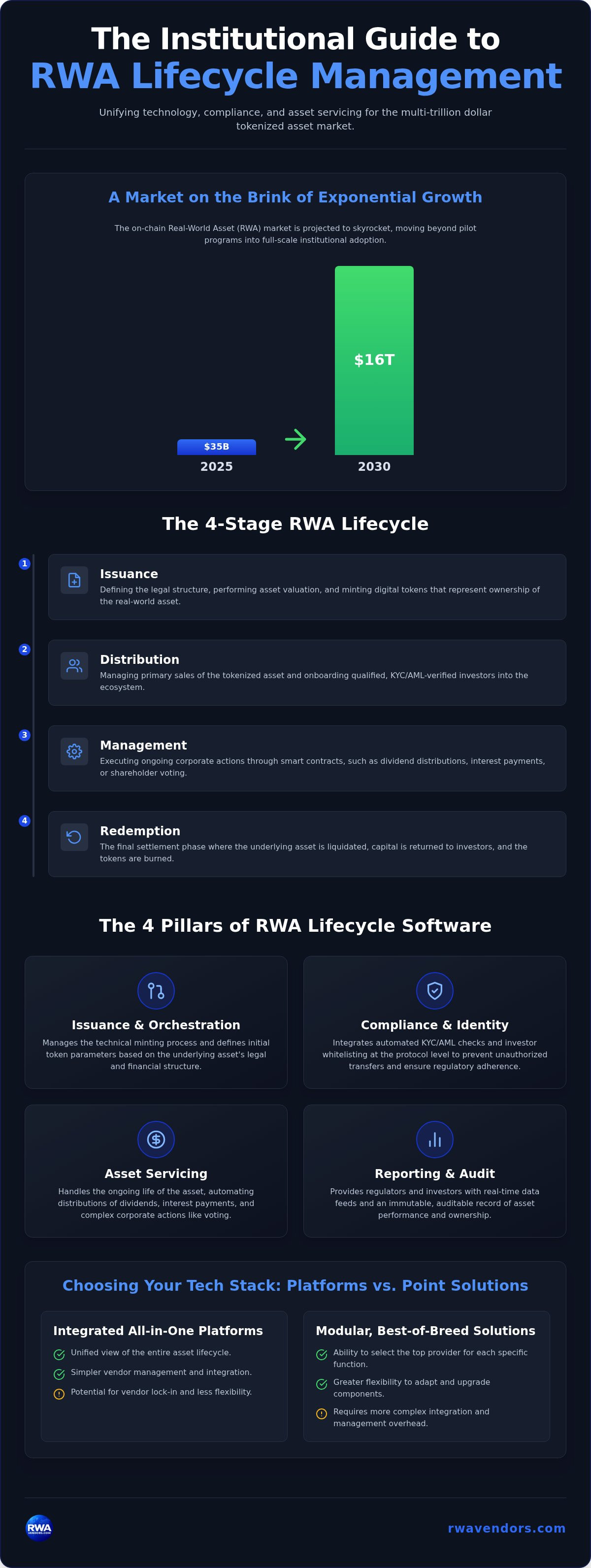
With the on-chain Real-World Asset (RWA) market surpassing $35 billion by late 2025 and projections reaching $16 trillion by 2030, the era of experimental pilots has ended. Institutional issuers now face the daunting task of managing complex digital securities across fragmented technology stacks and evolving regulatory frameworks like MiCA. You likely recognize that a lack of interoperability between custody, issuance, and secondary markets creates operational bottlenecks that threaten scalability. Finding the right RWA lifecycle management software is no longer a luxury; it's a foundational requirement for any firm seeking to maintain a competitive edge in tokenized capital markets.
This guide provides an institutional framework for managing the end-to-end lifecycle of tokenized assets, from initial issuance to final redemption. You'll discover how to unify your view of the RWA lifecycle, automate compliance reporting, and establish partnerships with vetted vendors. We examine the essential software components required to bridge the gap between traditional finance and blockchain infrastructure. This article outlines the roadmap for selecting the technology and service providers necessary to build a secure, compliant, and scalable tokenization ecosystem.
Key Takeaways
- Distinguish between traditional asset management and the specialized technical requirements of tokenized securities to ensure operational continuity.
- Identify the four critical pillars of RWA lifecycle management software, focusing on automated compliance orchestration and institutional-grade security.
- Evaluate the strategic trade-offs between integrated all-in-one orchestration platforms and modular, best-of-breed point solutions for your technology stack.
- Implement a rigorous vendor selection framework that prioritizes regulatory alignment with frameworks like MiCA and verified security certifications.
- Utilize the RWA Vendors global directory to source and connect with vetted technology providers across the entire issuance and management lifecycle.
Defining RWA Lifecycle Management: Beyond Traditional ITAM
Traditional IT Asset Management (ITAM) focuses on the physical procurement, maintenance, and disposal of hardware. While ITAM ensures that servers and laptops remain functional, it lacks the financial and legal sophistication required for modern capital markets. RWA management serves a different purpose. It governs the digital representation of high-value assets, such as private credit or real estate, on a distributed ledger. RWA Lifecycle Management is the digital orchestration of asset rights and compliance.
The Institutional Shift to Digital Securities
Financial institutions are currently migrating from opaque legacy ledgers to programmable, blockchain-based systems. This shift provides the real-time visibility that modern capital markets demand. To succeed, firms must partner with verified digital asset infrastructure providers that can handle the technical complexities of 2026 regulatory standards. This infrastructure allows for the seamless movement of value without the reconciliation delays inherent in older systems. The transition is not merely a technical upgrade; it's a fundamental change in how ownership is recorded and transferred.
The lifecycle of a tokenized asset follows a distinct four-stage progression:
- Issuance: Defining the legal structure, performing asset valuation, and minting the digital tokens.
- Distribution: Managing primary sales and onboarding qualified investors into the ecosystem.
- Management: Executing ongoing corporate actions, such as dividend distributions, interest payments, or voting.
- Redemption: The final settlement phase where the underlying asset is liquidated and tokens are burned.
Why General IT Software Fails the RWA Test
Standard enterprise resource planning (ERP) or general IT software cannot manage these complex stages. These systems don't have the logic to interact with smart contracts or enforce tokenization standards like ERC-3643. Without specialized RWA lifecycle management software, issuers can't automate KYC/AML checks at the protocol level. This failure creates significant regulatory risk and operational friction. Dedicated RWA lifecycle management software ensures that every transaction is compliant by design, linking the asset directly to institutional custody and liquid secondary markets. By 2026, the distinction between general IT tools and specialized financial orchestration platforms has become a critical factor in institutional success.
The 4 Pillars of RWA Lifecycle Software
Effective RWA lifecycle management software must address four distinct functional areas to support institutional-grade tokenization. These pillars ensure that an asset remains compliant, liquid, and transparent throughout its existence. Without a robust technical foundation, issuers risk operational failure or regulatory scrutiny as the asset moves from primary issuance to secondary trading.
- Issuance and Orchestration: This software foundation manages the technical minting process and defines the initial token parameters based on the underlying asset.
- Compliance and Identity: Automated KYC/AML integrations and investor white-listing prevent unauthorized transfers and ensure only verified participants enter the ecosystem.
- Asset Servicing: The platform handles the ongoing life of the asset, including the distribution of dividends, interest payments, and corporate actions like shareholder voting.
- Reporting and Audit: Real-time data feeds provide regulators and investors with an immutable record of asset performance, ownership, and reserve backing.
Smart Contract Orchestration Engines
Modern orchestration engines use code to automate the enforcement of asset-specific rules. By embedding logic directly into the token, issuers reduce the operational risk of human error in complex financial transactions. These engines rely on digital asset oracle providers to feed external market data, such as real estate valuations or interest rate changes, directly into the smart contract. This connectivity ensures the digital asset reflects real-world conditions without manual intervention, maintaining the integrity of the token's value at all times.
Integrated Compliance Modules
Institutional issuers require a "Compliance-by-Design" approach to satisfy global regulators. Integrated modules allow for jurisdictional adherence by using modular plugins that update as laws evolve. For instance, an issuer can apply specific European MiCA requirements to one tranche of tokens while maintaining different rules for investors in other regions. This flexibility is only possible when the software stack includes vetted legal and compliance vendors. Companies looking to showcase their specialized tools to global issuers can apply for a directory listing to join this professional ecosystem.
Asset servicing remains a critical but often overlooked phase. Robust RWA lifecycle management software automates the management of the ledger and executes complex corporate actions via programmable logic. This automation facilitates continuous transparency. Unlike traditional finance, where audits are retrospective and periodic, tokenized assets offer real-time verification. Regulators can access dashboards that verify investor eligibility instantly, which drastically reduces the long-term cost of oversight and improves market trust.
Comparative Analysis: Orchestration Platforms vs. Point Solutions
Choosing the right RWA lifecycle management software requires a strategic decision between monolithic orchestration platforms and modular point solutions. Each approach offers distinct advantages depending on the issuer's scale and asset complexity. All-in-one platforms provide a unified dashboard that simplifies the user experience and accelerates the initial launch. However, they often lead to vendor lock-in and may lack the depth required for highly specialized asset classes.
Conversely, best-of-breed point solutions allow institutions to select specialized vendors for specific functions, such as legal compliance or transfer agency. This modularity improves risk management by diversifying technical dependencies. It also ensures that each component of the stack is optimized for its specific purpose. The trade-off is a higher technical burden, as the issuer must maintain multiple integrations and ensure data consistency across the entire ecosystem.
Interoperability has become the defining requirement for RWA software in 2026. With the total market value of asset tokens exceeding $61 billion, assets must move seamlessly across different blockchain protocols. A software stack that lacks cross-chain compatibility limits secondary market liquidity and restricts institutional participation. Institutions must prioritize architectures that support standardized token formats to ensure long-term viability.
The Rise of White-Label Tokenization Platforms
White-label platforms offer a turnkey solution for firms needing rapid market entry. These systems provide pre-configured templates for common asset classes like real estate or private credit. While they offer speed, institutional issuers must evaluate their long-term scalability and security certifications. SOC2 and ISO standards are mandatory benchmarks for any white-label partner. A reliable provider should offer a robust API framework to allow for future customizations as the business scales.
Critical Integrations: Custody and Payments
No lifecycle management tool operates in isolation. Your software must link directly to institutional-grade RWA custody solutions to ensure asset security and regulatory compliance. This connection is vital for managing the secure storage of private keys and the execution of high-value transactions.
Additionally, the integration of blockchain payment solutions for RWAs enables the automation of the "on-ramp" and "off-ramp" process. This connectivity allows the software to handle fiat-to-token conversions and the automated distribution of yields without manual reconciliation. Managing these flows within a single dashboard reduces operational friction. It also enhances the investor experience by providing immediate settlement and transparent reporting.
Evaluation Framework: Selecting Institutional RWA Software
Selecting the appropriate RWA lifecycle management software is a high-stakes decision that dictates the operational resilience of a tokenization project. Institutions must move beyond generic software procurement and adopt a framework tailored to the specific demands of digital capital markets. This process requires a logical taxonomy of technical and legal requirements to ensure long-term stability.
- Step 1: Define the asset class and specific regulatory requirements. Each asset type, from private credit to infrastructure, carries unique lifecycle demands and must align with jurisdictions like the EU’s MiCA framework.
- Step 2: Audit the vendor's security certifications and track record. Demand proof of SOC2 Type II and ISO 27001 compliance to ensure the vendor meets institutional data protection standards.
- Step 3: Test for multi-chain support and future-proofing. Ensure the software facilitates interoperability across different blockchain networks to avoid liquidity silos.
- Step 4: Evaluate the developer API and ease of integration. A robust API is essential for connecting the software with existing internal ledgers and third-party service providers.
- Step 5: Verify the vendor's presence in a reputable directory like RWA Vendors. Use the global directory to confirm the vendor has been vetted within the professional tokenization ecosystem.
Security and Technical Due Diligence
Technical due diligence must prioritize the integrity of the underlying smart contracts. Review the vendor’s comprehensive audit history and their methodology for managing software vulnerabilities. It’s vital to establish clear protocols for private key management and signing authority. Inquire about multi-signature configurations and hardware security module (HSM) integrations to prevent single points of failure. Disaster recovery and business continuity plans are non-negotiable; they ensure that asset management and investor access remain uninterrupted during unforeseen technical disruptions or market volatility.
Scalability and Future-Proofing
As the on-chain RWA market targets a $16 trillion valuation by 2030, your software stack must handle high-volume transactions and rapid secondary market trading without performance degradation. Support for emerging standards like ERC-3643 (T-REX) is necessary for maintaining automated compliance during complex asset transfers. The software must remain adaptable, allowing for surgical modular updates as global regulations like MiCA continue to mature. This future-proofing ensures that your infrastructure supports the entire lifecycle of an asset, even as new jurisdictions and asset classes emerge in the global digital economy.
Evaluating these technical and regulatory dimensions requires a methodical approach. Institutional issuers don't have the luxury of trial and error in a market where legal compliance is the primary barrier to entry. By following this framework, firms can select RWA lifecycle management software that balances immediate operational needs with long-term strategic growth. This structured selection process minimizes vendor risk and establishes a credible foundation for tokenized capital markets.
Leveraging RWA Vendors to Build Your Lifecycle Stack
Building a robust technology stack for tokenized assets requires more than technical specifications; it demands a network of verified partners who understand the intersection of global finance and blockchain technology. RWA Vendors serves as the primary gateway for institutional issuers to discover and connect with these specialized providers. By using this curated directory, firms can bypass the fragmented vendor landscape and focus on building a scalable RWA lifecycle management software ecosystem with confidence.
The directory simplifies the sourcing process by categorizing vendors according to their specific role in the asset lifecycle. Issuers can filter through providers specializing in legal compliance, institutional custody, or secondary market liquidity. This structured approach ensures that every component of the stack is sourced from a professional firm with a documented track record. It also allows for the efficient comparison of service offerings, which reduces the time required to move from initial concept to live issuance.
The Benefits of a Vetted Vendor Ecosystem
Institutions must prioritize risk mitigation when selecting a technology partner. RWA Vendors reduces third-party risk by providing access to a pre-screened directory where providers are vetted for their expertise and global reach. This vetting process is particularly critical for Founding Members, who represent the gold standard in RWA infrastructure. These firms often offer pre-built integrations with other ecosystem partners, ensuring that your RWA lifecycle management software remains interoperable and efficient throughout the investment period.
A global network of service providers allows issuers to navigate complex multi-jurisdictional requirements. Whether you're launching a real estate fund or a private credit instrument, finding partners with specific regional expertise is essential for regulatory adherence. The RWA Vendors ecosystem acts as a trusted facilitator, connecting you with the legal and technical architects needed to maintain the integrity of your digital securities from issuance to redemption.
Next Steps for Asset Issuers
To begin building your lifecycle stack, utilize the platform’s search and filter tools to identify vendors that align with your specific asset class. Start by defining your core infrastructure needs, such as issuance platforms and custody solutions, before moving to secondary market integrations. This methodical approach ensures that your stack is logically organized and ready for institutional scale without unnecessary operational friction.
Review the detailed profiles of each vendor to understand their security certifications and past performance. By engaging with vetted experts, you simplify the Request for Proposal (RFP) process and ensure that your project is supported by industry leaders who have already done the hard work of organizing this complex landscape. The transition from legacy systems to digital capital markets is a complex journey, but it's more manageable with a curated roadmap of partners.
Explore the RWA Vendors Directory to find your software partner
Securing Your Position in Digital Capital Markets
Establishing a resilient tokenization framework requires a strategic shift from manual oversight to automated orchestration. You've explored how specialized RWA lifecycle management software serves as the foundation for this transition, ensuring every asset remains compliant from issuance to redemption. By focusing on the four pillars of software infrastructure and utilizing a rigorous evaluation framework, institutions can mitigate operational risks and navigate the complexities of global regulations like MiCA with surgical precision.
RWA Vendors provides a curated environment to source these essential tools. This global directory, operated by the STO Foundation since 2017, offers access to institutional-grade providers with a proven track record in capital markets. Utilizing a vetted ecosystem allows you to reduce third-party risk while accelerating your time to market. Building a scalable digital asset strategy is a significant undertaking, but it's achievable with the right network of professional partners.
The evolution toward a tokenized economy is well underway. By aligning your technology stack with verified industry leaders, you position your firm to capture the immense value of the emerging digital securities landscape. It's time to build with confidence.
Frequently Asked Questions
What is RWA lifecycle management software?
RWA lifecycle management software is a specialized technology stack designed to manage the digital representation of physical or financial assets on a blockchain. It facilitates the entire tokenization process, including legal structuring, minting, primary distribution, and final asset redemption. Unlike generic tools, these platforms automate corporate actions like dividend payments and ensure that all transactions adhere to pre-defined compliance protocols throughout the asset's existence.
How does RWA software differ from traditional IT asset management?
RWA software focuses on the financial and regulatory lifecycle of digital securities, whereas traditional IT asset management (ITAM) tracks physical hardware like servers and laptops. ITAM handles procurement and disposal of physical assets, but it lacks the logic to interact with smart contracts or manage investor white-lists. RWA platforms provide the specialized infrastructure required to maintain real-time visibility and legal compliance within global capital markets.
Is smart contract orchestration necessary for RWA management?
Smart contract orchestration is a fundamental requirement for efficient RWA management because it enables the automated enforcement of asset-specific rules. By using code-based logic, issuers can automate complex processes such as interest distributions, shareholder voting, and secondary market transfer restrictions. This automation reduces operational risk, eliminates manual reconciliation errors, and ensures that the digital asset remains synchronized with real-world conditions without constant human intervention.
What are the most important features of an RWA orchestration platform?
The most critical features include automated KYC/AML modules, multi-chain interoperability, and robust asset servicing capabilities. An institutional-grade RWA lifecycle management software must also provide real-time reporting and audit trails for regulators. Other essential components include developer-friendly APIs for ecosystem integration and the ability to handle high-volume transactions. These features ensure that the platform can scale alongside the growing demand for tokenized real-world assets.
Can I use white-label software for institutional RWA issuance?
White-label software is a viable option for institutional issuance if the provider adheres to rigorous security standards such as SOC2 Type II or ISO 27001. These platforms offer rapid deployment for common asset classes like real estate or private credit. However, institutions must verify that the white-label solution allows for custom API integrations and has a proven track record of handling high-value digital security offerings without performance degradation.
How do I ensure my RWA software is compliant with global regulations?
Compliance is achieved by integrating modular software plugins that adapt to specific jurisdictional requirements, such as the EU’s MiCA regulation. Issuers should adopt a "Compliance-by-Design" approach, where regulatory rules are embedded directly into the token's smart contract logic. It's also vital to source technology from providers who have been vetted by reputable industry architects to ensure their systems meet the latest 2026 regulatory standards for digital security transfer agents.
Where can I find vetted vendors for RWA lifecycle management?
You can find vetted service providers through the RWA Vendors global directory. This marketplace connects asset issuers with verified technology, legal, and compliance vendors who specialize in every stage of the tokenization lifecycle. Operated by the STO Foundation, the directory offers a curated list of professionals, including "Founding Members" who represent the highest standard of institutional-grade infrastructure for global capital markets.
What role does custody play in RWA lifecycle management software?
Custody serves as the secure foundation for the entire lifecycle by managing the private keys required to sign transactions and move assets. Institutional RWA lifecycle management software must link directly to verified custody solutions to ensure that digital securities are stored safely and compliantly. This integration allows issuers to manage assets through a unified dashboard while maintaining the high-security standards necessary for protecting institutional-grade investments.
Disclaimer
This article is provided by RWAVendors.com for general informational and educational purposes only. It does not constitute legal, financial, investment, tax, regulatory or other professional advice, or an offer, solicitation, recommendation or endorsement of any company, product, service, token, security or investment. RWAVendors.com is an informational vendor directory and does not sell, issue, broker, custody or facilitate transactions involving cryptocurrencies, digital tokens, tokenized assets, securities or investment products. Some vendor listings and references may involve paid advertising, sponsored placement or membership relationships. These relationships do not guarantee a vendor’s qualifications, regulatory status, performance or suitability. Information may be incomplete, outdated or subject to change. You should independently verify all information, conduct your own due diligence and consult qualified professionals before making any business or investment decision. RWAVendors.com is not responsible for the content, services, representations or actions of third-party vendors or linked websites.


