
On September 1, 2026, the U.S. Securities and Exchange Commission fundamentally redefined the backbone of capital markets by proposing that blockchain technology can serve as the official master securityholder file. You're likely aware that fragmented legacy systems and the friction of T+2 settlement cycles have long hindered institutional efficiency. High manual reconciliation costs continue to drain resources, while regulatory ambiguity has historically slowed the adoption of digital security transfer agents as a standard for modern registries.
This guide explores how these specialized partners are revolutionizing asset ownership records by enabling T+0 settlement and reducing back-office overhead by as much as 50%. You'll learn exactly how the DTA mechanism works and how to select a provider that maintains the exclusive control required by new compliance standards. We will examine the core functions of on-chain registries, evaluate the 2026 regulatory landscape, and provide a framework for identifying vetted service providers for your tokenization project.
Key Takeaways
- Understand how digital security transfer agents act as the regulated interface between legacy systems and on-chain registries to maintain an immutable record of ownership.
- Discover how smart contract triggers automate the asset lifecycle, facilitating efficient investor whitelisting and automated redemption processes.
- Analyze the operational shift from manual reconciliation to automated ledger updates that enables T+0 settlement speeds and reduces back-office overhead.
- Identify essential selection criteria for your project, focusing on technical blockchain compatibility and verified multi-jurisdictional compliance.
- Utilize a vetted directory of service providers to simplify the vendor selection process and connect with established industry architects.
Understanding the Role of Digital Security Transfer Agents
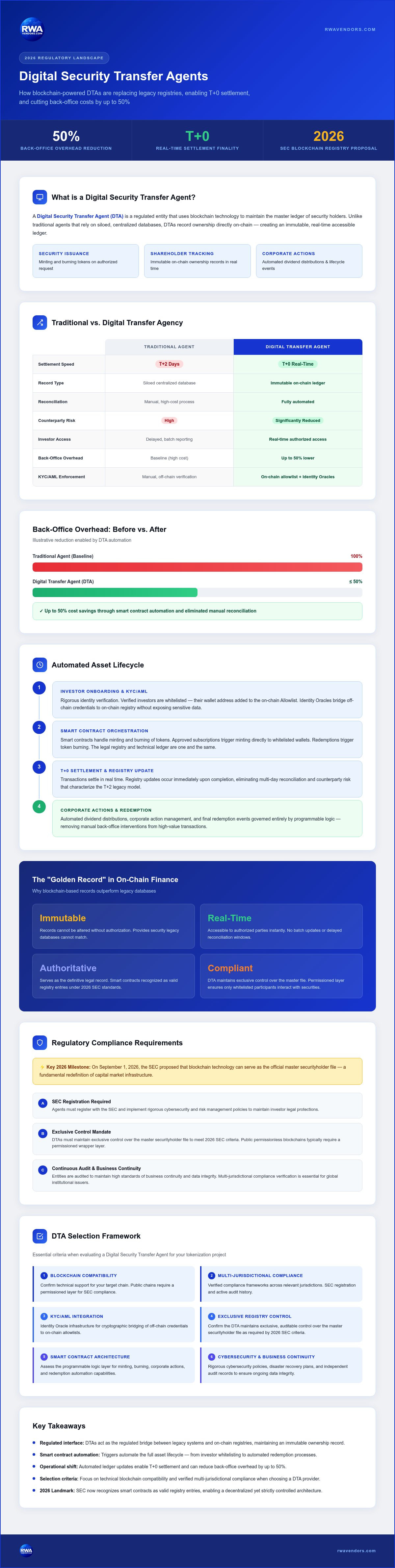
A digital security transfer agent (DTA) is a regulated entity that utilizes blockchain technology to maintain the master ledger of security holders. Traditional agents rely on siloed, centralized databases. DTAs record ownership directly on-chain. It's a structural shift that ensures the ledger is immutable and accessible to authorized parties in real time. Their core responsibilities include security issuance, shareholder tracking, and the management of digital corporate actions like dividend distributions.
The transition to on-chain registries creates a "Golden Record" for every asset. Historically, the Depository Trust & Clearing Corporation (DTCC) has served as the baseline for traditional record-keeping and settlement. The 2026 regulatory landscape now recognizes smart contracts as valid registry entries, allowing for a decentralized yet strictly controlled architecture. In this environment, the transfer agent acts as the primary gatekeeper of the protocol, ensuring that the digital registry remains the definitive legal record.
The "Golden Record" in On-Chain Finance
Digital security transfer agents enable a shift from T+2 settlement to T+0 real-time finality. Registry updates occur immediately upon transaction. This eliminates multi-day reconciliation and reduces counterparty risk for institutional issuers. Immutability ensures that records can't be altered without authorization, providing a level of security that legacy databases struggle to match.
DTAs also manage the link between off-chain identity and on-chain wallets. They verify the individuals or institutions behind every address. This process maintains ledger integrity while fulfilling KYC and AML mandates. It ensures that only whitelisted participants can hold or trade the securities, preserving the compliance of the entire ecosystem.
Regulatory Compliance and Licensing
DTA operations require specific licensing and oversight. In the United States, agents must register with the SEC and implement rigorous cybersecurity and risk management policies to ensure that while the technology is innovative, the legal protections for investors remain robust. These entities are audited to maintain high standards of business continuity and data integrity.
Integrating compliant asset tokenization tech is essential for maintaining this regulatory standing. DTAs must maintain exclusive control over the master securityholder file to meet 2026 SEC criteria. Public, permissionless blockchains often don't qualify for official records unless they are wrapped in a permissioned layer. The agent serves as the essential bridge between on-chain innovation and established securities law.
How Digital Transfer Agents Automate the Asset Lifecycle
Digital security transfer agents move beyond passive record-keeping to actively manage the automated asset lifecycle. By integrating with digital asset infrastructure providers, these agents ensure that every stage of an asset's existence, from issuance to redemption, is governed by programmable logic. This automation reduces the reliance on manual back-office interventions, significantly lowering the risk of human error in high-value transactions. It creates a seamless environment where the legal registry and the technical ledger are one and the same.
Onboarding and Identity Verification
The institutional lifecycle begins with rigorous investor onboarding. Digital security transfer agents implement KYC AML for digital securities to establish a secure perimeter for the fund or asset. Once an investor is verified, their wallet address is added to an "Allowlist." This on-chain permissioning layer ensures that only qualified participants can interact with the security tokens. Identity Oracles act as the cryptographic bridge, providing real-time verification of off-chain identity credentials to the on-chain registry without compromising sensitive personal data.
Smart Contract Orchestration
Smart contracts serve as the engine for modern asset management. DTAs use these protocols to handle the minting and burning of tokens based on authorized requests. When a subscription request is approved, the agent triggers the minting process, creating new tokens directly in the investor's whitelisted wallet. Conversely, redemption requests result in the burning of tokens, ensuring the total supply remains perfectly synchronized with the underlying asset value. The Role of a Transfer Agent in Tokenized Securities extends to the technical oversight of these automated functions to maintain legal finality.
Corporate actions like dividend distributions and voting are also streamlined through programmable triggers. Smart contracts can automatically calculate and distribute payments to shareholders based on their holdings at a specific block height. This eliminates the need for manual calculations and multi-day distribution windows. For voting, agents facilitate secure, on-chain ballot casting that is instantly tallied and recorded. During secondary market transfers, the DTA's protocol automatically checks the recipient's allowlist status. If the recipient isn't verified, the transaction fails at the protocol level, protecting the issuer from compliance breaches. Establishing these workflows requires collaboration with verified technology partners. Service providers looking to reach institutional issuers can get listed in our global directory to showcase their automation capabilities.
Traditional vs. Digital Transfer Agency: A Comparative Analysis
The distinction between legacy transfer agency and the model employed by digital security transfer agents lies in the underlying architecture of trust. Traditional agents operate as centralized gatekeepers, managing records within proprietary databases that require periodic reconciliation with brokers, custodians, and clearing houses. Digital agents replace these fragmented silos with a unified ledger where the technology itself enforces the rules of the registry. This shift from manual oversight to algorithmic certainty redefines the operational baseline for institutional finance.
- Settlement Velocity: Legacy systems typically operate on T+2 or T+1 cycles. Digital transfer agents enable T+0 settlement, achieving atomic finality in seconds.
- Ledger Maintenance: Manual reconciliation is replaced by automated ledger updates triggered by smart contracts, eliminating the risk of "breakage" between records.
- Data Accessibility: Transparency moves from periodic, static reporting to real-time, auditable on-chain data that's accessible to authorized stakeholders 24/7.
- Cost Scalability: High per-transaction fees, driven by intensive manual labor, are replaced by a scalable infrastructure that lowers the marginal cost of managing large investor bases.
Efficiency Gains and Cost Reduction
Operational cost reduction is a primary driver for the adoption of on-chain registries. Industry leaders like Clearstream have reported that automation through blockchain technology can reduce operational costs for asset managers by up to 50%. These savings originate from a significant reduction in back-office headcount and the near-elimination of manual error correction. When the registry is the ledger, the need for secondary verification disappears. T+0 settlement doesn't just save time; it optimizes capital efficiency by freeing up liquidity that would otherwise be locked in the settlement pipeline for days. It's a fundamental improvement in how capital is deployed and managed.
Interoperability and Global Reach
Traditional transfer agents are often geographically constrained by their integration with local central securities depositories. In contrast, digital security transfer agents function as cross-jurisdictional architects. They bridge multiple blockchain networks to ensure that assets can move across different ecosystems without losing their regulatory status. Utilizing cross-chain protocols, such as Chainlink’s Cross-Chain Interoperability Protocol (CCIP), allows these agents to distribute tokens globally while maintaining a single, unified Golden Record. This ensures that the master securityholder file remains accurate regardless of whether the asset is held on a private institutional network or a public blockchain. This interoperability is essential for issuers seeking global liquidity without the friction of traditional cross-border settlement.
Strategic Framework: Selecting a Digital Security Transfer Agent
Selecting a partner for on-chain record-keeping is a high-stakes decision that defines the structural integrity of your offering. Issuers must move beyond surface-level technology demonstrations and evaluate digital security transfer agents through a rigorous strategic framework. This assessment ensures that the chosen provider can maintain the exclusive control required by current regulatory standards while providing the scalability needed for global distribution. A misaligned choice can lead to significant technical debt or regulatory friction as your asset grows.
Technical and Security Due Diligence
Technical due diligence should prioritize the token standard and the security of the underlying code. You must confirm if the agent supports established protocols like ERC-3643 or T-REX. These standards are essential for enforcing compliance directly at the smart contract level. Review independent smart contract audits to verify the robustness of their architecture. It's also necessary to confirm the agent's insurance coverage for digital asset operations. Scalability remains a vital metric; the infrastructure must handle high-volume traffic from both retail investors and institutional participants without compromising performance or security finality.
Regulatory and Compliance Alignment
Compliance alignment is the most critical pillar of the selection process. You must verify the agent’s registration status with the SEC, FINRA, or relevant regional bodies. Under the SEC proposal from September 1, 2026, agents using blockchain for the master securityholder file must maintain exclusive control over the ledger. Confirm that the agent has the legal and technical capacity to meet this specific requirement. They must also demonstrate proficiency in managing complex cross-border compliance. This includes handling tax reporting, withholding requirements, and varying investor qualifications across multiple jurisdictions.
Integration capabilities represent the final piece of the framework. Efficient DTAs provide robust APIs that allow the blockchain registry to communicate seamlessly with your existing ERP or CRM systems. This connectivity ensures your internal records remain synchronized with the on-chain Golden Record without manual data entry. Vetting potential partners through an established industry directory is the most efficient way to identify vetted digital security transfer agents with a proven track record. This approach reduces the risk of engaging with unverified vendors and ensures your project starts on a stable, professional foundation.
Navigating the Vendor Landscape with RWA Vendors
The 2026 real-world asset (RWA) ecosystem has reached a level of complexity that demands a curated approach to vendor selection. With the on-chain RWA value reaching approximately $33.5 billion in July 2026, issuers face a crowded marketplace of service providers. RWA Vendors acts as an authoritative industry architect, simplifying the process of identifying and engaging with verified digital security transfer agents. By organizing a fragmented landscape into a logical taxonomy, the platform empowers businesses to build their tokenization infrastructure with confidence and precision. It serves as a central pillar for those who prioritize institutional-grade reliability over market hype.
Using the Global RWA Directory
The directory allows users to filter vendors by specific criteria such as category, service type, and institutional verification. This surgical precision is essential for matching your project’s unique legal and technical requirements with the right partner. You can navigate the platform to find providers that specialize in specific asset classes, from real estate to private equity. Key features of the directory include:
- Institutional Verification: Access profiles of vendors that have undergone a vetting process to ensure they meet professional standards.
- Founding Members: Identify industry leaders who have established a track record of excellence in the digital securities space.
- Global Coverage: Find partners with the jurisdictional expertise necessary for cross-border compliance.
- Direct Engagement: Initiate contact and request proposals through the platform to streamline your due diligence process.
Identifying the right digital security transfer agents is not just about technology; it's about finding a partner that understands the high-stakes nature of global finance. The directory provides the transparency needed to evaluate a vendor’s track record before committing to a long-term partnership.
Building Your Tokenization Stack
A successful tokenization project requires a cohesive stack where the transfer agent interacts seamlessly with custodians, legal counsel, and secondary trading venues. RWA Vendors provides the connectivity needed to assemble this end-to-end infrastructure. As an initiative operated by the Security Token Offering Foundation, the platform maintains a gatekeeper sensibility to ensure that every listed provider meets a high standard of professional quality. This vetted ecosystem is vital for establishing the institutional trust necessary to scale digital securities globally. It ensures that your "Golden Record" remains consistent across all service layers, from initial issuance to secondary market liquidity.
The role of the STO Foundation is to foster a compliant and professional vendor market that bridges traditional structures with modern innovation. By using a curated directory, you reduce the operational risk associated with unverified technology providers. Your next step in infrastructure planning is to visit the RWA Vendors Directory to identify the partners that'll support your long-term growth and ensure your project’s integrity within the global capital markets.
Securing the Future of Digital Capital Markets
The transition toward on-chain registries represents more than a technical upgrade; it's a fundamental shift in the architecture of global finance. By adopting digital security transfer agents, issuers move away from fragmented legacy databases toward a unified Golden Record that enables T+0 settlement and automated lifecycle management. This evolution reduces operational friction and establishes a transparent, auditable environment for institutional investors.
Success in this landscape depends on rigorous due diligence and the selection of partners who maintain exclusive control over the master securityholder file in alignment with 2026 regulatory standards. RWA Vendors serves as the essential gateway for this process. As the official directory of the STO Foundation, we catalog over 500+ verified institutional vendors with global infrastructure coverage to ensure your tokenization stack is built on a foundation of excellence.
Building a scalable, compliant registry is a strategic imperative for the modern asset manager. We invite you to leverage our curated resources to identify the technology and professional services that'll drive your project forward and ensure the long-term integrity of your digital assets.
Frequently Asked Questions
What is the difference between a digital transfer agent and a custodian?
A digital transfer agent manages the registry of ownership and maintains the master securityholder file for an issuer. In contrast, a custodian is responsible for the safekeeping of the actual assets, which in a digital context involves managing private keys and securing tokens. While the transfer agent ensures the registry reflects who owns the asset, the custodian ensures the asset itself is protected and accessible only to authorized parties.
Can a digital transfer agent work with traditional bank accounts?
Digital security transfer agents are designed to bridge the gap between blockchain-based registries and traditional banking infrastructure. They facilitate fiat-based dividend distributions and interest payments by linking on-chain ownership records with legacy payment rails. This integration allows issuers to maintain a modern, efficient registry while still supporting investors who prefer to receive payments or conduct subscriptions through standard institutional bank accounts and wire transfers.
Is an on-chain registry legally recognized by regulators in 2026?
On September 1, 2026, the SEC proposed modernized rules that officially permit registered transfer agents to use blockchain as the master securityholder file. This regulatory shift provides a clear legal framework for on-chain registries, provided the agent maintains exclusive control over the ledger. Many jurisdictions now recognize smart contracts as valid legal records, making digital security transfer agents a central component of compliant institutional tokenization projects globally.
How much does it cost to hire a digital security transfer agent?
The cost of hiring a transfer agent varies significantly based on the complexity of the asset class and the required jurisdictional coverage. Most providers utilize a fee structure that includes an initial setup cost followed by recurring maintenance fees. Because these agents automate many manual processes, some providers report up to a 50% reduction in operational costs for their clients compared to traditional agents who rely on labor-intensive reconciliation methods.
Do I need a separate transfer agent for each blockchain I use?
You don't necessarily need a separate agent for every blockchain network you utilize. Many modern transfer agents are chain-agnostic and use cross-chain interoperability protocols to manage a unified Golden Record across multiple networks. This approach ensures that your master securityholder file remains synchronized even if your tokens are distributed across different private or public blockchains, providing a single source of truth for all corporate actions.
What happens if the blockchain network goes down?
If a blockchain network experiences downtime, transfer agents rely on robust business continuity plans and off-chain data backups to maintain registry integrity. The SEC's 2026 proposed rules require agents to have written policies for risk management and disaster recovery. Because the agent maintains exclusive control over the master file, they can re-establish the ledger on an alternative network or restore records from verified snapshots if a primary network fails.
How does a DTA handle KYC/AML for secondary market trades?
Transfer agents manage secondary market compliance through automated allowlisting mechanisms. When a token is transferred between wallets, the underlying smart contract queries the agent's registry to verify that the recipient has completed all necessary KYC and AML checks. If the recipient isn't whitelisted, the transaction is automatically blocked at the protocol level. This ensures that the issuer remains compliant with securities laws throughout the entire secondary trading lifecycle.
Can traditional transfer agents transition to digital on-chain services?
Traditional transfer agents can transition to digital services by integrating blockchain-based infrastructure into their existing workflows. This usually involves partnering with technology vendors to replace legacy databases with distributed ledger systems. While the core regulatory responsibilities remain the same, the transition allows legacy agents to offer T+0 settlement and reduced operational overhead. Many established firms are currently undergoing this digital transformation to stay competitive in the evolving RWA ecosystem.
Disclaimer
This article is provided by RWAVendors.com for general informational and educational purposes only. It does not constitute legal, financial, investment, tax, regulatory or other professional advice, or an offer, solicitation, recommendation or endorsement of any company, product, service, token, security or investment. RWAVendors.com is an informational vendor directory and does not sell, issue, broker, custody or facilitate transactions involving cryptocurrencies, digital tokens, tokenized assets, securities or investment products. Some vendor listings and references may involve paid advertising, sponsored placement or membership relationships. These relationships do not guarantee a vendor’s qualifications, regulatory status, performance or suitability. Information may be incomplete, outdated or subject to change. You should independently verify all information, conduct your own due diligence and consult qualified professionals before making any business or investment decision. RWAVendors.com is not responsible for the content, services, representations or actions of third-party vendors or linked websites.


