
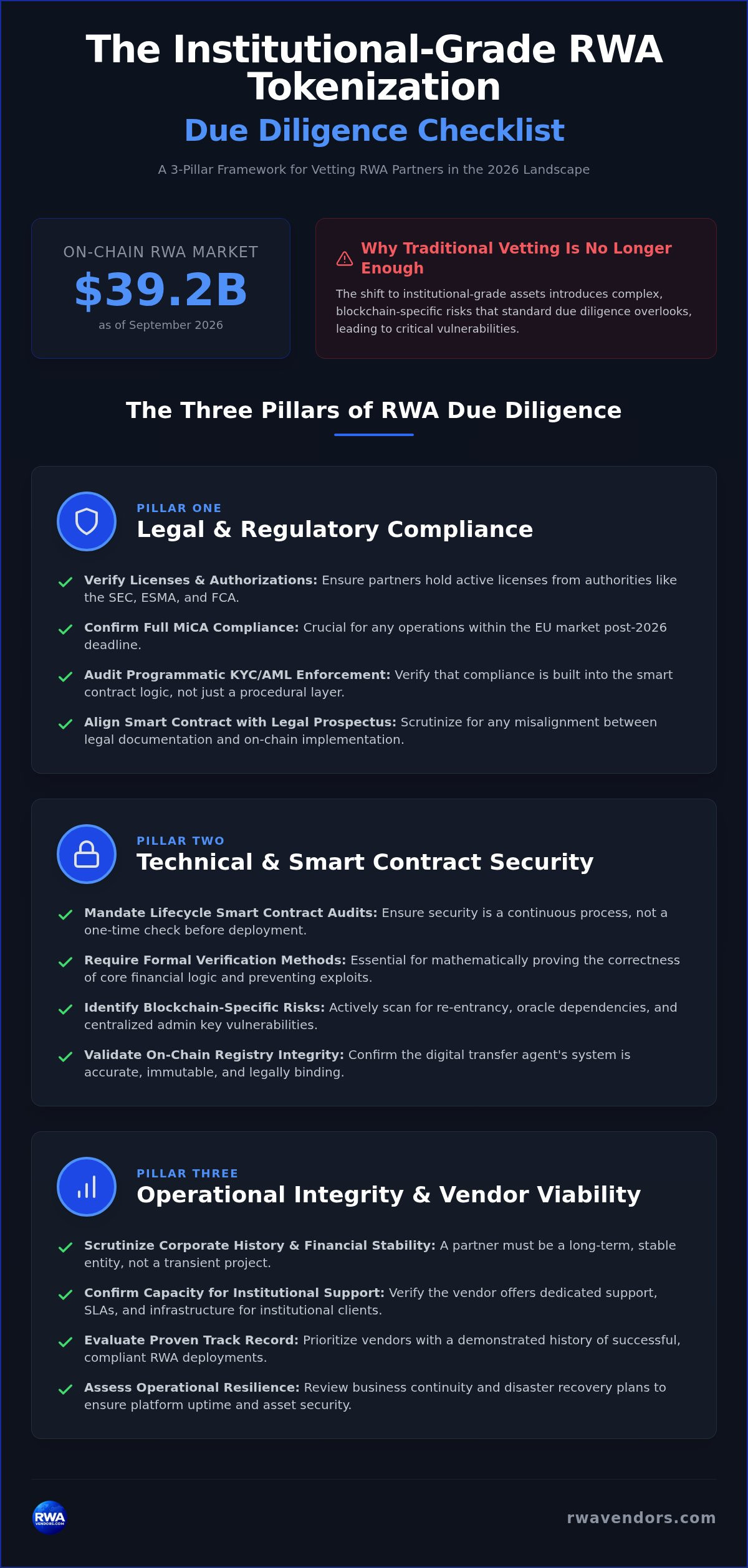
With the on-chain Real-World Asset (RWA) market reaching $39.2 billion as of September 2026, the transition from experimental pilots to full-scale production is a present reality. You've likely seen that as the market matures, the margin for error in partner selection has effectively vanished. The complexity of MiCA authorization deadlines and the technical demands of continuous smart contract security can make the vetting process feel like an insurmountable hurdle.
We understand the pressure to maintain institutional stability while accelerating your time-to-market. This article provides a comprehensive tokenization due diligence checklist designed to help you master the vetting of RWA partners through an institutional-grade framework. By following this structured approach, you'll reduce operational risk and establish a compliant foundation that meets the highest standards of global finance. We'll examine the critical criteria for regulatory compliance, technical security, and long-term vendor stability to ensure your structure is both resilient and ready for the 2026 landscape.
Key Takeaways
- Discover why it's critical to identify specific risks that traditional vetting processes overlook during the shift toward institutional-grade assets.
- Utilize our tokenization due diligence checklist to verify that potential partners hold the necessary licenses from authorities like the SEC or ESMA.
- Establish a standard for technical security that includes lifecycle smart contract audits and formal verification methods.
- Assess the corporate history and financial stability of vendors to ensure they provide long-term institutional support.
- Leverage a curated directory of service providers to streamline the initial screening phase of your partner search.
The Strategic Necessity of RWA Due Diligence
The institutional pivot in 2026 isn't just about adoption; it's about a fundamental change in operational standards. While earlier iterations of the market relied on experimental, crypto-native frameworks, today’s environment demands rigorous institutional-grade protocols. A standard Tokenization (data security) audit isn't enough when dealing with multi-billion dollar asset classes. Traditional due diligence often fails because it lacks the technical depth to evaluate blockchain-specific risks such as re-entrancy vulnerabilities, oracle dependencies, or centralized admin keys.
The cost of oversight is prohibitive for any serious firm. With the MiCA deadline of July 1, 2026, having already passed, any entity operating without the correct authorization faces immediate cessation of operations within the EU. Beyond regulatory fines, smart contract exploits can result in total capital loss, while reputational damage can permanently exclude an issuer from institutional capital markets. This reality makes a comprehensive tokenization due diligence checklist the most critical document in an issuer's operational library. We define the vetting process through three core pillars: Legal Compliance, Technical Security, and Operational Resilience.
Defining the 2026 RWA Landscape
The maturation of compliant asset tokenization tech has significantly raised the barrier to entry for issuers. Institutional infrastructure now drives secondary market liquidity, moving the industry away from the isolated silos of previous years. As a professional gatekeeper, RWA Vendors, operated by the STO Foundation (established 2017), provides the necessary vetting to ensure that every participant in the ecosystem adheres to these elevated standards. This curated approach ensures that issuers engage only with verified technology and legal providers who have demonstrated a commitment to long-term stability.
Risk Mitigation vs. Opportunity Capture
Success in the current market requires a delicate balance between strict compliance and the need for technological innovation. Vetting isn't a barrier to entry; it's the prerequisite for institutional capital to flow into tokenized products. RWA due diligence is the systematic verification of a vendor’s legal standing, technical security, and operational capability. By prioritizing these three pillars, firms can capture the massive opportunities in tokenized U.S. Treasuries and private credit without exposing themselves to avoidable systemic failures. Thorough vetting remains the only path to reducing operational risk and ensuring a faster time-to-market with a compliant structure.
Pillar 1: Legal and Regulatory Compliance Checklist
Legal compliance is the foundation of any institutional RWA project. Without a verified regulatory standing, even the most advanced technology becomes a liability. A robust tokenization due diligence checklist begins with a granular analysis of a vendor's jurisdictional stability and licensing status. In 2026, the global landscape has shifted toward harmonized frameworks, most notably with the full implementation of MiCA in the EU. You must verify that your partners hold active authorizations from relevant bodies like the SEC, FCA, or ESMA to ensure they aren't operating within regulatory blind spots.
The World Economic Forum's report on Asset Tokenization in Financial Markets highlights that the suitability of an asset for tokenization depends heavily on its legal clarity. Beyond simple registration, you must evaluate the vendor's KYC AML for digital securities integration. It's not enough for a platform to claim compliance; the code must programmatically enforce these requirements. This includes ensuring the smart contract precisely reflects the legal rights defined in the offering prospectus. Any misalignment between the technical implementation and the legal documentation creates significant litigation risk.
Regulatory Framework Evaluation
Cross-border offerings require a vendor capable of managing multiple regulatory regimes simultaneously. You should examine the track record of their digital security transfer agents to ensure the on-chain registry remains accurate and legally binding across jurisdictions. A comprehensive tokenization due diligence checklist must also account for 2026 digital security tax compliance standards, including automated reporting and withholding capabilities. If you're a service provider meeting these high standards, you can apply to be featured in our directory to connect with institutional issuers.
Investor Protection and Governance
Institutional investors prioritize the safety of their capital above all else. Your vetting process must include a review of the vendor’s insolvency protocols. If the technology provider or issuer fails, token holders must have clearly defined, legally enforceable rights to the underlying assets. Review the governance structures for smart contract upgrades; centralized control without multi-sig or time-lock mechanisms is a red flag. Finally, mandate regular, independent audits of asset-backed reserves to ensure transparency and maintain market trust.
Pillar 2: Technical Infrastructure and Smart Contract Security
Technical security is the bedrock of any digital asset ecosystem. With the on-chain RWA market reaching $39.2 billion as of September 2026, the stakes for technical failure have never been higher. A rigorous tokenization due diligence checklist must move beyond verifying a single audit report. In 2026, the industry standard for smart contract security has evolved into a continuous lifecycle approach. This includes AI-assisted reviews, fuzzing, and formal verification to provide mathematical proof of code correctness. You must evaluate the reputation of the auditing firms and the frequency of their assessments, ensuring that every protocol upgrade undergoes a fresh round of vetting.
Interoperability and data reliability are equally critical. You need to confirm whether the vendor’s tokens can move seamlessly between compliant institutional chains or if they are locked into a proprietary silo. Oracle reliability is the primary bridge between physical assets and their digital representations. Your vetting process should scrutinize how the vendor pulls real-world data on-chain. High-volume transactions also require infrastructure that is both scalable and gas-optimized to maintain economic viability as the project grows. Infrastructure that fails to scale will eventually lead to prohibitive operational costs and degraded user experiences.
Blockchain Architecture Assessment
Issuers must choose between private, public, or hybrid blockchain solutions based on their specific privacy and compliance needs. While public chains offer greater liquidity, hybrid models often provide the control required for regulated securities. You should evaluate the vendor’s support for institutional-grade digital asset infrastructure providers to ensure the underlying stack is resilient. Modern smart contracts should also include "circuit breaker" mechanisms. These automated triggers can pause transactions in the event of a detected exploit, providing a vital layer of defense against catastrophic capital loss.
Data Security and Privacy
Sensitive investor data must remain protected even in a decentralized environment. Vetting should include a review of the encryption standards used for off-chain storage and how the vendor manages the intersection of blockchain transparency and global privacy laws like GDPR. Compliance with these regulations is non-negotiable for institutional participants. Technical due diligence must include a review of the vendor’s disaster recovery and business continuity plans for on-chain registries. This ensures that the record of ownership remains accessible and verifiable even during significant technical disruptions or vendor-level outages.
Pillar 3: Operational Integrity and Vendor Viability
High-quality code and legal frameworks are insufficient if the vendor lacks operational permanence. Your tokenization due diligence checklist must evaluate the human and financial capital behind the technology. We look for founding teams with a dual pedigree in global finance and distributed systems. A vendor's financial stability is equally vital; you should review their revenue models and funding history to ensure they have the runway to support a multi-year asset lifecycle. Institutional projects don't exist in a vacuum; they require partners who carry specific cyber and professional indemnity insurance to mitigate residual risks. If the vendor lacks a sustainable business model, your project faces significant platform risk regardless of the asset's quality.
The Custody and Asset Management Layer
The connection between digital tokens and physical assets is the most vulnerable point in the RWA lifecycle. You must vet the relationship between the issuer and their third-party custodians. This involves evaluating the security of physical storage, whether it’s property titles in a digital registry or gold reserves in a high-security vault. Your checklist should verify the process for asset redemption. Token holders must have clearly defined rights to physical delivery or liquidation proceeds, ensuring the "real-world" aspect of the asset remains tangible and enforceable. Security of private keys is paramount; look for vendors utilizing multi-party computation (MPC) or hardware security modules (HSM) to eliminate single points of failure.
Operational Track Record
Historical performance is the best predictor of future reliability. Review the vendor's Total Value Locked (TVL) and their history of successful issuances. With the on-chain RWA market reaching $39.2 billion as of September 2026, you should prioritize partners with established institutional partnerships and verified client testimonials. Service-level agreements (SLAs) must be precise, defining support levels and uptime guarantees that meet the rigorous demands of global financial markets. A vendor’s ability to maintain high operational standards under market stress is what separates institutional leaders from transitory tech providers. Don't overlook the depth of their technical support teams, as rapid response times are critical during market volatility or technical upgrades.
Executing the Checklist with RWA Vendors
Applying a tokenization due diligence checklist manually across hundreds of unverified providers is an inefficient use of institutional resources. The RWA Vendors directory serves as a professional gatekeeper, providing a pre-vetted starting point that streamlines the initial screening phase of your search. By using this centralized hub, issuers can compare legal, technological, and custody providers side-by-side using standardized criteria. This structured environment ensures that the vendors you evaluate have already met a baseline of institutional excellence before you invest significant time in deep-dive technical audits or legal reviews.
Once you've identified a shortlist, the transition from the checklist to the Request for Proposal (RFP) stage becomes significantly more manageable. You can use the data gathered during the vetting process to draft targeted inquiries that address specific jurisdictional or technical requirements. For the final presentation to an investment committee, your tokenization due diligence checklist summary provides the necessary evidence of rigour. It demonstrates that every vendor in the proposed ecosystem has been systematically verified for legal compliance, technical security, and operational resilience, reducing the risk of project failure at the final approval stage.
Leveraging Vetted Directory Listings
Efficiency in partner selection depends on the ability to filter for specific project needs. Our directory allows you to isolate providers across legal, compliance, and payment sectors with surgical precision. We recognize "Founding Members" and premium directory listings as significant trust signals, representing entities that have committed to the long-term integrity of the RWA ecosystem. These verified profiles allow you to build a complete tokenization stack, from on-chain registries to compliant secondary market venues, without the risk of integrating unvetted or unstable components. This ecosystem-centric approach is vital for maintaining the interoperability and regulatory permanence required in 2026.
Next Steps for Issuers
To move forward, we recommend developing an internal scoring system based on the three pillars discussed in this framework. Assign weights to legal standing, technical robustness, and operational history based on your project’s specific risk profile. After narrowing your selection, schedule introductory calls with the shortlisted vendors found in our directory to discuss your specific RFP requirements. This methodical approach ensures that your final vendor selection is backed by data-driven insights and institutional-grade verification, allowing you to scale your tokenization initiatives with confidence.
Browse the RWA Vendors Directory to find your next vetted partner
Building Resilient Tokenization Ecosystems for 2026
Transitioning from experimental pilots to full-scale production requires a fundamental shift in how partners are evaluated. A comprehensive tokenization due diligence checklist ensures that every pillar of your structure, from jurisdictional compliance to smart contract lifecycle security, meets the highest institutional standards. By prioritizing legal clarity, technical robustness, and operational permanence, you protect your project from the systemic risks that often plague unvetted infrastructures.
RWA Vendors, operated by the STO Foundation infrastructure arm, acts as your professional gatekeeper in this evolving landscape. We provide access to a curated ecosystem of institutional providers with a global reach across the legal, technology, and custody sectors. This centralized hub allows you to execute your vetting process with surgical precision, connecting you with partners that have already demonstrated a commitment to regulatory permanence and technical excellence.
Establishing your project on a foundation of verified expertise is the most effective way to ensure long-term stability and success in the global RWA market. We look forward to facilitating your growth in this new era of finance.
Frequently Asked Questions
What is the most critical item in a tokenization due diligence checklist?
The most critical item is the verification of a vendor's regulatory authorization within a stable and recognized jurisdiction. In 2026, this involves ensuring compliance with harmonized frameworks like MiCA in the EU or SEC registrations in the United States. A tokenization due diligence checklist must prioritize legal standing because technical excellence cannot compensate for a lack of regulatory permission. Without it, an issuer faces the risk of immediate operational shutdown.
How often should smart contracts be audited for tokenized assets?
Smart contracts should be audited on a continuous, lifecycle basis rather than as a one-time event. The 2026 institutional standard dictates that any significant code change or protocol upgrade requires a fresh audit. This process includes automated AI-assisted reviews and formal verification. Leading platforms also perform annual comprehensive reviews to identify vulnerabilities arising from new exploit techniques or changes in the underlying blockchain infrastructure that could impact asset security.
Does the RWA Vendors directory provide legal advice on vendor selection?
No, RWA Vendors is a global directory and does not provide legal, financial, or tax advice. The platform acts as a professional gatekeeper by connecting asset issuers with verified service providers across the ecosystem. While we curate listings to ensure institutional quality, users must perform their own independent legal reviews. We recommend using our directory as a starting point to identify qualified legal counsel specializing in digital securities and compliance.
What regulatory bodies should I look for when vetting a tokenization platform?
You should look for authorizations from recognized national and international bodies such as the SEC in the United States, the FCA in the UK, or ESMA-regulated entities in the EU. Verification of MiCA authorization is particularly vital for any vendor operating within European markets as of July 2026. These licenses indicate that the platform adheres to strict institutional standards regarding investor protection, capital requirements, and operational transparency during the tokenization process.
How do I verify the physical backing of a tokenized real-world asset?
Verification requires a combination of independent third-party audits and on-chain proof-of-reserve mechanisms. You should review the frequency and reputation of the auditing firms responsible for inspecting the physical assets, such as gold vaults or property titles. Many institutional-grade providers now utilize automated oracles to provide real-time transparency. This ensures that the digital tokens in circulation correspond exactly to the underlying assets held in custody at any given time.
What is the difference between a technology vendor and a regulated service provider?
A technology vendor provides the software and blockchain infrastructure, while a regulated service provider holds the licenses to perform financial activities like custody or trading. Your tokenization due diligence checklist must distinguish between these two roles. Technology-only firms don't take responsibility for compliance or asset safety. Regulated entities are subject to government oversight and must maintain specific capital reserves to protect investors, making them a more stable choice for institutional projects.
Can I use this checklist for both real estate and fund tokenization?
Yes, the core pillars of legal compliance, technical security, and operational integrity apply to both real estate and fund tokenization. While the specific regulatory requirements might vary between property laws and securities regulations, the vetting process for technology and custody partners remains consistent. Both asset classes require a robust technical stack and a verified legal framework to ensure that token holder rights are enforceable and the underlying assets are secure throughout their lifecycle.
Why is institutional-grade custody essential for RWA due diligence?
Institutional-grade custody is essential because it eliminates single points of failure in asset management. It ensures that private keys are secured using technologies like multi-party computation (MPC) or hardware security modules (HSM). This level of security is a requirement for institutional investors who need assurance that assets can't be lost or stolen. Vetting a custodian’s insurance coverage and insolvency protocols is a critical step in reducing platform risk and ensuring long-term project viability.
Disclaimer
This article is provided by RWAVendors.com for general informational and educational purposes only. It does not constitute legal, financial, investment, tax, regulatory or other professional advice, or an offer, solicitation, recommendation or endorsement of any company, product, service, token, security or investment. RWAVendors.com is an informational vendor directory and does not sell, issue, broker, custody or facilitate transactions involving cryptocurrencies, digital tokens, tokenized assets, securities or investment products. Some vendor listings and references may involve paid advertising, sponsored placement or membership relationships. These relationships do not guarantee a vendor’s qualifications, regulatory status, performance or suitability. Information may be incomplete, outdated or subject to change. You should independently verify all information, conduct your own due diligence and consult qualified professionals before making any business or investment decision. RWAVendors.com is not responsible for the content, services, representations or actions of third-party vendors or linked websites.


