
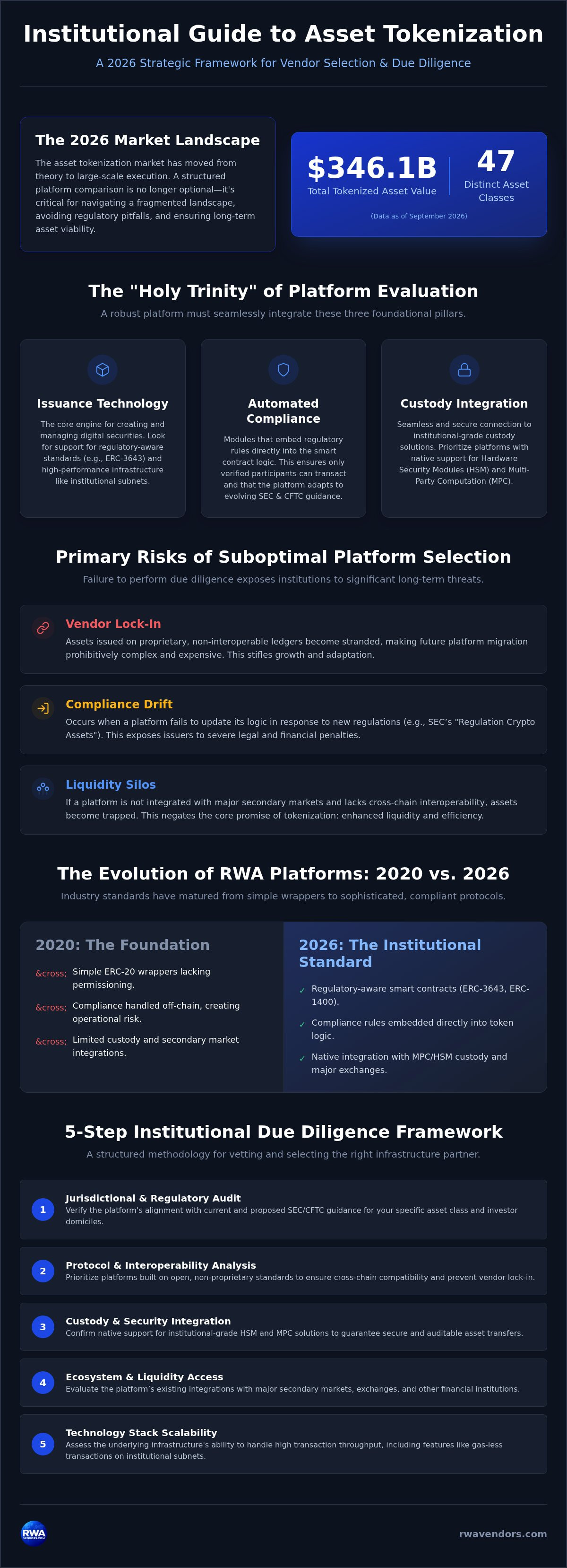
As of September 2026, the total value of on-chain tokenized assets has reached $346.1 billion across 47 distinct asset classes. This massive scale reflects a permanent shift from theoretical discussion to practical, regulated execution. It's understandable if you feel the pressure to deploy quickly while fearing the long-term consequences of vendor lock-in or proprietary protocols. This asset tokenization platform comparison provides the technical and regulatory clarity needed to evaluate providers against the latest SEC and CFTC joint guidance, ensuring your choice remains viable as the market evolves.
You'll discover a strategic framework to compare institutional-grade vendors based on regulatory compliance, custody integration, and ecosystem interoperability. We examine the functional trade-offs between white-label and custom solutions so you can't be blindsided by the high costs of future platform migration. This guide also outlines the 2026 fee landscape for digital transfer agents and investor verification services. By the end, you'll have a vetted shortlist of providers and a clear methodology to justify your infrastructure selection to internal stakeholders.
Key Takeaways
- Master the "Holy Trinity" of evaluation by analyzing how a platform integrates issuance technology, automated compliance modules, and institutional custody infrastructure.
- Perform a rigorous asset tokenization platform comparison to determine whether a fast-to-market white-label solution or a flexible custom-built architecture aligns with your specific scalability requirements.
- Implement a structured 5-step due diligence framework that prioritizes jurisdictional audits and ecosystem interoperability to prevent costly vendor lock-in.
- Identify the operational trade-offs between protocol-native platforms and institutional subnets to ensure secondary market liquidity and cross-chain compatibility.
- Utilize a curated directory of verified providers to streamline the selection of digital asset infrastructure and listing partners that meet high-stakes regulatory standards.
The 2026 Asset Tokenization Landscape: Why Comparison is Critical
Institutional asset tokenization platforms function as specialized middleware designed to bridge traditional capital markets with distributed ledger technology. These systems manage the issuance, distribution, and ongoing lifecycle of digital securities while maintaining rigorous compliance standards. By September 2026, the market has transitioned from experimental pilots to a robust ecosystem with $346.1 billion in on-chain tokenized assets across 47 distinct asset classes. This rapid expansion necessitates a structured asset tokenization platform comparison to navigate a landscape where infrastructure fragmentation poses a significant operational risk. Issuers must prioritize a compliance-first approach, aligning their technology stack with the institutional digital asset partners necessary for long-term viability. The stakes are high. A failure to vet infrastructure leads to stranded assets and regulatory scrutiny.
The Evolution of RWA Platforms: From 2020 to 2026
The sector has evolved significantly since 2020. Early iterations often relied on simple ERC-20 wrappers that lacked the sophisticated permissioning required for regulated securities. Today, the industry standard focuses on regulatory-aware smart contracts, such as ERC-3643 or ERC-1400. These protocols embed compliance rules directly into the token logic to ensure only verified participants hold the asset. While the foundational concept of Tokenization (data security) provides a neutral overview of data protection, institutional requirements demand far more than basic encryption. Crypto-native platforms frequently fail due diligence because they often prioritize permissionless decentralization over the identity verification and "clawback" capabilities essential for legal compliance and fiduciary responsibility.
Key Risks of Suboptimal Platform Selection
Selecting a platform without a rigorous asset tokenization platform comparison exposes institutions to three primary risks. First, vendor lock-in occurs when assets are issued on proprietary, non-interoperable ledgers, making migration nearly impossible. Second, compliance drift represents a constant threat. As frameworks like the SEC’s "Regulation Crypto Assets" (proposed August 18, 2026) or the SEC and CFTC joint guidance (March 17, 2026) evolve, platforms must update their smart contract logic to remain compliant. Finally, liquidity silos emerge when a platform isn't integrated with major secondary markets. Without cross-chain interoperability, assets remain trapped in isolated pools. This negates the efficiency gains that tokenization promises to provide. Careful vetting ensures your infrastructure supports the entire asset lifecycle without creating technical debt.
Core Evaluation Pillars: Comparing Technology, Compliance, and Custody
A comprehensive asset tokenization platform comparison must center on the "Holy Trinity" of digital finance: issuance technology, compliance modules, and custody integration. These three pillars shouldn't exist in silos. For an institutional issuer, the platform acts as the connective tissue between legal structures and technical execution. Selecting the right digital asset infrastructure providers ensures that the underlying blockchain layer supports the high-throughput and security requirements of global markets. High-performance environments often utilize gas-less transaction models on institutional subnets. This approach eliminates the volatility of public mainnet fees while maintaining the cryptographic integrity of a shared ledger.
Institutional Interoperability is the ability to move assets across vetted custodial boundaries. Without this capability, an issuer risks creating a closed ecosystem that prevents secondary market participation. Effective platforms integrate directly with Hardware Security Modules (HSM) and multi-party computation (MPC) custody solutions to ensure that asset transfers remain secure and auditable at every step. This integration allows for a seamless flow of value between different financial institutions without sacrificing control.
Issuance and Lifecycle Management Technology
Modern platforms must handle the entire lifecycle of a security beyond the initial minting. This includes automated corporate actions, such as dividend distributions and interest payments, which are executed via smart contracts. When comparing vendors, evaluate the transparency of their cap table management systems. An institutional-grade investor portal should provide real-time visibility into holdings while allowing for flexible minting and burning mechanisms. These features are critical for managing open-ended funds or debt instruments where the total supply fluctuates based on redemption requests or new capital inflows.
Embedded Compliance and Regulatory Modules
Compliance is no longer an external process; it's a programmable requirement. You must differentiate between platforms that offer on-chain identity verification and those that rely solely on off-chain KYC/AML databases. On-chain identity ensures that the token itself "knows" whether a recipient is eligible to receive it based on their jurisdictional status. The most robust compliant asset tokenization tech supports complex regulatory frameworks, including US Regulation D, Regulation S, and the EU’s MiCA requirements. This level of automation prevents illicit transfers before they occur, protecting the issuer from accidental regulatory breaches. If your organization provides these essential services, you can apply to be featured in our directory to reach active asset issuers.
Deployment Models: White-Label vs. Custom-Built vs. Protocol-Native
Selecting an architecture is a critical juncture in any asset tokenization platform comparison. This decision dictates your time-to-market, long-term scalability, and the total cost of ownership (TCO) over a five-year horizon. Tier-1 financial institutions often face a complex "Buy vs. Build" dilemma. They must decide whether to leverage existing vendor ecosystems or invest in proprietary stacks that offer absolute control. While the initial speed of a third-party solution is attractive, large-scale managers must account for the recurring costs of cap table maintenance and the technical overhead of keeping compliance logic updated with global securities laws.
White-Label Solutions: Speed and Standardization
White-label platforms are best suited for real estate syndicators and mid-market fund managers who require a reliable, accelerated path to issuance. These solutions offer proven security frameworks and pre-integrated custodial bridges, which significantly reduces initial capital expenditure. By using standardized tech, issuers can launch projects in weeks rather than months.
- Pros: Accelerated deployment timelines, lower upfront development costs, and standardized regulatory modules for common jurisdictions.
- Cons: Limited ability to customize the user interface and a potential lack of proprietary feature sets that differentiate the product in a competitive market.
Custom-Built Infrastructure: Control and Proprietary Value
Custom infrastructure is the preferred route for global asset managers who view their technology stack as a core competitive advantage. This model allows for full control over the investor experience and the underlying ledger logic, ensuring that the platform can adapt to highly specific financial instruments.
- Pros: Absolute control over data sovereignty and the ability to build unique investor experiences tailored to high-net-worth clients.
- Cons: Substantial ongoing development costs and the heavy burden of maintaining security protocols against evolving cyber threats.
By 2026, a third model has gained prominence: Protocol-Native platforms built on institutional subnets. These Layer 1 and Layer 2 environments provide the privacy and high throughput required for institutional capital markets while remaining protocol-agnostic. This shift toward multi-chain issuance ensures that assets don't remain trapped on a single proprietary ledger. It allows institutions to deploy assets where liquidity is deepest without being forced to rebuild their entire infrastructure every time they enter a new market. This flexibility is essential for maintaining secondary market liquidity and avoiding the vendor lock-in risks discussed in previous sections.
The Institutional Due Diligence Framework for Platform Selection
Conducting an asset tokenization platform comparison is a multi-layered process that extends far beyond a simple feature checklist. For institutional capital markets, the platform serves as a critical infrastructure layer that must withstand legal, technical, and operational scrutiny. A standardized five-step framework ensures that your selection aligns with fiduciary duties and long-term strategic goals. This framework encompasses Asset Class Mapping, Jurisdictional Audits, Ecosystem Checks, Security Reviews, and Scalability Testing. Each step identifies potential points of failure before capital is committed to a specific vendor stack.
Step 1 & 2: Asset and Jurisdictional Alignment
Begin by verifying that the platform's smart contracts are legally enforceable in your specific target market. You shouldn't assume that a protocol designed for US private equity is automatically compatible with EU real estate laws. Check for pre-set templates tailored to your asset class, whether it's private credit, debt instruments, or real estate syndication. Additionally, ensure the platform supports the investor onboarding workflows required for your target demographic. This includes verifying accredited status under US Reg D or retail participation under MiCA standards. A platform's inability to adapt to local compliance nuances is a primary driver of project failure.
Step 3 & 4: Ecosystem Interoperability and Security
The platform must integrate seamlessly with your existing financial stack, including transfer agents, brokers, and custodians. As part of your ecosystem check, you should find digital securities listing providers that are already integrated with the platform's issuance engine. Security reviews must prioritize recent audit histories over general reputation. Ask for the names of the firms that audited the smart contracts and verify the dates of their last reviews. Future-proofing is also vital; the platform should possess the capability to bridge assets to emerging institutional chains as liquidity shifts across the ecosystem.
Transparency is the final pillar of institutional due diligence. Demand "Proof of Reserves" and "Proof of Oracle" documentation to verify that on-chain representations accurately reflect the underlying collateral. Scalability testing is the final component of a thorough asset tokenization platform comparison, ensuring the system handles high-volume corporate actions without latency. During the RFP process, ask vendor sales teams specific, high-stakes questions to gauge their technical maturity:
- How does the platform's logic handle a "clawback" in the event of a lost private key or a court order?
- What is the specific uptime record for the underlying ledger over the past 24 months?
- Can you provide a SOC2 Type II report for the platform's issuance environment?
Navigating the Ecosystem: Finding Vetted Providers via RWA Vendors
Completing a professional asset tokenization platform comparison is a significant milestone, yet the transition from evaluation to execution requires access to a reliable network of partners. Identifying providers that meet the stringent requirements of institutional capital markets is often the most time-intensive phase of deployment. RWA Vendors serves as the definitive, vetted directory for this purpose. Operated by The STO Foundation, which has been active in the space since 2017, the platform functions as a central pillar for issuers seeking to build secure and compliant digital asset infrastructure. It acts as a bridge between traditional financial structures and modern technological innovation, ensuring that issuers engage with a curated ecosystem of professionals.
The vetting process used by RWA Vendors is designed to maintain the integrity of the marketplace. This gatekeeper sensibility ensures that every listed entity meets a high standard of excellence, which is critical in an industry where legal and financial stakes are immense. For issuers, this eliminates the initial burden of broad market scanning and allows them to focus on deep-tier due diligence. Within this ecosystem, a Founding Membership status serves as a hallmark of trust and industry leadership. It identifies providers that have demonstrated a long-term commitment to the digital securities space and have been verified as credible facilitators of RWA growth.
Leveraging the RWA Vendors Global Directory
The directory is organized with surgical precision to allow for efficient navigation through complex service categories. You can filter vendors by their specific role in the lifecycle, including Legal, Compliance, Technology, and Custody. This taxonomy enables a granular asset tokenization platform comparison by allowing you to evaluate how different tech providers integrate with specific legal or custodial partners. A 'Verified Profile' status provides an additional layer of assurance, indicating that a provider's credentials and track record have been reviewed. This allows your team to build a shortlist of partners who have already successfully navigated the complexities of the STO ecosystem.
Next Steps: Building Your Tokenization Stack
Moving forward requires a methodical approach to infrastructure assembly. While it's prudent to start with a focused pilot project, your selection process must account for future ecosystem-wide scaling. The infrastructure you choose today must support the multi-chain and protocol-agnostic requirements that will define the market in the coming years. Use the resources provided in the directory to identify partners who possess the technical maturity to handle high-volume corporate actions and cross-chain liquidity. By starting your search within a vetted marketplace, you ensure that your tokenization stack is built on a foundation of institutional-grade reliability.
Explore the Global RWA Vendor Directory to find your next infrastructure partner
Securing Your Infrastructure for the Next Era of Finance
The transition to a mature digital securities market demonstrates that tokenization is now a core requirement for modern capital markets. Completing a thorough asset tokenization platform comparison is the first step toward building a resilient ecosystem. The choice between white-label speed and custom-built control depends on your specific AUM and long-term scalability goals. By prioritizing interoperability and regulatory-aware smart contracts, you ensure your assets remain liquid across institutional chains.
Success in this high-stakes landscape requires more than just technology. It requires a network of verified partners across legal, custody, and compliance. RWA Vendors provides this essential infrastructure as a trusted resource vetted by The STO Foundation. Our directory offers global reach across 30+ specialized categories to support institutional issuers and service providers. Use the frameworks established in this guide to justify your selection to stakeholders and begin your deployment with absolute confidence.
Frequently Asked Questions
What is the most important factor in an asset tokenization platform comparison?
The primary factor in any asset tokenization platform comparison is the system's ability to maintain regulatory compliance across multiple jurisdictions. In 2026, this means ensuring smart contracts align with the SEC’s Regulation Crypto Assets and the latest CFTC guidance. Beyond legal frameworks, interoperability is critical. A platform must allow assets to move across different custodial boundaries and blockchains to prevent the creation of liquidity silos and vendor lock-in.
How much does it cost to implement an institutional tokenization platform?
Implementation costs vary based on complexity, but industry data from 2026 indicates that setup fees typically range between $50,000 and $100,000. Ongoing expenses include annual digital transfer agent fees of $5,000 to $25,000. Issuers should also budget for investor verification costs, often billed at $2 to $15 per identity check, and legal counsel fees which can range from $30,000 to $150,000 depending on the asset class.
Can I switch tokenization platforms after my assets are already issued?
Switching platforms is technically possible but often entails significant operational friction and cost. The difficulty depends on whether the original platform uses proprietary ledgers or open-source standards. Migrating issued assets usually requires a formal burn and remint process on the new infrastructure. To minimize this risk, institutions should prioritize protocol-agnostic platforms and ensure that their smart contracts include administrative clawback features for secure asset recovery and transfer.
What is the difference between a white-label and a custom tokenization platform?
White-label platforms provide pre-configured infrastructure that allows for rapid deployment at a lower initial cost, making them ideal for mid-market funds. In contrast, custom-built platforms offer absolute control over the user experience and technical logic, which is often preferred by global investment banks. While white-label solutions offer standardized security, custom builds require the issuer to manage ongoing maintenance and security audits for their proprietary tech stack.
Which blockchain is best for institutional asset tokenization in 2026?
The best blockchain depends on specific liquidity and throughput needs. As of September 2026, the XRP Ledger has led the year in RWA inflows with $3.6 billion, followed by BNB Chain and Stellar. Ethereum remains a standard for security, while Solana and institutional subnets are favored for high-frequency transactions. Most institutional issuers now opt for multi-chain strategies to ensure their assets access liquidity across various ecosystems.
How do I ensure my tokenization platform is compliant with global securities laws?
Compliance is achieved by integrating regulatory rules directly into the token's smart contract logic. Platforms should utilize standards like ERC-3643 to automate identity verification and transfer restrictions. It's essential to verify that the platform adheres to the SEC and CFTC joint guidance issued in March 2026, which classifies digital assets by their economic reality. Regular audits by specialized legal firms are necessary to ensure the software stays updated.
What role does a custodian play in the tokenization platform comparison?
A custodian acts as the secure storage layer for the private keys that control the tokenized assets. In an asset tokenization platform comparison, you must evaluate how well the issuance engine integrates with institutional custody providers. The most reliable platforms offer direct connectivity to Hardware Security Modules (HSM) or Multi-Party Computation (MPC) solutions. This integration ensures that asset transfers are only executed after meeting strict internal governance and authorization protocols.
How does RWA Vendors vet the platforms listed in its directory?
RWA Vendors follows a rigorous vetting process to maintain the integrity of its global directory. As an arm of The STO Foundation, the platform reviews the operational history, regulatory standing, and technical capabilities of each provider. Listings are categorized with surgical precision to help issuers find verified partners across 30+ sectors. This gatekeeper approach ensures that institutional users engage with a curated ecosystem of professionals who meet high standards for security.
Disclaimer
This article is provided by RWAVendors.com for general informational and educational purposes only. It does not constitute legal, financial, investment, tax, regulatory or other professional advice, or an offer, solicitation, recommendation or endorsement of any company, product, service, token, security or investment. RWAVendors.com is an informational vendor directory and does not sell, issue, broker, custody or facilitate transactions involving cryptocurrencies, digital tokens, tokenized assets, securities or investment products. Some vendor listings and references may involve paid advertising, sponsored placement or membership relationships. These relationships do not guarantee a vendor’s qualifications, regulatory status, performance or suitability. Information may be incomplete, outdated or subject to change. You should independently verify all information, conduct your own due diligence and consult qualified professionals before making any business or investment decision. RWAVendors.com is not responsible for the content, services, representations or actions of third-party vendors or linked websites.


