

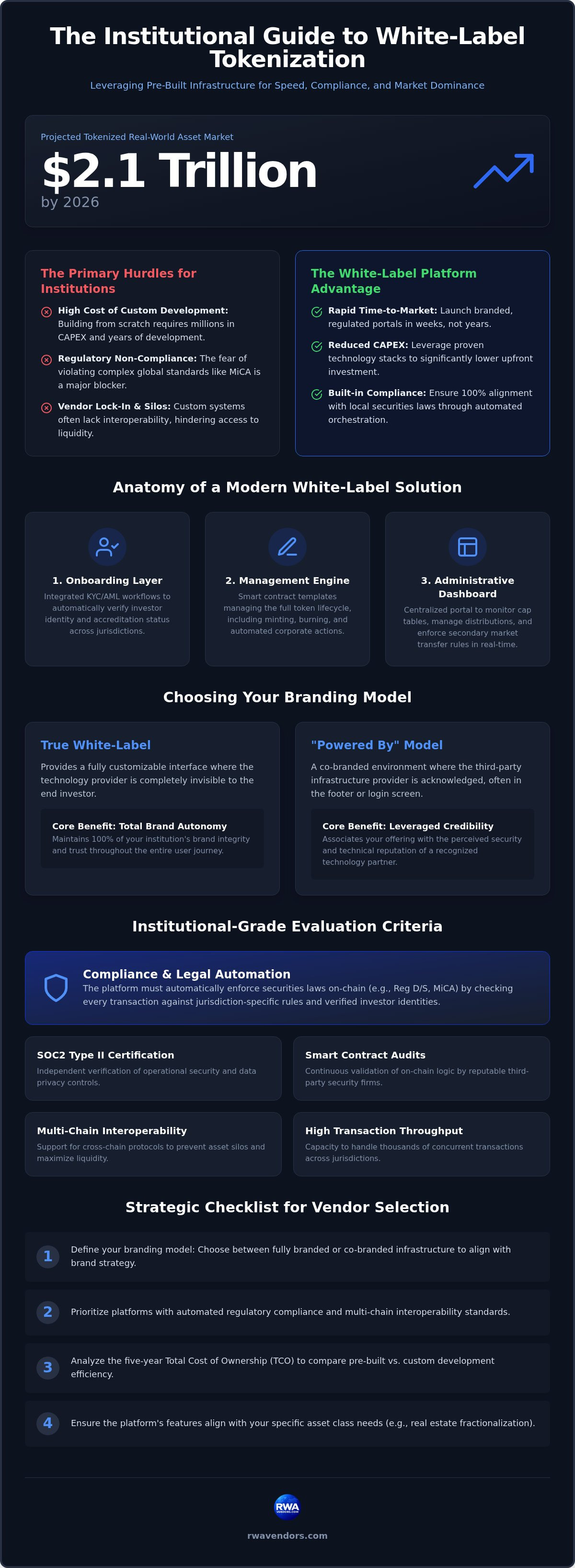
With the tokenized real-world asset market projected to hit $2.1 trillion in 2026, the race for institutional dominance has shifted from experimental pilots to regulated production environments. You likely recognize that the primary hurdle isn't just technology; it's the high cost of custom development and the persistent fear of regulatory non-compliance. Most institutions understand that building from scratch is often inefficient and carries a significant risk of vendor lock-in with non-interoperable systems.
Selecting the right white label tokenization platforms is now a strategic necessity to launch branded portals in weeks rather than years. This guide provides a rigorous framework to evaluate infrastructure based on compliance orchestration, technical interoperability, and long-term stability. You'll discover how to leverage proven technology stacks to reduce CAPEX while ensuring 100% alignment with local securities laws and global standards like the EU's MiCA regulation. We'll outline the essential criteria for selecting a vendor that acts as a bridge between traditional finance and modern innovation, ensuring your firm remains a credible pillar in the global digital asset ecosystem.
Key Takeaways
- Identify the critical distinctions between fully branded and co-branded infrastructure models to maintain institutional brand integrity.
- Evaluate white label tokenization platforms based on their ability to automate regulatory compliance and support multi-chain interoperability standards.
- Analyze the five-year total cost of ownership to determine whether pre-built infrastructure or custom development better serves your operational efficiency goals.
- Align your platform choice with specific asset-class requirements, such as fractionalization for real estate or complex waterfall distributions for private equity.
- Streamline the vendor selection process by leveraging a curated directory of vetted providers to mitigate the risks associated with unverified technology partners.
Understanding White Label Tokenization Platforms
A white label tokenization platform is a pre-configured, modular software suite that allows institutions to issue and manage digital securities under their own corporate identity. Instead of developing proprietary blockchain protocols from the ground up, firms utilize these established frameworks to tokenize assets like real estate, private funds, or corporate debt. In 2026, the shift toward these platforms is driven by a demand for technical standardization. Custom-built blockchain silos often lack the liquidity and cross-chain interoperability required for modern secondary markets, making pre-built infrastructure the more resilient choice.
There's a critical strategic distinction between "white label" and "powered by" models that decision-makers must recognize. A true white label solution provides a fully customizable interface where the technology provider remains invisible to the end investor. This maintains the institution's brand integrity throughout the user journey. Conversely, "powered by" models function as co-branded environments. Choosing between them depends on whether your priority is total brand autonomy or the perceived security of a recognized third-party infrastructure provider.
The Anatomy of a Modern White Label Solution
These systems are built on a multi-layered architecture designed for both security and regulatory adherence. The foundation involves Understanding Tokenization Technology to ensure that sensitive investor data and asset ownership are securely mapped to a distributed ledger. Modern white label tokenization platforms typically feature three core components:
- Onboarding Layer: Integrated KYC/AML workflows that verify investor identity and accreditation status automatically across different jurisdictions.
- Management Engine: Smart contract templates that handle the entire lifecycle of the token, including minting, burning, and automated corporate actions.
- Administrative Dashboard: A centralized portal where issuers monitor real-time cap tables, manage dividend distributions, and set secondary market transfer restrictions.
Strategic Benefits for Financial Institutions
The primary advantage is a drastic reduction in time-to-market. Developing a custom blockchain infrastructure can take years and millions in capital; a white label portal can be operational in weeks. This efficiency allows traditional finance (TradFi) teams to focus on their core competency of asset management rather than technical troubleshooting. These platforms also offer access to pre-integrated ecosystems. This means your issuance portal is already compatible with verified custodians, brokers, and transfer agents. It creates a seamless operational flow that significantly lowers technical barriers for firms entering the digital securities space.
Core Criteria for Evaluating Tokenization Infrastructure
Selecting white label tokenization platforms requires a shift from evaluating basic technical specifications toward assessing institutional-grade reliability. Security architecture is the non-negotiable foundation of any digital asset project. Vendors must demonstrate SOC2 Type II compliance and provide evidence of regular, third-party smart contract audits. This level of scrutiny ensures that the underlying code is resilient against vulnerabilities that could compromise investor assets or institutional reputation. To ensure long-term viability, platforms should meet these four technical benchmarks:
- SOC2 Type II Certification: Independent verification of operational security and data privacy controls.
- Smart Contract Audits: Continuous validation of on-chain logic by reputable security firms.
- Multi-Chain Interoperability: Support for cross-chain communication protocols to prevent asset silos.
- High Throughput: The capacity to handle thousands of concurrent transactions across multiple jurisdictions.
Compliance and Legal Automation
Regulatory adherence in 2026 relies on automated enforcement rather than manual oversight. Compliance orchestration is the automated enforcement of securities laws on-chain. This technology ensures that every transaction is checked against jurisdiction-specific rules, such as U.S. Regulation D and Regulation S or the EU’s MiCA framework, before it's processed. Verified digital identities and credentials allow platforms to restrict transfers to eligible investors in real-time. This prevents illicit secondary market activity while maintaining a Technical Analysis of Tokenization that prioritizes both transparency and privacy.
Infrastructure must also support a multi-chain environment to avoid liquidity fragmentation. The industry has moved toward interoperability standards that allow tokens to move between public and private ledgers seamlessly. Scalable platforms don't just mint tokens; they manage the entire asset lifecycle while adhering to complex, evolving global legal standards.
Investor Experience and Portal Customization
The investor portal serves as the primary touchpoint for your brand. High-quality white label tokenization platforms offer intuitive UI/UX that mirrors modern fintech applications rather than complex blockchain interfaces. Self-service features allow users to participate in governance voting, view real-time portfolio performance, and manage dividend distributions directly. Integration with traditional payment rails, such as SEPA, ACH, or SWIFT, is essential to bridge the gap between fiat capital and digital securities. It's often beneficial to identify vetted technology partners who have a proven track record of delivering these sophisticated, user-centric environments.
White Label vs. Custom Development: A Capability Comparison
Deciding between proprietary development and white label tokenization platforms represents a fundamental choice between owning intellectual property and achieving operational velocity. While custom-built solutions offer absolute control over governance logic and system architecture, they introduce significant technical debt and a heavy maintenance burden. For most institutions, the total cost of ownership (TCO) over a five-year horizon favors standardized infrastructure. Maintaining a custom blockchain stack requires dedicated engineering teams for continuous security patching and performance optimization, which often distracts from the core business of asset management.
Tier-1 banks may still find custom development superior when their requirements involve highly specialized, proprietary settlement logic that falls outside standard market practices. However, the recurring costs of smart contract audits, which can range from $50,000 to $200,000 per engagement, make the custom route economically challenging for individual projects. Standardized platforms distribute these security and maintenance costs across their entire user base, providing a more sustainable financial model for the majority of asset issuers.
Cost and Speed Analysis
The financial disparity between these two paths is stark. A basic white label platform can start at approximately $50,000, while comprehensive systems with custom integrations range from €80,000 to €300,000. In contrast, custom development frequently requires a multi-million dollar commitment and a larger internal headcount. Deployment timelines also vary significantly. White label solutions allow for a launch in roughly 4 weeks, whereas custom projects often exceed 12 months. This speed allows firms to capture market opportunities while reducing initial CAPEX. Regardless of the technical choice, institutions must still budget for legal counsel, which can range from $30,000 to $150,000 for drafting offering documents.
Flexibility and Future-Proofing
A common concern regarding white label tokenization platforms is the perceived "black box" nature of third-party software. Modern platforms address this through robust APIs that allow them to behave like custom builds, enabling seamless integration with existing internal legacy systems. This modularity ensures that the technology can adapt as the market evolves. The risk of vendor lock-in is mitigated by prioritizing data portability and adherence to interoperability standards. For most issuers, leveraging a vetted technology stack ensures that the infrastructure remains compliant with evolving global standards without the burden of constant manual updates or the risk of building on obsolete technology.
Asset-Class Specific Selection Strategies
The institutional utility of white label tokenization platforms depends on their ability to handle the unique functional requirements of specific asset classes. A "one-size-fits-all" infrastructure often fails to address the granular legal and operational nuances required for professional-grade issuance. Institutions must prioritize platforms that offer modular features tailored to their specific market segment, whether it involves fractionalizing physical property or automating the lifecycle of private debt instruments.
Real Estate Tokenization Requirements
Real estate remains one of the most active sectors for digital transformation, with a focus on increasing liquidity in traditionally illiquid markets. Effective platforms for this asset class must provide specialized property-level reporting and seamless integration with local land registries. For fractionalization to be successful, the infrastructure must support automated secondary market transfer restrictions that align with the specific legal frameworks of the property's jurisdiction. Issuers should look for portals that offer built-in property management tools, allowing investors to view real-time data on occupancy rates, maintenance costs, and rental yields directly from their dashboard.
Debt and Private Credit Infrastructure
With tokenized U.S. Treasuries reaching $12.88 billion by July 2026, the demand for robust fixed-income infrastructure is at an all-time high. Debt-focused platforms must automate the entire lifecycle of corporate bonds and loans, including the precise execution of interest payments and maturity date settlements. Real-time transparency for underlying asset performance is critical for maintaining investor trust in private credit markets. To evaluate the technical nuances of these systems, issuers should consult the asset tokenization platform comparison for deep technical dives into ledger performance and settlement finality.
Private equity and fund managers face a different set of challenges, primarily involving the management of complex cap tables and the execution of waterfall distributions. Modern white label tokenization platforms must be able to handle intricate profit-sharing rules and automated buy-backs without manual intervention. As issuance volumes increase, the necessity of tokenized fund administration services becomes evident. These services ensure that net asset value (NAV) calculations and tax reporting remain accurate as the number of on-chain participants scales into the thousands.
Using RWA Vendors to Find Vetted Platform Providers
The digital asset ecosystem is currently populated by a diverse array of service providers, but not all possess the institutional-grade rigor required for large-scale issuance. Engaging with unvetted technology partners presents significant operational risks, including potential security vulnerabilities and compliance failures. For asset issuers, the challenge lies in distinguishing between marketing claims and verified technical capability. RWA Vendors serves as a centralized hub to mitigate these risks by providing a curated directory of white label tokenization platforms that have undergone a structured review process.
Our platform acts as a bridge between traditional structures and modern innovation. We organize the complex landscape of digital finance into a logical taxonomy, allowing you to navigate various sectors with surgical precision. By using our centralized resource, you ensure that your due diligence process starts with a foundation of verified expertise rather than unverified search results. This approach maintains the integrity of the ecosystem and protects your firm from the technical debt associated with substandard infrastructure.
The RWA Vendors Vetting Process
Inclusion in our global directory is not automatic. We evaluate providers based on their technical stability, regulatory adherence, and history of successful deployments. The directory allows you to filter white label tokenization platforms by specific criteria, such as asset class compatibility, jurisdictional focus, and integration capabilities. This granular filtering ensures that you only engage with vendors capable of supporting your specific business model. Seeing the full ecosystem in one place—including legal partners, custodians, and technology providers—allows for a more holistic approach to infrastructure selection. You can utilize the institutional digital asset partners directory as a definitive reference during your initial due diligence phase.
Next Steps for Issuers
Once you've identified potential partners through the directory, the next step involves creating a shortlist of three to five platforms for a detailed Request for Proposal (RFP). This process should involve verifying vendor claims through the RWA Vendors community and the Security Token Offering Foundation. As you move toward the final stages of your project, you'll also need to understand how to find digital securities listing providers to ensure your tokens have access to regulated secondary markets. This methodical approach ensures that every component of your tokenization journey is supported by verified, professional-grade services. Browse our vetted directory today to identify the infrastructure partners that will accelerate your institutional tokenization journey.
Future-Proofing Your Institutional Tokenization Strategy
The transition from experimental pilots to regulated production environments marks a new era for global finance. Standardized infrastructure allows your firm to bypass the prohibitive costs and technical risks inherent in custom development. By prioritizing compliance orchestration and asset-class modularity, you ensure that your offerings remain resilient within a complex regulatory landscape. Modern white label tokenization platforms provide the essential bridge between legacy asset management and the efficiency of distributed ledgers.
Selecting the right partner is a matter of institutional security and long-term viability. You can now access a global network of verified technology providers through a centralized hub that covers the full lifecycle of digital securities. These comprehensive listings include vetted legal, tech, and custody partners, all verified by the Security Token Offering Foundation to ensure they meet the highest industry standards.
Taking a methodical approach to due diligence today secures your organization's position as a leader in the digital securities landscape. It's time to leverage proven technology stacks and accelerate your journey toward a more liquid and transparent future.
Frequently Asked Questions
What is the average cost of a white label tokenization platform in 2026?
Costs vary based on the complexity of the asset class and required integrations. A basic white label portal typically starts at approximately $50,000; however, comprehensive enterprise systems with custom compliance workflows can range from €80,000 to €300,000. Annual licensing and maintenance fees generally range from $5,000 to $25,000. These figures represent the technical infrastructure and do not include separate costs for legal counsel or smart contract audits.
Can I migrate my tokens if I change white label providers?
Token migration is possible if the underlying smart contracts utilize standardized protocols like ERC-3643 or ERC-1400. You must verify that your agreement grants you administrative ownership of the contracts and that the technology is not locked into a proprietary environment. Ensuring data portability for cap table history and investor records is a critical step during the due diligence phase to prevent long-term vendor lock-in.
How do white label platforms handle KYC and AML for international investors?
Modern white label tokenization platforms integrate with global identity verification providers to automate KYC and AML screening across multiple jurisdictions. These systems use verifiable credentials to ensure investors meet specific accreditation standards required by local laws. The platform's compliance engine automatically enforces transfer restrictions based on the investor’s residency and status, ensuring that all secondary market trades remain within the boundaries of global securities regulations.
Are white label tokenization platforms compliant with MiCA regulations?
Reputable platforms are designed to align with the Markets in Crypto-Assets Regulation (MiCA), which has been in full application since the end of 2024. These systems provide the transparency and reporting tools required for crypto-assets that fall under this framework. However, because MiCA governs assets not already classified as financial instruments, issuers must work with legal experts to confirm their specific configuration meets all European Union requirements for digital securities.
What is the difference between a white label platform and a tokenization engine?
A tokenization engine is a backend infrastructure focused on the technical minting and lifecycle management of tokens via APIs. A white label platform is a comprehensive solution that includes a branded investor portal, administrative dashboards, and pre-integrated compliance workflows. While an engine requires you to develop your own user interface, a white label solution provides a ready-to-use environment that is fully brandable for your institution.
Do white label platforms provide their own custody solutions?
Most platforms do not provide direct custody but instead offer deep integrations with verified third-party digital asset custodians. This separation of duties is often a regulatory requirement to ensure the safety of investor assets and the integrity of the ecosystem. Institutions can typically choose between various custodial models, including self-custody or fully managed sub-custodial solutions, depending on their internal risk policies and jurisdictional requirements.
How long does it take to deploy a branded tokenization portal?
Deployment timelines for white label tokenization platforms generally range from four to eight weeks. This schedule depends on the level of UI customization and the complexity of third-party integrations, such as payment rails or existing internal databases. This is significantly faster than custom development, which often exceeds twelve months. The primary time investment involves configuring jurisdiction-specific compliance rules and completing the necessary legal documentation for the offering.
Which blockchain networks are most supported by white label vendors?
Ethereum and its Layer 2 scaling solutions, such as Polygon and Arbitrum, remain the most widely supported networks due to their robust liquidity and developer ecosystems. Many institutional providers also support Avalanche and private EVM-compatible subnets for increased privacy and control. The industry has moved toward a multi-chain approach, where platforms prioritize interoperability standards to allow assets to move across different ledgers without fragmenting liquidity or creating isolated silos.
Disclaimer
This article is provided by RWAVendors.com for general informational and educational purposes only. It does not constitute legal, financial, investment, tax, regulatory or other professional advice, or an offer, solicitation, recommendation or endorsement of any company, product, service, token, security or investment. RWAVendors.com is an informational vendor directory and does not sell, issue, broker, custody or facilitate transactions involving cryptocurrencies, digital tokens, tokenized assets, securities or investment products. Some vendor listings and references may involve paid advertising, sponsored placement or membership relationships. These relationships do not guarantee a vendor’s qualifications, regulatory status, performance or suitability. Information may be incomplete, outdated or subject to change. You should independently verify all information, conduct your own due diligence and consult qualified professionals before making any business or investment decision. RWAVendors.com is not responsible for the content, services, representations or actions of third-party vendors or linked websites.


