
With the total value of distributed real-world assets reaching $38.76 billion in September 2026, this RWA industry analysis confirms the sector has transitioned from experimental pilots to a foundational pillar of global capital markets. You likely recognize that while this growth is undeniable, the sheer volume of fragmented data makes finding institutional-grade insights increasingly difficult. The market moves with surgical precision, yet the gap between speculative noise and vetted, professional intelligence remains a significant hurdle for serious participants.
This guide provides the most comprehensive resources for real-world asset tokenization, bridging the gap between market-moving news and elite career opportunities. We've done the heavy lifting of vetting the ecosystem so you don't have to. You'll gain access to top-tier news sources, understand the 2026 talent landscape, and discover how to connect with verified vendors capable of scaling institutional-grade projects. We'll move from broad market shifts to the granular details of specialized roles and infrastructure providers, ensuring you have the clarity needed to navigate this complex landscape.
Key Takeaways
- Understand the 2026 shift from pilot programs to systemic financial infrastructure across real estate, private equity, and government bonds.
- Identify high-signal data intelligence sources and learn why specialized newsletters provide superior insights compared to general financial media.
- Navigate the 2026 talent landscape by identifying critical roles in Legal Engineering and RWA Structuring while reviewing current salary benchmarks.
- Use the global directory to perform a comprehensive RWA industry analysis and identify critical gaps in your organization's technology stack.
- Learn how connecting with vetted partners helps you move from theoretical research to institutional-grade execution while maximizing your project's ROI.
The State of the RWA Industry in 2026: A Macro Analysis
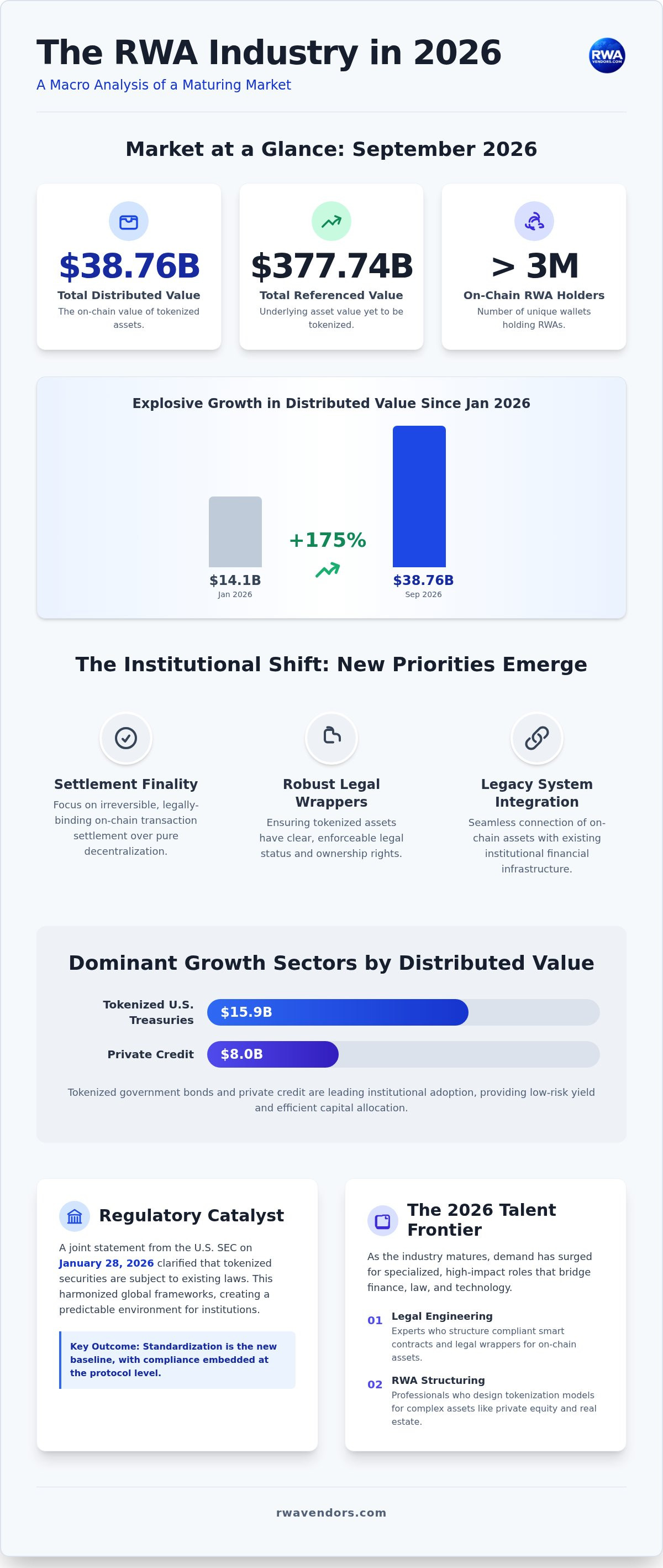
The RWA sector has matured into a core component of global capital markets. As of September 2026, the total value of distributed tokenized real-world assets has reached $38.76 billion; this represents a significant leap from the $14.1 billion recorded at the start of the year. This RWA industry analysis reveals a fundamental shift in market priorities. The industry no longer prioritizes pure decentralization for its own sake. Instead, institutional participants focus on settlement finality, robust legal wrappers, and the integration of on-chain assets with legacy financial systems.
The gap between distributed value and the $377.74 billion in referenced RWA value suggests that the market is only beginning to scratch the surface of its potential. While tokenized real estate and private equity continue to gain traction, the most aggressive growth is visible in government bonds and private credit. Tokenized U.S. Treasury funds now account for approximately $15.9 billion, providing a low-risk entry point for institutional liquidity providers who seek yield within a regulated framework.
Institutional Adoption and Capital Flows
The entry of Tier-1 global banks has transformed the liquidity profile of the ecosystem. These institutions are not merely observing; they are launching production-scale platforms that utilize digital asset infrastructure providers to manage lifecycle events of complex securities. Private credit has emerged as a leader in the 2026 surge, contributing $8 billion in distributed value. This growth is driven by the need for more efficient capital allocation and the transparency provided by on-chain tracking, which helps stabilize market volatility during periods of macroeconomic uncertainty.
Regulatory Evolution and Compliance Standards
Regulatory clarity is the primary catalyst for the current expansion. On January 28, 2026, the U.S. Securities and Exchange Commission issued a joint statement clarifying that tokenized securities remain subject to existing federal securities laws. This move has harmonized global digital security frameworks, making RWA industry analysis more predictable for compliance officers and legal departments.
Standardization is the new baseline. Implementing compliant asset tokenization tech is no longer optional for issuers. The market has moved decisively toward permissioned institutional environments where identity verification and jurisdictional compliance are embedded at the protocol level. This evolution ensures that digital assets can move seamlessly across borders while adhering to the strict requirements of global finance.
Essential RWA Industry News and Data Intelligence Sources
In an environment where on-chain real-world asset holders surpassed 3 million in early September 2026, the volume of available information is overwhelming. High-signal RWA industry analysis requires a departure from general financial media, which often lacks the technical depth to interpret smart contract upgrades or jurisdictional compliance shifts. Institutional participants must prioritize sources that provide transparency regarding the distinction between distributed value and referenced asset value. Discerning between objective market data and paid promotional content is critical. Reliable intelligence focuses on the underlying referencing assets, which reached $377.74 billion this month, rather than speculative price action.
Top-Tier News Aggregators for Digital Securities
The STO Foundation Insights remains the definitive source for regulatory updates and technical standards. While general outlets cover broad market trends, specialized newsletters focus on the operational benchmarks of tokenized fund administration services and custody protocols. Technical whitepapers have become the primary vehicle for "breaking news" in this sector. These documents reveal the legal wrappers and settlement finality mechanisms that determine an asset's institutional viability. Monitoring these filings allows issuers to anticipate shifts in the competitive landscape before they reach mainstream headlines.
Analyzing On-Chain Data for Market Sentiment
On-chain intelligence offers a level of transparency traditional markets cannot match. Using blockchain explorers to track institutional whale movements provides a real-time view of capital flows into tokenized U.S. Treasuries, which currently account for approximately $15.9 billion in market size. AI-driven analytics now assist in predicting liquidity cycles by correlating on-chain activity with macroeconomic indicators. These tools help firms understand when to deploy capital based on verifiable transaction volume rather than sentiment alone.
To maintain a competitive edge, firms utilize the RWA Vendors directory to track new market entrants and verified service providers. This structured approach to data gathering ensures that your RWA industry analysis is based on a vetted ecosystem rather than speculative social media trends. For service providers looking to establish themselves within this high-signal environment, the most effective strategy is to apply for a directory listing to ensure visibility among institutional issuers and asset managers.
Navigating RWA Job Postings: The 2026 Talent Landscape
The institutionalization of digital securities has transformed the human capital requirements of the financial sector. As the market scales toward production-level deployments, RWA industry analysis shows a critical shortage of professionals who can operate at the intersection of legacy finance and distributed ledger technology. The 2026 talent landscape is no longer defined by general blockchain enthusiasts. Instead, it's dominated by specialists in Legal Engineering, Smart Contract Auditing, and RWA Structuring. These roles require a sophisticated understanding of how code interacts with multi-jurisdictional property laws and securities regulations.
Compensation reflects this scarcity. Salary benchmarks for senior digital asset compliance officers in 2026 have surpassed traditional banking equivalents, often including performance incentives tied to successful asset lifecycle milestones. While LinkedIn remains a broad tool, specialized job postings are increasingly concentrated within niche hubs like the STO Foundation network and professional directory ecosystems. A notable trend is the rise of "Fractional RWA Experts." These senior consultants provide emerging asset issuers with institutional-grade structuring advice without the overhead of a full-time executive hire, allowing smaller projects to maintain high standards of compliance and technical integrity.
Skills Required for the Tokenization Era
Bridging the gap between Traditional Finance (TradFi) and digital systems is the primary requirement for 2026 roles. Technical proficiency alone is insufficient; candidates must possess regulatory fluency to ensure that tokenized products remain compliant throughout their duration. Modern professionals must master asset tokenization platform comparison metrics to advise issuers on infrastructure selection. Understanding the nuances of settlement finality and custody architecture is now as mandatory as knowing how to write a smart contract. This dual-track expertise ensures that the underlying asset's legal wrapper is perfectly synchronized with its digital representation.
Strategic Hiring for RWA Vendors
Service providers are scaling their teams with surgical precision to meet the demands of Tier-1 global banks. Within this competitive environment, Founding Members of the RWA Vendors directory are setting industry hiring standards by prioritizing vetted, cross-disciplinary talent. Vetting employees has become as critical as vetting technology partners. In a regulated environment, a single compliance failure can jeopardize an entire issuance. Consequently, RWA industry analysis suggests that firms are investing heavily in continuous education and certification programs to ensure their staff remains ahead of evolving SEC and global regulatory mandates. Hiring is no longer just about filling a seat; it's about securing the integrity of the entire tokenization ecosystem.
Strategic Resource Allocation: Using the Vendor Directory for Competitive Analysis
Executing a sophisticated RWA industry analysis requires more than just monitoring capital inflows. It demands a methodical audit of the infrastructure supporting those assets. A global directory provides the structured framework necessary to perform a competitive landscape audit, allowing firms to identify which technology providers are powering the market's most successful issuances. By analyzing vendor categorization, asset managers can pinpoint specific gaps in their own technology stacks. This systematic approach ensures that resource allocation is driven by proven market standards rather than speculative trends.
Brand authority within this ecosystem is often signaled through premium directory placement. Founding Membership in the RWA Vendors directory acts as a marker of industry leadership and stability. Because RWA Vendors is the infrastructure arm of The STO Foundation, established in 2017, every listing carries the weight of regulatory credibility. Evaluating partners based on their affiliation with this foundation allows issuers to bypass unverified startups and focus on institutional-grade providers who adhere to rigorous compliance standards.
Vetting Your Infrastructure Partners
Selecting the right partners is a high-stakes decision that impacts long-term settlement finality. When evaluating white label tokenization platforms, firms must utilize standardized criteria. Priority should be given to vendors with documented jurisdictional expertise and a track record of handling production-scale deployments. Red flags include a lack of transparent legal wrappers or infrastructure that hasn't been audited by reputable third parties. In a global market, the ability of a vendor to navigate varying regional securities laws is the difference between a successful launch and a regulatory failure.
Leveraging Ecosystem Synergies
The transition from research to execution requires finding complementary service providers who can operate in sync. Efficient issuers use the directory to bridge the gap between technology and professional services, such as connecting custody solutions with specialized legal counsel. This ecosystem approach is vital when sourcing digital securities listing providers. Utilizing a vetted directory significantly reduces corporate due diligence cycles. Instead of starting from zero, firms engage with a pre-screened pool of experts, ensuring that every component of the RWA lifecycle is managed by an institutional-grade professional.
Scaling with Vetted Partners: Beyond the News Cycle
Transitioning from theoretical research to production-scale execution is the most critical phase for any institutional participant. While the first half of 2026 was defined by rapid capital inflows, the remainder of the year requires a focus on operational durability. This RWA industry analysis indicates that firms successfully moving beyond the pilot phase are those that prioritize vetted partnerships over experimental infrastructure. Building an RWA project team is no longer just about hiring talent; it's about aligning with a verified ecosystem of technology and legal providers who can withstand the rigors of institutional due diligence.
Visibility within a professional directory has become a prerequisite for establishing institutional trust. Asset managers and Tier-1 banks don't source partners through social media or unvetted search results. They rely on curated environments where the "gatekeeper" function has already been performed. Future-proofing your business against the regulatory shifts expected in 2027 requires this level of strategic positioning. By securing a place within a recognized directory, firms demonstrate their commitment to the transparency and compliance standards that global regulators now demand.
Becoming a Verified Industry Leader
Establishing a presence as a verified leader involves more than just a basic listing. Firms that achieve Founding Member status signal to the market that they are part of the industry's architectural core. This status is a powerful tool for lead generation, as it places your firm directly in the path of asset issuers who are actively seeking institutional-grade solutions. Founding Membership represents a strategic alignment with The STO Foundation, signaling a firm's commitment to institutional-grade standards and regulatory integrity. Leveraging this affiliation allows vendors to capture high-intent referrals while bypassing the noise of the broader retail market.
Next Steps for Asset Issuers and Vendors
The long-term ROI of joining a professional industry directory is measured in reduced procurement cycles and increased deal flow. For asset issuers, the directory serves as a roadmap for scaling operations without the risk of technical or legal debt. For vendors, it's the primary channel for capturing institutional interest in an increasingly crowded market. Connecting with a global network of professionals ensures that your firm remains at the forefront of the next evolution in capital markets. It's time to move beyond passive observation and secure your role in the future of finance. Join the global standard for tokenization by getting listed in the RWA Vendors directory today.
Institutionalizing the Future of Real-World Assets
The transition from experimental pilots to production-scale deployments is now complete. This RWA industry analysis demonstrates that the sector's growth is driven by a fundamental shift toward institutional-grade infrastructure and regulatory clarity. Success in this landscape requires more than just capital; it demands a dual-track strategy of high-signal intelligence and the acquisition of specialized human capital. By prioritizing vetted partnerships over unverified technology, firms can navigate the complexities of 2026 and beyond with confidence.
As the official directory of The STO Foundation, RWA Vendors provides a curated ecosystem that bridges the gap between traditional finance and modern innovation. Every provider in our network is vetted by industry experts to ensure they meet the highest standards of professional excellence. Visibility in this environment offers global institutional reach and serves as a prerequisite for firms seeking to establish long-term market trust.
Establish your firm as a leader in the tokenization era and connect with the global network of professionals currently shaping the future of capital markets.
Frequently Asked Questions
What are the top RWA industry news sources for 2026?
High-signal news is primarily found through specialized outlets like The STO Foundation Insights and technical newsletters focused on capital markets. Institutional participants should prioritize sources that distinguish between distributed and referenced asset values. Relying on data oracles and technical whitepapers provides more accurate intelligence than general financial media. These sources offer the granular detail necessary for a sophisticated RWA industry analysis in a market that has surpassed $38 billion in distributed value.
Where can I find the most reliable RWA job postings?
Reliable job postings are increasingly concentrated within specialized ecosystem hubs and professional directory networks rather than general boards. The 2026 talent landscape favors niche platforms that cater to Legal Engineering, Smart Contract Auditing, and RWA Structuring. You can find high-tier opportunities by monitoring the career portals of Founding Members within the RWA Vendors directory. These organizations lead the sector in hiring professionals who bridge the gap between traditional finance and blockchain technology.
How do I perform an RWA industry analysis for my firm?
Performing a comprehensive RWA industry analysis requires a methodical audit of current infrastructure providers and market capitalization trends. Use a global directory to categorize vendors by jurisdictional expertise and technology stack capabilities. Evaluate the competitive landscape by identifying which platforms power the most successful institutional issuances. This structured approach allows your firm to identify operational gaps and align with service providers that meet the rigorous compliance standards of the 2026 market.
What is the average salary for a tokenization specialist in 2026?
Salaries for tokenization specialists vary based on seniority and technical complexity, though senior digital asset compliance officers now frequently command higher compensation than their traditional banking counterparts. Market scarcity for dual-track expertise in finance and legal engineering has driven these benchmarks upward. Many firms also utilize fractional experts for specific structuring needs. While exact figures depend on jurisdictional requirements, the trend indicates a significant premium for professionals who possess verified experience in production-scale RWA deployments.
Why should a vendor join a vetted RWA directory?
Joining a vetted directory is a prerequisite for establishing trust with institutional asset issuers. It provides a signal of regulatory credibility and professional excellence that unvetted platforms lack. Vendors gain access to high-intent lead generation and referrals within a curated marketplace. Because the directory is operated by The STO Foundation, membership aligns your brand with the industry's architectural core. This visibility is essential for capturing market share as the sector moves toward systemic financial infrastructure.
What qualifications are needed for a career in real-world asset tokenization?
Successful candidates must possess a blend of traditional finance experience and technical proficiency in distributed ledger systems. Regulatory fluency regarding global securities laws is mandatory for roles involving asset structuring or compliance. Professionals should demonstrate an understanding of settlement finality and asset tokenization platform metrics. Certifications in blockchain auditing or digital asset law are highly valued. Most 2026 roles prioritize demonstrated skills and practical experience in managing the lifecycle of tokenized assets over traditional academic degrees.
How does The STO Foundation support the RWA ecosystem?
The STO Foundation serves as a central pillar of the industry by establishing technical standards and providing regulatory updates. It operates the RWA Vendors directory to ensure asset issuers can connect with a vetted ecosystem of infrastructure providers. By fostering transparency and compliance, the foundation helps stabilize the market and encourages institutional adoption. Its role as a knowledgeable guide and facilitator ensures the integrity of the digital securities landscape, supporting the growth of tokenized real-world assets globally.
Can I find legal and compliance vendors in the RWA directory?
Yes, the directory lists vetted providers across multiple specialized categories, including legal compliance, custody, and blockchain infrastructure. Users can browse and filter vendors globally to find partners who possess specific jurisdictional expertise. This allows asset issuers to build a comprehensive project team that adheres to federal securities laws. Every legal and compliance vendor listed has undergone a vetting process to ensure they meet the high standards required for institutional-grade real-world asset tokenization.
Disclaimer
This article is provided by RWAVendors.com for general informational and educational purposes only. It does not constitute legal, financial, investment, tax, regulatory or other professional advice, or an offer, solicitation, recommendation or endorsement of any company, product, service, token, security or investment. RWAVendors.com is an informational vendor directory and does not sell, issue, broker, custody or facilitate transactions involving cryptocurrencies, digital tokens, tokenized assets, securities or investment products. Some vendor listings and references may involve paid advertising, sponsored placement or membership relationships. These relationships do not guarantee a vendor’s qualifications, regulatory status, performance or suitability. Information may be incomplete, outdated or subject to change. You should independently verify all information, conduct your own due diligence and consult qualified professionals before making any business or investment decision. RWAVendors.com is not responsible for the content, services, representations or actions of third-party vendors or linked websites.


