
As of July 1, 2026, the transition from speculative pilots to institutional-grade infrastructure is complete, marked by the final MiCA authorization deadline for all EU crypto-asset service providers. For global firms, the primary obstacle isn't a lack of interest but the sheer density of a fragmented vendor landscape. You understand that building a resilient digital securities tech stack requires more than just selecting a blockchain; it demands a precise alignment between code and the legal mandates of DAC8 and CARF reporting standards.
This guide offers an authoritative breakdown of the architecture required to issue and manage tokenized assets within a professional ecosystem. You'll gain a clear map of the current landscape, moving beyond the hype to focus on vetted technology partners and interoperability requirements. We provide a structured framework for selecting infrastructure that bridges legacy systems with distributed ledger technology, ensures compliance with tax reporting mandates, and meets the ISO/IEC 27001:2022 benchmark for information security. By the end of this analysis, you'll have the technical clarity needed to scale in a mature, regulated market.
Key Takeaways
- Understand the shift toward modular architectures that provide the necessary flexibility to navigate the 2026 regulatory landscape.
- Identify the optimal protocol layer for your digital securities tech stack by comparing public blockchains, specialized subnets, and hybrid solutions.
- Learn to embed compliance and identity management directly into the token lifecycle to automate KYC and AML requirements across jurisdictions.
- Navigate the complexities of institutional custody and secondary market distribution through qualified providers and alternative trading systems.
- Implement a strategic vetting process using the RWA Vendors directory to select infrastructure partners that meet rigorous global standards.
Understanding the Digital Securities Tech Stack in 2026
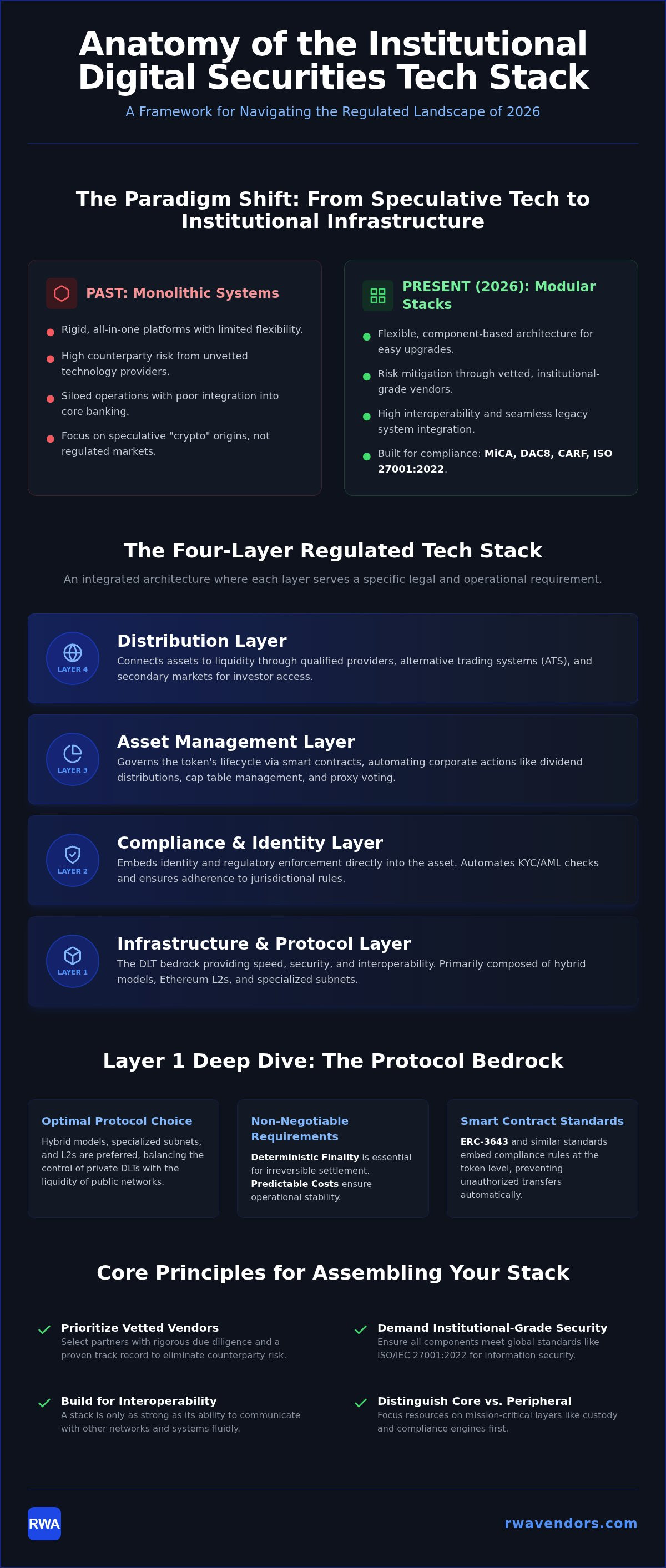
A modern digital securities tech stack is far more than a simple blockchain implementation. It represents a sophisticated, integrated architecture comprising Distributed Ledger Technology (DLT), programmable smart contracts, and a network of off-chain financial services. By 2026, the industry has moved away from the monolithic legacy systems of the past in favor of a modular approach. This modularity allows institutions to swap specific components, such as custody providers or compliance engines, without rebuilding their entire infrastructure. We define the Regulated Tech Stack as a system where every line of code serves a specific legal requirement.
This architecture is organized into four primary layers that ensure the integrity of the asset lifecycle:
- Infrastructure: The underlying protocol and network layer that provides the base for all transactions.
- Compliance: The identity and regulatory enforcement layer where KYC and AML rules reside.
- Asset Management: The lifecycle and smart contract layer responsible for corporate actions and dividends.
- Distribution: The trading and investor access layer that connects assets to secondary markets.
The Shift from Blockchain to Institutional Infrastructure
The narrative has matured from the speculative origins of "crypto" toward the structured reality of tokenized capital markets. For institutions, the focus isn't on the novelty of decentralization but on institutional-grade uptime, redundancy, and risk mitigation. A Security Token Offering (STO) now requires a stack that can guarantee high availability and seamless integration with existing core banking systems. In this environment, vetted vendors are a prerequisite. Financial firms don't accept the counterparty risk of unverified technology providers; they require partners that have undergone rigorous due diligence and adhere to global security standards like ISO/IEC 27001:2022.
Core Components vs. Peripheral Services
Distinguishing between mission-critical layers and supporting tools is essential for strategic resource allocation. Mission-critical components, such as qualified custody and automated compliance engines, form the core of the digital securities tech stack. If these layers fail, the entire security is compromised. Conversely, peripheral services like advanced data analytics or secondary market sentiment tools provide value but aren't vital for the security's legal existence. The STO Foundation, established in 2017, plays a central role in standardizing these components to ensure they function as a cohesive unit. As we progress through 2026, interoperability remains the dominant theme. A stack is only as strong as its ability to communicate with other networks, ensuring that assets move fluidly between different institutional silos without friction.
Layer 1: The Infrastructure and Protocol Layer
The infrastructure layer serves as the bedrock of any digital securities tech stack, dictating the speed, security, and interoperability of the entire system. In 2026, the debate between public and private blockchains has shifted toward a nuanced preference for hybrid models. While private blockchains offer superior control for internal bank processes, public networks and their extensions provide the global liquidity required for broad distribution. Institutions now prioritize protocols that balance privacy with the reach of decentralized ecosystems.
Ethereum Layer 2 solutions and specialized financial subnets have emerged as the primary choice for high-throughput institutional applications. These subnets provide dedicated block space, ensuring that transaction costs remain predictable even during periods of network congestion. For institutional settlement, probabilistic finality is insufficient. Architects must select protocols that offer deterministic finality to ensure that once a trade is settled, it cannot be reversed; this is a non-negotiable requirement for regulatory compliance and risk management.
Smart Contract Standards (ERC-3643 and Beyond)
Standardizing the token layer via protocols like ERC-3643 is essential for maintaining secondary market liquidity. Unlike utility tokens, which often lack regulatory hooks, security token standards include built-in compliance layers that prevent unauthorized transfers at the protocol level. These standards ensure that every token remains "permissioned" throughout its entire lifecycle. Smart contracts automate complex corporate actions, such as dividend distributions and proxy voting, by executing pre-defined code directly on the ledger without manual intervention. This automation reduces operational costs and minimizes the risk of human error in cap table management.
Oracle Providers and Data Integrity
Reliable price feeds and asset valuation data are the lifeblood of Real-World Asset (RWA) tokenization. Oracles act as the essential bridge between physical assets and digital tokens, providing the data integrity required for accurate on-chain valuation. Without secure oracles, the link between a token and its underlying collateral remains fragile. When vetting oracle providers, prioritize those offering multi-source verification and low-latency data delivery to prevent price manipulation or stale valuations. You can identify vetted infrastructure providers through our directory to ensure your protocol layer is supported by reliable data partners.
Layer 2: Compliance and Lifecycle Management
The compliance layer represents the operational heart of a digital securities tech stack, transforming a neutral ledger into a legally enforceable financial instrument. While the protocol layer handles the "where" of a transaction, this second layer governs the "who" and "how." It ensures that every transfer adheres to jurisdictional mandates in real-time. By automating these workflows, industry estimates suggest that institutions can reduce the total cost of issuance and lifecycle management by up to 40% compared to traditional, manual processes. This efficiency is achieved by replacing paper-based verification with programmable logic that executes at the speed of the network.
Tax compliance has become a critical technical requirement in 2026. The implementation of the EU’s 8th Directive on Administrative Cooperation (DAC8) and the OECD’s Crypto-Asset Reporting Framework (CARF) on January 1, 2026, necessitates automatic data reporting to tax authorities. A robust digital securities tech stack must now include integrated reporting tools that capture and transmit this data without manual intervention. These tools ensure that issuers remain compliant with the first reporting period for 2026 data, which is due by July 2027.
On-Chain Identity and Permissioning
The "Identity Layer" utilizes whitelists and restricted token standards to ensure that only verified participants can hold or trade an asset. Unlike traditional systems where compliance is checked post-trade, digital securities utilize pre-trade permissioning. If a buyer does not meet the necessary KYC or AML requirements, the smart contract simply refuses the transaction. This layer must also handle real-time jurisdictional changes, such as moving an investor from one tax bracket or regulatory category to another as their status evolves. It's vital to vet identity providers against global privacy standards, including GDPR, to ensure that sensitive investor data is handled with institutional-grade security.
Cap Table Management and Investor Relations
Digital Transfer Agents (DTAs) have replaced traditional spreadsheets with real-time blockchain reporting. This shift allows for an immutable, always-accurate cap table that updates instantly with every secondary market trade. Beyond simple record-keeping, these tools facilitate automated corporate governance, including on-chain proxy voting and dividend distributions. By integrating investor portals directly with the core blockchain ledger, issuers provide a transparent interface where stakeholders can view holdings, access tax documents, and participate in governance. This direct connection eliminates the reconciliation delays that typically plague legacy capital markets, providing a single source of truth for all parties involved.
Layer 3: Custody, Trading, and Distribution
The third layer of the digital securities tech stack facilitates the actual movement and storage of assets. While previous layers define the rules and protocols, this execution layer governs how value is held and transferred between participants. For institutional users, the choice of a custody model is a matter of fiduciary responsibility. Self-custody is rarely an option for regulated entities due to the extreme operational risks. Instead, firms utilize Multi-Party Computation (MPC) or Qualified Custodians. MPC technology splits private keys into multiple shards distributed across different environments, which eliminates single points of failure while maintaining the transaction speed required for active trading.
The distribution layer represents the most frequent bottleneck for Real-World Asset (RWA) initiatives. Issuing a token is technically straightforward; however, connecting that token to a regulated secondary market is a significant challenge. Success requires the stack to integrate seamlessly with Alternative Trading Systems (ATS) in the United States or Multilateral Trading Facilities (MTF) in Europe. Without these pre-built connections, digital securities remain illiquid, which undermines one of the primary value propositions of tokenization. Settlement efficiency in this layer is driven by the "delivery vs. payment" (DvP) mechanism. By utilizing stablecoins or emerging Central Bank Digital Currencies (CBDCs), the digital securities tech stack can achieve atomic settlement. This shift from traditional T+2 cycles to T+0 reduces counterparty risk and drastically improves capital efficiency.
Institutional Digital Asset Custody
Evaluating the choice between sub-custody and direct custody technology is a critical strategic decision. Direct custody offers maximum control but requires a substantial investment in internal security infrastructure and specialized personnel. Sub-custody models allow institutions to leverage the existing regulatory licenses and technical frameworks of established third-party providers. Regardless of the chosen path, SOC2 Type II compliance and comprehensive insurance coverage are mandatory benchmarks for institutional trust. These standards ensure that the technology provider maintains rigorous controls over data integrity and operational security.
Liquidity and Secondary Market Connectivity
A mature stack must provide API-driven connections to global liquidity pools. These integrations allow the issuance platform to communicate directly with various regulated trading venues, ensuring that assets are accessible to a broad investor base. Market makers are essential components of this ecosystem, providing the necessary liquidity to maintain tight bid-ask spreads. By moving to a T+0 settlement cycle, your organization can eliminate the reconciliation delays that characterize legacy capital markets. To ensure your execution layer is built on a solid foundation, you should identify vetted custody and trading partners through our professional directory.
Assembling Your Stack: A Strategic Vetting Framework
Constructing a robust digital securities tech stack requires a methodical approach that prioritizes risk mitigation and regulatory alignment. The process begins with a precise definition of your asset class and the specific jurisdictional requirements that will govern the issuance. For example, a stack designed for private credit in the United States must account for different reporting mandates than a real estate tokenization project in the European Union. Once these legal parameters are established, institutions should identify "Founding Member" providers within a curated ecosystem. These entities have undergone rigorous vetting to ensure they meet the high standards required for global finance.
The third phase involves evaluating interoperability through "Proof of Concept" (PoC) testing. It's not enough for individual components to function; they must communicate seamlessly across the compliance, custody, and distribution layers. Following successful PoC testing, conduct thorough technical due diligence on smart contract audits. This step verifies that the code is secure and functions exactly as intended. Finally, finalize the legal-technical bridge by engaging specialized counsel. This ensures that the programmable logic of the token remains perfectly synchronized with the legal rights of the underlying asset.
Using the RWA Vendors Directory for Due Diligence
The RWA Vendors directory serves as a central resource for firms looking to reduce counterparty risk. Users can filter providers by specific categories, including Legal, Custody, and Issuance, to find the exact expertise required for their project. Vetted profiles provide an additional layer of security, signaling that a vendor has the necessary infrastructure and experience to support institutional-grade tokenization. By connecting with partners who have a proven track record, you can avoid the common pitfalls of a fragmented vendor landscape and build with confidence.
The Future of the Stack: Modular vs. All-in-One
The industry is currently debating the merits of white-label platforms versus custom-built modular stacks. While all-in-one platforms offer a faster time-to-market, they often lack the flexibility needed as regulations evolve. Conversely, a modular "best-of-breed" approach allows institutions to select the highest-quality components for each specific layer of their digital securities tech stack. This strategy provides the agility required to adapt to new regulatory frameworks like DAC8 and CARF without rebuilding the entire system. To begin building your architecture, Browse the RWA Vendors Directory to find your next infrastructure partner.
Future-Proofing Your Institutional Infrastructure
The maturation of global regulations in 2026 has transformed tokenization from a technical experiment into a standardized financial requirement. Success in this landscape depends on your ability to maintain a modular and interoperable digital securities tech stack that can adapt to evolving tax reporting and compliance mandates. It's no longer enough to simply issue a token; you must manage its entire lifecycle with surgical precision across every layer of your architecture.
Assembling these complex layers requires access to a verified ecosystem of professional partners. RWA Vendors serves as the central pillar for this coordination, offering a comprehensive directory of institutional-grade providers across the legal, technical, and financial sectors. Each profile is vetted by The STO Foundation to ensure your infrastructure is supported by reliable experts with global coverage. We invite you to Explore the Global RWA Vendors Directory to identify the infrastructure partners necessary for your next phase of growth. Building a resilient foundation today ensures your assets remain liquid and compliant in the capital markets of tomorrow.
Frequently Asked Questions
What is the most critical component of a digital securities tech stack?
The compliance layer is the most critical component. It enforces legal rules directly at the token level, ensuring that every transaction meets regulatory standards before it executes. Without this "Identity Layer," a digital security is merely a token without legal standing. This layer integrates KYC/AML data and jurisdictional restrictions into the smart contract, preventing unauthorized transfers and maintaining the integrity of the asset's regulatory status across its entire lifecycle.
Can I use a public blockchain for regulated digital securities?
Yes, you can use public blockchains, provided you implement a permissioned layer on top. Many institutions favor Ethereum or its Layer 2 extensions because they offer global liquidity and standardized protocols. The key is ensuring the digital securities tech stack includes smart contracts that restrict transfers to verified addresses only. This hybrid approach combines the reach of public networks with the control required by financial regulators like the SEC or European authorities.
How much does it cost to build a full tokenization tech stack?
Costs vary significantly based on the complexity of the asset class and the chosen architecture. A modular stack using third-party providers typically involves implementation fees and ongoing SaaS costs, whereas a custom-built private infrastructure requires a significant investment in development and security. Institutions should evaluate the total cost of ownership by considering legal fees, smart contract audits, and the operational savings gained through automated lifecycle management and reduced reconciliation across the asset's life.
What is the role of a transfer agent in a blockchain-based stack?
A transfer agent maintains the official record of ownership for a security. In a blockchain-based environment, this role evolves into managing the digital cap table and ensuring that on-chain records match the legal register. The agent utilizes the digital securities tech stack to authorize transfers, process corporate actions like dividends, and handle investor communications. This digital-first approach provides a real-time, immutable source of truth that simplifies secondary market trading and jurisdictional reporting.
How do I ensure my digital securities stack is compliant with SEC or MiCA regulations?
Compliance is achieved by mapping regulatory requirements directly into the technical architecture. For MiCA, your stack must support the mandatory reporting and transparency requirements for crypto-asset service providers before the July 1, 2026 deadline. For SEC regulations, you must ensure that token transfers are restricted to accredited investors or meet specific exemption criteria. Engaging specialized legal counsel to vet the smart contract logic is essential to ensure that the code accurately reflects governing laws.
What is the difference between an issuance platform and a tech stack?
An issuance platform is a specific application used to create and launch tokens, while a tech stack is the entire ecosystem of integrated technologies. The stack includes the underlying blockchain protocol, custody solutions, compliance engines, and distribution channels. Think of the issuance platform as the user interface and the tech stack as the "digital plumbing" that supports the asset's entire lifecycle. A modular stack allows you to integrate multiple specialized platforms into one system.
Why do I need an oracle for real-world asset tokenization?
Oracles provide the essential link between off-chain data and on-chain tokens. For real-world assets like real estate or private credit, the token needs accurate valuation data and price feeds to function correctly. Oracles transmit this information from trusted sources into the smart contract, enabling automated dividend payments or collateral management. Without a reliable oracle, the digital security can't respond to real-world events, making it impossible to maintain an accurate valuation on the ledger.
How do I vet blockchain technology vendors for institutional use?
Vetting requires a multi-layered due diligence process focusing on security, compliance, and track record. Start by verifying that the vendor holds relevant certifications, such as SOC2 Type II or ISO/IEC 27001:2022. Evaluate their history of successful deployments and check for independent smart contract audits. You should also utilize professional directories to identify vendors who are recognized as industry leaders and have been vetted by authoritative bodies like The STO Foundation to reduce risk.
Disclaimer
This article is provided by RWAVendors.com for general informational and educational purposes only. It does not constitute legal, financial, investment, tax, regulatory or other professional advice, or an offer, solicitation, recommendation or endorsement of any company, product, service, token, security or investment. RWAVendors.com is an informational vendor directory and does not sell, issue, broker, custody or facilitate transactions involving cryptocurrencies, digital tokens, tokenized assets, securities or investment products. Some vendor listings and references may involve paid advertising, sponsored placement or membership relationships. These relationships do not guarantee a vendor’s qualifications, regulatory status, performance or suitability. Information may be incomplete, outdated or subject to change. You should independently verify all information, conduct your own due diligence and consult qualified professionals before making any business or investment decision. RWAVendors.com is not responsible for the content, services, representations or actions of third-party vendors or linked websites.


