
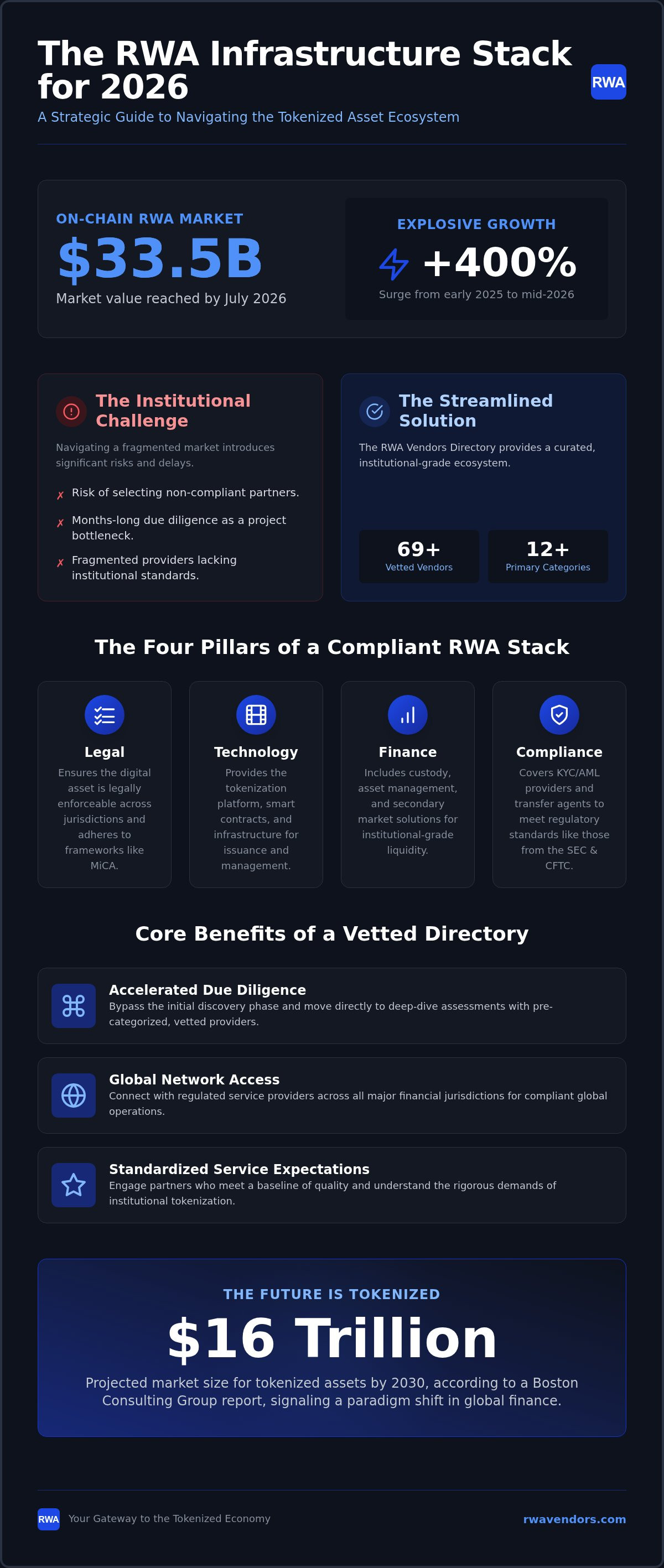
Between early 2025 and July 2026, the on-chain Real-World Asset market surged by over 400 percent to reach a value of 33.5 billion dollars. You likely recognize that this rapid expansion creates a paradox of choice where the risk of selecting non-compliant partners is higher than ever. The fragmentation of service providers often makes rigorous due diligence a months-long bottleneck that delays your project's launch. It's a common frustration for institutional architects who need to move from pilot programs to scalable, regulated market operations.
This guide introduces the latest RWA Vendors Directory, a curated ecosystem designed to streamline your selection process. By utilizing this vetted resource, you gain a clear understanding of the 2026 infrastructure stack and a shortlisted selection of reliable partners. We'll analyze the 69 vendors currently leading the 12 primary industry categories. This strategic overview ensures you can reduce your time-to-market while adhering to the latest SEC, CFTC, and MiCA regulatory frameworks. You'll find the specific tools needed to build a secure, compliant tokenization project without the traditional overhead of manual vendor discovery.
Key Takeaways
- Identify the transition from fragmented experimental lists to a centralized, institutional-grade RWA vendor directory for 2026.
- Understand the four essential pillars of the RWA infrastructure stack, comprising legal, technology, finance, and compliance, to ensure full lifecycle coverage.
- Learn to evaluate service providers using a multi-point vetting framework that prioritizes regulatory licenses across major jurisdictions such as the SEC and the EU.
- Discover a methodical approach to building a compliant infrastructure stack by aligning directory filters with your specific asset class and operational needs.
- Gain insight into how the STO Foundation’s oversight and Founding Members establish the integrity and standards necessary for the modern tokenized economy.
What is an RWA Vendor Directory and Why is it Critical for 2026?
An RWA vendor directory is a centralized, curated repository of service providers specialized in the tokenization of tangible and intangible assets. In 2026, digital capital markets have transitioned from experimental pilots to a period defined by infrastructure readiness. This shift requires more than a simple list of blockchain enthusiasts. It demands a structured ecosystem of vetted professionals who understand the high-stakes nature of global finance. By centralizing these resources, an RWA vendor directory serves as a critical tool for reducing counterparty risk and ensuring that every participant in the value chain meets institutional standards.
The Evolution of the Tokenization Ecosystem
The landscape has matured significantly since the early days of basic security tokens and initial offerings. By August 2026, the market has moved beyond simple asset representation to complex, multi-jurisdictional frameworks. Generic blockchain directories often fail to provide value here because they lack the granular categorization required for institutional compliance. A modern project doesn't just need a developer; it needs a custodian with specific FINRA approvals or a legal firm specializing in the Cayman Islands' statutory tokenized-funds regime. Specialized knowledge in legal and regulatory sub-sectors is now the baseline for entry. This directory provides the surgical precision needed to find those specific experts.
Core Benefits of Using a Vetted Directory
Utilizing a curated RWA vendor directory transforms the vendor selection process from a networking exercise into a data-driven strategic operation. It eliminates the fragmented market friction by providing a standardized comparison framework. This allows issuers to focus on asset performance rather than infrastructure debugging. The core advantages include:
- Accelerated Due Diligence: Pre-categorized profiles allow teams to bypass the initial discovery phase and move directly to deep-dive assessments.
- Global Network Access: Reach regulated providers across all major financial jurisdictions, ensuring your infrastructure stack remains compliant regardless of your operational base.
- Standardized Service Expectations: A vetted directory establishes a baseline of quality, ensuring that vendors understand the rigorous requirements of institutional-grade tokenization.
Using these resources helps issuers avoid the liquidity reality check by ensuring that secondary market structures and custody solutions are integrated from day one. It's about moving fast while maintaining the high standards that institutional investors demand. Reliance on a vetted ecosystem isn't just a convenience; it's a risk management necessity in 2026.
Mapping the RWA Lifecycle to Service Provider Categories
Successful tokenization requires a coordinated infrastructure stack that supports an asset from inception through secondary trading. This stack rests on four essential pillars: Legal, Technology, Finance, and Compliance. Each stage of the lifecycle requires specialized vendors whose expertise matches your specific asset class. A comprehensive RWA vendor directory provides the taxonomy needed to align these providers with your operational requirements. Real estate projects, for instance, demand different oracle structures and legal frameworks than private equity or tokenized US Treasuries.
Issuance and Legal Compliance Infrastructure
Legal counsel and compliant tokenization platforms form the foundation of any project. These entities ensure the digital representation of an asset remains legally enforceable across jurisdictions. KYC/AML providers specialized in digital securities are essential for maintaining ongoing regulatory standards. Digital-native transfer agents now manage cap tables in real-time, replacing the manual processes of traditional finance. This structural integrity is vital, especially as a Boston Consulting Group report projects the tokenized asset market could reach 16 trillion dollars by 2030.
Custody and Asset Management Solutions
Institutional custody differs fundamentally from retail solutions in terms of security and oversight. In May 2026, FINRA approved the first broker-dealer for the custody of tokenized securities with atomic settlement. This development allows for the secure holding of assets with immediate transaction finality. Lifecycle management software handles complex tasks like distributions, voting rights, and corporate actions automatically. Oracle providers supply the real-time data feeds required for transparent asset valuation, ensuring that on-chain data reflects off-chain reality without delay.
Secondary Markets and Liquidity Providers
Liquidity remains a primary challenge for many issuers. Secondary markets have evolved rapidly following the March 2026 SEC approval of NASDAQ rule changes for tokenized securities. Trading platforms and Alternative Trading Systems (ATS) provide the venue for exchange, while market makers ensure there is sufficient depth for institutional trades. By consulting a specialized RWA vendor directory, you can identify liquidity partners who specialize in your specific jurisdiction and asset type. Blockchain settlement systems facilitate T+0 finality, removing the multi-day delays inherent in legacy systems.
Interoperability between these categories ensures a seamless flow of data and value across the entire stack. Founding Members within the directory often serve as the primary architects of these interoperability standards. You can explore the full list of founding members to identify providers who are actively building the core infrastructure of the modern tokenized economy. Choosing partners from a vetted ecosystem reduces the risk of technical silos and ensures your project is built on a scalable, institutional-grade foundation.
Evaluating RWA Vendors: A Strategic Comparison Framework
Selecting a partner from an RWA vendor directory requires a rigorous methodology that extends beyond social proof or market popularity. Institutional issuers must establish a multi-point vetting criteria that prioritizes regulatory standing and technical durability. This framework ensures your infrastructure stack can withstand the scrutiny of global regulators and the demands of high-value asset management. A structured comparison allows you to move past the fragmented market noise and focus on vendors that offer genuine institutional-grade reliability.
Regulatory and Compliance Checkpoints
In 2026, the regulatory landscape is more defined yet increasingly complex. On March 17, 2026, the SEC and CFTC issued a joint interpretation categorizing crypto assets into five distinct classes. Vendors must demonstrate specific jurisdictional expertise that aligns with these federal classifications. You should prioritize providers with SOC2 Type II compliance and a history of recurring institutional-grade audits. It's also vital to verify the liability framework of the service provider. A vendor that cannot clearly define its legal responsibilities in the event of a system failure is a significant risk. Since the MiCA transitional period in the EU concluded in July 2026, any vendor operating in that region must prove full adherence to these harmonized standards.
Technical and Integration Capability
Technical evaluation must focus on the vendor’s ability to integrate with legacy financial systems. High-quality providers offer robust API documentation and support for seamless integration into existing ERP systems. They must also demonstrate support for industry-standard smart contract frameworks such as ERC-3643 or ERC-1400. In a multi-chain environment, interoperability is non-negotiable. Your vendors must communicate across different networks to prevent liquidity silos and ensure asset portability. Uptime statistics and a history of clean security audits are the only acceptable proofs of a technical track record. Scalability is equally vital. As your assets under management grow, your infrastructure must handle increased transaction volumes without performance degradation or increased latency. Using a vetted RWA vendor directory helps you filter for these specific technical competencies early in the discovery phase.
Ultimately, the goal is to build a stack where each component is as robust as the next. This methodical approach to evaluation reduces the time spent on due diligence and minimizes the risk of technical or legal friction during the project lifecycle. By applying these standards, you ensure your project is built on a foundation of verified expertise rather than unproven claims.
How to Build Your RWA Infrastructure Stack Using the Directory
Transitioning from a theoretical framework to a functional implementation requires a methodical execution plan. Building an institutional-grade infrastructure stack involves more than selecting individual tools; it requires assembling a cohesive ecosystem where every component is verified for compliance and interoperability. By utilizing the Version 2 RWA vendor directory, launched in August 2026, you can follow a structured five-step process to move your project from conception to launch with surgical precision.
- Step 1: Define your asset class and jurisdictional requirements. Your choice between tokenized US Treasuries, which hit 16.16 billion dollars in July 2026, and private credit will dictate your legal and technological needs.
- Step 2: Shortlist vendors using directory filters. Leverage the 12 primary categories and 52 subcategories to identify the 69 vetted vendors currently active in the ecosystem.
- Step 3: Conduct technical and legal deep-dives. Focus on Founding Member profiles to identify industry leaders who set the standard for security and reliability.
- Step 4: Execute pilot integrations and SLA reviews. Test how a vendor’s API interacts with your existing systems and ensure their Service Level Agreements meet institutional uptime requirements.
- Step 5: Finalize your ecosystem partners. Secure the contracts and finalize the integration of your legal, custody, and trading pillars.
Defining Your Strategic Requirements
Before engaging with providers, you must determine the balance between white-label solutions and custom builds. White-label platforms offer a faster time-to-market, but custom builds provide the flexibility needed for complex asset classes. Identify "must-have" features, such as real-time oracle feeds for asset valuation, versus "nice-to-have" secondary market integrations. It's also essential to set a realistic budget for institutional-grade service provider fees, which reflect the high level of compliance and security they provide. This early planning prevents scope creep and ensures your infrastructure remains scalable as your assets under management grow.
Navigating the Directory Efficiently
The RWA vendor directory is designed for high-density information retrieval. Use advanced search filters to isolate providers by specific financial jurisdictions, such as those compliant with the Cayman Islands' statutory tokenized-funds regime. To assess a vendor’s long-term health, look beyond their profile. Review the integrated industry news and job postings to see if they are expanding their team or launching new products. This data serves as a proxy for financial stability and market commitment. Once you have identified a match, use the directory referral system to establish a direct line of communication with the vendor’s institutional team.
Efficient discovery reduces the administrative burden of vendor management and allows your team to focus on asset performance. You can access the RWA Vendors directory today to begin shortlisting the partners essential for your 2026 launch. Following this methodical workflow ensures that your infrastructure is not just functional, but built to the highest standards of the global tokenized economy.
The RWA Vendors Directory: Your Gateway to the Tokenized Economy
The RWA Vendors platform serves as the specialized infrastructure arm of the Security Token Offering (STO) Foundation, Inc. This institutional oversight provides a unique layer of trust that generic blockchain lists or transient social media groups cannot replicate. By acting as an industry architect, the STO Foundation ensures that the RWA vendor directory remains a stable and credible resource for global finance. It's not just a collection of names; it's a curated ecosystem designed to maintain the integrity of digital capital markets. This gatekeeper approach ensures that institutional users engage only with verified, professional service providers.
Founding Members play a pivotal role in this ecosystem by setting the standards for the broader industry. Their participation signals a commitment to long-term market stability and technological excellence. These members often collaborate to solve the "missing middle" of the market, ensuring that small-to-mid-market issuers have access to the same high-quality infrastructure as global giants like BlackRock or Franklin Templeton. As the directory evolves, it continuously vets new entrants to ensure they meet the rigorous demands of the 2026 regulatory environment, including the finalized MiCA standards and SEC classifications.
Leveraging Ecosystem Synergies
Listed vendors don't operate in silos. They function as part of a unified value chain where legal, technical, and financial services are designed to be complementary. Choosing partners from a single, vetted RWA vendor directory ensures a baseline of interoperability and professional alignment. This synergy is critical for executing complex launches, such as tokenized funds in the Cayman Islands or Russell 1000 securities on NASDAQ. Case studies of successful RWA projects consistently show that using a pre-vetted stack reduces the administrative burden of vendor management. It allows project leads to focus on asset performance and investor relations rather than troubleshooting infrastructure gaps.
Becoming a Part of the Ecosystem
For service providers, securing a listing in the directory is a strategic move for brand alignment and institutional visibility. The platform isn't just a discovery tool; it's a facilitator for lead generation and referrals. Providers can apply for a verified profile to showcase their jurisdictional expertise and technical certifications to a global audience of issuers. Founding Membership offers the highest level of brand alignment, positioning a company as a central pillar of the tokenized economy. Beyond directory listings, the platform provides access to industry news and job postings, helping firms scale their operations alongside the growing market.
The transition to a tokenized global economy requires a foundation built on verified expertise and institutional-grade reliability. Whether you are an issuer looking for a compliant custody solution or a provider seeking to join a professional network, this ecosystem provides the necessary tools for success. You can Browse the RWA Vendor Directory Today to identify the partners who will power your next project. Taking this step ensures your infrastructure is ready for the demands of the modern financial landscape.
Architecting the Future of Institutional Tokenization
The evolution of digital capital markets in 2026 demands a shift from experimental discovery to institutional execution. You've seen how mapping the RWA lifecycle and applying a rigorous evaluation framework can eliminate the traditional bottlenecks of fragmented due diligence. By leveraging a centralized RWA vendor directory, you ensure that your project is built on a foundation of verified expertise rather than unproven claims. This strategic approach minimizes counterparty risk and aligns your operations with the highest global standards across all major financial jurisdictions.
Success in the tokenized economy depends on the durability of your infrastructure stack. As the official infrastructure arm of the Security Token Offering Foundation, RWA Vendors offers comprehensive coverage of legal, technical, and financial service providers. It's the primary resource trusted by institutional capital market participants to navigate this sophisticated landscape with confidence. We invite you to Access the Global RWA Vendor Directory today to begin shortlisting your partners. Your project's journey toward a scalable, compliant launch begins with a single, vetted connection.
Frequently Asked Questions
What is the RWA Vendor Directory?
The RWA vendor directory is the official infrastructure repository operated by the Security Token Offering Foundation, Inc. It functions as a curated ecosystem designed to connect asset issuers with institutional-grade service providers. The directory organizes vendors into a clear taxonomy across legal, custody, trading, and blockchain sectors. This professional resource helps businesses identify reliable partners capable of building and scaling compliant tokenization projects in a complex global market.
How are vendors vetted before being listed in the directory?
Vendors undergo a rigorous verification process to ensure they meet the high standards of global finance and legal compliance. This vetting focuses on the provider's technical track record, regulatory standing, and jurisdictional expertise. The STO Foundation acts as an industry architect, maintaining the integrity of the ecosystem by only listing professional-grade entities. This methodical approach reassures institutional users that they are engaging with a stable and credible network of vetted experts.
Does the directory include legal and compliance experts?
Legal and compliance experts represent one of the primary pillars within the directory’s infrastructure stack. You can search for firms with specialized knowledge in digital securities, KYC/AML procedures, and jurisdictional requirements. These professionals help ensure that your tokenization project adheres to federal laws, such as the SEC’s digital security classifications or the EU’s MiCA regulations. The directory simplifies finding these experts by categorizing them according to their specific legal and regulatory sub-sectors.
Can I find custody solutions for tokenized real estate?
You can find institutional-grade custody solutions tailored for specific asset classes like real estate within the RWA vendor directory. The platform categorizes providers by their ability to handle diverse assets, ensuring that issuers find partners with the appropriate regulatory approvals. These vendors offer the security and oversight necessary for managing high-value tangible assets on-chain. This structured approach allows you to identify custodians who specialize in the unique requirements of your chosen asset class.
What is a Founding Member in the RWA Vendors ecosystem?
A Founding Member is a service provider that has established itself as a central pillar of the tokenized ecosystem. This status signals industry leadership and a commitment to maintaining the integrity of the RWA infrastructure stack. Founding Members often contribute to setting the standards for interoperability and compliance that define the modern market. For issuers, choosing a Founding Member ensures they are partnering with a stable, authoritative entity that has undergone extensive vetting.
Is the RWA Vendor Directory global or focused on specific regions?
The directory provides comprehensive global coverage across all major financial jurisdictions. This includes established markets in the United States and the European Union, as well as critical fund domiciles like the Cayman Islands. Since the market is increasingly cross-border, the platform allows you to filter vendors by their specific regional expertise and regulatory licenses. This ensures your infrastructure stack remains compliant regardless of where your assets are located or where your investors reside.
How often is the vendor information updated?
The directory is updated continuously to reflect the rapid evolution of the digital capital markets. The launch of Version 2 on August 26, 2026, introduced 69 vetted vendors across 12 primary categories and 52 subcategories. This ongoing maintenance ensures that the directory remains a definitive reference for institutional users. The platform monitors market shifts, such as new regulatory classifications or technological advancements, to provide the most current data on the infrastructure providers active today.
How do I contact a vendor through the platform?
You can initiate contact with service providers through the directory’s integrated lead generation and referral system. This tool is designed to facilitate direct and efficient communication between issuers and verified vendors. By using the platform’s resources, you can request specific information or start the due diligence process with a provider that matches your requirements. This streamlined approach reduces the time-to-market for your project by removing the friction typical of manual discovery.
Disclaimer
This article is provided by RWAVendors.com for general informational and educational purposes only. It does not constitute legal, financial, investment, tax, regulatory or other professional advice, or an offer, solicitation, recommendation or endorsement of any company, product, service, token, security or investment. RWAVendors.com is an informational vendor directory and does not sell, issue, broker, custody or facilitate transactions involving cryptocurrencies, digital tokens, tokenized assets, securities or investment products. Some vendor listings and references may involve paid advertising, sponsored placement or membership relationships. These relationships do not guarantee a vendor’s qualifications, regulatory status, performance or suitability. Information may be incomplete, outdated or subject to change. You should independently verify all information, conduct your own due diligence and consult qualified professionals before making any business or investment decision. RWAVendors.com is not responsible for the content, services, representations or actions of third-party vendors or linked websites.


