
The fastest blockchain isn’t necessarily the safest choice for an institutional RWA launch. The real test is whether a provider can connect legal requirements, asset controls, and technology that works with existing financial systems. That’s why evaluating RWA tokenization vendors requires more than comparing platform features or watching a polished demo.
If you’re sorting through a crowded field of providers, the challenge is familiar: how do you distinguish crypto-native capability from institutional readiness, and avoid a partner that won’t withstand regulatory or operational scrutiny? A token’s technology matters, but it doesn’t change the asset’s legal nature or remove the need for sound compliance and custody arrangements.
This framework helps you assess vendors against clear criteria for compliance, security, interoperability, and scalability. You’ll learn how to compare modular and full-stack approaches, identify providers for different stages of the tokenization lifecycle, and build a shortlist that supports a more informed launch decision. The goal is a decision stakeholders can justify, with fewer integration surprises and a stronger foundation for future operations.
Key Takeaways
- Use four evaluation pillars to structure vendor comparisons and give internal stakeholders a clear basis for decisions.
- When evaluating RWA tokenization vendors, weigh platform architecture against your integration capacity, launch requirements, and long-term operating needs.
- Apply a due diligence checklist that examines jurisdictional permissions, data privacy controls, security practices, and exit provisions.
- Compare full-stack and modular models, including white-label options, to understand where speed may involve trade-offs in flexibility or vendor dependence.
- Use a vetted global directory to discover providers across the tokenization lifecycle, and consider Founding Member status as one indicator of ecosystem participation.
The Strategic Importance of Evaluating RWA Tokenization Vendors
Evaluating RWA tokenization vendors is a multi-dimensional risk management process, not simply a software comparison. Issuers need to assess whether a provider’s technology, operating model, security controls, and regulatory capabilities fit the asset’s legal structure and intended lifecycle. The choice can shape how assets are issued, administered, and transferred, as well as how operations continue if the vendor relationship changes.
Tokenization can represent rights to tangible or intangible assets digitally; the broader concept is outlined in Tokenization. Putting an asset on a blockchain doesn’t change its legal classification. On January 28, 2026, the SEC’s Divisions of Corporation Finance, Investment Management, and Trading and Markets stated that tokenized securities remain subject to existing federal securities laws. A permissionless environment may suit experimentation, but institutional issuance calls for controls that address investor eligibility, asset records, custody arrangements, and applicable compliance obligations.
Vendor roles differ. A technology provider may supply a specific component, such as token issuance software or blockchain infrastructure. A full-service tokenization platform may coordinate several stages, but its precise scope varies. Neither label proves suitability. Before choosing a model, map each provider’s responsibilities, dependencies, and handoffs. This makes it easier to identify gaps, duplicated services, and work that remains with your team.
Vendor choice can influence secondary-market readiness and investor confidence. Interoperability, reliable servicing data, transfer controls, and clear operational responsibilities can support orderly asset administration and potential transfers. They don’t guarantee liquidity: actual trading depends on the asset, market access, and participant demand. Gaps in these areas can make the token harder to use and weaken trust in the issuer’s controls.
Why Traditional Due Diligence Fails in Tokenization
Financial audits examine financial statements, controls, and records; smart contract audits assess code behavior and technical vulnerabilities. These reviews address different risks, so one cannot substitute for the other. Blockchain experience alone is also insufficient. Providers need to understand how the legal structure and compliance requirements shape platform design. Assess proprietary systems for technical debt, too: limited interoperability or difficult data extraction can make future integrations and vendor transitions costly and complex.
The 2026 Market Landscape for Digital Securities
Tokenized private credit and real estate funds are among the use cases drawing institutional attention, alongside established financial assets. The direction is shifting from isolated pilots toward infrastructure intended for ongoing issuance and servicing. Institutional-grade RWA infrastructure in 2026 is a coordinated set of compliant, secure, interoperable systems and services that supports an asset throughout its lifecycle. Use that standard to evaluate vendors as long-term operating partners, not just launch tools.
The Four Pillars of RWA Vendor Evaluation
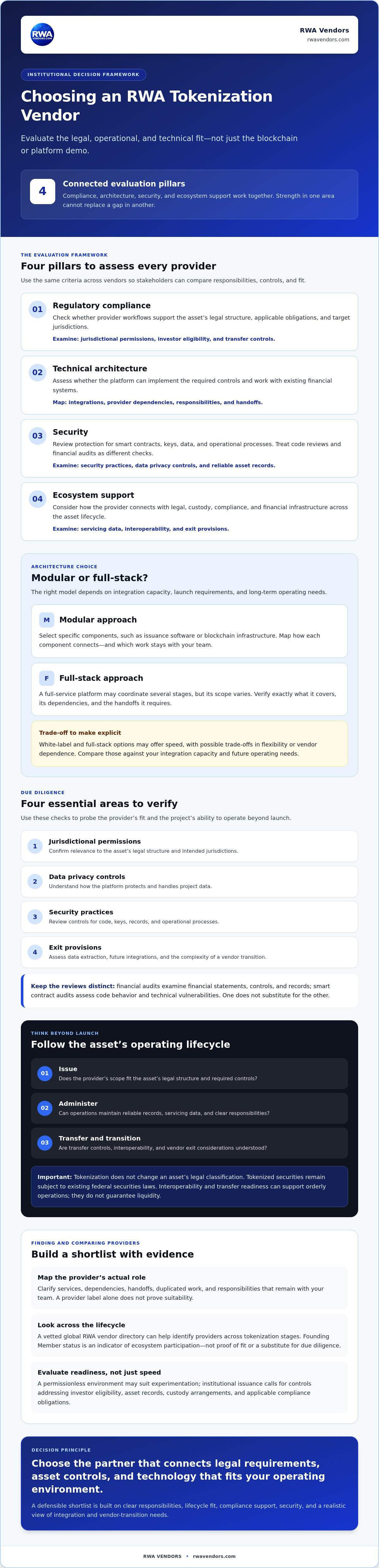
A useful vendor assessment groups capabilities into four pillars: regulatory compliance, technical architecture, security, and ecosystem support. These are connected controls, not interchangeable strengths. A well-designed smart contract cannot compensate for an unsuitable legal structure, and a compliance process is difficult to operate if the platform can’t enforce transfer restrictions or maintain reliable records. For an institutional perspective on the underlying model, see this institutional guide to tokenization.
Regulatory compliance is the foundation. The issuer remains responsible for determining its obligations, but vendors should explain how their systems and workflows support the project’s legal structure and target jurisdictions. Technical architecture must implement those requirements, while security protects the contracts, keys, data, and operational processes involved. Ecosystem support connects the platform to relevant legal, custody, compliance, and financial infrastructure. This is where digital asset infrastructure providers can fit into an operating tokenization ecosystem.
Regulatory Compliance and Legal Wrapping
When evaluating RWA tokenization vendors, ask for evidence of experience supporting securities and other relevant asset structures across the jurisdictions in scope. Clarify which activities the vendor performs, which remain with the issuer or its professional advisers, and how the platform reflects applicable transfer and investor eligibility rules. Automated KYC/AML and onboarding tools can help apply documented controls, but automation alone doesn’t establish compliance. Confirm how identity checks, exceptions, records, and ongoing updates are handled.
Also establish who performs transfer-agent-like functions, where applicable. The platform may record ownership changes and enforce approved transfer rules on-chain, but the contract, operating procedures, and legal records must align. Ask how discrepancies are resolved and who is accountable for maintaining authoritative records.
Institutional-Grade Custody and Security
Compare key-management designs against the issuer’s threat model and governance requirements. Multi-party computation (MPC) distributes signing authority across participants or systems; a hardware security module (HSM) protects keys within dedicated hardware. Either approach requires clear policies for access, recovery, approvals, and incident response. Don’t treat the technology label as proof of control quality.
Review smart contract audit scope, findings, remediation evidence, and any changes made after the review. Ask what insurance coverage applies, what exclusions or limits matter, and whether the policy covers the relevant risks. Don’t assume coverage. SOC 2 reports and ISO certifications can provide useful evidence of controls, but their scope, validity, and relevance to the specific service need verification. They aren’t a substitute for project-specific diligence.
Use these pillars to create a comparable assessment rather than treating RWA, AI, and Web3 vendors as one category. A vetted global directory can help issuers identify providers across the lifecycle. Organizations seeking a directory listing can review vendor listing information.
Modular vs. Full-Stack: Analyzing Vendor Architectures
Architecture determines how much of the tokenization lifecycle one provider controls and how much responsibility stays with the issuer. A full-stack platform brings multiple functions together. A modular approach combines specialist providers for distinct needs, such as issuance technology, custody, legal structuring, and trading infrastructure. Neither model is inherently superior. The right fit depends on internal expertise, integration capacity, governance, and the issuer’s plans for the asset after launch.
White-label solutions can shorten implementation by letting issuers use an existing platform under their own brand. That can help teams with limited technical resources, but speed should be weighed against customization limits, reliance on the provider’s roadmap, and clarity over ongoing charges. Before committing, confirm which components can be configured, what data and functionality can be exported, and how the arrangement can be unwound.
The Full-Stack Platform Advantage
For first-time issuers, a unified platform can reduce the number of integrations to design and manage. One provider may coordinate issuance workflows, investor-facing tools, and operational support, with a single account-management channel for resolving issues. This convenience can simplify coordination, but it may also constrain customization or make it harder to compare the costs of bundled components. Request a clear breakdown of included functions, dependencies, service responsibilities, and any costs that vary with usage.
The Modular Infrastructure Approach
A bespoke stack lets an issuer select specialist vendors for legal, custody, technology, and trading functions. This can provide greater choice and make individual components easier to replace, provided the contracts and interfaces support portability. The trade-off is integration work: the issuer must coordinate providers, align responsibilities, and manage service handoffs. Middleware and interoperability protocols help systems exchange data and execute workflows, but assess their reliability, documentation, upgrade process, and role in the overall architecture.
As you compare models, consider compliant asset tokenization technology alongside portability. Compliance logic should be compatible with the asset’s governing requirements, while system design should avoid making essential records or controls inaccessible if a vendor relationship ends. Ask for export formats, transition support terms, interface documentation, and a practical migration path.
Choose chain architecture based on requirements, not novelty. A single-chain design can limit the number of environments the issuer must support; a multi-chain design may offer broader connectivity but increases coordination and monitoring demands. Evaluate where investors and service providers can operate, whether the required controls work consistently across networks, and how records remain synchronized. When evaluating RWA tokenization vendors, document these trade-offs against current operating needs and credible future scenarios before selecting an architecture.
The 10-Point Tokenization Due Diligence Checklist
Use this checklist to make vendor reviews repeatable across legal, risk, technology, and operations teams. When evaluating RWA tokenization vendors, request evidence for each answer and record unresolved issues, owners, and follow-up actions. A polished demo is not a substitute for documented controls.
- Jurisdictional permissions: Identify where the vendor operates and what permissions, registrations, or partner arrangements apply to the services it performs. Verify these against the project’s jurisdictions and obtain appropriate professional review.
- Asset and legal structure: Confirm the vendor can support the planned asset structure and explain how legal rights, token records, and transfer rules relate.
- Investor onboarding: Review how identity checks, eligibility rules, exceptions, and ongoing record updates are handled. Establish which responsibilities belong to the vendor and which remain with the issuer.
- Data privacy: Ask how personal data is collected, stored, accessed, retained, and deleted. Assess the vendor’s controls against applicable privacy obligations, including GDPR or CCPA where relevant to the project.
- Security assurance: Request current third-party smart contract audit evidence and ask whether penetration testing is conducted. Examine findings, remediation, and any material changes made since testing.
- Key and incident controls: Document access approvals, recovery procedures, incident escalation, and responsibility for communicating material events. Confirm these processes fit your internal governance.
- Technical integration: Review API documentation, supported integrations, data export options, and the process for upgrades. Poorly documented APIs or few integration partners can signal delivery and portability risks.
- Governance and continuity: Understand who can change the underlying protocol, how changes are approved, and how the vendor handles outages or service disruption. Opaque governance deserves further scrutiny.
- Commercial transparency: Request a complete fee schedule and clarify whether charges are SaaS-based, AUM-based, usage-based, or a combination. Unexplained costs or reluctance to disclose pricing are red flags.
- Ownership, track record, and exit: Verify the leadership team, relevant experience, institutional relationships, and any claimed industry affiliations. Anonymous founders or unsupported partnership claims warrant verification. Document data portability, transition assistance, termination rights, and a workable exit strategy.
How to Interpret the Findings
Look for evidence, not labels. Institutional backing, established partnerships, transparent fees, and active participation in recognized industry initiatives can be positive signals, but none replaces project-specific diligence. Likewise, a vendor’s presence in a vetted global directory such as RWA Vendors can help narrow discovery and provide an initial signal; it isn’t a guarantee of suitability. Confirm current credentials, scope, and references directly, especially for cross-border projects.
Navigating the Ecosystem via the RWA Vendor Directory
Finding institutional partners is easier when providers are organized around the work an issuer needs to complete. RWA Vendors, the infrastructure directory arm of The STO Foundation, connects issuers with vetted global providers across technology, legal, compliance, custody, trading, blockchain infrastructure, and payment solutions. Use the directory to identify relevant categories, then assess each provider against your project’s requirements and due diligence criteria. A broad vendor pool is a discovery resource, not a ready-made shortlist.
For example, an issuer exploring real estate tokens might look for legal and technology providers with relevant experience, then compare their stated capabilities, jurisdictions, and roles in the project. Use the directory’s search and filters to narrow discovery. A directory listing is a starting point, not a substitute for checking credentials, references, service scope, and contractual terms.
Leveraging the STO Foundation Network
RWA Vendors is operated by The STO Foundation, established circa 2017 to 2018. An industry organization can provide a structured setting for discovering providers across the ecosystem, while a vetted listing offers an initial signal that a company has been reviewed for directory inclusion. Verify what that review covers before relying on it. Founding Member status can indicate a provider’s commitment to participating in the ecosystem, but it shouldn’t be treated as proof of regulatory suitability or a replacement for issuer-led diligence.
For cross-border projects, a global directory can help issuers identify legal and compliance providers with potentially relevant experience across jurisdictions. Confirm the provider’s precise capabilities directly. A well-organized directory can make specialist providers easier to discover and compare, without replacing the issuer’s own selection and oversight process.
Next Steps for Asset Issuers
Start with the asset type, intended investor base, operating jurisdictions, and services your team needs. Search relevant categories and apply available filters, then create a shortlist that records each provider’s stated scope, evidence to verify, open questions, and fit with your technical architecture. Contact shortlisted companies individually using the available information, and use consistent questions to make responses comparable. This keeps the process focused on quality and fit rather than directory volume.
For issuers evaluating RWA tokenization vendors, a vetted directory can reduce discovery friction while preserving the need for rigorous independent diligence. It can also help stakeholders see the legal, compliance, and technology capabilities that may be required across the asset lifecycle.
Explore the Global RWA Vendor Directory
Build Your RWA Vendor Shortlist with Confidence
Institutional tokenization depends on more than selecting capable software. A sound partner assessment connects regulatory requirements, technical architecture, security controls, and ecosystem support. Comparing full-stack and modular models against your operating needs, then documenting evidence through a consistent due diligence checklist, helps turn a complex selection into a defensible decision.
That’s the practical value of evaluating RWA tokenization vendors with a clear framework: your team can identify gaps early, compare providers on relevant criteria, and build a shortlist suited to the asset’s lifecycle. RWA Vendors helps issuers discover vetted providers across technology, legal, compliance, custody, trading, and other areas of the tokenization ecosystem. Founding Member profiles offer an additional signal of ecosystem participation, while project-specific verification remains essential.
Use the directory as a starting point for focused discovery, then apply your internal review to confirm fit, evidence, and responsibilities. Careful selection gives your organization a clearer basis for moving forward with its tokenization plans.
A well-structured shortlist is a practical first step toward building with confidence.
Frequently Asked Questions
What is the most important factor when evaluating an RWA tokenization vendor?
Start with whether the vendor can support the asset’s legal and regulatory requirements in the jurisdictions involved. Technology, security, and integration matter, but they must work within the asset’s legal structure and operating controls. Ask the vendor to define its responsibilities, provide evidence for its claims, and identify tasks that remain with the issuer or its professional advisers. A strong assessment considers the full lifecycle, not just the initial token issuance.
How do I know if a tokenization platform is truly compliant with global regulations?
There’s no single global compliance status to rely on. Identify the jurisdictions and activities relevant to your project, then verify the vendor’s permissions, registrations, or partner arrangements for the services it performs. Request documentation on investor onboarding, transfer restrictions, recordkeeping, and data handling. Confirm the scope and validity of any claims directly, and involve qualified legal and compliance professionals to assess whether the platform’s controls fit your project.
What is the difference between a technology vendor and a regulated transfer agent?
A technology vendor provides software or infrastructure, such as tools for issuing tokens, managing records, or enforcing transfer rules. A transfer agent performs specific functions related to maintaining securityholder records and processing transactions, subject to the requirements that apply in the relevant jurisdiction. These roles may be separate or overlap in a project, but don’t assume a platform performs regulated transfer-agent functions. Confirm responsibilities, authority, and applicable status directly.
Can I switch RWA vendors after I have already issued tokens?
It may be possible, but a transition depends on the token’s legal structure, technical design, contracts, and control over records and keys. Before selecting a vendor, check data export formats, API documentation, contract upgrade or migration processes, termination terms, and transition assistance. Establish who can authorize changes and how investor records remain accurate during a move. A documented exit strategy reduces dependence on a single provider and helps expose portability limits early.
Why is institutional-grade custody critical for real-world asset tokenization?
Custody controls help protect the keys and operational permissions used to administer tokenized assets. Weak key management can expose assets to unauthorized transfers, service disruption, or loss of access. Assess the custody arrangement, approval workflows, recovery procedures, segregation of duties, and incident response. Also clarify how the digital token relates to records and rights in the underlying asset. Custody design should align with the project’s governance and legal structure.
How much does it typically cost to partner with an RWA tokenization vendor in 2026?
There isn’t a reliable single price for a vendor partnership because scope, asset type, jurisdictions, integrations, and operating responsibilities differ. Request an itemized proposal that separates implementation, recurring platform charges, transaction or usage-based fees, and third-party services. Ask whether pricing is SaaS-based, linked to assets under management, or structured another way. Compare what each quote includes, excludes, and requires from your team before drawing conclusions.
What are the risks of using a white-label tokenization platform?
A white-label platform can support faster market entry, but the issuer may have less control over product configuration, technical changes, and the provider’s roadmap. Branding can also obscure which organization is responsible for specific services. Review customization limits, service dependencies, data ownership, pricing, security evidence, and exit provisions. Confirm that compliance controls can be configured for the project, and understand how the platform handles upgrades or a future provider transition.
How does the RWA Vendors directory vet the providers listed on the platform?
RWA Vendors describes its global directory as a vetted listing of providers across areas such as legal, compliance, custody, trading, blockchain infrastructure, and payments. The detailed verification steps and the suitability of any provider for a particular project should be confirmed independently. Treat a listing as a discovery signal, then check credentials, service scope, references, and relevant permissions. Founding Member status indicates ecosystem participation, not a substitute for due diligence.
Disclaimer
This article is provided by RWAVendors.com for general informational and educational purposes only. It does not constitute legal, financial, investment, tax, regulatory or other professional advice, or an offer, solicitation, recommendation or endorsement of any company, product, service, token, security or investment. RWAVendors.com is an informational vendor directory and does not sell, issue, broker, custody or facilitate transactions involving cryptocurrencies, digital tokens, tokenized assets, securities or investment products. Some vendor listings and references may involve paid advertising, sponsored placement or membership relationships. These relationships do not guarantee a vendor’s qualifications, regulatory status, performance or suitability. Information may be incomplete, outdated or subject to change. You should independently verify all information, conduct your own due diligence and consult qualified professionals before making any business or investment decision. RWAVendors.com is not responsible for the content, services, representations or actions of third-party vendors or linked websites.


