
Deploying institutional capital across disparate blockchains shouldn't force an unacceptable trade-off between secondary liquidity and structural asset security. You already recognize the dilemma: remaining confined to a single ledger eliminates interoperability attack vectors but restricts investor access, while hastily implementing multi-chain tokenization solutions often exposes balance sheets to catastrophic bridge vulnerabilities. With the tokenized asset market surpassing $2 trillion in 2026, institutional issuers can't afford isolated issuance silos or fragile third-party wrappers that compromise legal ownership.
This architecture comparison guide evaluates single-chain versus multi-chain models to help your organization deploy the optimal interoperability framework for institutional real-world assets. We analyze how native cross-chain messaging and identity standards like ERC-3643 maintain compliance-by-design across public and permissioned ledgers without sacrificing sovereign legal enforcement. Below, you'll examine the structural trade-offs between market reach and systemic bridge risk, unpack core multi-chain deployment patterns, and establish rigorous due diligence criteria for selecting vetted infrastructure providers.
Key Takeaways
- Compare single-chain isolation against native cross-chain deployment architectures to determine where market liquidity justifies cross-ledger operational complexity.
- Discover why enterprise-grade multi-chain tokenization solutions utilize programmable messaging protocols rather than wrapped token bridges to eliminate systemic smart contract attack vectors.
- Learn how decentralized identity frameworks and standards like ERC-3643 maintain unified cap table synchronization and automated jurisdictional compliance across multiple blockchains.
- Implement a multi-tier due diligence framework to audit third-party protocol dependencies, multisig administrative controls, and contract upgradeability timelocks.
- Utilize independent vendor directories to evaluate verified infrastructure providers and protect your organization against proprietary platform lock-in.
What Are Multi-Chain Tokenization Solutions in Institutional Finance?
In institutional capital markets, multi-chain tokenization solutions refer to software architectures and protocol layers that permit the synchronized issuance, settlement, and lifecycle management of real-world assets across multiple independent blockchains. Rather than restricting an asset's ownership ledger to a single environment, these frameworks treat underlying networks as execution layers while preserving a single legal source of truth. As public blockchain asset tokenization expanded from $20.6 billion to roughly $38 billion between 2025 and late August 2026, capital dispersed rapidly across networks such as Ethereum, Polygon, and Avalanche. Confining a major institutional debt or equity vehicle to one network severely limits the available secondary market liquidity pool.
Securities tokenization diverges sharply from speculative decentralized finance. Retail cryptocurrency bridges rely on lock-and-mint collateral pools that routinely invite smart contract exploits. Compliant institutional tokenization demands verifiable cap table integrity, regulatory enforcement at the contract level, and immediate legal finality across all supported networks. Modern multi-chain architectures ensure that transferring an asset across networks updates beneficial ownership records synchronously, preventing conflicting title claims or double-spending.
The Single-Chain Bottleneck for Institutional Issuers
Issuing long-term instruments like a 10-year municipal bond or private credit fund on a single ledger introduces counterparty and infrastructure concentration risks. Single-chain confinement creates liquidity silos, trapping investor capital within one public network or walled private consortium. If network congestion spikes gas costs, or an enterprise ledger suffers developer stagnation, issuers face vendor lock-in. Migrating an active investor registry off a proprietary network involves arduous legal and operational overhauls that asset managers prefer to avoid entirely.
Defining Compliant Multi-Chain Interoperability
True institutional interoperability focuses on message verification rather than asset wrapping. By leveraging verified standards for blockchain interoperability, platforms execute cross-chain state synchronization without transferring custodian-held collateral into vulnerable smart contracts. Programmable messaging layers, including Chainlink CCIP and LayerZero, transport compliance metadata and burn-and-mint instructions between networks. This guarantees that whether an investor holds a tokenized treasury note on Ethereum or Polygon, both balances reflect identical identity permissions and legally binding investor rights maintained on a master cap table.
Multi-Chain vs Single-Chain Tokenization: Direct Architectural Comparison
Selecting the right framework requires balancing operational complexity against market reach. Single-chain deployments minimize infrastructure overhead and simplify auditing, but they restrict an asset's distribution to one ledger's participant base. Wrapped multi-chain systems attempt to bridge this divide by locking tokens on an origin chain and minting representations elsewhere. This approach introduces severe custodial risks and fragmented liquidity pools. Conversely, native omnichain and programmable multi-chain tokenization solutions deploy synchronized, canonical contracts across multiple networks simultaneously. While initial deployment overhead and gas coordination costs increase, native architectures eradicate central collateral honey pots. Specialized tokenization cybersecurity vendors rigorously audit these multi-contract systems to verify that state updates across asynchronous environments can't be manipulated through replay attacks or delayed validation loops.
Lock-and-Mint Bridging vs Native Multi-Chain Minting
Lock-and-mint bridges rely on smart contract vaults that pool locked collateral. If an exploit drains that vault, every wrapped derivative becomes unbacked and legally worthless. Institutional multi-chain tokenization solutions avoid this vulnerability through burn-and-mint logic or native multi-chain minting. When moving an asset across ledgers, the protocol burns the canonical balance on the origin chain and issues an identical, compliant share on the destination ledger via cryptographically verified messages. Total circulating supply stays mathematically constant, eliminating custodial intermediaries.
Latency, Finality, and Cross-Chain Settlement Risk
Settlement finality varies dramatically across heterogeneous consensus algorithms. A transaction achieving probabilistic finality on one network might encounter a chain reorganization while a secondary ledger executes instant delivery-versus-payment (DvP). Asynchronous networks require deterministic settlement windows to prevent failed reconciliations and orphaned legs in trade clearing. Infrastructure teams must implement defensive timelocks and deterministic state attestations before updating official beneficial ownership records. Providers offering these institutional-grade frameworks can apply to get listed in the global directory to connect directly with regulated asset issuers.
The Cross-Chain Compliance Dilemma: Cap Tables, Identity, and Regulatory Controls
Operating a security across disparate ledgers introduces a severe governance paradox: securities laws demand a single, immutable register of members, while multi-ledger environments create distributed records. Under guidance from the SEC and ESMA, token format does not alter statutory compliance obligations; a tokenized instrument must confer the exact legal, voting, and liquidation rights as a traditional share. Deploying multi-chain tokenization solutions without synchronized compliance rules exposes issuers to regulatory penalties and fragmented shareholder records. Transfer agents remain legally responsible for the master cap table. Consequently, decentralized identity frameworks such as ONCHAINID (integrated within the ERC-3643 standard, which accounts for over $28 billion in tokenized volume) propagate verified investor claims across independent blockchains without requiring investors to repeat KYC procedures.
Smart contracts must read these identity claims locally to enforce real-time transfer restrictions. Enterprise subledgers maintained on disparate chains must also feed directly into traditional accounting systems. To maintain institutional reporting standards, RWA accounting software providers reconcile multi-chain transactional data with corporate general ledgers to ensure tax compliance, audit readiness, and accurate balance-sheet representations.
Synchronizing Cross-Chain Transfer Restrictions
Regulated assets require conditional execution logic embedded directly into the token contract. When an investor executes a transfer on Polygon or Ethereum, the contract checks jurisdictional limits, accreditation status, and holding periods against the on-chain identity registry. If an unauthorized wallet attempts an interaction, the transaction reverts instantly at the EVM level. Institutional multi-chain tokenization solutions also incorporate court-ordered asset recovery and freeze functions, allowing transfer agents to cancel compromised units on one chain and re-issue them on another.
Unified Cap Table Reconciliation and Off-Chain Registries
Off-chain corporate registries remain the ultimate legal arbiter of ownership. Digital transfer agents monitor state transitions across every active network, synchronizing dividend distributions, proxy voting rights, and mandatory tax withholding. Specialized tokenization data providers aggregate these distributed settlement proofs into unified, machine-readable audit trails. This continuous data aggregation prevents double-pledging during cross-border repo transactions and ensures that corporate actions execute accurately across multi-chain token holders.
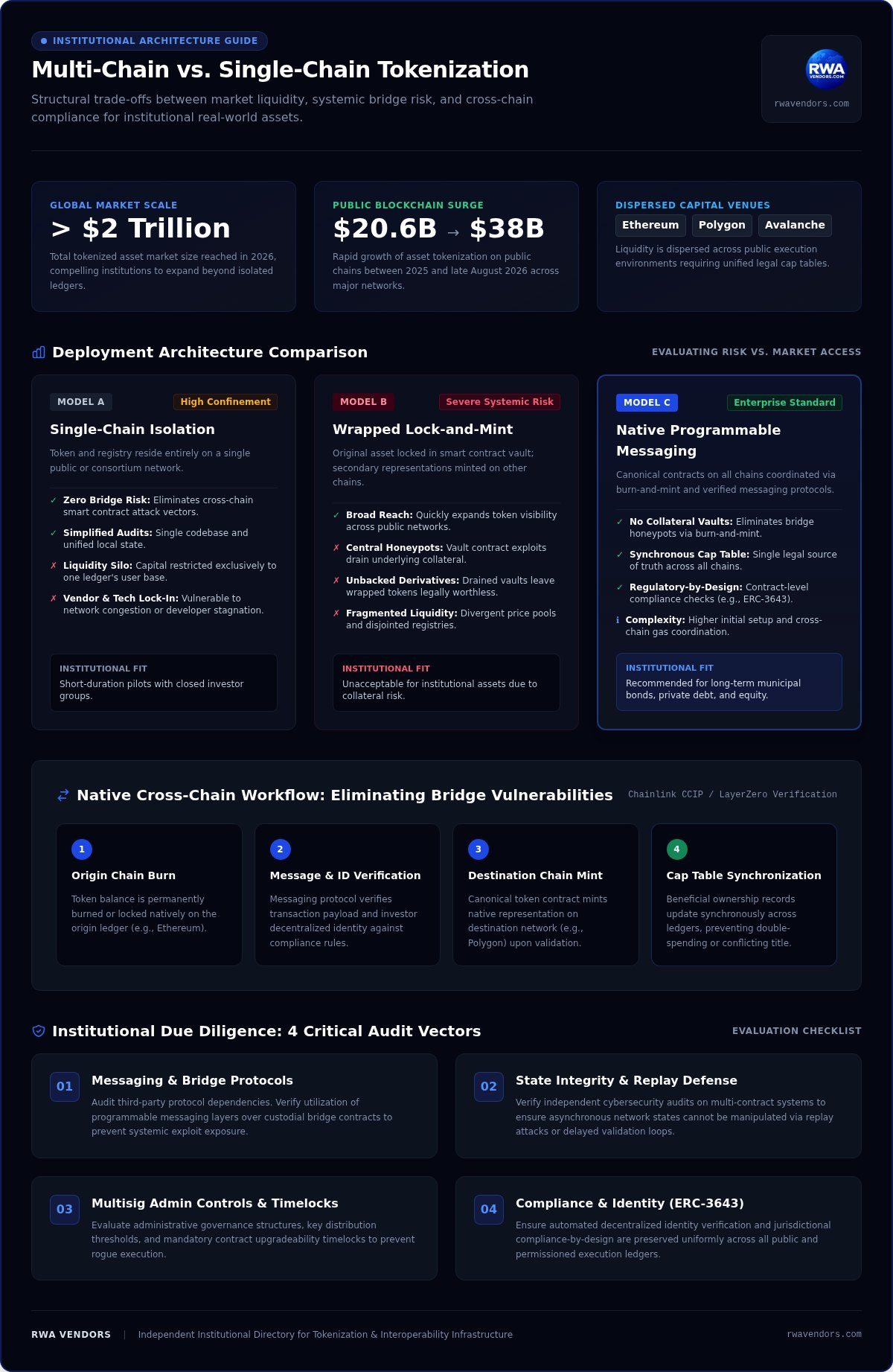
Institutional Due Diligence: How to Evaluate Multi-Chain Tokenization Providers
Evaluating infrastructure partners requires moving past marketing claims and auditing the operational dependencies underpinning multi-chain architectures. When selecting enterprise-grade multi-chain tokenization solutions, institutional procurement teams should apply a structured five-step assessment framework:
- Step 1: Protocol Trust Assumptions. Audit the consensus mechanisms, relayer incentives, and validator economic security securing cross-chain messaging layers to ensure zero single points of failure.
- Step 2: Governance and Upgradeability. Inspect smart contract proxy architectures, administrative multisig threshold configurations, and mandatory timelocks to prevent unilateral logic mutations.
- Step 3: Ecosystem Interoperability. Validate turnkey compatibility with institutional custodians, regulated broker-dealers, and licensed alternative trading systems (ATS).
- Step 4: Regulatory Integrations. Verify provider support across specific legal jurisdictions, automated tax frameworks, and registered digital transfer agent software.
- Step 5: Ecosystem Breadth. Reference our comprehensive institutional guide to digital asset infrastructure providers in 2026 to ensure complete alignment across your technical and legal stack.
Security and Infrastructure Verification Criteria
Institutions must require dual-firm formal verification audits on every contract repository before deploying assets live. Scrutinize whether cross-chain relays rely on centralized oracle committees or decentralized verification networks. Additionally, assess failover mechanisms: if a destination blockchain undergoes an unscheduled hard fork or extended downtime, the provider's architecture must automatically pause state messaging and prevent double-minting risks.
Ecosystem Compatibility and Custody Interoperability
Asset issuers can't operate in technological isolation. Enterprise multi-chain tokenization solutions must natively integrate with qualified custodian software, including Fireblocks and Copper, enabling institutional investors to safeguard private keys within compliant multi-party computation (MPC) environments. Ensure the vendor utilizes open standards like ERC-3643 rather than proprietary, closed-source smart contracts that lock your cap table into their ecosystem indefinitely.
Selecting Verified Multi-Chain Infrastructure Through RWA Vendors
Sourcing production-ready infrastructure requires an objective view of the market landscape. Rather than relying on closed vendor presentations that promote single-stack monopolies, asset managers must independently evaluate modular technology partners. As the global asset tokenization market targets over $2.1 trillion in 2026, issuers require transparent data to compare deployment engines, identity registries, and institutional custody integrations. Reviewing our foundational analysis on compliant asset tokenization provides the structural baseline required before issuing formal vendor RFPs. Using a neutral industry directory ensures your selection process remains free from proprietary lock-in.
Navigating the Tokenized Capital Markets Directory
RWA Vendors serves as an independent ecosystem directory, originally established through its affiliation with The STO Foundation circa 2017-2018. The platform provides a categorized taxonomy of verified technology, compliance, and legal infrastructure partners. Issuers can filter providers by specific criteria:
- Supported Blockchains: Identify protocols compatible with specific EVM environments, sovereign subnets, or permissioned ledgers.
- Interoperability Stacks: Filter for native burn-and-mint architectures, decentralized identity frameworks, and zero-knowledge proof verification.
- Institutional Servicing: Connect with vetted transfer agents, qualified digital asset custodians, and cybersecurity audit firms.
Accelerating Multi-Chain Asset Deployment
Procuring vetted multi-chain tokenization solutions dramatically reduces deployment timelines and protects issuers against counterparty execution risks. Instead of spending months verifying smart contract reliability or regulatory compliance claims, issuers can evaluate pre-screened directory profiles detailing real-world institutional experience. When you are ready to explore verified partners across every stage of the lifecycle, you can discover verified multi-chain tokenization providers positioned to scale your capital market operations globally.
Scaling Institutional Interoperability for Tokenized Capital Markets
Navigating institutional real-world asset distribution demands moving past single-ledger silos without exposing balance sheets to vulnerable collateral pools. Modern multi-chain tokenization solutions succeed when programmable messaging protocols, decentralized identity frameworks, and automated transfer restrictions harmonize to preserve master cap table integrity across every connected network.
Selecting the right technical partners is essential to preventing proprietary lock-in and safeguarding asset sovereignty. As the independent ecosystem directory arm affiliated with The STO Foundation since circa 2017-2018, RWA Vendors delivers comprehensive global coverage of vetted digital asset partners. Our structured taxonomy categorizes institutional providers across qualified custody, automated compliance layers, and core tokenization infrastructure.
Equipping your organization with vetted, modular architecture today establishes the operational foundation needed to capture global liquidity safely and scale your issuance pipeline with confidence.
Frequently Asked Questions
What is the difference between multi-chain tokenization and traditional crypto bridging?
Traditional bridges lock collateral in smart contract pools on an origin network and issue wrapped representations on a destination chain, exposing capital to bridge pool hacks. In contrast, enterprise multi-chain tokenization solutions coordinate canonical issuance natively across ledgers using burn-and-mint mechanisms or synchronized messaging. Tokens represent genuine underlying ownership without custodial intermediary risk, ensuring legal title remains tied directly to the asset rather than a synthetic wrapper.
Can real-world asset security tokens legally exist on more than one blockchain simultaneously?
Yes, provided the issuer maintains a legally recognized master registry of record. Securities regulators evaluate legal ownership based on the issuer's transfer agent cap table rather than network location. As long as contracts communicate state changes deterministically to prevent double-spending or conflicting title claims, a single security offering can have compliant shares circulating simultaneously across multiple approved public and private blockchains.
How do multi-chain tokenization solutions maintain an accurate shareholder cap table?
Institutional multi-chain tokenization solutions synchronize on-chain balances with a centralized or federated digital transfer agent registry. Whenever a transaction settles on a secondary network, cross-chain messaging layers broadcast state attestations back to the canonical ledger. This ensures corporate actions, voting rights, and tax records reflect real-time global positions without balance mismatches, maintaining an authoritative, auditable record of beneficial ownership across every active ecosystem.
What happens if one of the blockchains supporting a multi-chain security token halts or hard forks?
Modern architectures incorporate administrative emergency pause logic and deterministic off-chain failovers. If an underlying network halts, contracts on that specific ledger freeze trading while unaffected chains continue regular settlement. Digital transfer agents retain legal authority to cancel orphaned tokens on the dysfunctional chain and re-issue valid shares on a functioning network or an off-chain book-entry ledger, ensuring investor property rights remain intact.
Which technical standards govern compliant multi-chain real-world asset issuance?
The ERC-3643 standard leads regulated token issuance by enforcing identity checks directly within smart contracts, backed by over $28 billion in tokenized assets. When paired with cross-chain communication protocols like Chainlink CCIP and LayerZero, ERC-3643 tokens synchronize transfer compliance rules globally. These open standards enable deterministic permission verification, cap table updates, and seamless interoperability with institutional custodians across distinct EVM-compatible ecosystems.
Does deploying tokens across multiple chains increase smart contract security risk for asset issuers?
Deploying across multiple networks expands an asset's attack surface through additional smart contract deployments, asynchronous settlement windows, and external messaging relayers. Issuers mitigate this risk by avoiding lock-and-mint bridge vaults in favor of native burn-and-mint architectures. Engaging tier-one cybersecurity auditors for dual-firm formal verification and enforcing multisig governance timelocks ensures multi-contract configurations remain secure against reentrancy, replay attacks, and state synchronization exploits.
How do transfer agents manage KYC and AML whitelists across disparate blockchain networks?
Transfer agents leverage decentralized identity registries, such as ONCHAINID, rather than managing manual, fragmented address lists on every chain. When an investor completes KYC and AML vetting, a digital identity token issues cryptographic proof of compliance to their wallet. Smart contracts across all supported networks read these identity claims directly before approving transfers, ensuring global regulatory compliance without requiring investors to submit credentials repeatedly.
Disclaimer
This article is provided by RWAVendors.com for general informational and educational purposes only. It does not constitute legal, financial, investment, tax, regulatory or other professional advice, or an offer, solicitation, recommendation or endorsement of any company, product, service, token, security or investment. RWAVendors.com is an informational vendor directory and does not sell, issue, broker, custody or facilitate transactions involving cryptocurrencies, digital tokens, tokenized assets, securities or investment products. Some vendor listings and references may involve paid advertising, sponsored placement or membership relationships. These relationships do not guarantee a vendor’s qualifications, regulatory status, performance or suitability. Information may be incomplete, outdated or subject to change. You should independently verify all information, conduct your own due diligence and consult qualified professionals before making any business or investment decision. RWAVendors.com is not responsible for the content, services, representations or actions of third-party vendors or linked websites.


