
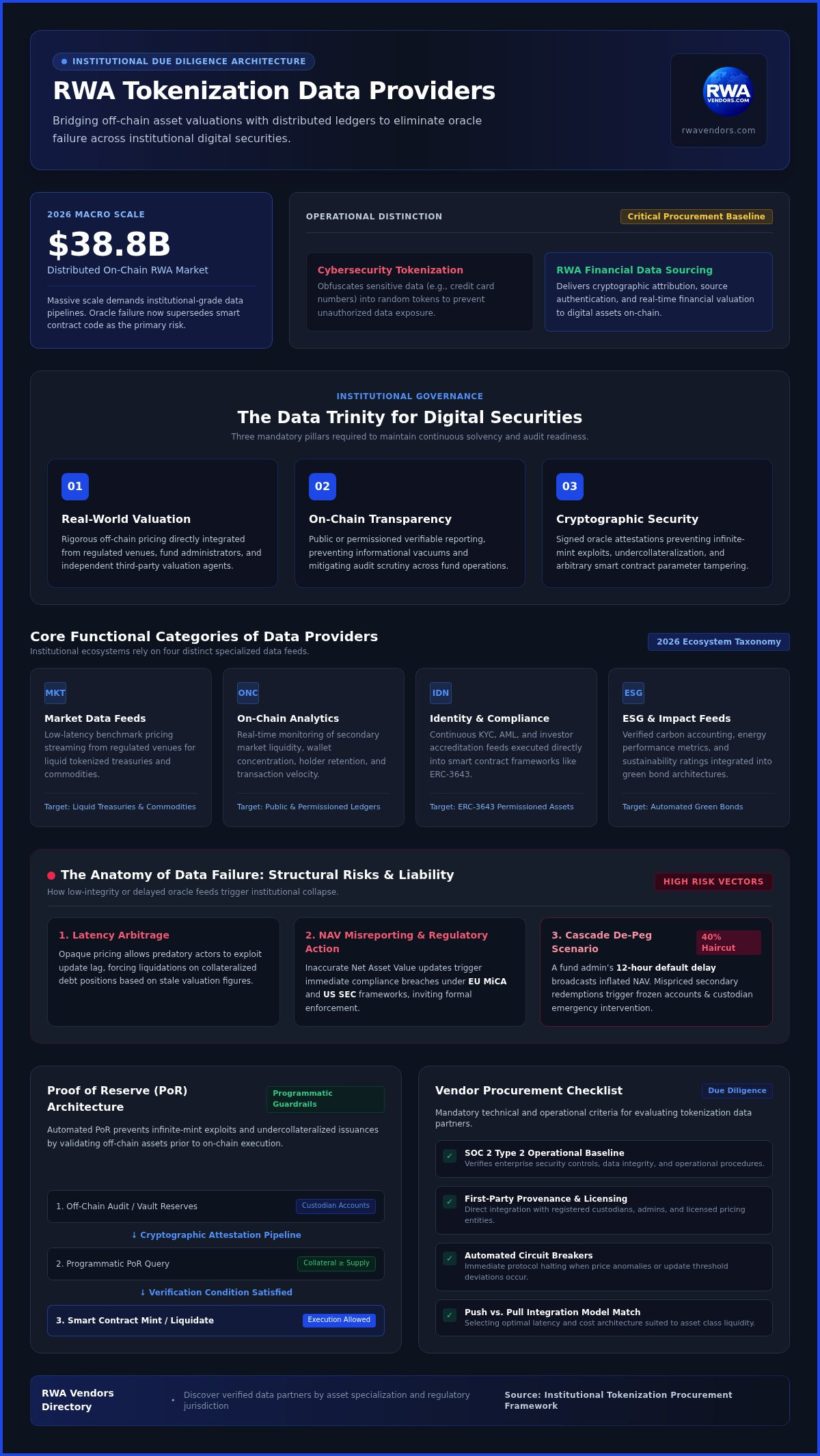
With the distributed on-chain RWA market reaching $38.8 billion in 2026, the primary threat to institutional digital securities isn't smart contract code; it's oracle failure. When tokenized assets rely on flawed off-chain valuations, bad pricing breaks compliance models and invalidates collateral rules. Choosing reliable tokenization data providers has quickly become the defining risk-management decision for modern asset issuers.
You already know the operational headache behind this reality. Integrating legacy accounting feeds with distributed ledgers creates persistent friction, while a lack of transparent on-chain reporting leaves your fund exposed to audit scrutiny. Sustained success requires mastering the Data Trinity: rigorous real-world valuation, verifiable on-chain transparency, and cryptographic security.
This guide delivers a clear due diligence framework to evaluate RWA data partners and establish seamless connections between physical asset valuations and smart contracts. We examine critical 2026 procurement benchmarks, including SOC 2 Type 2 operational baselines, first-party data provenance, and automated Proof of Reserve guardrails.
Key Takeaways
- Understand the operational distinction between data obfuscation and financial data sourcing to prevent valuation vulnerabilities across the RWA lifecycle.
- Evaluate primary categories of tokenization data providers, from real-time pricing feeds and NAV attestations to on-chain liquidity analytics.
- Apply a comprehensive institutional checklist covering SOC 2 Type 2 verification, regulatory registrations, update latency, and automated circuit breakers.
- Select optimal oracle integration architectures (push vs. pull models) matched specifically to your underlying asset class and smart contract execution needs.
- Leverage the RWA Vendors global directory to discover and evaluate verified data partners filtered by asset specialization and regulatory jurisdiction.
The Critical Role of Data Providers in Asset Tokenization
Enterprise procurement teams often conflate two entirely different concepts: cybersecurity data tokenization and real-world asset (RWA) data sourcing. The former focuses on obfuscating sensitive information like credit card numbers into random tokens to prevent unauthorized access. In institutional capital markets, however, tokenization data providers serve the opposite function. They deliver cryptographic attribution, source authentication, and real-time financial valuation to on-chain tokens representing private credit, real estate, and government treasuries.
Without rigorous off-chain feeds, distributed ledgers operate in an informational vacuum. The smart contracts governing digital securities cannot natively query external APIs, assess secondary market pricing, or independently audit off-chain reserves. This limitation forms the classic "Oracle Problem." For institutional issuers, bad data creates structural failure: an error in an external valuation feed propagates instantly across secondary markets, triggering erroneous liquidations and violating automated compliance rules.
Bridging the Off-Chain and On-Chain Gap
In the 2026 RWA infrastructure stack, data oracles serve as cryptographically verified pipelines that transport real-world financial valuations, custody balances, and audit records directly into smart contracts. Deploying institutional assets requires stable blockchain oracle mechanisms that connect custody accounts, fund administrators, and market makers directly to on-chain ledgers.
Proof of Reserve (PoR) protocols represent a key defense against systematic risk. Programmatic PoR architectures query custodian bank balances or physical vault audits, validating that real-world collateral equals or exceeds the distributed token supply before allowing mint operations. This prevents infinite-mint exploits and undercollateralized issuances.
The Consequences of Poor Data Quality
Low-integrity feeds expose asset issuers to immediate legal liabilities and market vulnerabilities:
- Market Exploitation: Opaque pricing feeds allow sophisticated actors to exploit latency arbitrage, liquidating collateralized debt positions based on stale valuation figures.
- NAV Misreporting: Inaccurate Net Asset Value (NAV) updates trigger direct compliance breaches under frameworks like the EU's MiCA and US SEC guidelines, subjecting managers to formal enforcement actions.
- Cascade De-Pegs: Consider a hypothetical 2025 incident involving a tokenized private credit portfolio: a fund administrator's delayed default reporting led the oracle to broadcast an inflated NAV for twelve straight hours. Secondary liquidity pools mispriced redemptions, resulting in a 40% protocol haircut, frozen investor accounts, and emergency intervention by custodians.
Institutional issuers must source vetted tokenization data providers capable of delivering resilient, cryptographically attested records across every market cycle.
Core Categories of Tokenization Data Providers
Enterprise procurement teams cannot rely on generic enterprise analytics tools for digital securities. While legacy software monitors off-chain databases, institutional tokenization data providers must deliver cryptographically signed feeds directly into smart contract execution environments. In 2026, the institutional vendor landscape divides into four core functional disciplines:
- Market Data Providers: Stream low-latency benchmark pricing from regulated venues, supplying the primary price discovery feeds required for liquid tokenized treasuries and commodities.
- On-Chain Analytics: Track secondary market liquidity, wallet concentration, holder retention, and transaction velocity across public and permissioned ledgers.
- Identity and Compliance Feeds: Deliver continuous KYC, AML, and accreditation verification data directly to permissioned smart contract frameworks like ERC-3643.
- ESG and Impact Feeds: Provide verified carbon accounting, energy performance, and sustainability ratings to automated green bond architectures.
Real-World Asset (RWA) Valuation Feeds
Illiquid assets such as commercial real estate, private credit, and infrastructure debt cannot rely on continuous exchange trading for price discovery. They require programmatic interfaces with independent, third-party valuation agents and fund administrators. As highlighted in recent Federal Reserve remarks on tokenization, resolving operational reconciliation between off-chain books and distributed ledgers is vital for managing structural liquidity risk. Issuers handling complex private debt frequently coordinate with verified institutional digital asset partners to establish automated, auditable Net Asset Value (NAV) attestation schedules that update on-chain tokens at predetermined intervals.
Blockchain Intelligence and Forensics
Institutional compliance requires continuous surveillance of token circulation to prevent sanctions breaches and satisfy FATF Travel Rule mandates. Modern forensics feeds monitor wallet interactions, flag mixing behaviors, and identify counterparty risk before transactions settle. The global RWA Vendors directory curates verified blockchain intelligence providers built specifically for institutional digital assets, while specialized data providers can apply for a directory listing to connect directly with regulated token issuers.
The Institutional Checklist for Evaluating Data Vendors
Evaluating external data partners requires balancing financial accuracy against operational resilience. Selecting suitable tokenization data providers demands looking past superficial dashboards to verify legal standing, architectural fail-safes, and protocol integration parameters across four baseline categories:
- Regulatory Standing: Verify whether the vendor holds formal registrations with capital market regulators or maintains recognized auditor oversight, satisfying governance expectations highlighted in the CPMI report on asset tokenisation.
- Latency and Push-Frequency SLAs: Match update cadences to asset characteristics. Liquid securities require sub-second feeds, while private equity or private credit mandates scheduled daily or weekly Net Asset Value (NAV) attestation schedules.
- Fail-Safe Fallbacks and Circuit Breakers: Confirm automated pause procedures. If a feed deviates past set variance thresholds or encounters network dropouts, the feed should halt smart contract minting and redemption operations automatically.
- Multi-Ledger Portability: Ensure native cross-chain compatibility across institutional environments, including major EVM networks, Solana, and permissioned enterprise subnets.
Technical Due Diligence
Technical due diligence begins with examining operational controls. Enterprise procurement mandates SOC 2 Type 2 reports covering 3 to 12 months, along with ISO 27001 certifications. Feeds must deliver 99.9% or higher API uptime backed by binding service-level agreements. Cryptographic signing at the source is required to prove provenance and prevent man-in-the-middle exploits. For an in-depth review of infrastructure hardening, reference our operational guide on tokenization cybersecurity vendors.
Commercial and Operational Viability
Operational due diligence must establish long-term provider viability. In 2026, enterprise vendor contracts generally operate under three billing structures: fixed enterprise SaaS subscriptions for NAV updates, per-query gas-metered fees for pull oracles, or volume-indexed rates based on distributed Assets Under Management (AUM). Balance these commercial terms against balance-sheet depth, historical uptime audits, and verified footprint across major RWA deployments before signing long-term data service contracts.
Integrating Data Feeds into the RWA Lifecycle
Integrating off-chain valuation into on-chain architecture is not a one-time API deployment. It requires a continuous data pipeline that aligns with each phase of the asset lifecycle. Qualified tokenization data providers must deliver structured inputs across four clear operational stages:
- Stage 1: Lifecycle Requirement Mapping: Define the data dependencies for primary issuance, periodic interest calculations, compliance whitelisting, and secondary redemptions.
- Stage 2: Architectural Selection: Choose between push oracles, which broadcast data on-chain at scheduled intervals or variance thresholds, and on-demand pull oracles, which allow users to fetch cryptographically signed data only when executing transactions to conserve gas.
- Stage 3: Multi-Source Aggregation: Ingest feeds from multiple independent valuation agents and exchanges. Aggregating diverse nodes prevents single-source manipulation and eliminates reliance on any individual vendor.
- Stage 4: Automated Circuit Breakers: Program smart contracts to pause trading, minting, or redemptions automatically if feeds go stale or report values beyond pre-configured standard deviations.
Data Sourcing for Primary Issuance
Primary minting requires rigorous appraisal records to set base pricing. Independent physical inspections, custodian balance reconciliations, and verified financial audits must be cryptographically attested before smart contracts mint security tokens. Integrating these checks with compliant asset tokenization tech ensures identity feeds verify accredited investor limits, jurisdiction permissions, and cap-table rules prior to token transfer.
Ongoing Reporting and Secondary Markets
Following issuance, the operational burden shifts to continuous Net Asset Value calculation and secondary trading support. Private credit and fund assets depend on verified fund administrators to push daily or monthly valuations directly into smart contracts. These attested NAV feeds publish directly to institutional venues, supporting orderly price discovery on security token secondary markets while giving LPs transparent performance dashboards.
Securing resilient data pipelines protects issuers against catastrophic oracle drift and preserves institutional market integrity.
Finding Vetted Tokenization Data Providers
Procuring digital securities infrastructure is often delayed by fragmented market information. Traditional IT research firms frequently lump decentralized oracle networks and valuation engines under broad software categories, while closed research databases lock provider intelligence behind expensive consulting retainers. Asset issuers need direct, transparent access to specialized firms that understand the legal and technical boundaries of asset-backed tokens.
The RWA Vendors directory simplifies this discovery phase. Operated by the Security Token Offering (STO) Foundation, which has supported the digital securities ecosystem since 2017, the platform serves as a central discovery engine. It empowers fund managers, enterprise sponsors, and procurement teams to identify and evaluate qualified tokenization data providers alongside custody, legal, and compliance partners.
Leveraging the RWA Vendors Directory
The platform provides granular filtering tools tailored specifically to institutional workflows. Issuers can filter infrastructure vendors based on target asset classes, such as private credit, real estate, or fixed income, as well as relevant legal frameworks across global jurisdictions. Each profile features verified operational details, architectural whitepapers, and integration documentation.
Providers carrying the "Verified" badge undergo structured diligence within the STO Foundation ecosystem. This badge confirms active operational deployment, authentic case evidence, and proven compatibility with established security token protocols.
Building Your Infrastructure Partner Network
External feeds do not operate in a silo. A resilient issuance program requires seamless technical and operational alignment across three core layers:
- Custody and Safeguarding: Connecting off-chain account reserves directly to qualified custodian APIs.
- Valuation Feeds: Routing independent calculation agent Net Asset Value (NAV) updates into smart contract oracles.
- Compliance and Transfer Agency: Synchronizing on-chain investor whitelists with statutory ownership registries.
Ensuring technical interoperability across these systems protects your fund against integration bottlenecks before primary issuance begins. Explore verified market leaders to accelerate your institutional rollout:
Browse vetted tokenization data providers on RWA Vendors
Executing Your 2026 Data Provider Strategy
Institutional scale requires eliminating the single point of failure between physical valuations and distributed networks. Deploying digital securities demands rigorous diligence across SOC 2 operational baselines, multi-source aggregation, and automated smart contract circuit breakers. Selecting resilient tokenization data providers transforms off-chain transparency from an audit risk into a clear competitive advantage.
You don't need to navigate this fragmented landscape alone. The RWA Vendors directory offers comprehensive global coverage for digital securities infrastructure. Operated by The STO Foundation, the platform streamlines enterprise procurement by connecting asset issuers directly with vetted, institutional-grade vendors across data feeds, custody solutions, and compliance frameworks.
Equip your tokenized issuance with verified infrastructure partners today, and position your portfolio for compliant, long-term growth across global capital markets.
Frequently Asked Questions
What is the difference between a data provider and a blockchain oracle?
A data provider generates, audits, or aggregates off-chain information such as appraisals, exchange pricing, or NAV calculations. A blockchain oracle is the middleware technology that transmits and cryptographically attests that data onto the blockchain. In short, the data provider supplies the raw valuation records, while the oracle acts as the secure transportation bridge that makes those records readable by smart contracts.
How do data providers ensure the accuracy of real estate valuations?
Institutional providers partner with licensed appraisal firms, property managers, and automated valuation models. They ingest certified property appraisals, rental cash flow statements, and local market comparables on a periodic schedule. These figures are cross-checked against independent accounting reports before being cryptographically signed, ensuring that on-chain Net Asset Value representations reflect audited real-world property performance rather than unverified estimates.
Are there specific data providers for regulated security tokens?
Yes, regulated security tokens require specialized tokenization data providers that support institutional compliance standards like ERC-3643. These specialized vendors deliver real-time compliance feeds, accredited investor verification, and transfer-restriction checks directly to smart contracts. They also integrate with regulated fund administrators to publish periodic NAV updates, satisfying supervisory requirements under capital market frameworks such as the EU's MiCA and US SEC exemptions.
How much do institutional tokenization data feeds typically cost?
Pricing varies widely based on asset complexity, update frequency, and delivery architecture. High-frequency pricing feeds for liquid securities typically charge monthly enterprise retainers or per-query gas fees. Conversely, periodic NAV feeds for private credit or real estate usually operate under fixed annual software licenses paired with auditing costs. Issuers should negotiate custom SLAs directly with vendors based on required data redundancy and update velocity.
Can I use multiple data providers for a single tokenized asset?
Yes, utilizing multiple data providers is an established institutional best practice known as multi-oracle aggregation. By ingesting valuations from several independent calculation agents or feeds, smart contracts calculate a median or trimmed mean value. This structure eliminates single points of failure, prevents bad actor manipulation, and protects secondary market liquidity if a single feed experiences downtime or reports erroneous data.
What happens if a data provider goes offline during a market event?
If an oracle feed drops offline, properly constructed smart contracts trigger automated fallback mechanisms or heartbeat timeouts. When an update fails to arrive within the agreed SLA window, programmatic circuit breakers immediately pause secondary trading, minting, or liquidations. This prevents the contract from executing transactions at stale prices until redundant feeds confirm accurate market values or administrative recovery triggers.
Do tokenization data providers handle KYC and AML data?
Specialized identity and compliance data vendors manage verification feeds, but they rarely expose raw Personally Identifiable Information on public ledgers. Instead, institutional tokenization data providers issue cryptographic attestations or zero-knowledge credentials linked to an investor's wallet address. This process allows smart contracts to verify accredited status, jurisdiction eligibility, and AML compliance programmatically without compromising sensitive investor identity records.
How do I integrate a data feed into my smart contract safely?
Safe integration requires implementing robust defensive programming practices. Developers should deploy multi-source aggregation, strict deviation checks, and fallback oracle addresses. Contracts must also enforce heartbeat timeouts to reject stale data and utilize multi-signature controls for critical parameter updates. Comprehensive smart contract audits and continuous testnet simulations under extreme volatility conditions are mandatory before deploying live institutional capital.
Disclaimer
This article is provided by RWAVendors.com for general informational and educational purposes only. It does not constitute legal, financial, investment, tax, regulatory or other professional advice, or an offer, solicitation, recommendation or endorsement of any company, product, service, token, security or investment. RWAVendors.com is an informational vendor directory and does not sell, issue, broker, custody or facilitate transactions involving cryptocurrencies, digital tokens, tokenized assets, securities or investment products. Some vendor listings and references may involve paid advertising, sponsored placement or membership relationships. These relationships do not guarantee a vendor’s qualifications, regulatory status, performance or suitability. Information may be incomplete, outdated or subject to change. You should independently verify all information, conduct your own due diligence and consult qualified professionals before making any business or investment decision. RWAVendors.com is not responsible for the content, services, representations or actions of third-party vendors or linked websites.


