
While the 2024 shift to T+1 settlement was hailed as a modernization milestone, it merely highlighted the persistent capital inefficiencies inherent in legacy financial plumbing. In 2026, the demand for instantaneous finality has transformed blockchain settlement systems from experimental projects into the essential efficiency layer for global capital markets. You're likely aware that traditional T+2 cycles and intermediary fees represent a significant drag on asset management performance. These legacy delays don't just increase costs; they create unnecessary counterparty risks in increasingly complex cross-border transactions.
This guide serves as your institutional reference for mastering the transition to atomic, 24/7 settlement. We'll break down the architecture of unified ledgers, evaluate the shift from isolated pilots to interoperable networks like Project Agorá, and define the criteria for selecting high-performance infrastructure. By the end of this analysis, you'll understand how to leverage vetted vendors to reduce operational overhead and achieve true Delivery versus Payment (DvP) in the tokenized economy. The era of probabilistic settlement is over; the era of cryptographic finality has arrived.
Key Takeaways
- Contrast the architectural differences between traditional messaging-based systems and modern value-based distributed ledger technology.
- Understand the mechanics of atomic settlement and how simultaneous trade execution eliminates counterparty risk.
- Identify the cost-saving potential of migrating from legacy T+2 cycles to instantaneous blockchain settlement systems.
- Establish a rigorous framework for evaluating vendor capabilities, focusing on regulatory status and technical liveness.
- Learn to navigate the global provider landscape by leveraging the RWA Vendors directory of vetted institutional partners.
What are Blockchain Settlement Systems in 2026?
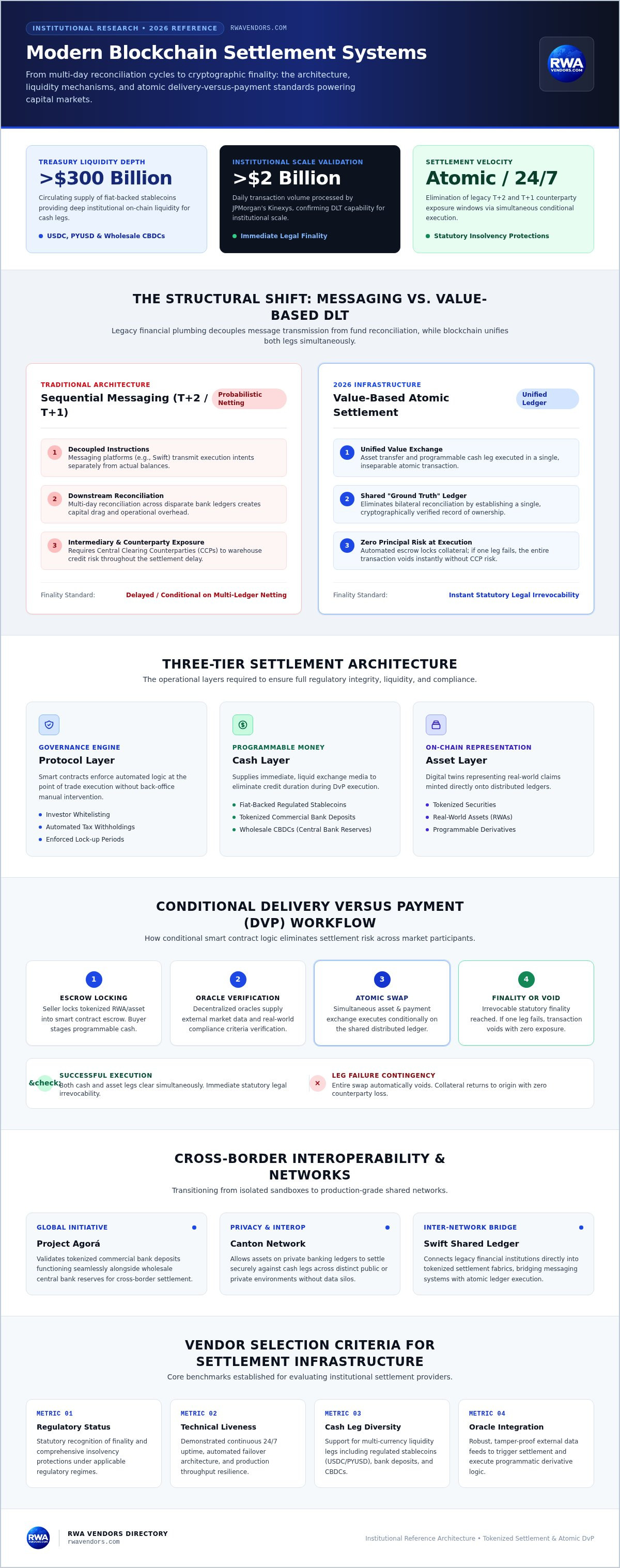
In 2026, blockchain settlement systems represent the final, irrevocable exchange of assets for payment directly on a distributed ledger. This architecture marks a fundamental departure from legacy messaging-based systems like Swift. In traditional finance, a message triggers a series of downstream reconciliation steps across disparate bank ledgers. In a value-based DLT environment, the asset transfer and the payment leg occur as a single, unified transaction. This shift eliminates the latency inherent in multi-day reconciliation cycles and provides a ground truth for ownership that all participants share simultaneously.
The 2026 landscape is defined by the integration of programmable cash legs. Institutional adoption has moved beyond isolated pilots toward interoperable networks where Central Bank Digital Currencies (CBDCs) and regulated stablecoins serve as the primary medium of exchange. For example, Project Agorá has validated the use of tokenized commercial bank deposits alongside central bank reserves for cross-border transactions. Smart contracts now automate the settlement logic, ensuring that compliance checks and tax withholdings are executed the moment the trade conditions are met. This automation transforms settlement from a back-office burden into a real-time competitive advantage.
The Core Components of On-Chain Settlement
Modern blockchain settlement systems rely on a three-tier architecture to ensure operational integrity:
- Asset Layer: This consists of tokenized securities and real-world assets (RWAs) that have been minted as digital twins on the ledger.
- Cash Layer: Programmable money, such as USDC, PYUSD, or wholesale CBDCs, provides the liquidity necessary for instant exchange. By 2026, the circulating supply of fiat-backed stablecoins has exceeded $300 billion, providing deep liquidity for treasury operations.
- Protocol Layer: This is the governance engine where smart contracts enforce the rules of the exchange, including lock-up periods and investor whitelisting.
Institutional Demand for Real-Time Finality
Institutional participants prioritize "finality" as their most critical performance metric. While legacy frameworks utilize the delivery versus payment settlement mechanism, they often involve significant counterparty risk during the T+1 or T+2 window. Blockchain infrastructure reduces this risk through automated collateral management, where assets are locked in escrow until the payment leg is verified. Systems like JPMorgan’s Kinexys now process over $2 billion in daily volume, proving that DLT can handle institutional scale while providing immediate legal certainty.
Under 2026 regulatory standards, settlement finality is defined as the precise moment a transaction becomes legally irrevocable and unconditional, secured by statutory insolvency protections rather than mere probabilistic network consensus.
Mechanisms of Modern Blockchain Settlement
Traditional settlement relies on a sequential process where the transfer of securities and funds occurs at different times, often across disparate systems. In contrast, blockchain settlement systems utilize a Delivery versus Payment (DvP) model where the exchange is conditional and inseparable. This means the transfer of the asset only occurs if the payment is simultaneously confirmed on the ledger. If one leg of the transaction fails, the entire swap is voided. This conditional logic is baked into the protocol, ensuring that no participant is left exposed to a counterparty who fails to deliver.
To maintain this integrity across a fragmented landscape, interoperability protocols like the Canton Network or Swift’s shared ledger are essential. These frameworks allow assets on a private banking ledger to settle against cash legs on public chains or other private environments without creating data silos. Oracles act as the critical bridge in this ecosystem, providing the external data required to trigger settlement for complex instruments. Whether it's a price feed for a derivative or a verification of a real-world event, oracles ensure the smart contract has the "ground truth" necessary to execute the trade.
Atomic Settlement vs. Traditional Netting
Legacy netting models reduce the total number of transactions but require central clearing counterparties (CCPs) to manage the resulting credit risk during the T+1 or T+2 window. Atomic settlement removes the need for a CCP by making the transaction risk-free at the point of execution. According to the Federal Reserve Bank of New York's analysis of atomic settlement, the move toward simultaneous execution reduces the duration of credit exposure to zero. This shift frees up billions in capital that was previously locked in clearinghouse margin accounts, though it requires institutions to manage intraday liquidity with greater precision.
A typical atomic swap transaction follows a structured four-step process:
- Trade Agreement: Counterparties agree on terms and lock their respective assets into a secure smart contract.
- Compliance Verification: The protocol automatically validates that both parties meet KYC/AML requirements and possess the necessary balances.
- Simultaneous Swap: The smart contract executes the transfer of ownership for both the asset and the cash leg in a single ledger update.
- Irrevocable Finality: The transaction is broadcast and confirmed, achieving immediate legal finality under 2026 statutory frameworks.
The Role of Smart Contracts in Compliance
In the 2026 environment, compliance isn't a post-trade check; it's a pre-condition for settlement. Smart contracts automate KYC and AML protocols at the settlement layer, preventing unauthorized transfers before they can occur. These programmable restrictions ensure that only eligible, whitelisted investors can receive specific tokens, maintaining regulatory integrity across secondary markets. For a deeper look at the technical requirements for these systems, consult our guide on compliant asset tokenization tech. Institutions looking to implement these advanced mechanisms should evaluate vetted technology providers within our directory to ensure they meet global standards.
Blockchain vs. Legacy Settlement Systems
The primary distinction between legacy financial infrastructure and blockchain settlement systems lies in the temporal gap between trade execution and finality. Traditional systems operate on an asynchronous messaging model, typically requiring T+1 or T+2 cycles to reconcile disparate ledgers. While North America migrated to a mandatory T+1 baseline in May 2024, the UK and EU continue to target 2027 for similar transitions. This lag creates inherent "Herstatt Risk," the danger that one party delivers payment while the counterparty fails before asset delivery. DLT-native architectures neutralize this risk by collapsing the clearing and settlement phases into a single, atomic T+0 event.
Transitioning to these modern systems doesn't always require a "rip-and-replace" approach. Many institutions now employ hybrid models where a blockchain orchestration layer sits atop existing rails. This allows firms to benefit from 24/7/365 availability and cryptographic certainty while maintaining backward compatibility with legacy core banking systems. As detailed in the Federal Reserve research on distributed ledger clearing and settlement, these architectures fundamentally alter the post-trade landscape by providing a shared, immutable record that eliminates the need for manual, multi-party reconciliation.
Efficiency Metrics: Cost and Speed
Legacy settlement relies on a complex web of intermediaries, including Central Securities Depositories (CSDs) and Central Clearing Counterparties (CCPs), each adding layers of fees and operational friction. In contrast, blockchain settlement systems automate these functions through smart contracts, significantly reducing the back-office headcount previously dedicated to resolving trade breaks. Industry data suggests that manual reconciliation can account for up to 30% of operational overhead in traditional asset management; DLT-driven automation targets the near-total elimination of these costs.
| Feature | Legacy Systems (T+1/T+2) | Blockchain Systems (T+0) |
|---|---|---|
| Speed | 24–48 Hours | Near-Instant |
| Operational Cost | High (Manual Reconciliation) | Low (Automated Logic) |
| Intermediaries | Multiple (CSDs, CCPs) | Minimal (Direct Peer-to-Peer) |
| Finality Risk | Probabilistic/Delayed | Deterministic/Immediate |
Liquidity and Capital Efficiency
Instantaneous settlement provides a massive boost to capital efficiency by reducing "margin drag." In legacy cycles, capital is often locked in clearinghouse margin accounts to cover potential defaults during the multi-day settlement window. Atomic settlement frees this liquidity for immediate redeployment, allowing treasury departments to optimize intraday cash flows. This is particularly transformative for security token secondary markets, where high-velocity trading requires the rapid rotation of both assets and cash legs to maintain market depth and narrow spreads.
Selection Criteria for Institutional Settlement Vendors
Choosing a provider for blockchain settlement systems requires a rigorous assessment of both legal standing and technical resilience. Institutions must treat the settlement layer as the primary engine of their risk management strategy rather than a modular add-on. A vendor’s ability to guarantee irrevocable finality depends on their regulatory permissions and the robustness of their underlying code. Prioritize partners who demonstrate a clear understanding of the "gatekeeper" responsibilities inherent in institutional finance and real-world asset management.
Regulatory and Compliance Standards
Verify that the vendor holds appropriate licenses for custody and transfer agency within your operating jurisdictions. In Europe, adherence to the Markets in Crypto-Assets (MiCA) framework is a mandatory baseline for any serious provider. Auditability is equally critical; the system must provide real-time, granular reporting that allows regulators to inspect transaction trails without delay. Insist on seeing a current SOC2 Type II certification. This document serves as a verified benchmark for a provider’s internal controls and their long-term commitment to data integrity.
Technical Scalability and Interoperability
Evaluate the "liveness" and throughput of the infrastructure to ensure it can handle peak institutional volumes. High-performance settlement requires low-latency finality and high transactions-per-second (TPS) capabilities that don't degrade during periods of market volatility. The architecture should support a multi-chain environment, allowing for seamless transfers across networks like Ethereum, Polygon, and Avalanche. Robust API documentation is essential for integrating the settlement layer with legacy ERP systems and core banking platforms. For a comprehensive review of the physical hardware required for these deployments, consult our institutional guide to digital asset infrastructure providers.
Security posture remains a fundamental pillar of the selection process. Most institutional-grade blockchain settlement systems in 2026 utilize a combination of Multi-Party Computation (MPC) and Hardware Security Modules (HSM). MPC provides a distributed, flexible key management system that eliminates single points of failure, while HSMs offer a physical, tamper-proof environment for sensitive cryptographic material. This hybrid approach ensures that the platform remains agile enough for high-velocity trading while maintaining the highest standards of asset protection.
Navigating the Blockchain Settlement Ecosystem
Building resilient blockchain settlement systems requires more than just high-performance code; it demands a curated ecosystem of partners who understand the nuances of global financial compliance. Infrastructure risk remains a primary concern for institutional asset managers, making the selection of vetted technology providers a critical operational milestone. The RWA Vendors platform serves as a central pillar in this landscape, providing a structured taxonomy of settlement and payment providers who have undergone rigorous evaluation.
Founding Members of the RWA Vendors ecosystem play an active role in establishing the technical and legal benchmarks that govern modern settlement. These organizations act as industry architects, bridging the gap between traditional banking structures and the efficiency of distributed ledgers. By engaging with these verified entities, asset issuers ensure their settlement stacks are built on foundations of reliability and institutional-grade security.
Sourcing Vetted Infrastructure Partners
The RWA Vendors directory provides a surgical approach to vendor selection, allowing users to filter providers by regulatory status, geographic reach, and specific asset class expertise. This methodical organization ensures that issuers can identify partners with proven track records in high-stakes RWA projects. When evaluating potential collaborators, leverage our institutional digital asset partners directory to compare service levels and compliance frameworks across the global landscape.
Asset issuers should follow a logical progression when building their settlement stack:
- Define the legal jurisdiction and the required cash leg, such as a regulated stablecoin or wholesale CBDC.
- Select an interoperability protocol that prevents asset fragmentation across different chains.
- Verify the provider’s ability to handle sub-transaction privacy and selective disclosure requirements.
- Establish a redundancy plan for cryptographic key management and disaster recovery.
Future-Proofing Your Settlement Strategy
As we look toward 2027, the integration of wholesale CBDCs will redefine the cash leg of blockchain settlement systems. Institutions must ensure their current infrastructure is compatible with emerging central bank conduits like the Eurosystem’s Pontes pilot or the BIS Project Agorá framework. The evolution of cross-chain settlement protocols will further dissolve the boundaries between private banking ledgers and public liquidity pools, requiring a flexible architecture that can adapt to changing standards. Success in this new paradigm depends on the integrity of your partners and the precision of your technology stack.
Browse vetted blockchain settlement vendors on RWA Vendors
Advancing Toward Atomic Financial Infrastructure
The transition from legacy T+1 cycles to T+0 atomic settlement is now a functional requirement for maintaining capital efficiency in global markets. Implementing high-performance blockchain settlement systems allows your institution to neutralize Herstatt risk while significantly reducing the margin drag inherent in traditional clearing models. Success depends on selecting partners who demonstrate deep technical liveness and hold the necessary regulatory licenses for institutional custody.
RWA Vendors acts as the industry's trusted facilitator for this transition. Operated by The STO Foundation, our platform offers a curated directory of infrastructure vendors who meet the highest digital security standards. We've done the work of vetting the ecosystem so you can focus on scaling your asset management operations. The shift toward cryptographic finality is accelerating, and the right partners are waiting to help you lead the way.
Frequently Asked Questions
What is the difference between clearing and settlement in blockchain?
In blockchain architecture, clearing and settlement are often collapsed into a single, unified process. Traditional clearing involves the reconciliation and netting of obligations before the final transfer occurs. In DLT-based systems, the shared ledger provides a real-time record of ownership that allows for the simultaneous verification of assets and funds. This eliminates the multi-day reconciliation phase and the need for separate messaging and value transfer layers.
How does atomic settlement reduce capital requirements for institutions?
Atomic settlement reduces capital requirements by eliminating the need for margin collateral held against settlement risk. Because assets and payments exchange hands simultaneously, there is no temporal window where one party is exposed to counterparty default. This architecture frees up liquidity that would otherwise be locked in central clearinghouse margin accounts; it allows institutions to optimize their intraday treasury operations and redeploy capital more efficiently.
Can blockchain settlement systems handle cross-border RWA transactions?
Yes, blockchain settlement systems are specifically engineered to streamline cross-border RWA transactions by bypassing the fragmented network of correspondent banks. By utilizing a unified ledger or interoperable protocols, these systems enable 24/7 transfers across different jurisdictions. This reduces the reliance on local intermediaries and lowers the fees associated with international asset movements, provided the underlying cash leg is represented by a regulated settlement asset like a wholesale CBDC.
What are the main regulatory hurdles for blockchain settlement in 2026?
The primary regulatory hurdles involve the legal recognition of settlement finality on a distributed ledger and compliance with digital asset frameworks like MiCA. Regulators require absolute certainty that a blockchain-based transfer is legally irrevocable under insolvency laws. Additionally, maintaining sub-transaction privacy while meeting strict AML and KYC reporting requirements remains a challenge. Institutions must ensure their chosen infrastructure complies with specific statutory protections in every operating jurisdiction.
Is T+0 settlement always desirable for institutional markets?
While T+0 settlement eliminates counterparty risk, it is not always desirable due to the loss of netting benefits. Instantaneous gross settlement requires participants to have full liquidity available for every individual trade, which can be more capital-intensive than traditional netted cycles. Many institutional blockchain settlement systems now offer hybrid models. These systems use intraday netting algorithms to minimize liquidity demand before executing final atomic settlement at scheduled intervals.
How do stablecoins facilitate blockchain-based financial settlement?
Stablecoins serve as the programmable cash leg in a blockchain-based transaction, providing the liquidity needed for Delivery versus Payment (DvP). By tokenizing fiat currency, stablecoins allow the payment to exist on the same ledger as the asset; this enables smart contracts to execute simultaneous swaps. In 2026, regulated, fiat-backed stablecoins are a primary medium for wholesale treasury operations, offering a stable and liquid alternative to traditional bank transfers.
What is the role of a transfer agent in a blockchain settlement system?
The role of a transfer agent evolves from manual record-keeping to overseeing the smart contract logic that governs the ledger. They ensure the digital register of members remains accurate and that all token transfers comply with the issuer's restrictions. Transfer agents act as a critical bridge between the decentralized technology and the legal requirements of securities law; they maintain the integrity of the cap table and facilitate corporate actions like distributions.
How can I find a vetted blockchain settlement provider for my RWA project?
You can identify institutional-grade partners by searching the RWA Vendors directory. This comprehensive resource allows asset issuers to filter providers by their regulatory status, geographic coverage, and technical capabilities. Managed by The STO Foundation, the directory focuses on vetted vendors who specialize in digital securities and blockchain infrastructure. Using a curated marketplace ensures you engage with professional service providers who meet the high standards required for complex tokenization projects.
Disclaimer
This article is provided by RWAVendors.com for general informational and educational purposes only. It does not constitute legal, financial, investment, tax, regulatory or other professional advice, or an offer, solicitation, recommendation or endorsement of any company, product, service, token, security or investment. RWAVendors.com is an informational vendor directory and does not sell, issue, broker, custody or facilitate transactions involving cryptocurrencies, digital tokens, tokenized assets, securities or investment products. Some vendor listings and references may involve paid advertising, sponsored placement or membership relationships. These relationships do not guarantee a vendor’s qualifications, regulatory status, performance or suitability. Information may be incomplete, outdated or subject to change. You should independently verify all information, conduct your own due diligence and consult qualified professionals before making any business or investment decision. RWAVendors.com is not responsible for the content, services, representations or actions of third-party vendors or linked websites.


