
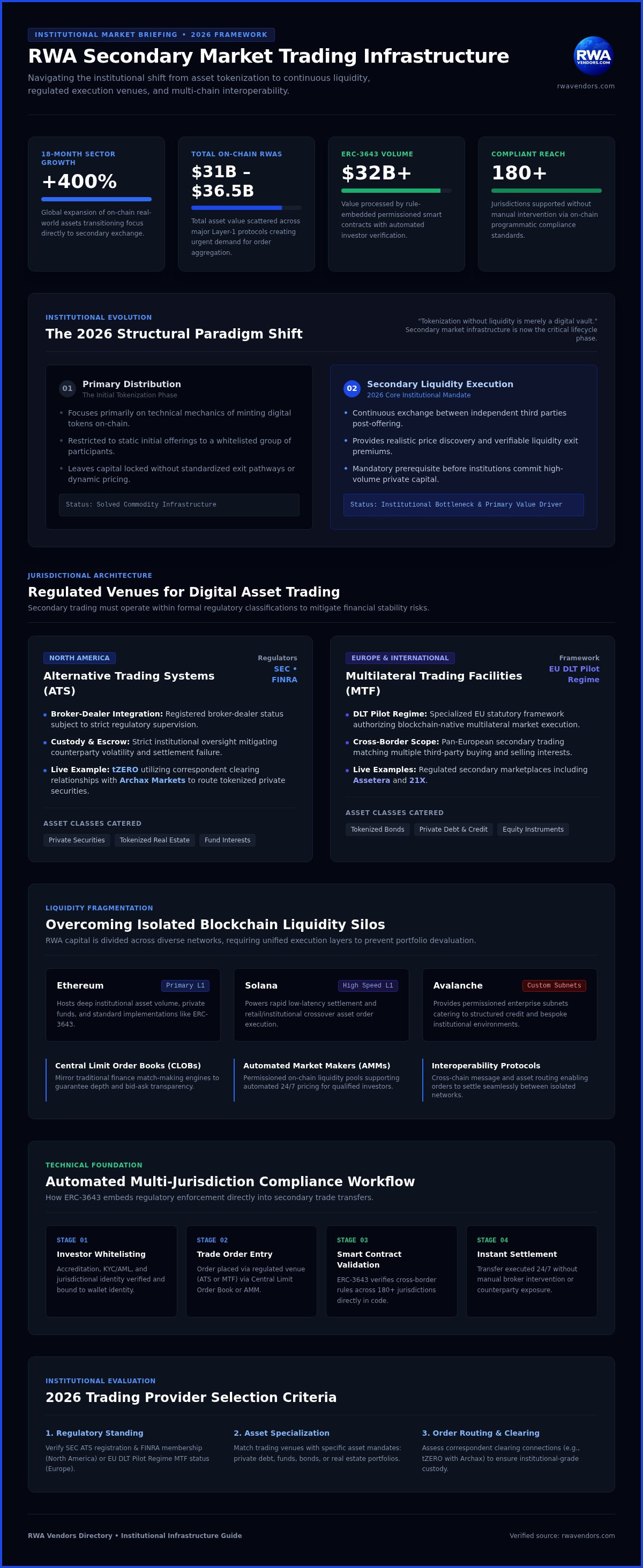
The global market for on-chain real-world assets expanded by over 400% in the last 18 months, yet the primary bottleneck for institutional growth isn't minting tokens; it's the ability to trade them. You've likely realized that a successful tokenization strategy is meaningless without a reliable secondary market. Identifying truly institutional-grade RWA trading platform providers remains a significant challenge as you manage fragmented liquidity across multiple blockchains and navigate complex global compliance requirements.
This guide provides the definitive 2026 framework for selecting trading infrastructure that meets rigorous regulatory standards. We've vetted the current landscape to help you understand the critical differences between ATS, MTF, and permissioned DEX solutions. You'll gain a clear shortlist of infrastructure partners and a strategic path to enabling secondary market exits. This ensures your tokenized assets remain liquid and compliant throughout their entire lifecycle, allowing you to bridge the gap between traditional finance and modern digital markets with confidence.
Key Takeaways
- Identify the 2026 industry shift from initial token issuance toward the complex infrastructure required for secondary market liquidity.
- Distinguish between regional regulatory frameworks, specifically the roles of Alternative Trading Systems (ATS) in North America and Multilateral Trading Facilities (MTF) in Europe.
- Apply a professional selection framework to evaluate RWA trading platform providers based on their specific licensing and asset-class specializations.
- Examine a curated roundup of institutional-grade exchanges currently facilitating secondary trading for tokenized real estate, funds, and private credit.
- Streamline your due diligence process by accessing a verified directory of global trading infrastructure partners to ensure long-term ecosystem integrity.
The Evolution of RWA Trading: From Issuance to Liquidity
The RWA industry has entered a new phase of institutional maturity. While previous years focused on the technical mechanics of minting tokens, 2026 marks the era of secondary market execution. High-volume asset managers no longer ask how to put an asset on-chain; they ask where they can exit. This shift toward RWA trading platform providers reflects a broader realization that tokenization without liquidity is merely a digital vault. Secondary market infrastructure is now the most critical component of the asset lifecycle, providing the price discovery and exit paths necessary for large-scale capital entry.
Institutional investors distinguish clearly between primary distribution and secondary liquidity. Primary distribution involves the initial sale of a tokenized asset to a whitelisted group of investors. Secondary liquidity, however, requires a continuous trading environment where assets can be exchanged between parties long after the initial offering. Without vetted trading venues, the "liquidity premium" promised by blockchain technology remains theoretical. Consequently, professional firms won't commit significant capital until they identify regulated venues, such as Alternative trading systems (ATS) or Multilateral Trading Facilities (MTF), that offer the same protections found in traditional equity markets.
The Liquidity Gap in Tokenized Assets
Fragmented liquidity remains the primary hurdle for the RWA sector in 2026. With on-chain RWA value reaching approximately $31 billion to $36.5 billion, assets are scattered across diverse blockchains including Ethereum, Solana, and Avalanche. This fragmentation makes it difficult for RWA trading platform providers to consolidate order books. To bridge this gap, market makers and specialized liquidity providers have become essential, using automated market makers (AMMs) and central limit order books (CLOBs) to facilitate trades. Interoperability protocols now play a decisive role, allowing volume to flow between chains and preventing isolated "liquidity silos" from devaluing tokenized portfolios.
Regulatory Foundations for RWA Trading
Compliance is the bedrock of secondary market infrastructure. Trading platforms must manage complex cross-border jurisdictional requirements, ensuring that every participant is whitelisted and every trade adheres to local securities laws. The success of these venues depends on the underlying compliant asset tokenization tech used during the issuance phase. For example, standards like ERC-3643 have processed over $32 billion in value by embedding compliance rules directly into the token's smart contract. This automation allows platforms to handle secondary transfers across 180+ jurisdictions without manual intervention, maintaining the integrity of the ecosystem while enabling 24/7 global trading.
Core Categories of RWA Trading Platform Providers
The institutional market distinguishes sharply between platforms that issue tokens and those that facilitate secondary exchange. While many software vendors offer "tokenization," the pool of RWA trading platform providers is significantly smaller and more specialized. These entities operate within strict regulatory frameworks to ensure investor protection and market integrity. Understanding the structural differences between these venues is essential for asset managers aiming to provide liquidity for private equity, real estate, or credit-based assets.
Regulated Trading Venues (ATS & MTF)
In North America, secondary trading of digital securities primarily occurs through Alternative Trading Systems (ATS). These venues are SEC-registered and FINRA-member broker-dealers. A prominent example is tZERO, which recently established a correspondent clearing relationship with Archax Markets to route tokenized private securities for secondary trading. These structures provide the oversight required by institutional mandates, offering clear rules for custody and escrow. Federal Reserve research on asset tokenization highlights how these structured environments mitigate risks associated with financial stability and market volatility.
European and global markets utilize Multilateral Trading Facilities (MTF) and the EU DLT Pilot Regime. Platforms like Assetera and 21X operate under these frameworks to provide regulated secondary marketplaces. To function effectively, these venues rely on sophisticated digital asset infrastructure providers to manage the underlying ledger and wallet interactions. The recent public listing of Securitize (NYSE: SECZ) in July 2026 underscores the maturation of these regulated infrastructure firms as they transition from private startups to publicly traded pillars of the financial system.
On-Chain Trading Protocols and DEXs
The rise of permissioned DeFi has introduced on-chain trading protocols that cater to institutional needs. Unlike retail-focused decentralized exchanges, these platforms use "compliance-gated" liquidity pools. Smart contracts automate order matching and settlement while ensuring that only whitelisted participants can execute trades. These systems often utilize the ERC-3643 standard to embed transfer restrictions directly into the asset. This automation reduces settlement times and operational costs through atomic Delivery-versus-Payment (DvP) mechanisms.
Security remains a primary concern for non-custodial infrastructure. Institutions often prefer hybrid models where a regulated custodian manages private keys while the trading occurs on a permissioned ledger. This approach combines the transparency of on-chain settlement with the security of traditional asset protection. For firms seeking to establish themselves within this ecosystem, ensuring your services are visible to the right partners is vital. You can apply to be featured in our directory to connect with issuers seeking vetted infrastructure.
Direct Peer-to-Peer (P2P) settlement systems also play a role in 2026, particularly for large-scale private placements. These systems allow two whitelisted parties to exchange assets and payment simultaneously on-chain without a central order book. This model is frequently used for illiquid assets like high-value real estate or bespoke private credit, where trading volume is lower but transaction values are high. By choosing the right RWA trading platform providers, issuers can match their asset's liquidity profile with the appropriate venue type.
Evaluating RWA Trading Providers: A Selection Framework
Selecting RWA trading platform providers requires a methodical evaluation that extends beyond basic software functionality. You must prioritize regulatory standing as the non-negotiable first step in your due diligence. Verify that the provider holds active broker-dealer registrations or exchange licenses in the specific jurisdictions where your assets will be traded. Adhering to SEC regulatory guidance on digital asset trading ensures the venue operates with the oversight and investor protections required for institutional capital. Beyond legal status, you should assess the provider's asset class specialization; a venue optimized for high-turnover tokenized treasuries often lacks the bespoke reporting tools required for private equity or complex real estate debt.
Technical interoperability represents the second pillar of a robust selection framework. In the multi-chain environment of 2026, your chosen provider shouldn't lock you into a single ecosystem. They must demonstrate the ability to support standard protocols and bridge assets between public and private ledgers without compromising security. Evaluate the platform’s existing liquidity depth by examining their current whitelisted investor base and the bid-ask spreads of live assets. A venue with a pre-established network of institutional participants significantly reduces the time required to achieve meaningful secondary market turnover.
Technical and Operational Due Diligence
Reliable execution depends on the robustness of the provider's API integrations and order book management systems. You should request audit reports or case studies detailing their track record for handling institutional trade volumes without latency. Understanding the role of security token secondary markets in your broader capital strategy helps you determine if a provider’s infrastructure can scale with your long-term roadmap. Conduct a thorough review of their custody arrangements and disaster recovery protocols to ensure asset safety during periods of extreme market volatility.
Compliance and Reporting Capabilities
Operational efficiency in a professional environment relies on automated KYC/AML verification at the trading layer. The platform must offer real-time monitoring and global regulatory filing support to minimize your administrative burden. Verify that the provider integrates with reputable third-party oracles and compliance engines to maintain accurate asset valuations and holder registries. These reporting features are essential for meeting the transparency requirements of institutional LPs and ensuring that your RWA trading platform providers remain compliant with evolving tax laws across multiple jurisdictions.
Roundup: Leading RWA Trading Platform Providers in 2026
The institutional landscape for 2026 is defined by a small group of highly regulated RWA trading platform providers that have successfully bridged the gap between legacy finance and on-chain efficiency. These entities have moved beyond the "proof of concept" phase, now supporting billions in active trading volume. Their success stems from deep integration with the broader institutional digital asset partners ecosystem, ensuring that secondary market trades are supported by robust custody, clearing, and settlement layers.
Institutional-Grade Regulated Platforms
Securitize (NYSE: SECZ) stands as a primary market leader after its July 2026 public listing, providing a vertically integrated stack that spans from issuance to its own regulated secondary market. In the United Kingdom, Archax has established itself as an FCA-regulated powerhouse, recently launching $GOVY, a 24/7 perpetual tokenized U.S. T-bill instrument. tZERO continues to expand its North American footprint through its correspondent clearing relationship with Archax, allowing for seamless cross-border order flow. INX remains a vital venue for global digital securities, offering a regulated exchange environment that supports a wide array of tokenized equity and debt products. These platforms utilize regulated smart contracts to deliver the efficiency of decentralized settlement within a legally compliant framework.
Specialized and Niche Trading Venues
Private credit has seen significant traction, with protocols like Centrifuge and Maple Finance facilitating active portfolio volumes between $8.0 billion and $18.9 billion. These platforms cater to institutional lenders by providing specialized dashboards for credit monitoring and automated repayment structures. In the real estate sector, platforms such as ADDX and InvestaX in Singapore operate as licensed Recognized Market Operators (RMOs). They address the unique liquidity challenges of property markets by fractionalizing high-value assets and providing a structured environment for secondary transfers. Identifying rising stars in this space requires looking for providers that have secured national-level licenses, such as those operating under the EU DLT Pilot Regime like Assetera and 21X.
Emerging institutional DeFi protocols are also gaining ground by adopting permissioned Automated Market Makers (AMMs). These protocols, often built on the ERC-3643 standard, ensure that every trade is compliance-gated, meaning only whitelisted wallets can participate in the liquidity pool. This hybrid approach allows for the 24/7 availability of DeFi while maintaining the rigorous oversight required by institutional mandates. As the market matures, the most successful providers are those that offer seamless API connectivity to traditional brokerage desks and asset management software.
Sourcing Vetted Trading Partners via RWA Vendors
Manual discovery of institutional partners in the digital asset space is an increasingly complex task. The market moves too fast. As the number of RWA trading platform providers grows, asset issuers face the dual challenge of verifying technical competence and ensuring regulatory compliance. A simple web search often yields fragmented results that don't distinguish between retail-focused tools and institutional-grade infrastructure. This lack of centralized, verified data creates a significant bottleneck for firms ready to scale their secondary market operations.
Why a Vetted Directory is Essential for Institutions
RWA Vendors serves as a critical bridge between asset issuers and the professional services they require. Operated by the Security Token Offering Foundation, Inc., the platform maintains a curated ecosystem where every entry for RWA trading platform providers undergoes a vetting process. This oversight minimizes the risk of partnering with unverified technology vendors that might lack the necessary licenses or security protocols. By providing a single source of truth, the directory allows users to access global vendors across specialized categories, including legal counsel, digital custody, and secondary trading venues.
The STO Foundation’s role as an industry organization ensures that the directory’s integrity remains a top priority. It isn't just a list; it's a professional marketplace designed to maintain the high standards of global finance. Issuers can confidently build a complete RWA infrastructure stack by selecting partners who've already demonstrated their commitment to the ecosystem through a professional Vendor Directory Listing.
Getting Started: Connecting with RWA Trading Experts
The RWA Vendors platform is designed for surgical precision in vendor discovery. You can filter the directory to find companies that specialize in specific asset classes, such as real estate or private credit, or those that operate within particular regulatory jurisdictions. This functionality eliminates the need for months of preliminary research. It allows you to identify partners that fit your specific operational requirements with ease.
Engaging with those who hold a Founding Membership provides an additional layer of security for those seeking strategic leadership. These members represent the infrastructure arm of the industry and often possess the deep expertise required to navigate the complexities of 24/7 on-chain settlement. Whether you're looking for a primary issuance tool or a secondary marketplace partner, the directory provides a direct path to verified professionals.
Explore the RWA Vendors Directory to find your next trading partner
Securing Institutional Liquidity in the Tokenized Economy
The transition from asset issuance to secondary market liquidity represents the most significant milestone in the maturation of digital capital markets. Success in this landscape requires a deep understanding of the regulatory requirements governing ATS and MTF venues, as well as the technical standards that ensure cross-chain interoperability. Identifying the right RWA trading platform providers is no longer a matter of simple software selection; it's a strategic decision that impacts the long-term viability and exit potential of your tokenized portfolio.
By leveraging a curated ecosystem, asset managers can overcome the challenges of fragmented liquidity and complex global compliance. RWA Vendors, operated by the STO Foundation, provides the authoritative architecture necessary to connect with verified partners across legal, technical, and trading sectors. This structured approach ensures that your infrastructure stack is built on a foundation of reliability and professional expertise.
Building a liquid future for real-world assets starts with identifying partners who share a commitment to excellence and regulatory integrity. We look forward to helping you build a scalable and compliant trading ecosystem.
Frequently Asked Questions
What is the difference between an RWA issuance platform and a trading platform?
An issuance platform focuses on the primary lifecycle of a token, including smart contract deployment and initial distribution to investors. In contrast, RWA trading platform providers facilitate secondary market activity where assets are exchanged between parties after the initial offering. While issuance tools manage the "minting" process, trading platforms provide the order books, matching engines, and regulatory oversight necessary for continuous price discovery and investor exits.
Are RWA trading platforms regulated like traditional stock exchanges?
Many institutional venues operate under specific regulatory frameworks such as Alternative Trading Systems (ATS) in the United States or Multilateral Trading Facilities (MTF) in Europe. While they function similarly to traditional stock exchanges by matching buyers and sellers, they often hold specialized broker-dealer licenses rather than full national exchange designations. These platforms must adhere to strict investor protection rules, including custody requirements and market surveillance standards, to maintain their operating status in major financial jurisdictions.
Can I trade tokenized real-world assets across different blockchains?
Cross-chain trading is increasingly common in 2026 due to the adoption of interoperability protocols. Leading RWA trading platform providers often support multiple networks like Ethereum, Polygon, and Avalanche to prevent liquidity silos. However, trading across chains requires sophisticated technical bridging and a compliance layer that can verify investor whitelisting across different ledgers. This ensures that a tokenized asset remains a legal security regardless of the underlying blockchain used for the transaction.
What are the typical fees associated with RWA trading platform providers?
Fee structures typically include a combination of listing fees for issuers and transaction-based commissions for traders. Some providers also charge technology licensing fees or recurring maintenance costs for managing the underlying ledger. Because these platforms provide specialized compliance and settlement services, their costs reflect the high-stakes nature of regulated finance. You should always request a detailed fee schedule from a provider to understand how volume-based discounts or membership tiers might affect your long-term operational expenses.
How do I ensure a trading platform is compliant with local securities laws?
You should verify that the platform holds the appropriate national licenses, such as a SEC broker-dealer registration or an FCA authorization. Compliant platforms integrate automated KYC and AML checks directly into their trading layer, ensuring that only verified participants can hold or transfer tokens. Reviewing the provider’s regulatory filings and checking for their status within industry organizations like the STO Foundation can provide additional assurance that they meet current institutional standards.
What role do liquidity providers play on RWA trading platforms?
Liquidity providers and market makers are essential for maintaining stable bid-ask spreads and ensuring that large orders can be executed without significant price slippage. On many RWA platforms, these participants use automated market makers (AMMs) or institutional central limit order books to provide continuous buy and sell quotes. Their presence is particularly critical for illiquid assets like real estate or private credit, where they act as a bridge between buyers and sellers who may not be active simultaneously.
Do RWA trading platforms require institutional investors to undergo KYC?
Institutional investors must undergo rigorous Know Your Customer (KYC) and Know Your Business (KYB) checks before accessing these venues. This is a mandatory requirement for maintaining compliance with global anti-money laundering regulations. Modern trading infrastructure often uses on-chain identity standards to automate this process, allowing an investor’s verified status to travel with their digital wallet across different permissioned platforms. This reduces administrative friction while ensuring that every transaction remains within legal boundaries.
How can the RWA Vendors directory help me select a trading provider?
RWA Vendors provides a curated directory of vetted capital markets vendors, allowing you to bypass the risks of manual discovery. The platform, operated by the Security Token Offering Foundation, Inc., offers a global reach across legal, technical, and trading sectors. By using our directory, you can filter for providers with specific regulatory licenses and asset class specializations. This ensures you are connecting with institutional-grade partners that have been verified for their role in the tokenization ecosystem.
Disclaimer
This article is provided by RWAVendors.com for general informational and educational purposes only. It does not constitute legal, financial, investment, tax, regulatory or other professional advice, or an offer, solicitation, recommendation or endorsement of any company, product, service, token, security or investment. RWAVendors.com is an informational vendor directory and does not sell, issue, broker, custody or facilitate transactions involving cryptocurrencies, digital tokens, tokenized assets, securities or investment products. Some vendor listings and references may involve paid advertising, sponsored placement or membership relationships. These relationships do not guarantee a vendor’s qualifications, regulatory status, performance or suitability. Information may be incomplete, outdated or subject to change. You should independently verify all information, conduct your own due diligence and consult qualified professionals before making any business or investment decision. RWAVendors.com is not responsible for the content, services, representations or actions of third-party vendors or linked websites.


