
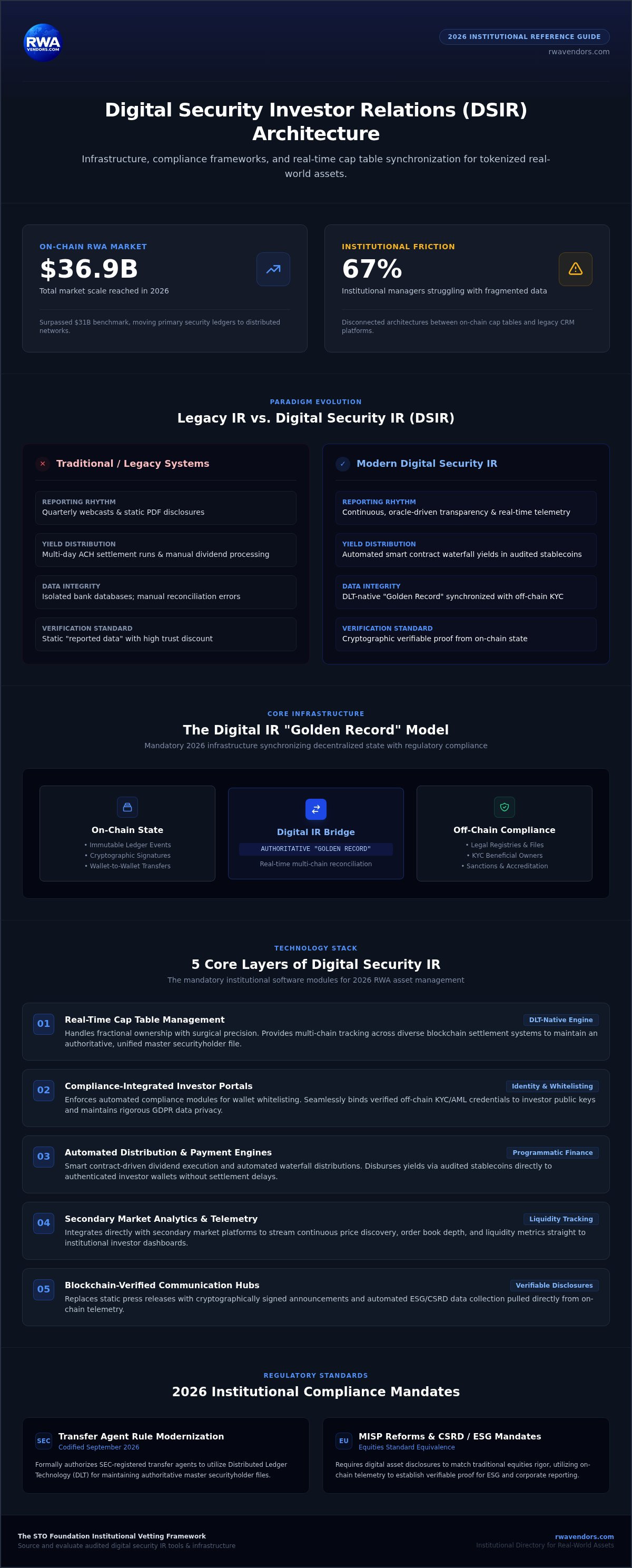
The on-chain real-world asset market has reached a staggering $36.9 billion in 2026, yet 67% of institutional managers still struggle with the friction of fragmented data between on-chain cap tables and legacy CRM systems. You've likely realized that traditional platforms cannot support the demands of real-time cryptographic ownership or automated waterfall distributions. To bridge this gap, selecting the right digital security investor relations tools is now a mandatory requirement for maintaining regulatory compliance and investor trust.
This guide identifies the essential software and platforms required to unify your communications, automate reporting, and manage tokenized assets within a rigorous institutional framework. You'll discover how to transition from static quarterly filings to continuous, oracle-driven transparency that satisfies both investors and regulators. We examine the integration of SEC-registered digital transfer agents with advanced investor portals, providing a clear roadmap for achieving seamless secondary market liquidity and automated corporate actions in the 2026 ecosystem.
Key Takeaways
- Understand why legacy IR systems are insufficient for 2026 capital markets and how digital security investor relations tools provide the real-time on-chain synchronization required for modern asset management.
- Identify the core technology layers necessary for institutional digital security IR, including cryptographic cap table engines and automated compliance modules for wallet whitelisting.
- Evaluate the security audit and GDPR compliance requirements essential for maintaining investor data privacy within a transparent blockchain ecosystem.
- Learn to integrate IR portals with secondary market platforms to deliver continuous price discovery and liquidity telemetry directly to investor dashboards.
- Utilize the RWA Vendors directory to source and vet service providers that meet the rigorous institutional standards established by The STO Foundation.
The Shift from Traditional IR to Digital Security Investor Relations Tools
Digital Security Investor Relations (DSIR) represents a fundamental evolution in how issuers manage shareholder communications and compliance for tokenized assets. In the 2026 capital markets, where the on-chain RWA market has surpassed $31 billion, the primary ledger for securities now resides on distributed networks rather than isolated bank databases. While traditional investor relations functions focused on quarterly webcasts and static PDF disclosures, DSIR requires a continuous, real-time approach to data management. Traditional software fails to track on-chain asset ownership because it lacks the connectivity to monitor wallet-to-wallet transfers or verify cryptographic signatures in real time. This technical gap creates a "trust discount" for digital assets, which can only be mitigated through the transparency provided by specialized digital security investor relations tools.
The transition to these modern tools replaces manual dividend processing with automated waterfall distributions. Instead of executing multi-day ACH settlement runs, issuers now utilize smart contracts to distribute yields in audited stablecoins directly to authenticated investor wallets. This shift reduces administrative overhead and eliminates the reconciliation errors common in legacy systems. By providing investors with a real-time view of asset performance and ownership, institutions can effectively remove the opacity that previously hindered the scaling of private market tokenization.
On-Chain vs. Off-Chain Data Synchronization
The core challenge for 2026 issuers is maintaining a "Golden Record" where the blockchain serves as the authoritative source of truth. Modern IR tools must synchronize immutable ledger events with off-chain legal registries and KYC identities. This ensures that every wallet address on the cap table corresponds to a verified beneficial owner, maintaining compliance with global sanctions and accreditation rules. The Digital IR Bridge is a mandatory 2026 infrastructure component that synchronizes immutable blockchain ledger events with off-chain legal compliance and identity registries.
The 2026 Regulatory Landscape for Digital Reporting
Recent regulatory updates have codified the requirement for digital-first reporting. The SEC’s September 2026 modernization of federal transfer agent rules formally permits registered agents to use DLT for authoritative securityholder files. Simultaneously, the EU’s MISP reforms require that digital asset disclosures meet the same rigorous standards as traditional equities. Digital security investor relations tools now automate the collection of data for CSRD and ESG mandates, pulling verifiable proof directly from on-chain telemetry. This transition from "reported data" to "verifiable proof" is the new benchmark for institutional credibility in the tokenized ecosystem.
Core Categories of Digital Security IR Software and Tools
The institutional infrastructure for RWA issuers has crystallized into several distinct software layers that function as an integrated ecosystem. Unlike legacy systems, modern digital security investor relations tools must operate as active participants in the asset lifecycle. This technical stack comprises five primary categories: real-time cap table management, compliance-integrated investor portals, automated distribution engines, secondary market analytics, and blockchain-verified communication hubs. Each component ensures that the issuer maintains a compliant environment while providing the high-velocity transparency that digital asset investors expect in 2026.
Cap Table Management for Tokenized Assets
Authoritative ownership records are now handled by DLT-native cap table engines. These platforms manage fractional ownership with surgical precision, accommodating high-frequency secondary transfers across various blockchain settlement systems to provide instant ledger updates. Because an asset might exist across multiple networks, these tools must support multi-chain tracking to prevent record fragmentation. This ensures that the master securityholder file remains accurate regardless of where the underlying tokens are traded or held, providing a unified view of the entire investor base.
Automated Distribution and Payment Engines
Programmatic finance has redefined how capital is returned to investors. Modern IR stacks include smart contract-driven engines that execute dividend and interest payments in stablecoins or central bank digital currencies (CBDCs). These systems satisfy the SEC digital asset securities framework by ensuring that every distribution is tied to a verified identity. Beyond simple payments, these engines automate complex tax withholding requirements for global investor bases, significantly reducing the administrative overhead associated with manual cross-border processing and reconciliation.
Investor portals now serve as the primary compliance gatekeeper. They integrate KYC/AML workflows directly with wallet whitelisting, ensuring that only qualified participants can hold or transfer securities. To maintain the integrity of the ecosystem, communication tools within these portals utilize encrypted, blockchain-verified messaging. This prevents phishing and ensures that corporate actions are received by the correct beneficial owners. Issuers looking to scale their digital offerings should evaluate verified technology providers that offer these integrated capabilities to avoid the risks of fragmented data and operational silos.
Evaluating IR Tools for Transparency and Security
Institutional-grade digital security investor relations tools must withstand rigorous technical and regulatory scrutiny. Security audits aren't just for the smart contracts themselves; they must extend to the IR portals that connect to them. Any bridge between a web-based portal and a blockchain ledger represents a potential attack vector. Issuers must ensure their chosen tools have undergone SOC 2 Type II audits and independent penetration testing of their API integrations. This level of diligence aligns with the SEC regulatory framework for digital asset securities, which emphasizes the need for robust control environments and ongoing disclosure requirements.
Managing data privacy presents a unique challenge in a transparent blockchain environment. While transaction hashes are public, investor identities must remain confidential to satisfy global regulations. Effective digital security investor relations tools solve this by maintaining sensitive KYC data off-chain while using zero-knowledge proofs or identity-linked tokens to verify eligibility on-chain. This architecture allows for GDPR compliance without sacrificing the benefits of ledger-based settlement, ensuring that personal data isn't permanently etched into a public record.
For non-crypto native institutional investors, the user experience (UX) is a critical adoption factor. Portals should abstract away the complexities of gas fees and private key management, providing a familiar interface that mirrors traditional brokerage dashboards. A professional dashboard shouldn't require an investor to understand the underlying protocol to view their holdings or participate in a vote. Instead, it should offer a clean, functional environment that prioritizes information density and ease of navigation, ensuring that the technology remains a facilitator rather than a barrier to entry.
Vetting Technical Interoperability
API-first architectures ensure seamless data flow between disparate tokenization service providers. Support for industry standards like ERC-3643 or ERC-1400 is vital for cross-platform compatibility and long-term asset portability. Issuers should compare custodial and non-custodial portal options, as the choice impacts both investor responsibility and corporate liability. These standards prevent vendor lock-in and ensure the IR stack evolves alongside the broader capital markets ecosystem.
Data Integrity and Audit Trails
Modern digital security investor relations tools provide a "read-only" view of on-chain data for auditors, enabling continuous verification without introducing security risks. All investor communications, proxy voting results, and corporate actions are recorded in immutable logs to prevent tampering. In decentralized environments, disaster recovery is managed through redundant node architectures. This ensures that the "Golden Record" of shareholder activity remains available and accurate even during localized network disruptions, maintaining the integrity of the institutional ecosystem.
Strategic Implementation: Connecting IR to the RWA Ecosystem
Strategic implementation of digital security investor relations tools requires a shift from passive reporting to active ecosystem integration. In a 24/7 market environment, the IR portal acts as the primary interface between the issuer and the liquidity pool. This connection ensures that investors have access to the same high-fidelity data regardless of where they acquired their assets. By centralizing "Insider Manager" functions, issuers can monitor restricted periods and manage compliance for executives and large stakeholders directly through the IR dashboard, preventing accidental violations in high-velocity trading environments.
Integration with Secondary Markets
Issuers must synchronize their IR portals with licensed security token secondary markets to provide a unified experience. This integration allows for the delivery of real-time price discovery data and liquidity telemetry, such as bid-ask spreads and trading volumes, directly to the investor private dashboard. Connecting with verified RWA trading platform providers ensures that secondary market activity is reflected in the master cap table without manual intervention. High levels of IR transparency directly impact token valuation by reducing information asymmetry and lowering the risk premium for institutional buyers.
Lifecycle Management and Corporate Actions
Managing the full lifecycle of a digital security involves more than just initial issuance. Modern digital security investor relations tools automate complex corporate actions, including token buybacks, redemptions, and interest resets. For debt-based RWAs, the system can trigger automated notifications for maturity dates or coupon payments, ensuring that all token holders are informed simultaneously. Digital voting and proxy solicitation also become more efficient. By utilizing on-chain identity standards, issuers can execute legally binding votes where results are tallied and recorded in real time, eliminating the delays of traditional paper-based proxy systems.
Finding Vetted IR Vendors on the RWA Vendors Directory
Selecting the right digital security investor relations tools is a critical decision that impacts long-term compliance and investor satisfaction. The market is increasingly crowded with emerging technology providers, making it difficult for institutional issuers to distinguish between experimental platforms and robust, production-ready infrastructure. The RWA Vendors directory serves as the primary resource for navigating this complexity by providing a structured taxonomy of service providers. It functions as a central pillar for the industry, allowing firms to bypass the noise of the broader market and focus on institutional-grade solutions that have already been evaluated for technical and regulatory alignment.
The RWA Vendors Vetting Standard
The STO Foundation has operated as an authoritative industry architect since 2017, establishing the high standards required for tokenized capital markets. Every provider listed within the directory undergoes a vetting process designed to mitigate the operational risks and audit gaps often found in unverified solutions. When searching the Global RWA Vendor Directory, issuers can filter results based on specific jurisdictions, supported tech stacks, and regulatory registrations. This surgical precision allows firms to find partners that align with their specific asset class, whether it's tokenized real estate, private credit, or government debt. Founding Members represent a tier of established expertise, offering the deep knowledge required for complex, multi-chain infrastructure deployments that must satisfy global regulatory standards.
Building Your Infrastructure Stack
A successful RWA project doesn't exist in a silo. It requires a synchronized stack where digital security investor relations tools work in harmony with legal, compliance, and custodial partners. Utilizing a curated ecosystem prevents the operational friction caused by fragmented vendor selection. Instead of managing disparate relationships, issuers can build a cohesive lifecycle strategy using partners that have already demonstrated interoperability within the RWA Vendors network. This methodical approach streamlines the transition from initial directory browsing to the formal Request for Proposal (RFP) process. By selecting from a vetted list, issuers ensure that every component of the digital asset lifecycle is handled by a verified professional, reducing the time to market and enhancing the long-term viability of the tokenized asset.
Browse vetted IR vendors in the RWA Vendors directory today
Future-Proofing Your Institutional IR Infrastructure
The evolution of capital markets toward tokenization demands a departure from legacy communication models. By prioritizing real-time data synchronization and automated compliance, issuers can eliminate the trust discount and unlock the full potential of secondary market liquidity. Adopting the right digital security investor relations tools is the definitive step toward professionalizing your asset’s lifecycle management. These platforms transform IR from a cost center into a strategic driver of investor confidence and operational efficiency in the 2026 ecosystem.
RWA Vendors facilitates this transition as the primary infrastructure directory of The STO Foundation. Our global directory of verified blockchain finance vendors provides the institutional-grade RWA ecosystem mapping required to build a compliant and scalable stack. By selecting vetted partners, you ensure that your infrastructure meets the rigorous standards of the modern digital economy. This curated approach minimizes technical risk and positions your firm as a leader in the next generation of global finance.
Take the next step in establishing a transparent and compliant investor ecosystem that is built to last.
Frequently Asked Questions
What is the difference between traditional IR software and digital security IR tools?
Digital security investor relations tools differ from traditional software by providing real-time synchronization with blockchain ledgers. While legacy systems rely on manual entry and static quarterly reports, digital tools monitor on-chain wallet transfers and cryptographic ownership instantly. This allows for immediate cap table updates and automated compliance checks that traditional platforms aren't equipped to execute within a decentralized ecosystem.
Do digital security IR tools integrate with existing CRMs like Salesforce?
Most institutional digital security investor relations tools offer API-first architectures designed to integrate with existing CRM systems like Salesforce. This connectivity allows issuers to map cryptographic wallet addresses to specific KYC-verified identities within their central database. It ensures that the master record of shareholder information remains consistent across both on-chain and off-chain environments without requiring manual data reconciliation.
How do IR tools handle KYC/AML for secondary market buyers?
These tools manage secondary market compliance by integrating with identity-linked protocols and whitelisting services. When a token is traded on an Alternative Trading System, the IR tool verifies the buyer’s accreditation and jurisdiction against pre-defined smart contract rules. Only wallets that pass these automated KYC/AML checks are permitted to receive and hold the digital securities, maintaining the integrity of the regulatory perimeter.
Can I automate dividend distributions through an investor relations portal?
You can automate dividend and interest distributions directly through an integrated investor relations portal. By utilizing smart contracts, the system executes payments in stablecoins or CBDCs to all authenticated token holders simultaneously. This reduces administrative overhead and eliminates the multi-day settlement delays associated with traditional ACH runs, providing investors with immediate access to their yields in a programmatic fashion.
Is on-chain data enough for investor reporting, or do I need an IR tool?
On-chain data provides the raw transaction history, but an IR tool is necessary to transform this information into human-readable reports and legal documentation. Issuers require these tools to generate specific tax forms and to provide a secure environment for proxy voting. Without an IR layer, raw ledger data lacks the identity context and historical narrative required for institutional regulatory reporting and audit readiness.
What are the security risks of using a blockchain-integrated investor portal?
The primary security risks involve API vulnerabilities and the management of sensitive investor data. To mitigate these, institutional portals utilize SOC 2 Type II compliant infrastructure and provide read-only views of on-chain data for reporting purposes. It's essential to select vendors that conduct regular smart contract audits and employ zero-knowledge proofs to protect investor privacy while maintaining ledger transparency.
How much do institutional digital security IR tools typically cost in 2026?
Pricing for institutional tools in 2026 varies based on the complexity of the asset and the required regulatory integrations. Most providers utilize a SaaS-based model with tiered structures that scale with the asset's total value locked or transaction volume. Issuers should consult the RWA Vendors directory to compare specific vendor models and service levels to find a solution that fits their specific capital structure.
Which digital security standards should my IR tool support?
Your IR tool should support widely adopted institutional standards such as ERC-3643 and ERC-1400 to ensure interoperability across the ecosystem. As of September 2026, the ERC-3643 standard has processed over $32 billion in tokenized assets, making it a benchmark for permissioned tokens. Supporting these standards ensures your assets remain portable across different trading platforms and custodial environments while satisfying the SEC’s modernized recordkeeping requirements.
Disclaimer
This article is provided by RWAVendors.com for general informational and educational purposes only. It does not constitute legal, financial, investment, tax, regulatory or other professional advice, or an offer, solicitation, recommendation or endorsement of any company, product, service, token, security or investment. RWAVendors.com is an informational vendor directory and does not sell, issue, broker, custody or facilitate transactions involving cryptocurrencies, digital tokens, tokenized assets, securities or investment products. Some vendor listings and references may involve paid advertising, sponsored placement or membership relationships. These relationships do not guarantee a vendor’s qualifications, regulatory status, performance or suitability. Information may be incomplete, outdated or subject to change. You should independently verify all information, conduct your own due diligence and consult qualified professionals before making any business or investment decision. RWAVendors.com is not responsible for the content, services, representations or actions of third-party vendors or linked websites.


