
With protocol hacks draining 3.35 billion dollars in 2025 and the average exploit now exceeding 5.3 million dollars, the stakes for real-world asset protection have never been higher. As an institutional issuer, you likely recognize that the transparency of blockchain is its greatest strength, yet it's also a significant liability for sensitive data. You might fear personally identifiable information leaking onto immutable public ledgers or feel overwhelmed trying to distinguish between basic encryption and true data tokenization. Selecting the right tokenization cybersecurity vendors is no longer a matter of checking a box. It's about building a robust fortress around your digital architecture.
We've designed this guide to provide a definitive framework for securing your tokenized economy using multi-layered, institutional-grade protocols. You'll discover how to navigate the 2026 regulatory environment, including the full enforcement of the Digital Operational Resilience Act (DORA) and the mandatory transition to ISO/IEC 27001:2022 standards. We'll help you identify vetted infrastructure partners that reconcile data sovereignty with blockchain's immutability. This overview ensures your organization maintains compliance with global laws while protecting the integrity of every on-chain transaction.
Key Takeaways
- Learn to differentiate between asset-level tokenization and security-focused data tokenization to implement a robust placeholder system for sensitive information.
- Understand the critical role of Hardware Security Modules and Multi-Party Computation in establishing a resilient root of trust for your digital asset infrastructure.
- Discover how Zero-Knowledge Proofs resolve the privacy paradox by allowing secure transaction verification without exposing private data on public ledgers.
- Access a structured framework for vetting tokenization cybersecurity vendors to avoid the operational risks associated with unverified or sub-standard infrastructure providers.
- Navigate the complexities of global data sovereignty by aligning your infrastructure with international regulatory standards and local residency requirements for token vaults.
Defining Tokenization Data Security for the RWA Ecosystem
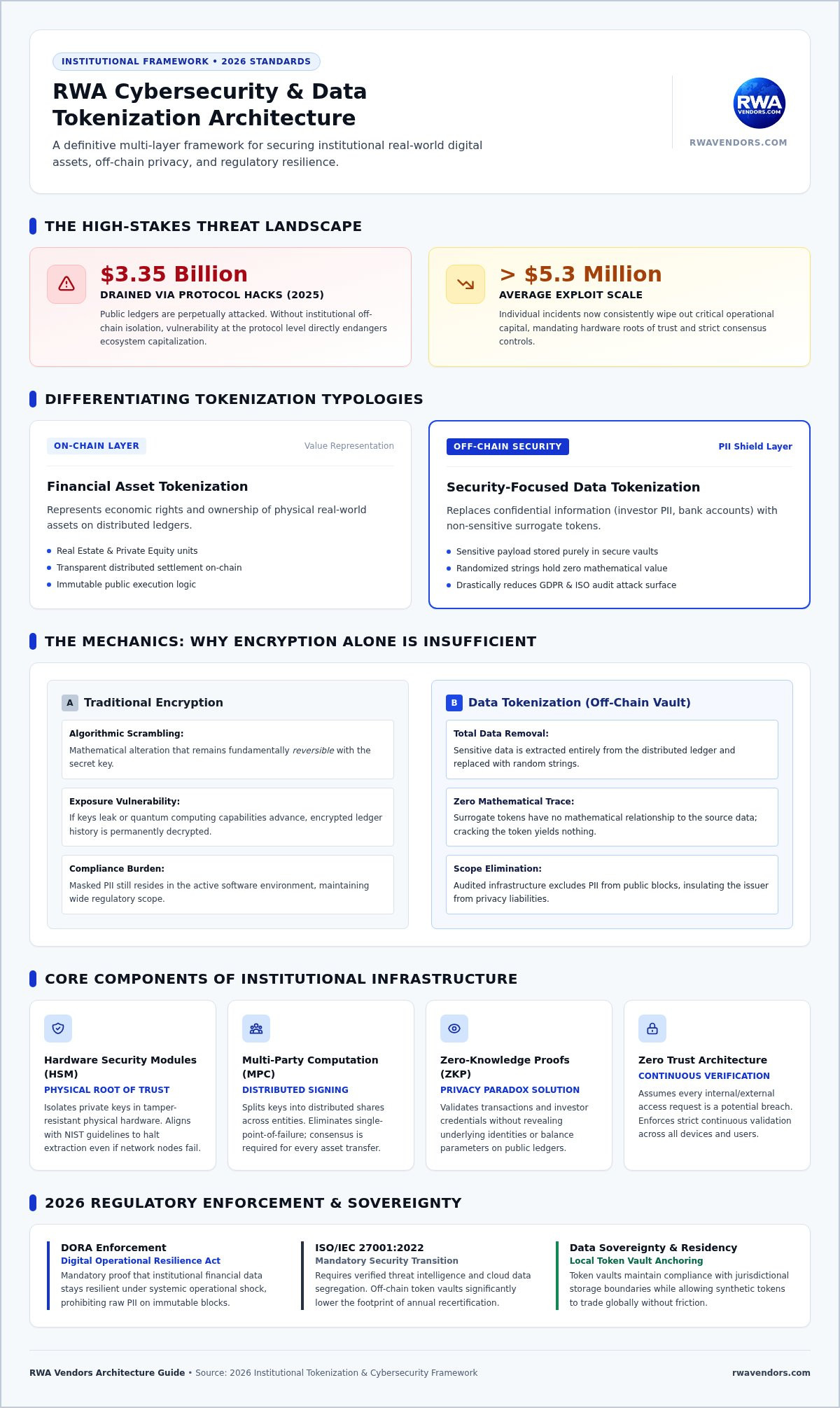
In the high-stakes environment of institutional finance, it's vital to distinguish between two distinct processes: financial asset tokenization and data tokenization. While the former involves representing ownership of a physical asset like real estate or private equity on a blockchain, the latter is a specialized cybersecurity strategy. Data tokenization replaces sensitive records, such as investor identities or bank account details, with non-sensitive placeholders known as tokens. Leading tokenization cybersecurity vendors prioritize this distinction to ensure that sensitive information remains entirely outside the reach of the distributed ledger.
Traditional encryption is often insufficient for the transparency requirements of digital securities. Encryption relies on mathematical algorithms to scramble data, which can eventually be decrypted if a key is compromised or if quantum computing capabilities advance. In contrast, a token vault keeps the actual data in a secure, centralized, or distributed off-chain environment, issuing a surrogate value that has no intrinsic meaning. This architecture ensures that even if a blockchain's transaction history is public, the underlying personally identifiable information (PII) is never exposed. Vetted infrastructure partners act as the gatekeepers of these vaults, maintaining the rigorous security layers necessary for institutional-grade reliability.
The Mechanics: How Tokenization Differs from Encryption
Encryption and tokenization serve different roles within a security stack. Encryption uses reversible algorithms to hide data, which means the sensitive information still exists within the system, just in a masked form. Standard data security tokenization methods remove the data from the environment entirely, replacing it with a randomized string. This process significantly reduces the scope of compliance audits for standards like GDPR or ISO 27001:2022 because the sensitive data isn't present in the application or on the ledger. A Zero Trust architecture in RWA tokenization assumes every access request is a potential breach and requires continuous verification of every user and device regardless of their location.
The Institutional Shift to Data-Centric Security
As we move through 2026, institutional standards have shifted from protecting network perimeters to prioritizing data-centric security. With the full enforcement of the Digital Operational Resilience Act (DORA), financial entities must prove that their data remains resilient regardless of where it travels. Utilizing compliant asset tokenization tech allows firms to meet these mandates by ensuring PII never reaches the immutable ledger. This approach prevents permanent privacy leaks that could occur if encrypted data were stored on-chain and later cracked. By partnering with specialized tokenization cybersecurity vendors, issuers can maintain a clear separation between the transparent transaction layer and the private identity layer, satisfying both investors and global regulators.
Core Components of Secure Digital Asset Infrastructure
Institutional-grade security for real-world assets (RWA) requires more than just high-level software encryption. It demands a physical root of trust. Hardware Security Modules (HSMs) provide this by securing private keys within tamper-resistant hardware environments. This physical layer prevents external extraction of sensitive keys, even if the surrounding network is compromised. When evaluating tokenization cybersecurity vendors, institutions must verify that these hardware protections align with the NIST token architecture and security overview, which outlines the necessary cryptographic standards for digital token design and key custody.
Modern architectures often pair HSMs with Multi-Party Computation (MPC). MPC eliminates the single point of failure inherent in traditional private key management by splitting the key into multiple shares distributed across different parties. No single entity ever possesses the full key. This ensures that asset transfers require a consensus, significantly mitigating the risk of internal collusion or external theft. Integrating these technologies with verified digital asset infrastructure providers allows issuers to build a tiered security model that scales with their portfolio.
Secure oracles complete this infrastructure by providing a verifiable bridge between off-chain data and the blockchain. For RWAs, oracles must reliably report the status of physical collateral or valuation updates. Without a secure oracle, even the most fortified smart contract remains vulnerable to "garbage in, garbage out" data manipulation. This layer is essential for maintaining the integrity of the tokenized asset throughout its lifecycle.
Key Management and Custody Solutions
Institutional RWA projects require a sophisticated mix of storage solutions. While "cold" storage offers maximum security for long-term holdings, "hot" and "warm" wallets are necessary for the liquidity and agility of a modern trading environment. Leading tokenization cybersecurity vendors now offer MPC-based custody that achieves sub-millisecond signing latency without compromising security. This high-availability standard is essential for maintaining market confidence in tokenized securities. If your firm provides these specialized services, you can get listed in our global directory to connect with active asset issuers.
Data Classification and Automated Discovery
Protecting investor privacy starts before a single token is minted. Institutions use AI-driven data discovery tools to scan and classify sensitive information across their workflows. These tools identify personally identifiable information (PII) and apply pre-minting filters to ensure this data remains in a secure off-chain vault. A cryptographic audit trail links the on-chain token to the original record, allowing for regulatory reporting without ever exposing sensitive data to the public ledger. This automated approach ensures compliance with global data sovereignty laws while maintaining the operational efficiency required by the 2026 market.
The Privacy Paradox: Protecting Sensitive Data on Public Ledgers
A primary barrier to institutional adoption of public blockchains is the perceived lack of confidentiality. The concern is straightforward: if an asset is tokenized on a public ledger, sensitive transaction details and investor identities might become visible to competitors or bad actors. However, leading tokenization cybersecurity vendors have developed sophisticated protocols to resolve this "privacy paradox." These solutions allow institutions to benefit from the transparency and liquidity of distributed ledgers while maintaining strict data silos for sensitive information. This balance is especially vital for the expansion of security token secondary markets, where private settlement is required to prevent front-running and protect proprietary trading strategies.
Governance frameworks must now account for these operational complexities. As detailed in the FSB report on tokenisation risks and governance, the shift toward decentralized infrastructure introduces new dependencies on third-party vendors. Institutions must ensure that their chosen partners can provide selective disclosure capabilities. This allows firms to share necessary data with regulators or auditors without exposing that same information to the general public. By implementing these privacy-preserving layers, issuers can meet their reporting obligations while safeguarding the integrity of the broader financial ecosystem.
Zero-Knowledge Proofs in Asset Issuance
Zero-Knowledge Proofs (ZKPs) represent the most effective method for verifying facts without revealing the underlying data. In the context of asset issuance, ZKPs allow an issuer to prove that an investor meets specific accreditation or residency requirements without ever publishing the investor's tax records or government IDs on-chain. This technology enables tokenization cybersecurity vendors to facilitate compliant cross-border transactions across multiple jurisdictions. ZKPs effectively solve the conflict between blockchain immutability and the GDPR "Right to be Forgotten" because the sensitive personally identifiable information (PII) is never actually written to the ledger, only a cryptographic proof of its validity remains.
Hybrid Architectures: Off-Chain Storage and Hashing
To manage the high volume of data associated with complex real-world assets, institutions often deploy hybrid architectures. This model separates the transaction layer from the data layer. Sensitive or "heavy" data is stored in secure, off-chain environments, while a unique cryptographic hash is anchored on the blockchain. This hash acts as a digital fingerprint, ensuring the off-chain data hasn't been tampered with. When vetting vendors for these hybrid models, institutions should prioritize those offering:
- Redundant Decentralized Storage: Ensures high data availability and durability for off-chain records.
- Cryptographic Anchoring: Provides a permanent link between the on-chain token and its off-chain documentation.
- Granular Access Controls: Allows for precise management of who can view the unhashed sensitive data.
These hybrid systems provide the auditability regulators demand without the risks associated with storing PII on a public network. Choosing a vendor with expertise in these specific architectures is a critical step in building a resilient RWA platform.
Regulatory Compliance and Global Data Sovereignty Standards
Data sovereignty is no longer a localized legal concern; it's a critical operational hurdle for global RWA issuers. When an asset is tokenized, the underlying data often resides in a secure vault, and the physical location of that server can trigger specific legal obligations. For instance, European data residency requirements might mandate that personally identifiable information (PII) remains within EU borders, even if the token trades on a global secondary market. Experienced tokenization cybersecurity vendors architect their systems to ensure that data residency remains compliant with local laws while maintaining the 24/7 availability required for digital asset trading. This complexity is why institutions prioritize working with institutional digital asset partners who maintain a global footprint and a deep understanding of multi-jurisdictional compliance.
Global Data Protection Frameworks in 2026
By September 2026, the regulatory landscape has solidified into a rigorous enforcement phase. The transitional grandfathering window for the EU Markets in Crypto-Assets (MiCA) regulation officially expired on July 1, 2026. Any vendor providing services to EU institutions must now hold a full license or an approved notification route. Simultaneously, the Digital Operational Resilience Act (DORA) is in full effect, requiring rigorous threat-led penetration testing and strict oversight of third-party ICT providers. Non-compliance leads to severe consequences, including asset freezing, legal liability, and significant administrative fines. To mitigate these risks, issuers utilize smart contracts with embedded data access rules. These contracts automatically enforce transfer restrictions based on the investor jurisdiction, ensuring every transaction remains within the bounds of GDPR, CCPA, or other local frameworks.
Auditability and Real-Time Reporting
Transparency is a core promise of blockchain, but it must be balanced with privacy. Modern security architectures provide regulators with "read-only" keys to encrypted data vaults, allowing for real-time oversight without exposing sensitive information to the general public. Unlike traditional end-of-month reporting cycles, tokenized systems enable continuous auditing. Partnering with specialized tokenization cybersecurity vendors allows for the implementation of automated reporting triggers. Regulators can verify the Proof of Reserves for an asset at any moment, confirming that on-chain tokens are accurately backed by off-chain collateral. This shift from reactive to proactive reporting reduces operational friction and builds trust with institutional investors.
How to Vet Vendors for Tokenization Data Security
The rapid expansion of the RWA market has unfortunately given rise to 'security theater,' where providers utilize complex blockchain terminology to mask a lack of institutional-grade rigor. In high-stakes capital markets, surface-level cloud security isn't enough. Issuers must distinguish between providers who merely offer software wrappers and those who maintain a physical root of trust. Vetting tokenization cybersecurity vendors requires a methodical approach that moves beyond marketing claims to verify technical resilience and regulatory alignment. Moving from initial discovery to a formal partnership involves a structured onboarding flow that prioritizes transparency and verifiable proof of security.
The Institutional Vendor Due Diligence Checklist
A standardized due diligence process is essential for maintaining the integrity of your digital asset ecosystem. Institutions should follow these four critical steps when evaluating potential partners:
- Step 1: Verify Certifications. Confirm the vendor holds a current SOC2 Type II report and ISO 27001:2022 certification. Since the transition period for the older 2013 standard ended in October 2025, any provider still relying on outdated frameworks presents a significant compliance risk.
- Step 2: Assess Audit History. Review the provider's history of third-party smart contract audits. Priority should be given to vendors who utilize continuous formal mathematical verification rather than simple point-in-time code reviews.
- Step 3: Evaluate Hardware Robustness. Examine the implementation of MPC and HSM layers. Ensure that physical hardware meets FIPS 140-2/3 Level 3 standards to protect against physical and logical tampering.
- Step 4: Confirm Jurisdictional Compliance. Verify that data hosting and vault locations align with your specific residency requirements. Vendors must demonstrate they can meet DORA requirements for threat-led penetration testing and ICT risk management.
Leveraging the RWA Vendors Directory
The RWA Vendors directory serves as a vital resource for institutional due diligence. It acts as an authoritative industry architect, having already performed the foundational work of vetting and organizing a complex landscape of service providers. By using the directory, asset issuers can filter tokenization cybersecurity vendors by security category, vetting status, and global coverage with surgical precision. This efficient discovery process allows firms to bypass unverified startups and focus on established infrastructure partners.
Identifying 'Founding Members' within the directory offers a strategic advantage. These entities are often the central pillars of the industry, providing the high-tier reliability and strategic alignment necessary for large-scale asset tokenization. Whether you are building a stack for real estate, private funds, or debt instruments, the directory provides a logical taxonomy to connect you with the right technology, legal, and compliance experts. This curated approach ensures that every component of your RWA ecosystem meets the highest standards of excellence and professional integrity.
Building a Resilient RWA Security Framework
Securing real-world assets in 2026 requires a decisive transition from traditional network perimeters to data-centric architectures. Success depends on reconciling the inherent transparency of public ledgers with stringent data sovereignty laws through zero-knowledge proofs and hybrid off-chain storage. As an established authority in the digital asset space since 2017, RWA Vendors provides the essential starting point for institutional due diligence. Our platform connects asset issuers with a curated global ecosystem of verified infrastructure and compliance providers. Selecting the right tokenization cybersecurity vendors is no longer just a technical choice; it's a fundamental requirement for maintaining market integrity and investor trust. By utilizing comprehensive directory categories that span from qualified custody to specialized legal services, your organization can build a full-stack environment that's both secure and compliant. The path to a scalable tokenized economy starts with verified partnerships.
Establishing these connections early ensures your infrastructure remains resilient against evolving threats while meeting the high standards expected by global capital markets. We invite you to explore our vetted ecosystem to secure your digital future.
Frequently Asked Questions
What is the difference between data tokenization and asset tokenization?
Asset tokenization involves representing physical or financial interests on a distributed ledger. In contrast, data tokenization is a cybersecurity strategy that substitutes sensitive information with non-sensitive placeholders. Institutions use this to keep investor identities off immutable ledgers while maintaining the transparency of the transaction. Leading tokenization cybersecurity vendors facilitate this distinction to ensure that regulatory compliance doesn't compromise individual privacy or expose personally identifiable information to public networks.
Is tokenization more secure than encryption for institutional RWA assets?
Tokenization offers a distinct security advantage because it removes sensitive data from the environment entirely rather than just masking it. While encryption uses reversible mathematical algorithms, a tokenized system replaces the data with a surrogate value that has no intrinsic meaning. This reduces the risk of decryption via quantum computing or key theft. For institutional RWA assets, this architecture minimizes the scope of compliance audits and prevents permanent data exposure on public networks.
How does tokenization help with GDPR compliance on a public blockchain?
GDPR requires the "Right to Erasure," which often contradicts the permanent nature of blockchain. Tokenization resolves this by ensuring that personally identifiable information is never written to the ledger. Instead, only non-sensitive tokens or cryptographic hashes are stored on-chain. If an investor requests data deletion, the off-chain record is removed from the secure vault, rendering the on-chain token useless and effectively satisfying the regulatory requirement for data removal without compromising the ledger's integrity.
What are the primary risks of using unvetted tokenization cybersecurity vendors?
Working with unvetted tokenization cybersecurity vendors exposes institutions to "security theater," where marketing claims mask technical vulnerabilities. The primary risks include logic flaws in smart contracts, insufficient hardware protections, and a lack of multi-party computation. These weaknesses can lead to asset theft or permanent data leaks. Using a curated directory like RWA Vendors helps mitigate these risks by connecting issuers with infrastructure partners who have passed rigorous institutional-grade due diligence.
Can tokenized data be accessed if the underlying blockchain is compromised?
If a blockchain is compromised, the sensitive data remains protected because it isn't stored on the ledger itself. In a properly architected system, the blockchain only contains non-sensitive placeholders. The actual data resides in a secure, off-chain vault managed by the issuer or a qualified custodian. Without access to that specific vault and its associated security protocols, an attacker cannot retrieve the original investor information or financial records, ensuring institutional resilience during a network breach.
What role do Hardware Security Modules (HSMs) play in tokenization data security?
Hardware Security Modules serve as the physical root of trust by securing cryptographic keys within tamper-resistant environments. They ensure that private keys used for asset transfers are never exposed to the broader network. HSMs provide a critical layer of protection against logical and physical attacks, making them essential for institutional-grade tokenization data security. Most qualified vendors utilize FIPS 140-2/3 Level 3 certified hardware to meet the highest global security standards for asset protection.
How do Zero-Knowledge Proofs enhance privacy in RWA transactions?
Zero-Knowledge Proofs allow parties to verify specific facts, such as investor accreditation or age, without revealing the underlying sensitive data. This technology enables private transaction verification on public ledgers, preventing competitors from seeing proprietary order flows or personal identities. ZKPs are fundamental for institutional RWA transactions because they reconcile the need for regulatory transparency with the requirement for commercial and personal confidentiality in high-stakes capital markets, allowing for secure, private settlements.
Why is data sovereignty a concern for global tokenized asset issuance?
Data sovereignty involves the legal requirement that data be subject to the laws of the country where it's collected or stored. For global asset issuance, this means issuers must ensure their tokenization vaults are physically located in jurisdictions that comply with local residency mandates. Failure to align infrastructure with these laws can lead to asset freezing or heavy administrative fines. Institutions must vet their partners to ensure their global footprint supports cross-border compliance and data protection.
Disclaimer
This article is provided by RWAVendors.com for general informational and educational purposes only. It does not constitute legal, financial, investment, tax, regulatory or other professional advice, or an offer, solicitation, recommendation or endorsement of any company, product, service, token, security or investment. RWAVendors.com is an informational vendor directory and does not sell, issue, broker, custody or facilitate transactions involving cryptocurrencies, digital tokens, tokenized assets, securities or investment products. Some vendor listings and references may involve paid advertising, sponsored placement or membership relationships. These relationships do not guarantee a vendor’s qualifications, regulatory status, performance or suitability. Information may be incomplete, outdated or subject to change. You should independently verify all information, conduct your own due diligence and consult qualified professionals before making any business or investment decision. RWAVendors.com is not responsible for the content, services, representations or actions of third-party vendors or linked websites.


