
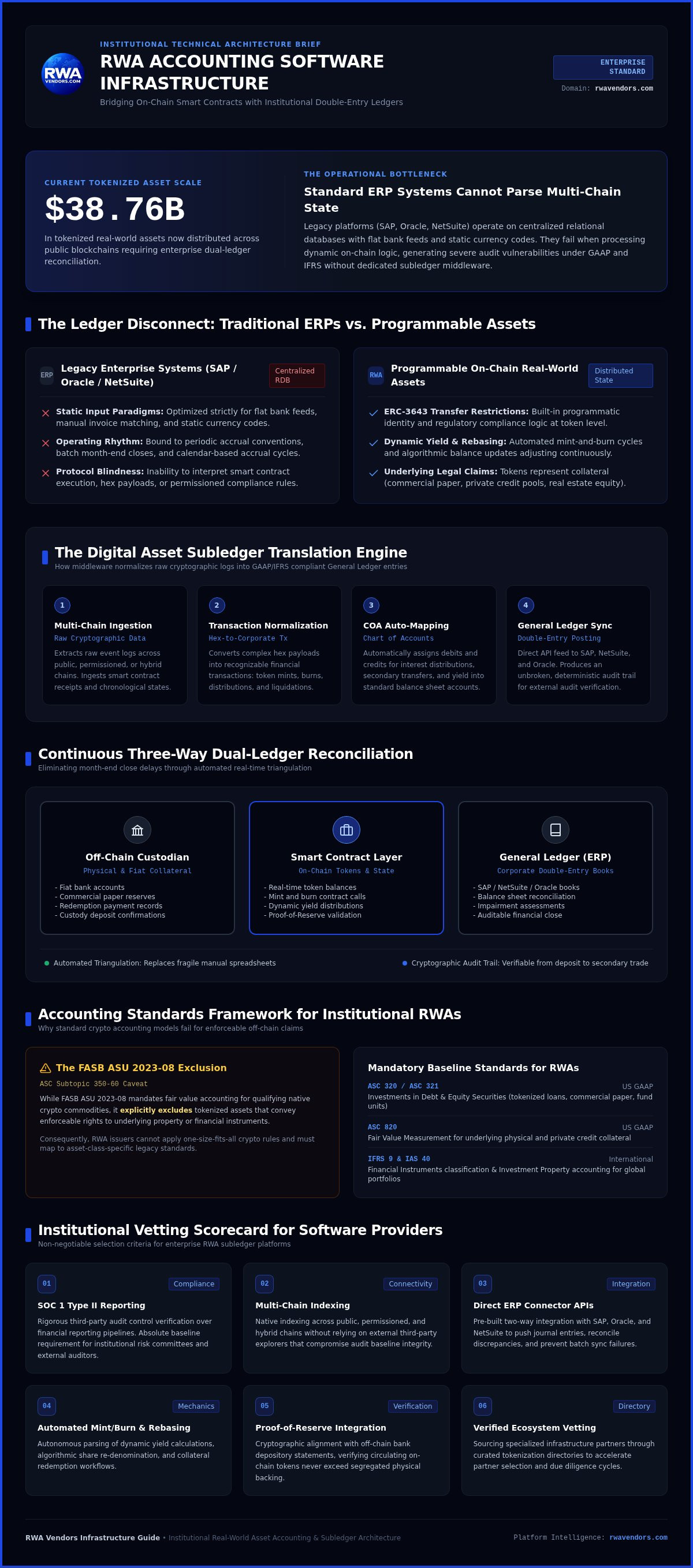
With more than $38.76 billion in tokenized real-world assets now distributed across public blockchains, institutional finance teams face an urgent operational hurdle. Standard ERP systems cannot natively parse multi-chain smart contract events or automated mint-and-burn mechanics. Relying on manual spreadsheets creates severe audit vulnerabilities under GAAP and IFRS when reconciling off-chain custodian records against on-chain logs. To prevent reporting bottlenecks, institutional issuers increasingly depend on specialized RWA accounting software providers to establish an auditable control bridge between distributed networks and their primary general ledger.
You already know that scaling an on-chain product requires institutional-grade financial discipline, but legacy enterprise tools weren't built for programmable assets. In this guide, you'll discover how institutional issuers evaluate and select dedicated RWA accounting software providers to reconcile on-chain assets with standard general ledgers. We break down the technical architecture required for continuous dual-ledger orchestration, outline non-negotiable vetting criteria like SOC 1 Type II reporting, and show you how to source verified infrastructure vendors across the tokenization ecosystem.
Key Takeaways
- Understand why legacy ERP systems cannot process smart contract events and how subledger architecture bridges on-chain transactions with double-entry ledgers.
- Discover the critical criteria for vetting institutional RWA accounting software providers, including SOC 1 Type II controls, multi-chain indexing, and direct ERP integrations.
- Address core compliance challenges, from reconciling dynamic yield distributions and rebasing mechanics to meeting GAAP and IFRS fair value standards.
- Learn how continuous three-way reconciliation between custodian accounts, smart contracts, and general ledgers reduces monthly financial close timelines.
- Explore how institutional finance teams use specialized tokenization directories to source verified infrastructure partners and accelerate vendor selection.
What Are RWA Accounting Software Providers in Institutional Tokenization?
Search engines often conflate "RWA accounting" with housing society platforms that manage Resident Welfare Associations. In institutional capital markets, the acronym means something entirely different: Real-World Assets. Here, RWA accounting software providers deliver enterprise subledger middleware designed to bridge multi-chain smart contracts directly with institutional double-entry books.
Enterprise Resource Planning (ERP) systems like SAP, Oracle, and NetSuite were designed around centralized relational databases. They understand flat bank feeds, predictable invoices, and static currency codes. They fail when forced to parse raw blockchain states. An ERP cannot natively interpret an ERC-3643 transfer restriction, a rebasing balance update, or the smart contract logic behind an institutional mint-and-burn. Without purpose-built middleware, financial institutions face fragmented audit trails and manual data entry errors. The surge in tokenized funds, cash-equivalent products, and private credit has made automated, real-time proof-of-reserve reconciliation an operational requirement rather than an experimental feature.
The Core Role of Digital Asset Subledgers
Digital asset subledgers act as a specialized translator between distributed ledgers and the primary general ledger. They ingest raw, cryptographic transaction receipts and transform them into compliant debits and credits.
- Transaction normalization: They extract event logs from public, permissioned, or hybrid chains, converting complex hex payloads into recognizable corporate transactions.
- Automated chart of accounts mapping: Subledgers automatically categorize token events, whether interest distributions, liquidations, or secondary transfers, into specific general ledger balance sheet accounts.
- Multi-chain state maintenance: They maintain an unbroken, chronological history of multi-party contract calls across disparate networks, creating a verifiable historical audit baseline.
Bridging Off-Chain Custody and On-Chain Securities
The central difficulty in asset tokenization is dual-ledger alignment: the off-chain reality must match the on-chain representation at all times. Specialized RWA accounting software providers construct data pipelines that keep both environments synchronized.
When an issuer executes an on-chain stablecoin yield distribution, the software ties those transfers directly to fiat bank custody balances and redemption records. It tracks physical or financial collateral, such as commercial paper held at a custodian bank, alongside the dynamic digital units circulating on-chain. Crucially, these subledger platforms generate deterministic, cryptographic audit pipelines. Independent auditors and regulators can verify the full lifecycle of an asset from custody deposit to smart contract issuance without relying on fragile, manual spreadsheet reconciliations.
Key Technical Challenges in Accounting for Tokenized Real-World Assets
Native cryptocurrency accounting primarily tracks spot transfers, exchange trades, and gas fees. Tokenized real-world assets introduce structural layers that break traditional crypto bookkeeping models. In an RWA context, a token isn't a standalone digital commodity; it's a programmable digital representation of an underlying legal claim. Whether managing tokenized real estate equity, fractional commercial paper, or private credit loan pools, finance teams face distinct ledger frictions.
The core accounting friction stems from conflicting operating rhythms. Blockchains update state continuously on a transaction-by-transaction basis. Corporate finance operates on periodic accrual conventions, requiring monthly closes, interest accruals, and impairment assessments. Additionally, regulatory standards complicate balance sheet presentation. FASB ASU 2023-08 (ASC Subtopic 350-60) mandates fair value accounting for qualifying digital assets, yet it explicitly excludes tokenized assets that convey enforceable rights to underlying property or financial instruments. Issuers must instead account for RWAs under baseline standards such as ASC 320/321 for debt and equity, ASC 820 for fair value, or IFRS 9 and IAS 40 for international reporting. Selecting capable RWA accounting software providers is vital to avoid classifying these holdings under incorrect reporting frameworks.
Handling Yield Distributions and Amortization Schedules
Real-world asset contracts automate cash flows in ways that standard accounting systems cannot decipher without manual intervention.
- Continuous micro-yield: Private credit protocols often stream interest second-by-second or day-by-day. Software must aggregate thousands of micro-transactions into consolidated monthly income entries without bloating the general ledger.
- Tax withholding and distribution waterfalls: On-chain distributions to global investors require simultaneous tracking of principal repayments, interest income, and applicable withholding tax schedules across multiple jurisdictions.
- Impairments and restructuring: When an underlying borrower defaults in a private credit pool, the subledger must reflect written-down principal across tokenized junior and senior tranches rather than simply recording a market price fluctuation.
Oracle Data Feeds and Net Asset Value (NAV) Adjustments
Unlike liquid digital tokens traded on 24/7 public exchanges, many real-world assets are inherently illiquid. Software subledgers must ingest external valuation data to update token balances accurately.
When Chainlink or specialized data oracles publish daily Net Asset Value adjustments, the subledger software reconciles those off-chain appraisal reports against circulating on-chain tokens. This synchronization prevents balance sheet divergence between physical assets under custody and on-chain capital accounts. Enterprise platforms that solve these integration issues can apply for a vendor directory listing to help institutional issuers source reliable financial infrastructure for their tokenization workflows.
Essential Features to Look for in RWA Accounting Software
Selecting enterprise infrastructure requires moving past generic crypto aggregators. Vetting prospective RWA accounting software providers begins with core technical integration: the platform must offer automated smart contract event indexing across EVM networks and non-EVM protocol environments such as Solana or the Canton Network. Institutional systems need bidirectional synchronization with core general ledgers like Oracle NetSuite, SAP, and Sage Intacct through documented, enterprise-grade APIs. Without native two-way sync, finance teams remain trapped in manual data transformation pipelines.
Security validation remains equally vital. Institutional issuers and asset managers must require independent SOC 1 Type II and SOC 2 Type II certifications. Big Four audit teams regularly dismiss unaudited subledger exports because the underlying data pipelines, pricing ingestion routines, and journal entry rules have not been tested over sustained operational cycles. Additionally, platforms must support multi-entity and multi-jurisdiction consolidation. Institutional tokenization structures commonly route assets through cross-border special purpose vehicles (SPVs), meaning the software must isolate subsidiary books while rolling up aggregated figures to a parent entity under both local statutory rules and group reporting standards.
Automated Reconciliations and Rule-Based Categorization
Configurable rules engines convert erratic cryptographic events into clean, auditable general ledger feeds with minimal manual oversight.
- Granular transaction tagging: Custom rules engines automatically differentiate between gas consumption expenses, initial mint liquidity, balance-rebasing interest payouts, and redemption burns.
- Multi-party balance verification: The engine automatically reconciles fiat disbursements from custodial banks against on-chain transaction logs and token deliveries.
- Discrepancy alerting: Continuous balance monitoring instantly flags variances between attested off-chain asset reserves and total circulating on-chain token supply.
Audit-Ready Trail and Provenance Tracking
Institutional reporting requires continuous, tamper-evident record keeping. Top-tier RWA accounting software providers design their platforms to stand up to stringent regulatory examination.
Every administrative adjustment or manual reclassification must generate an immutable, timestamped audit log documenting who made the change, when it occurred, and why. Leading platforms provide independent auditors with read-only portal access, allowing them to inspect transaction flows, valuation schedules, and cost-basis allocations directly. Most importantly, every debited and credited journal line item must maintain a verifiable cryptographic link back to raw transaction hashes, contract addresses, and block timestamps, ensuring complete data provenance from the distributed ledger to the final financial statements.
How to Evaluate and Select RWA Accounting Software Providers
Procuring digital asset financial software requires an exhaustive technical assessment. When finance teams begin vetting prospective RWA accounting software providers, they must first audit their technical scope: verify native indexing support for the specific networks running your token contracts, whether public chains or permissioned institutional ledgers. Assess supported token architectures across your product roadmap to ensure the subledger parses both debt instruments and fractional equity structures without requiring bespoke smart contract modifications.
ERP interoperability stands as the next critical hurdle. Building custom data transformation pipelines internally drains engineering resources and introduces operational fragility. The software must deliver pre-built, certified connectors to your core accounting suite, whether NetSuite, SAP, or Sage Intacct. Insist on reviewing third-party SOC 1 Type II examination reports covering transaction processing integrity, data encryption, and oracle data validation. Finally, examine vendor balance sheets, engineering headcount, and verified customer references to ensure your software partner possesses the operational stability required for multi-year capital markets deployments.
Establishing Technical RFP Requirements
A rigorous Request for Proposal (RFP) weeds out consumer-grade crypto tools early in the procurement lifecycle.
- Permissioned security standards: Require documented indexing for permissioned standards like ERC-3643 and ERC-1400, ensuring identity registries and transfer restrictions map cleanly into balance sheet accounts.
- Synchronization frequency: Define expected syncing intervals, establishing whether your reporting cadence requires real-time streaming updates or scheduled batch pushes into the primary ledger.
- Re-indexing and throughput thresholds: Mandate minimum latency metrics, API rate limits, and rapid historical re-indexing capabilities to accommodate network hard forks or contract upgrades.
Leveraging Specialized Directories for Due Diligence
Vetting institutional vendors through ad-hoc web searches wastes valuable weeks and risks engaging unverified providers. Finance executives streamline discovery by utilizing centralized, curated directories that organize the tokenization market by functional category.
Specialized marketplaces allow procurement teams to cross-reference accounting subledgers with complementary custodians, identity verification platforms, and legal service providers. This connected view accelerates due diligence by identifying proven technology stacks that already interoperate seamlessly in live enterprise environments.
The Future of RWA Accounting: Programmable Ledgers and Continuous Audit
Enterprise accounting is shifting from retroactive periodic reconciliation to programmatic continuous assurance. In traditional capital markets, back offices wait until the end of a monthly cycle to reconcile bank statements, adjust asset ledgers, and resolve balance discrepancies. Programmable distributed ledgers collapse this timeline. When legal contracts are codified into smart contracts, economic transactions trigger immediate, deterministic debits and credits. Forward-thinking RWA accounting software providers form the operational backbone of this transition, giving finance teams the infrastructure required to scale high-volume asset tokenization programs safely.
Instead of relying on sampling methods or backward-looking reviews, external auditors can continuously inspect transaction streams in real time. Continuous verification removes operational friction, cuts month-end reporting friction, and guarantees that balance sheet entries match collateral reserves around the clock.
Zero-Knowledge Financial Proofs and Institutional Privacy
Public distributed ledgers offer high liquidity and broad settlement accessibility, but institutional issuers can't broadcast trade secrets or counterparty identities. Zero-knowledge (ZK) financial reporting systems resolve this trade-off.
- Solvency validation: Issuers can mathematically verify full asset backing and reserve sufficiency to market participants without revealing underlying corporate account numbers or counterparty terms.
- Verifiable regulatory reporting: Compliance teams can deliver cryptographic proofs of capital adequacy to regulators without exposing sensitive commercial agreements to public view.
- Confidential participation: Enterprise treasury teams can deploy capital into public tokenized liquidity pools while preserving client and institutional transaction privacy.
Connecting with Vetted Tokenization Infrastructure Partners
Executing an institutional tokenization initiative demands a cohesive ecosystem. Subledger software doesn't operate in a vacuum; it functions as the central nervous system connecting qualified custodians, smart contract issuance platforms, oracle networks, and primary enterprise ledgers. Sourcing compatible tools independently exposes organizations to integration failures and compliance blind spots.
Institutions stay aligned with established industry standards by consulting curated directories backed by ecosystem architects like the Security Token Offering Foundation, established circa 2017-2018. Sourcing proven infrastructure partners accelerates procurement and ensures your technology stack meets institutional-grade audit standards from day one.
Discover vetted RWA accounting software providers to scale your digital asset operations.
Architecting Institutional-Grade Financial Reporting for Digital Assets
Bridging decentralized smart contracts with standard double-entry accounting is no longer a downstream operational concern. As asset tokenization expands across debt, equity, and yield-bearing instruments, financial teams can't rely on manual spreadsheets. Selecting capable RWA accounting software providers establishes continuous dual-ledger reconciliation, reliable data provenance, and verifiable audit compliance under GAAP and IFRS frameworks.
Backed by the Security Token Offering Foundation, established circa 2017-2018, RWA Vendors maintains a comprehensive global taxonomy categorizing institutional-grade tokenization service providers. Sourcing verified infrastructure partners streamlines procurement and protects your balance sheet from operational risks.
Explore vetted RWA accounting software providers on RWA Vendors
Deploying the right subledger architecture today ensures your organization is prepared to scale seamlessly alongside the rapid expansion of digital capital markets.
Frequently Asked Questions
What is the difference between RWA accounting software and standard crypto accounting tools?
Standard crypto tools focus on spot token trades, gas fees, and wallet capital gains. In contrast, RWA accounting platforms model underlying legal rights, debt schedules, and equity distributions. They reconcile dynamic on-chain states with traditional GAAP and IFRS standards like ASC 320 and ASC 820. Rather than treating tokens as volatile commodities, dedicated RWA software connects off-chain bank accounts and collateral documents directly with programmatic smart contract ledgers.
Can standard ERP systems like NetSuite or SAP manage tokenized real-world assets natively?
No. Traditional enterprise ERP platforms cannot natively parse multi-chain smart contracts, rebase mechanics, or cryptographic transaction receipts. They expect flat financial files and predictable bank feeds. To record tokenized assets accurately, organizations must deploy specialized digital asset subledgers as an intermediary control layer. This subledger parses blockchain event logs, translates raw hex data into compliant double-entry journals, and syncs those debits and credits into the central ERP.
Why is SOC 1 Type II compliance critical for RWA subledger software providers?
SOC 1 Type II certification proves that a vendor's internal reporting controls, data ingestion pipelines, and calculations have undergone independent third-party examination over a continuous period. Big Four audit firms often dismiss unaudited subledger exports because unverified systems introduce serious financial statement risk. Working with certified RWA accounting software providers ensures that transaction histories, valuation updates, and journal entries satisfy the rigorous governance expectations of external auditors.
How do RWA accounting platforms handle continuous yield distributions and interest payments?
Platforms automate yield processing by listening to smart contract distribution events in real time. Because private credit and treasury tokens frequently stream micro-yields or rebase balances continuously, the subledger aggregates thousands of granular events into clean, periodic journal entries. It applies configurable rules to split principal payments from taxable interest, records appropriate jurisdictional withholding taxes, and updates amortized cost schedules without overwhelming the primary general ledger.
How does real-world asset accounting software verify off-chain collateral reserves?
The software establishes automated three-way reconciliation pipelines connecting three distinct data points: custodial bank statements, on-chain token supplies, and internal general ledger accounts. By integrating with verified oracle networks like Chainlink Proof of Reserve and direct institutional banking APIs, the system continuously compares physical or financial collateral balances against total circulating tokens, instantly flagging any reserve discrepancies or collateral deficits for compliance teams.
What token standards should enterprise RWA accounting software support?
Enterprise platforms must support permissioned security token standards such as ERC-3643 and ERC-1400, which incorporate compliance identity registries and automated transfer restrictions. They should also parse custom ERC-20 wrappers, native treasury fund tokens, and assets deployed on institutional networks like the Canton Network. Robust subledgers ensure that compliance checks, freeze events, and forced transfers map directly to the corresponding balance sheet equity and liability line items.
Where can financial institutions find vetted RWA accounting software providers?
Institutional finance teams can source verified technology partners through RWA Vendors. Backed by the Security Token Offering Foundation, established circa 2017-2018, the directory maintains a comprehensive taxonomy of institutional-grade service providers across the tokenized capital markets ecosystem. Issuers can review pre-vetted RWA accounting software providers, compare enterprise ERP integration capabilities, and identify complementary custody and compliance partners to build a secure, audit-ready operational infrastructure.
Disclaimer
This article is provided by RWAVendors.com for general informational and educational purposes only. It does not constitute legal, financial, investment, tax, regulatory or other professional advice, or an offer, solicitation, recommendation or endorsement of any company, product, service, token, security or investment. RWAVendors.com is an informational vendor directory and does not sell, issue, broker, custody or facilitate transactions involving cryptocurrencies, digital tokens, tokenized assets, securities or investment products. Some vendor listings and references may involve paid advertising, sponsored placement or membership relationships. These relationships do not guarantee a vendor’s qualifications, regulatory status, performance or suitability. Information may be incomplete, outdated or subject to change. You should independently verify all information, conduct your own due diligence and consult qualified professionals before making any business or investment decision. RWAVendors.com is not responsible for the content, services, representations or actions of third-party vendors or linked websites.


