

Deploying a smart contract is often the simplest phase of modern asset tokenization; coordinating the underlying market infrastructure is where institutional projects actually succeed or fail. If you're launching a digital security in 2026, you already know that conflicting cross-border regulations and incompatible tech stacks can trigger months of expensive operational rework. Establishing a compliant offering feels exceptionally complex when custody providers, transfer agents, and trading venues operate in fragmented silos without a unified playbook.
This guide delivers the operational blueprint needed to master the regulatory, technical, and vendor infrastructure behind institutional issuances. You'll learn how to navigate evolving compliance standards, evaluate production-grade token frameworks like ERC-1400 and ERC-3643, and identify vetted ecosystem partners across every lifecycle stage. Ahead, we break down the end-to-end roadmap for building a secure, interoperable issuance architecture that satisfies global regulators from day one.
Key Takeaways
- Understand the five foundational infrastructure layers necessary to bridge distributed ledgers with statutory corporate governance and physical asset custody.
- Align regulatory structuring with technical architecture early to avoid costly smart contract refactoring across primary jurisdictions.
- Follow a phased six-step execution roadmap when launching a digital security to maintain operational control from entity formation to secondary trading.
- Establish rigorous partner selection criteria across tokenization platforms, qualified custodians, and transfer agents to build an institutional-grade issuance consortium.
What Is a Digital Security? Institutional Definitions and Asset Eligibility
Enterprise search engines often conflate digital security with IT cybersecurity, identity access management, or network defense. In global capital markets, the term carries a precise legal definition. A digital security is a regulated financial instrument and investment contract recorded natively on distributed ledger technology. Known in institutional finance as a security token, it represents enforceable economic ownership of an underlying asset, carrying the exact statutory rights, disclosure obligations, and investor protections of paper-based securities.
Unlike unregulated utility tokens or speculative crypto assets, digital securities embed regulatory compliance directly into their architectural framework. When launching a digital security, institutional issuers translate investor agreements, voting thresholds, and transfer restrictions into programmatic smart contracts. Code does not supersede statutory securities law; it enforces statutory requirements at the protocol level.
Digital Securities vs. Conventional Paper-Based Assets
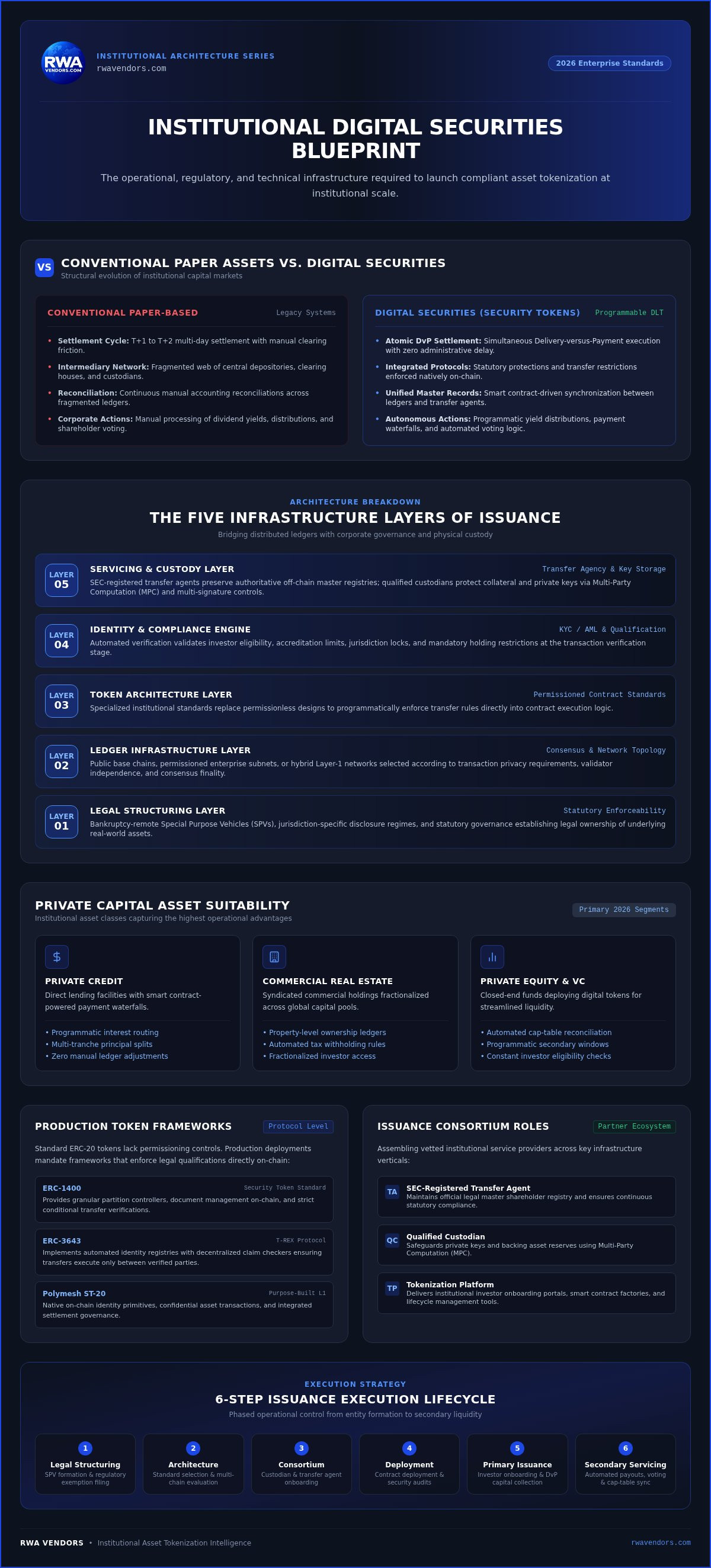
Conventional securities infrastructure relies on fragmented networks of central depositories, clearing houses, and custodians. These intermediaries introduce administrative latency, stretching settlement across one to two business days (T+1 or T+2) and requiring continuous manual reconciliation. Digital securities collapse this stack into atomic, delivery-versus-payment (DvP) settlement, where cash and asset transfers execute simultaneously. Furthermore, corporate actions transition from manual processing to autonomous execution. Dividend yields, interest disbursements, and shareholder voting execute directly via smart contract logic without administrative delay.
Asset Classes Best Suited for Tokenization in 2026
Private capital markets capture the greatest operational advantages from distributed ledgers:
- Private Credit: Direct lending facilities benefit from programmatic distribution waterfalls, automatically routing interest and principal payments to multi-tranche lenders without manual ledger updates.
- Commercial Real Estate: Syndicated real estate assets achieve fractionalized investor participation, maintaining property-level ownership ledgers while automating cross-border tax withholdings.
- Private Equity and Venture Funds: Closed-end funds deploy tokens to streamline secondary transfers, automating cap-table reconciliation and maintaining investor eligibility rules across secondary windows.
Determining structural asset eligibility forms the initial baseline when launching a digital security, dictating which regulatory exemptions and technical layers your issuance stack must satisfy.
The Five Infrastructure Layers of a Digital Security Issuance
Institutional issuance requires an integrated operational stack rather than isolated blockchain code. A production deployment orchestrates five distinct layers: legal structuring (bankruptcy-remote SPVs), ledger infrastructure (base chain network), token architecture (permissioned contract logic), identity compliance (KYC and transfer validation), and servicing (custody and transfer agency). When launching a digital security, failure to coordinate these interconnected layers creates severe operational bottlenecks and regulatory exposure.
Blockchain Protocol and Smart Contract Token Standards
General-purpose ERC-20 tokens lack the permissioning controls required for regulated assets. Institutional issuances instead deploy standards such as ERC-1400, ERC-3643, or Polymesh ST-20, which programmatically enforce investor qualification checks, holding locks, and jurisdiction limits directly on-chain. While public ledgers maximize secondary liquidity access, enterprise issuers often deploy on permissioned subnets or hybrid layer-1 architectures to ensure transaction privacy. Evaluating specialized multi-chain tokenization solutions helps issuers assess consensus finality, validator independence, and cross-chain messaging security across target networks.
Qualified Custody and Transfer Agency Integration
Statutory compliance mandates unbroken continuity of legal ownership. SEC-registered transfer agents serve as the authoritative record keepers, maintaining the master shareholder registry off-chain while smart contracts process secondary transfers on-chain. Meanwhile, qualified custodians secure underlying collateral and private keys using multi-party computation (MPC) and multi-signature cold storage vaults. Binding cryptographic wallet addresses to verified investor records ensures every settlement meets strict regulatory custody guidelines.
Identity, Compliance, and Data Reporting Engines
Automated compliance engines validate secondary trades against predefined regulatory rules before execution occurs. Reusable identity credentials streamline investor accreditation and cross-border KYC screening. At the servicing layer, automated oracle feeds stream real-time asset appraisals and net asset value (NAV) calculations to smart contracts. Issuers also connect specialized RWA accounting software providers to automate subledger reconciliations, wallet-by-wallet cost basis tracking, and Form 1099-DA tax reporting. Verified technology partners supporting these workflows can apply to get listed to connect with enterprise teams launching a digital security.
Regulatory Structuring vs. Technical Architecture: Aligning Both Tracks
A fatal assumption in early tokenization initiatives was believing code could supersede established commercial law. It cannot. When launching a digital security, software architecture must directly reflect statutory covenants, operating agreements, and jurisdictional exemptions. Issuers must advance regulatory structuring and technical implementation in lockstep. Disconnecting these workstreams risks invalidating the entire security offering and triggers catastrophic technical refactoring after primary capital deployment.
Major Jurisdictional Securities Exemptions
Institutional issuers typically rely on proven statutory exemptions rather than public registrations:
- United States: Offerings leverage Regulation D Rule 506(c) for accredited investors, Regulation S for offshore non-US capital, or Regulation A+ Tier 2 for public distribution up to $75 million annually. While the SEC proposed a standalone "Regulation Crypto Assets" framework, it remains a proposal; existing securities exemptions govern current issuances.
- European Union: Financial instruments fall under statutory national frameworks and the EU DLT Pilot Regime, operating alongside the finalized Markets in Crypto-Assets (MiCA) regulation.
- Asia-Pacific & Switzerland: The Monetary Authority of Singapore (MAS) and the Swiss DLT Act provide explicit statutory recognition for uncertificated ledger-based securities.
Translating Legal Shareholder Agreements into Smart Contract Code
Every term outlined in a private placement memorandum (PPM) requires programmatic validation. Smart contracts enforce investor holding periods, such as Rule 144 one-year restriction locks, before permitting transfers. Code logic must also automate corporate actions, routing prorated distributions based on registered token holdings. Crucially, contracts require administrative recovery mechanisms. If a court orders an asset freeze or an institutional investor loses wallet credentials, authorized transfer agents must possess the cryptographic authority to burn lost tokens and reissue equivalent shares.
Smart Contract Auditing and Cybersecurity Protocols
Legal enforceability means little if protocol logic harbors exploitable flaws. Institutional issuers use verified smart contract libraries and mandate independent dual-firm security audits before deployment. Engaging specialized tokenization cybersecurity vendors helps identify reentrancy bugs, access control vulnerabilities, and logic flaws that could expose shareholder ledgers. Beyond standard code reviews, operational runbooks must define administrative key management, multisig signing policies, and emergency circuit breakers to pause contract execution during anomalous network activity.
The 6-Step Implementation Roadmap for Launching a Digital Security
Executing an institutional issuance requires synchronizing corporate governance, technology architecture, and capital formation. Without a disciplined deployment framework, cross-functional dependencies stall progress and inflate legal expenses. Structuring the project across six sequential milestone gates keeps your internal teams aligned and prevents rework.
Phases 1 to 3: Structuring, Vendor Vetting, and Technical Development
The primary workstreams establish legal boundaries and configure core infrastructure:
- Phase 1: Legal Structuring and Exemption Selection. Establish bankruptcy-remote special purpose vehicles (SPVs), draft the private placement memorandum (PPM), and lock in statutory exemptions across target jurisdictions.
- Phase 2: Infrastructure Consortium Procurement. Contract qualified custodians, SEC-registered transfer agents, and software providers concurrently. Vetting compatibility between your transfer agent's master registry and the custody stack avoids critical integration roadblocks later.
- Phase 3: Smart Contract Configuration and Audit. Customize token logic (such as ERC-3643 or ERC-1400 parameters) and integrate institutional identity registries. Rigorously stress-test smart contracts through external cybersecurity audits before deploying to production testnets.
Phases 4 to 6: Investor Onboarding, Primary Issuance, and Secondary Trading
Once your infrastructure passes audit, focus transitions to capital intake, settlement, and lifecycle operations:
- Phase 4: Investor Onboarding and Credentialing. Direct prospective participants through institutional onboarding portals. Verify accreditation status, execute KYC/AML checks, and bind approved wallet addresses to digital identity credentials. Consulting institutional checklists for tokenization data providers ensures reliable verification feeds across multiple jurisdictions.
- Phase 5: Primary Issuance and Atomic Settlement. Execute delivery-versus-payment (DvP) settlement. Smart contracts mint and allocate tokens directly to investor custodial wallets upon confirmed receipt of fiat or stablecoin subscriptions. The transfer agent synchronizes the authoritative off-chain cap table in real time.
- Phase 6: Servicing and Secondary Market Connectivity. Initiate lifecycle servicing, including automated dividend distributions and corporate actions. Transition secondary liquidity onto regulated alternative trading systems (ATS) in the US or multilateral trading facilities (MTF) in Europe, where smart contract whitelist rules continuously police secondary transfers.
Rigorous milestone management ensures that launching a digital security progresses seamlessly from legal structuring through secondary liquidity without regulatory or technical delays.
Building Your Issuance Consortium: How to Select and Assemble Vetted Providers
Successful institutional tokenization is fundamentally an exercise in multi-party coordination rather than solitary software development. No single technology vendor delivers end-to-end capabilities spanning legal structuring, primary distribution, qualified custody, and secondary exchange connectivity. Issuers that rely on closed-source, monolithic platforms frequently suffer painful vendor lock-in, leaving them unable to migrate assets or switch servicing partners as regulatory environments evolve. When launching a digital security, assembling a modular consortium of independent, vetted specialists preserves operational sovereignty and long-term infrastructure flexibility.
Essential Selection Criteria for Capital Market Vendors
Evaluating potential partners requires assessing operational resilience, technical maturity, and regulatory compliance. Prioritize these core criteria during initial discovery:
- Regulatory Authorizations and Risk Controls: Confirm that custodians maintain state or federal trust charters, transfer agents hold active SEC registrations, and technology vendors provide verified SOC 2 Type II audit reports alongside comprehensive cyber insurance policies.
- API Interoperability and Modular Design: Choose vendors with production-grade REST and GraphQL APIs, bidirectional webhooks, and documented integrations across custody, compliance engines, and transfer agent ledgers to prevent custom middleware development.
- Demonstrated Issuance Track Record: Prioritize providers with demonstrable historical volume across your specific asset class and pre-established conduits to regulated secondary venues like alternative trading systems (ATS).
Streamlining Due Diligence Through Curated Vendor Directories
Conducting vendor discovery through unverified search queries or fragmented provider claims exposes issuers to significant execution risk. Finding capable partners requires transparent, independent evaluation frameworks that clearly distinguish compliant enterprise infrastructure from consumer-grade software tools.
Issuers can discover vetted technology, legal, and custody partners via the RWA Vendors Directory. Filtering providers by regulatory jurisdiction, targeted asset class specialization, and token standard compatibility shortens procurement cycles from months to days. To initiate your consortium, begin by securing specialized securities counsel to establish your offering structure, followed immediately by transfer agency and custody integration before contract deployment. Partnering with proven market participants ensures your issuance remains compliant, scalable, and resilient throughout its lifecycle.
Orchestrating Your Institutional Issuance Architecture
Successfully launching a digital security requires parallel coordination across statutory compliance, transfer agency operations, and cryptographic infrastructure. Treating tokenization as an isolated software build invites expensive regulatory rework, operational delays, and secondary liquidity friction. Sustainable capital formation demands an integrated ecosystem where qualified custodians, registered transfer agents, and audited smart contracts operate in unified lockstep.
Established as the infrastructure directory arm of The STO Foundation, RWA Vendors provides a neutral, global directory indexing vetted partners across custody, compliance, and distributed ledger architecture. Assembling a specialized partner consortium early transforms complex cross-border requirements into a reliable, repeatable market deployment.
With structured governance and institutional-grade infrastructure vendors in place, your organization can bring real-world assets on-chain with total regulatory confidence.
Frequently Asked Questions
What is the fundamental difference between a digital security and an unbacked cryptocurrency?
Digital securities represent legal, regulatory-enforced claims on underlying economic assets, whereas unbacked cryptocurrencies derive value strictly from market supply and demand without statutory shareholder protections. A digital security is an investment contract issued under established securities frameworks. It grants enforceable rights like equity ownership, dividends, or debt claims. In contrast, unbacked crypto assets function as open-market commodities or speculative utility instruments without off-chain asset backing or statutory corporate governance.
How long does it typically take to launch an institutional digital security?
A standard institutional issuance timeline ranges between three to six months from initial entity structuring to capital closing. The timeline depends heavily on the chosen regulatory exemption, the complexity of underlying asset appraisals, and how quickly cross-functional partners are onboarded. Structuring the legal private placement memorandum typically requires four to eight weeks, while parallel smart contract customization, dual cybersecurity audits, and qualified custody integrations take six to twelve weeks to complete securely.
Can an issuer launch a digital security without an SEC-registered transfer agent?
While private placements under certain non-US regimes or narrow exemptions technically permit issuers to self-administer cap tables, institutional issuances in the United States practically require an SEC-registered transfer agent. Transfer agents provide the legally authoritative master shareholder registry required by regulators. When launching a digital security, relying entirely on smart contracts without an official transfer agent creates significant compliance liability, especially if court-mandated share cancellations or investor wallet recoveries become necessary.
What smart contract standards are most widely adopted for digital securities in 2026?
The industry has consolidated primarily around ERC-3643, ERC-1400, and Polymesh ST-20 for permissioned issuances. Unlike general-purpose ERC-20 tokens, these standards incorporate native compliance modules that enforce transfer restrictions directly on-chain. They integrate decentralized identity checks, conditional transaction validation, and administrative controls. This architecture ensures tokens cannot transfer to non-whitelisted addresses or violate jurisdiction-specific holding rules, making them the standard choice for enterprise-grade asset tokenization.
How do smart contracts enforce investor accreditation and secondary trading lockups?
Smart contracts validate every transfer transaction against an on-chain identity registry and an automated compliance rule engine before execution. If an investor attempts a transfer during a statutory holding period, like a Rule 144 one-year restriction, the contract rejects the transaction. Similarly, the protocol checks whether both sender and recipient hold valid, accredited identity credentials. If either party fails jurisdictional verification or sanctions screening, the transaction reverts immediately without manual intervention.
Is it possible to launch a digital security using public blockchain networks?
Yes, issuers regularly deploy digital securities on public blockchains by utilizing permissioned smart contract layers. Public networks offer continuous uptime, global settlement finality, and broad access to institutional liquidity. Security and privacy are maintained at the application and protocol level rather than the base ledger. Permissioned standards ensure only verified, KYC-cleared wallets can hold or trade the tokens, combining the openness of public infrastructure with strict regulatory controls when launching a digital security.
Where can asset issuers find vetted vendors for tokenization infrastructure?
Asset issuers can evaluate and source verified service partners through the RWA Vendors Directory. Operated as the infrastructure directory arm of The STO Foundation, the platform provides a neutral global index of vetted providers across smart contract development, custody, transfer agency, legal compliance, and secondary trading venues. Issuers can filter partners by jurisdiction, supported token standards, and asset specialization to assemble a fully compliant issuance consortium.
Disclaimer
This article is provided by RWAVendors.com for general informational and educational purposes only. It does not constitute legal, financial, investment, tax, regulatory or other professional advice, or an offer, solicitation, recommendation or endorsement of any company, product, service, token, security or investment. RWAVendors.com is an informational vendor directory and does not sell, issue, broker, custody or facilitate transactions involving cryptocurrencies, digital tokens, tokenized assets, securities or investment products. Some vendor listings and references may involve paid advertising, sponsored placement or membership relationships. These relationships do not guarantee a vendor’s qualifications, regulatory status, performance or suitability. Information may be incomplete, outdated or subject to change. You should independently verify all information, conduct your own due diligence and consult qualified professionals before making any business or investment decision. RWAVendors.com is not responsible for the content, services, representations or actions of third-party vendors or linked websites.


