
A token can be technically live and still leave critical questions unanswered: What legal rights does it represent, who manages the underlying asset, and how can eligible participants use it? The challenges of RWA tokenization are rarely confined to the technology. They emerge where legal structures, compliance processes, custody, platforms, and asset operations must work together.
That coordination is the part many project plans underestimate. Issuance alone doesn’t establish enforceable rights, create a usable market, or manage ongoing events across an asset’s lifecycle. Each depends on decisions and capabilities that need to align from the outset.
This guide explains the legal, operational, and technical challenges to assess before committing to a project. You’ll learn how to compare provider capabilities, identify coordination gaps, and build a practical plan for issuance and ongoing oversight. It also previews the specialist provider categories involved, so you can evaluate how each part of the ecosystem fits your objectives.
Key Takeaways
- The challenges of RWA tokenization span legal rights, compliance, infrastructure, and asset operations, so evaluate the full operating model rather than issuance alone.
- Map the rights represented by a token to the asset, investor terms, and relevant jurisdictions before settling on a project structure.
- Assess custody, wallets, smart contracts, identity tools, payment rails, and records as connected components with clear operational responsibilities.
- Use a staged risk assessment to define objectives, identify obligations, assign risk owners, and test dependencies before launch.
- Identify specialist partners by need, including legal and compliance, custody, infrastructure, payments, trading, and asset servicing.
What makes RWA tokenization challenging beyond putting an asset on-chain?
RWA tokenization represents rights or interests in real-world assets through digital tokens. It is more than recording asset information on a blockchain: the token’s terms, the legal structure behind it, and the processes for managing it must work together. A token can record or transfer an interest digitally, but issuance alone doesn’t establish legal ownership, define investor rights, or service the underlying asset.
This is why the challenges of RWA tokenization span several connected areas: legal design, compliance, technology, operations, custody, and market access. The right approach depends on the asset, investor base, operating model, and jurisdictions involved. The Tokenization overview offers a foundational explanation of the term, including its use in representing asset rights through blockchain-based tokens.
How do token rights connect to the underlying asset?
Token terms need to match the enforceable rights established by the relevant ownership or contractual structure. A blockchain record isn’t automatically the same as a legal register, title document, beneficial interest, or claim against an issuer. The relationship between them should be clear and documented.
For example, a property-linked vehicle might issue tokens that represent an interest defined by its governing documents. That doesn’t necessarily mean each token holder directly owns part of the property. The rights depend on the chosen structure and applicable legal framework, so one model shouldn’t be assumed to fit every asset or jurisdiction.
Why is tokenization a lifecycle project?
Tokenization extends beyond structuring and issuance. A project may need to plan for ongoing servicing, permitted transfers, investor reporting, and redemption. Each stage depends on practical arrangements: who maintains records, processes updates, handles investor communications, and coordinates activity involving the underlying asset.
Choices made at issuance can shape these later tasks. Transfer rules need to align with the operating process; reporting must reflect the information investors are entitled to receive; and redemption terms need an operational path. Assess these dependencies early, alongside compliant asset tokenization guidance such as the article “Compliant Asset Tokenization: 2026 Institutional Guide.”
The key test is not simply whether a token can be issued. It’s whether the legal rights, supporting records, technology, and asset-management processes remain aligned throughout the token’s lifecycle, while providing a workable route to market access.
Which legal, compliance, and governance challenges must issuers resolve?
Legal and compliance decisions depend on the asset, issuer, investor rights, and jurisdictions involved. A structure that fits one project may not suit another, so there’s no universal legal template. Token rules and legal rights require coordinated design and review. Issuers should work with qualified counsel on project-specific questions; this section is a planning overview, not legal advice.
These are central challenges of RWA tokenization because a mismatch between legal documents and token functionality can create uncertainty about who may hold or transfer tokens, what rights they carry, and who is responsible for acting when circumstances change. The World Economic Forum’s discussion of barriers to RWA tokenization adoption also highlights broader coordination concerns, including interoperability and legacy infrastructure.
How can legal rights and token rules become misaligned?
Misalignment can arise if offering documents describe a transfer restriction that the token system doesn’t enforce, or if smart-contract functionality allows an action that the governing documents don’t authorize. A ledger entry also shouldn’t be assumed to replace legal records or establish an investor’s rights by itself.
Build a rights map: list each material investor right, identify the document that governs it, and assign an operational owner responsible for carrying it out. Check that token functions and transfer procedures reflect those terms. Structures vary by asset and jurisdiction, so have qualified counsel review the design.
What ongoing compliance and governance work is easy to underestimate?
Issuance is only one point in the process. Issuers may need defined procedures for investor onboarding and eligibility checks, restricted transfers, disclosures, and recordkeeping. Requirements depend on the project and relevant jurisdictions. A process that works at launch also needs an owner and a method for handling updates over time.
Set decision rights before deployment. Specify who can propose, review, approve, and implement changes to token contracts, asset terms, or operating procedures. Smart-contract controls can support agreed processes, but they don’t replace legal documentation, accountable decision-makers, or oversight. For further reading, see KYC and AML Solutions for Digital Securities and its discussion of digital securities KYC and AML considerations.
Clear roles help translate policy into practice. Issuers can also compare specialist provider capabilities across legal and compliance services, technology, and operations. Providers serving these needs can use a directory listing to present their capabilities to organizations exploring tokenization.
How do infrastructure and operating-model choices affect RWA tokenization?
Infrastructure is a set of interdependent components, not a standalone blockchain choice. The challenges of RWA tokenization often surface at the handoffs: who controls access, how records are reconciled, what happens when data changes, and which party handles exceptions. Compare options by governance, control, interoperability, integration needs, and operational responsibility, not by headline claims.
Start with the intended investor and operating model. Assess network governance, security controls, upgrade processes, and whether the infrastructure supports the transfer restrictions the project requires. Permissioning may help manage access, while interoperability can affect how systems and participants connect. Neither is automatically preferable for every project. The Federal Reserve’s discussion of the financial stability implications of tokenization provides additional context for evaluating how design choices may affect broader market structures.
How do the components depend on one another?
Use this comparison to identify decisions and handoffs that need an accountable owner. The criteria are project-specific, so confirm how each provider’s system integrates with the rest of the operating model.
How do custody, data, and asset servicing create operational dependencies?
Map who manages keys, reconciles token and business records, processes asset events, maintains investor records, and resolves exceptions. An oracle can relay external information to a smart contract, but it doesn’t establish that the information is legally authoritative or correct. Define how inputs are checked, who can correct them, and what happens when records conflict.
Unclear ownership can leave a valid update unapplied or investor records out of sync. Review specialist capabilities through resources such as Institutional Guide to Digital Asset Infrastructure Providers in 2026 and Selecting Digital Asset Custody Providers for RWAs, focusing on integration and responsibility boundaries.
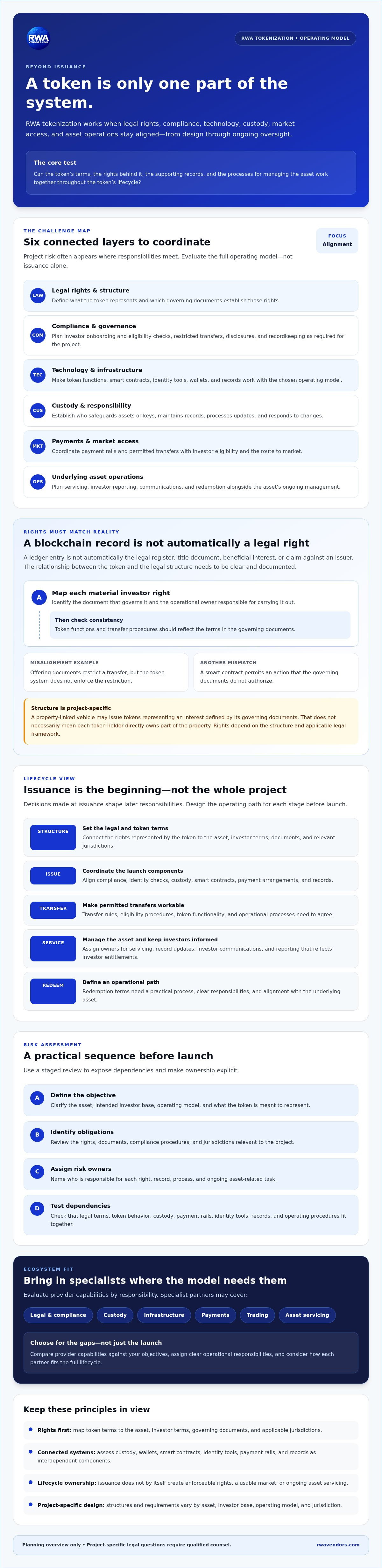
How can an issuer assess and reduce tokenization project risks?
A structured readiness assessment helps an issuer identify, assign, and manage risk before commitments become difficult to change. It won’t eliminate risk, but it can expose gaps between the project’s purpose, rights, operations, and technology while there’s still time to address them.
What questions belong in an issuer readiness assessment?
Work through the decisions in sequence. Record assumptions and evidence at each stage, and make unresolved issues visible rather than treating them as launch details.
- Define the objective. What problem is tokenization intended to solve, and how will the organization assess whether the project meets that objective?
- Map the rights. What rights or interests will the token represent, where are they documented, and how will relevant records stay aligned?
- Identify obligations. Document investor workflows, required disclosures, transfer conditions, and continuing responsibilities for the project’s asset and investor base.
- Design operations. Assign responsibility for onboarding, custody arrangements, servicing, reporting, reconciliation, and exception handling.
- Test dependencies. Check integrations and handoffs among providers, data sources, asset administrators, and other parties the project relies on.
A useful readiness test is simple: every material right and task has an owner. For each risk, document the owner, decision gate, underlying assumption, escalation path, and evidence needed before launch. This gives teams a basis for tracking open questions and deciding whether to proceed, revise the design, or pause.
How should organizations evaluate providers and integration risks?
Compare providers against the responsibilities the project actually needs covered. Review relevant experience, service scope, control responsibilities, integrations, incident processes, and documentation. Ask who owns each handoff across legal, compliance, technology, and operations, and how a team will detect and resolve a failed or delayed dependency.
Before expanding scope, pilot the end-to-end workflow. Test permitted and restricted transfers, routine servicing events, investor reporting, and exceptions such as mismatched records or delayed data. Confirm what evidence the test produces, who reviews it, and what conditions must be met at each decision gate. These checks help teams surface integration issues without assuming a pilot proves every future scenario will work.
Organizations identifying specialist support can consult the Institutional Digital Asset Partners guide and compare institutional digital asset partners by capability and project-stage fit. Use the same documented criteria for each provider, then confirm responsibilities directly before relying on a capability in the operating model.
Where can issuers find the specialist partners needed for RWA tokenization?
Tokenization projects depend on coordinated specialists, not one technology platform acting alone. Legal structure, compliance processes, custody, infrastructure, payments, trading, and asset servicing each address different needs. Gaps between these roles can create handoff problems, so provider discovery should begin with the project’s documented requirements rather than a single platform’s feature list.
Use provider categories to organize the search:
- Legal and compliance: assess support for project-specific structuring and compliance requirements.
- Custody: clarify how key management and related responsibilities fit the operating model.
- Infrastructure: compare tokenization technology, blockchain infrastructure, and required integrations.
- Payments: identify providers that support the project’s payment workflows.
- Trading: assess whether and how trading-related capabilities fit the intended market model.
- Asset servicing: identify who will handle ongoing administration, records, and investor-facing processes.
A directory can help issuers locate relevant specialist providers and begin comparing capabilities. It doesn’t determine whether a provider is suitable, and it doesn’t replace independent due diligence. RWA Vendors connects issuers with providers across these categories; it doesn’t tokenize assets or provide legal, custody, brokerage, or investment services.
How can issuers organize provider discovery?
Start with requirements, then shortlist providers by category, scope, and integration needs. Use a consistent question set to compare relevant experience, control responsibilities, service boundaries, documentation, and handoffs. Confirm references and conduct appropriate legal, compliance, security, and commercial due diligence independently. Record who owns each dependency before selecting partners.
How can tokenization service providers reach relevant issuers?
For service providers, a clear directory profile can explain service categories, target use cases, and the responsibilities the company can support. Specific descriptions help issuers assess potential fit and identify follow-up questions. A listing is a way to present capabilities, not a guarantee of referrals, leads, verification outcomes, or commercial results.
Issuers can use the RWA Vendors provider directory as one starting point for partner research, then evaluate each provider against their project’s needs. Service providers can submit a company for directory listing to present their capabilities to organizations exploring tokenization.
Build a tokenization plan around coordinated expertise
The challenges of RWA tokenization are best approached as connected decisions, not a technology launch alone. Align the rights represented by tokens with their legal structure, define compliance and governance responsibilities, and test how infrastructure, custody, data, and asset operations work together.
Before moving forward, document the project’s objective, dependencies, risk owners, and readiness criteria. Then identify specialist support by need. RWA Vendors connects asset issuers with tokenization providers and professional services through directory categories that include legal and compliance, custody, trading, infrastructure, and payments. Use the directory for initial provider research, and assess each organization’s suitability independently.
If your company supports tokenization projects, a clear directory profile can help issuers understand your service categories and potential fit. Take the next step by submitting your company for listing.
With clear responsibilities and the right specialist partners, your organization can approach tokenization with greater clarity and a more coordinated plan.
Frequently Asked Questions
What are the main challenges of RWA tokenization?
The main challenges of RWA tokenization are aligning legal rights, compliance processes, technology, and asset operations. Issuers need to define what rights tokens represent, how investor eligibility and transfers will be managed, and how custody, records, servicing, and reporting will work. Infrastructure must also integrate with relevant systems and support the intended operating model. These issues vary by asset, investor base, and jurisdictions, so projects need coordinated responsibilities rather than a technology-only plan.
Is RWA tokenization legally equivalent to owning the underlying asset?
No, a token doesn’t automatically give its holder legal ownership of the underlying asset. It may represent a claim, contractual right, beneficial interest, or another form of interest, depending on the structure and applicable jurisdiction. The governing documents and relevant legal records establish what rights apply; a digital token record alone may not establish title. Issuers and participants should have qualified counsel assess the specific structure rather than assume all tokens confer the same rights.
Can tokenization make an illiquid asset liquid?
No, tokenization doesn’t guarantee liquidity. Digital representation or the ability to transfer tokens doesn’t ensure there will be willing buyers, an active market, or a practical route to sell. Liquidity depends on factors such as investor demand, transfer restrictions, market access, settlement arrangements, and ongoing asset information. Before launch, assess who may hold and transfer the tokens, how transfers will be supported, and what exit options are actually available under the project’s terms.
How do smart contracts create challenges for RWA tokenization?
Smart contracts can encode and automate defined rules, but they can also create operational risks if code doesn’t match legal documents or intended processes. Errors, upgrade decisions, access controls, and dependencies on external data need careful management. A contract can process information supplied to it, but that doesn’t prove the information is accurate or legally authoritative. Document who reviews changes, tests updates, handles exceptions, and reconciles on-chain activity with relevant records.
What happens if a tokenization platform or service provider stops operating?
The impact depends on the project’s contracts, technical design, custody arrangements, and access to records. Issuers should plan for provider disruption before launch: identify who can access essential data, how records can be exported, who can maintain operations, and what transition or recovery processes apply. Don’t assume tokens or records will remain usable without the provider. Review continuity arrangements and responsibilities with appropriate technical and legal specialists.
How should an issuer choose providers for an RWA tokenization project?
Choose providers against documented project requirements, not broad claims about technology. Compare service scope, relevant experience, control responsibilities, integrations, incident processes, and documentation. Map handoffs across legal, compliance, custody, infrastructure, payments, and asset operations, then conduct independent due diligence and confirm references as appropriate. RWA Vendors’ directory helps issuers discover providers across these categories, but directory discovery doesn’t establish suitability or replace the issuer’s own assessment.
Does RWA tokenization eliminate the need for intermediaries?
No, tokenization may change how some tasks are performed, but it doesn’t remove every intermediary or operational responsibility. Projects may still depend on legal and compliance specialists, custodians, technology providers, payment services, asset administrators, and trading infrastructure. The roles vary by structure and operating model. Map which functions remain necessary, who is accountable for each one, and how information and decisions move between providers throughout the asset lifecycle.
Disclaimer
This article is provided by RWAVendors.com for general informational and educational purposes only. It does not constitute legal, financial, investment, tax, regulatory or other professional advice, or an offer, solicitation, recommendation or endorsement of any company, product, service, token, security or investment. RWAVendors.com is an informational vendor directory and does not sell, issue, broker, custody or facilitate transactions involving cryptocurrencies, digital tokens, tokenized assets, securities or investment products. Some vendor listings and references may involve paid advertising, sponsored placement or membership relationships. These relationships do not guarantee a vendor’s qualifications, regulatory status, performance or suitability. Information may be incomplete, outdated or subject to change. You should independently verify all information, conduct your own due diligence and consult qualified professionals before making any business or investment decision. RWAVendors.com is not responsible for the content, services, representations or actions of third-party vendors or linked websites.


