
Tokenization can make real estate interests easier to divide and administer, but it can’t change a property’s economics or guarantee a buyer when an investor wants to sell. The benefits of tokenizing real estate assets depend on the legal structure behind each token, not just the technology used to record it.
That distinction matters. A token may represent a claim on a property-owning entity rather than direct ownership of the property itself, and the governing documents determine what rights holders actually receive. Fractional interests, coordinated recordkeeping, and more structured investor administration may be practical advantages, but liquidity and legal ownership shouldn’t be assumed.
This guide examines potential benefits alongside their limits, with a focus on what issuers need to evaluate before moving forward. You’ll learn which advantages depend on the asset, investor rights, and operating model, and what questions to ask about legal structure, compliance, transfers, and provider coordination. The aim is to help you decide whether tokenization addresses a real operational need or adds complexity without enough practical value.
Key Takeaways
- Evaluate the benefits of tokenizing real estate assets against a specific ownership, recordkeeping, distribution, or administration challenge.
- Confirm what rights each token represents by reviewing the offering’s legal and operating structure, not just its digital design.
- Assess whether shared ledgers and smart contracts could improve workflows, while keeping legal agreements and oversight in view.
- Do not assume tokenization guarantees liquidity or lower overall costs. Examine market access and the full range of ongoing responsibilities.
- Before proceeding, define the intended benefit, validate investor rights, and assess operational readiness with qualified specialists.
What Are the Benefits of Tokenizing Real Estate Assets?
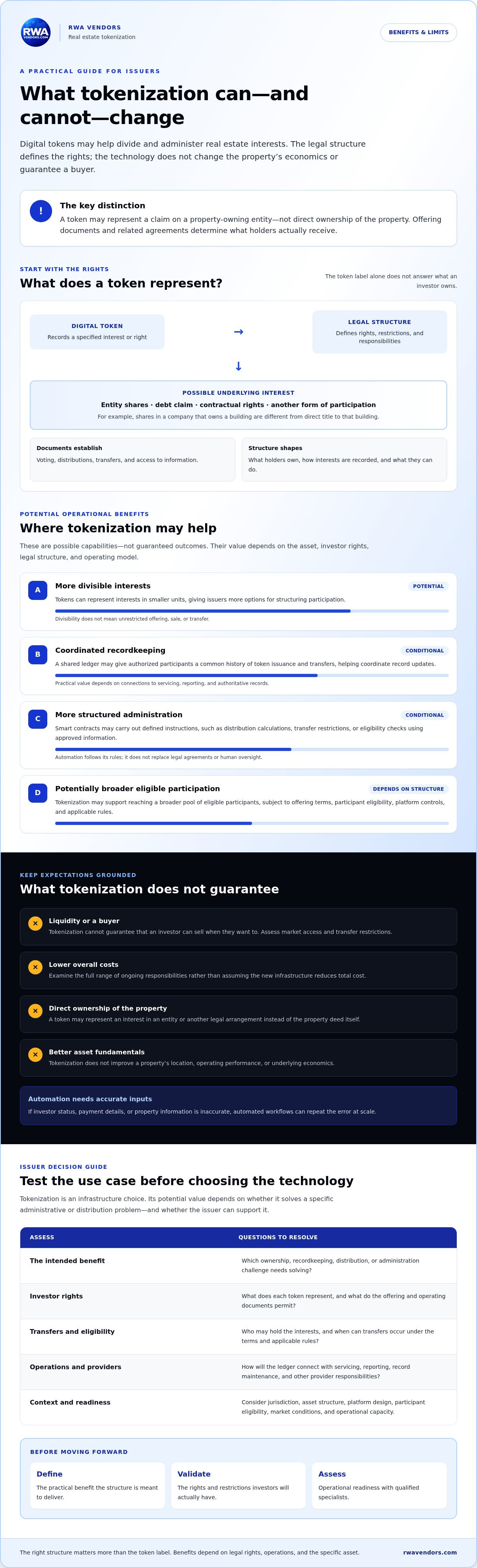
Real estate tokenization uses digital tokens to represent specified rights connected to a property or a property-owning structure. A token is not automatically the property deed, and holding one doesn’t by itself establish direct title to the real estate.
In practice, the offering’s legal and operational structure determines what tokenholders own, how their interests are recorded, and what they can do with them. Depending on that structure, potential benefits of tokenizing real estate assets include dividing interests into smaller units, coordinating records and transfers, reaching a broader pool of eligible participants, and programming certain administrative steps. These are possible capabilities, not guaranteed outcomes.
How does real estate tokenization represent a property interest?
An issuer may connect tokens to an interest in a property-owning entity or another legal arrangement. The represented interest could be shares in an entity, a debt claim, contractual rights, or another form of participation. That distinction matters: a token representing shares in a company that owns a building is different from a token representing direct title to the building.
The offering documents and related agreements establish the rights and restrictions. They determine matters such as voting, distributions, transfers, and access to information. The label “tokenized real estate” alone doesn’t answer what a holder owns. For related context on digitally represented securities, see Security token.
Why are real estate assets being tokenized?
Real estate tokenization is the use of digital tokens to represent rights in property or a property-owning structure, with those rights defined by the relevant legal documents.
Property interests can be challenging to divide, transfer, and administer through conventional processes. A token-based system may provide infrastructure for recording interests, coordinating transfers, and managing distributions. Programmable processes, often implemented through smart contracts, can automate defined instructions. They don’t replace legal agreements, operational controls, or oversight.
Tokenization is an infrastructure choice, not a substitute for sound asset fundamentals. It doesn’t improve a property’s location, operating performance, or underlying economics. Its potential value depends on whether the proposed system solves a specific administrative or distribution problem and whether the issuer can support it.
Benefits also vary with jurisdiction, asset structure, platform design, participant eligibility, and market conditions. Issuers assessing the provider landscape can use RWA Vendors’ directory to discover tokenization technology and professional-service vendors. The directory is a discovery resource, not a tokenization or advisory service.
How Tokenization Can Change Real Estate Ownership and Administration
A shared digital ledger can give authorized participants a common record of token issuance and subsequent transfers. Instead of reconciling separate records manually, an issuer and its service providers may use the ledger to track transactions and coordinate updates to investor records. The practical benefit depends on how the ledger connects with the systems responsible for servicing, reporting, and maintaining authoritative records.
Smart contracts add programmable instructions to these workflows. Depending on the design, they may help carry out distribution calculations, apply transfer restrictions, or check an investor’s eligibility using approved information. They execute defined rules. They don’t establish the legal rights behind the offering or replace human oversight. If an investor’s status, payment details, or property information is inaccurate, automation can repeat the error at scale.
Can tokenization make property interests more divisible?
Tokenization can represent an interest in smaller units, giving issuers more options for structuring participation. But divisibility doesn’t mean every token can be freely offered, sold, or transferred. Offering terms, participant eligibility, platform controls, and applicable rules may restrict who can hold tokens and when transfers are permitted. Issuers should define those conditions before choosing how interests are represented.
Can blockchain improve real estate recordkeeping?
A blockchain can provide a consistent, reviewable history of transactions recorded on that network. This may help authorized participants trace when a token was issued or transferred. It doesn’t automatically update a land registry, company register, or separate investor database. Those records may need their own processes and accountable operators, with clear procedures for resolving discrepancies between systems.
A blockchain record can show that a transaction was recorded under a particular system. By itself, it doesn’t prove legal title to the property or validate the rights the token is said to represent.
That distinction shapes whether administrative efficiency is achievable. Issuers should map how data moves from the property-owning entity and investor onboarding process into the token platform. They should also identify who checks, corrects, and maintains each record. Technology integration, reliable source data, and clear responsibility for ongoing servicing matter as much as the ledger itself.
The potential benefits of tokenizing real estate assets therefore depend on more than issuance. They require coordination among technology providers and relevant legal, compliance, and operating specialists. Providers working in this ecosystem can review RWA Vendors listing information to explore visibility in a directory for tokenization services.
Do Tokenized Real Estate Assets Guarantee Liquidity or Lower Costs?
No. Token issuance doesn’t guarantee liquidity, willing buyers, or reliable price discovery. A token may be technically transferable while the offering’s terms restrict who can hold it, when transfers can occur, or which platform can process them. Even where resale is permitted, activity depends on demand for that specific interest and access to a functioning secondary market.
Fractional units can change how interests are divided and transferred, but they don’t make the underlying property easier to sell. A tokenholder seeking an exit is selling an interest defined by the offering, not necessarily a slice of the building that can be independently sold on the property market.
What determines liquidity for tokenized real estate?
Liquidity depends on the combination of investor demand, permitted transfers, secondary-market access, and the asset’s appeal. Issuers should distinguish between a token being available for transfer and an active market where eligible buyers are prepared to transact. An exchange or platform listing, on its own, doesn’t establish trading volume, a dependable sale price, or a timely exit.
When might efficiency or access benefits be limited?
Digital workflows may reduce some manual steps, but implementation introduces its own requirements. Legal structuring, compliance processes, technology, custody arrangements, investor servicing, and distributions all need clear ownership and coordination. A system that reaches participants across locations also doesn’t mean those participants are eligible to invest or can transfer interests freely.
Tokenization may improve how eligible property interests are divided, recorded, or administered, but it can’t guarantee buyers, resale prices, lower total costs, or broad investor access.
| Potential advantage | What issuers still need to assess |
|---|---|
| More structured transfer workflows | Transfer restrictions, participant eligibility, and access to an active resale venue |
| Less manual handling of selected processes | Platform, integration, compliance, servicing, and ongoing administration requirements |
| Interests divided into smaller units | Whether the structure suits the asset and intended participant base |
| More consistent transaction records | How digital records connect with authoritative legal, company, and investor records |
The benefits of tokenizing real estate assets are best assessed against the full operating model, not a projected technology saving alone. Compare the manual work a proposed system could replace with the costs and responsibilities it adds. If the main objective is easier resale, check whether the transfer rules, likely demand, and market access support that outcome before treating tokenization as a liquidity solution.
How to Assess Whether Tokenizing a Real Estate Asset Makes Sense
Start with the operational problem, not the platform. The benefits of tokenizing real estate assets are relevant only if they address a defined need and the issuer can support the required legal and administrative structure. Use this framework to test whether the project is ready for further evaluation.
- Set the objective. Identify a specific issue in ownership administration, investor distributions, records, or transfer workflows. Define how you’ll assess improvement, such as fewer manual reconciliation steps or clearer responsibility for record updates. Don’t treat tokenization as a way to improve the property’s returns.
- Map the property and ownership structure. Specify the asset, the entity or arrangement that holds it, the rights intended for tokenholders, and the entities responsible for property operations and investor servicing. Establish how the proposed token relates to existing company and property records.
- Define the participant profile. Identify the intended participants and assess whether applicable rules or offering terms affect eligibility, disclosures, or transfers. Technical reach across markets doesn’t establish that participants can legally take part or freely resell.
- Test operating readiness. Determine who will maintain records, process distributions, respond to investor requests, oversee transfers, and resolve errors. Confirm that systems and accountable operators can support these activities throughout the asset’s lifecycle.
Before committing to a design, have qualified legal and compliance professionals review the proposed rights, offering disclosures, servicing responsibilities, and transfer conditions. Tax and technical review may also be relevant to the structure and operating model. This is an evaluation framework, not legal, financial, or tax advice. For additional context, consult resources focused on compliant asset tokenization.
Which providers may be needed across the token lifecycle?
Map provider needs to actual responsibilities rather than selecting technology in isolation. Depending on the model, the ecosystem may involve legal, compliance, custody, blockchain technology, payment, and trading providers. For each provider, assess its role, accountability, system interoperability, and continuity arrangements. Also consider how these functions connect to institutional digital asset infrastructure, including the controls and handoffs required between providers.
A practical decision test is straightforward: can the proposed structure deliver a specific operational improvement while preserving clear rights, reliable records, and workable servicing? If those requirements remain unresolved, pause and address them before launch planning. RWA Vendors’ directory can help issuers discover tokenization technology and professional-service providers. It does not provide tokenization or professional advice.
What Real Estate Issuers Should Do Before Launching Tokenization
Before selecting a platform, turn the intended benefit into a documented operating plan. If the goal is more orderly investor records, describe the current process and the change you expect. If the goal is streamlined distributions, identify the steps, data, and responsible parties involved. This makes it possible to test whether tokenization addresses a real need rather than adding technology without a clear operational case.
What should a real estate tokenization readiness plan include?
Prepare a concise plan that describes the asset, ownership structure, proposed tokenholder rights, governance, and ongoing servicing responsibilities. Include the processes that will govern investor communications, distributions, transfers, recordkeeping, and reporting. These details help qualified professionals assess how the proposed arrangement is intended to work.
Then establish decision gates before moving toward launch:
- Rights and structure: Have qualified legal professionals review the ownership arrangement and the rights the tokens are intended to represent.
- Disclosure and compliance: Request qualified legal and compliance review of offering disclosures, participant eligibility, and transfer controls.
- Tax and technology: Seek qualified tax and technical review of relevant implications, platform design, integrations, and data handling.
- Operating readiness: Confirm who will maintain records, handle servicing, monitor processes, and address errors over time.
These reviews are not a formality to postpone until launch preparation. If rights remain unclear, providers lack defined responsibilities, or ongoing administration is unassigned, treat that as a reason to pause and resolve the issue. This article provides general information, not legal, compliance, tax, or technical advice.
How can issuers find specialist tokenization providers?
Start with a requirements map, then compare providers against it. Depending on the structure, the project may need legal, compliance, custody, technology, payment, or trading capabilities. Evaluate each provider’s relevant experience, scope, accountability, security practices, interoperability, and dependencies on other services. A platform’s feature list matters less than whether it fits the asset’s rights, workflows, and operating model.
RWA Vendors is a global directory where issuers can discover providers across technology and professional-service categories for the tokenization lifecycle. Use it as a provider discovery resource, not as a substitute for due diligence or professional review. The potential benefits of tokenizing real estate assets depend on coordinated execution, so clarify provider roles and handoffs before choosing partners.
Relevant tokenization providers seeking directory visibility can explore RWA Vendors listing opportunities.
Move Forward With a Clear Basis for Decision
The benefits of tokenizing real estate assets depend on more than the technology. Tokens need to represent clearly defined rights, and the proposed system should address a specific need in ownership records, distributions, or administration. Tokenization may support more structured processes, but it doesn’t guarantee liquidity, lower costs, or improved property performance.
For issuers, the next step is to document the intended benefit, confirm who is responsible for investor and asset operations, and have qualified professionals review the rights, disclosures, and transfer conditions. Map provider requirements before choosing a platform, then assess how each provider’s role fits the operating model.
RWA Vendors connects issuers with providers serving tokenized capital markets through a global directory covering legal, compliance, custody, trading, blockchain infrastructure, and payment providers. It offers a discovery point for organizations assessing the vendor ecosystem, not professional advice.
A well-defined use case and coordinated provider landscape can make the evaluation more practical. Explore RWA Vendors to find providers aligned with your tokenization requirements.
Frequently Asked Questions
What are the main benefits of tokenizing real estate assets?
The main potential benefits of tokenizing real estate assets are divisible interests, coordinated digital records, and programmable administrative workflows. Depending on the offering, these features may help issuers structure participation and manage selected recordkeeping or distribution tasks. They don’t change the property’s fundamentals or guarantee investor access, resale opportunities, or better returns. The value depends on whether the chosen structure solves a defined operational need and can be supported over time.
How does real estate tokenization work?
Real estate tokenization links digital tokens to rights defined in an offering’s legal documents. An issuer may structure those rights through a property-owning entity, with tokens representing shares, debt, or another interest rather than direct title to the building. A digital platform records token issuance and permitted transfers. The documents and operating arrangements determine what holders can do, how records are maintained, and who manages investor communications and servicing.
Does tokenizing real estate guarantee liquidity?
No. Tokenization doesn’t guarantee that holders can sell, find a buyer, or receive a particular price. Resale depends on the offering’s transfer conditions, participant eligibility, access to a functioning secondary market, and demand for the specific interest. Before launch, issuers should establish whether transfers are permitted and how they would occur. A token’s technical transferability alone doesn’t demonstrate that a market is active or that an exit will be available.
Can tokenized real estate be traded on a secondary market?
It may be traded on a secondary market if the offering permits transfers and an appropriate market or platform supports them. Transfer controls may limit who can buy or sell, and platform access doesn’t necessarily mean eligible buyers are available. Issuers should examine the rules, participant requirements, transaction process, and record updates before describing resale as a feature. A listing or technical connection is not proof of regular trading or reliable price discovery.
Does tokenization make property investment accessible to everyone?
No. Dividing an interest into smaller units may create more structuring options, but it doesn’t make every offering available to every person. Eligibility, offering terms, transfer restrictions, minimum participation requirements, and platform access can all affect who may participate. Issuers should define the intended participant group and have qualified professionals review the relevant conditions. Broader digital reach should not be confused with universal access or unrestricted transfers.
Is tokenized real estate ownership the same as owning property directly?
Not necessarily. A token may represent shares in a company that owns the property, a debt claim, or contractual rights, rather than direct ownership of the land or building. The legal documents define the holder’s interest, including any voting, distribution, information, or transfer rights. Review those documents to understand the relationship between the token, the property-owning entity, and the property itself. The token label alone doesn’t establish direct title.
What risks should issuers consider before tokenizing real estate?
Issuers should assess legal and structural uncertainty, compliance obligations, restricted transfers, limited buyer demand, technology and data risks, and the work required to service holders over time. Poorly defined responsibilities can also create gaps in recordkeeping, reporting, or distributions. Consider how the platform connects with existing property, company, and investor records, and who will resolve errors. Qualified legal, compliance, tax, and technical professionals can review the proposed structure and operating plan.
Disclaimer
This article is provided by RWAVendors.com for general informational and educational purposes only. It does not constitute legal, financial, investment, tax, regulatory or other professional advice, or an offer, solicitation, recommendation or endorsement of any company, product, service, token, security or investment. RWAVendors.com is an informational vendor directory and does not sell, issue, broker, custody or facilitate transactions involving cryptocurrencies, digital tokens, tokenized assets, securities or investment products. Some vendor listings and references may involve paid advertising, sponsored placement or membership relationships. These relationships do not guarantee a vendor’s qualifications, regulatory status, performance or suitability. Information may be incomplete, outdated or subject to change. You should independently verify all information, conduct your own due diligence and consult qualified professionals before making any business or investment decision. RWAVendors.com is not responsible for the content, services, representations or actions of third-party vendors or linked websites.


